Diuremid
Ukraine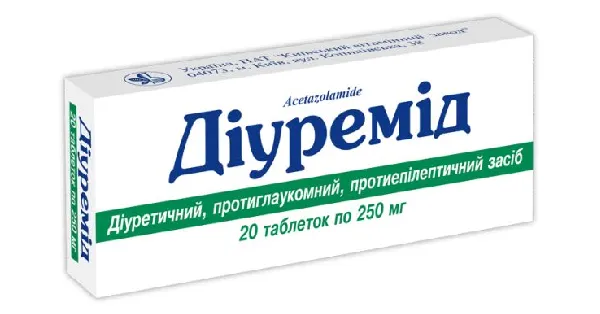
Table of Contents
INSTRUCTIONS FOR MEDICAL USE OF THE MEDICINAL PRODUCT DIUREMID (DIUREMID)
Composition:
Active substance: acetazolamide;
1 tablet contains acetazolamide 250 mg;
Excipients: potato starch, talc, sodium starch glycolate (type A).
Pharmaceutical form. Tablets.
Main physical and chemical properties: flat cylindrical tablets with bevelled edges, white or almost white in color.
Pharmacotherapeutic group. Anti-glaucoma preparations and miotics. Carbonic anhydrase inhibitors. ATC code S01E C01.
Pharmacological properties.
Pharmacodynamics.
A diuretic, antiglaucoma, and antiepileptic agent. The mechanism of action is due to selective inhibition of carbonic anhydrase—an enzyme that catalyzes the reversible hydration of carbon dioxide and subsequent dissociation of carbonic acid. The diuretic effect is caused by inhibition of carbonic anhydrase activity in the kidneys (mainly in the proximal renal tubules), leading to reduced reabsorption of bicarbonate, sodium, and potassium ions, enhanced diuresis, increased urine pH, and increased reabsorption of ammonia. It does not affect chloride ion excretion. As a result of inhibition of carbonic anhydrase in the ciliary body, secretion of aqueous humor is reduced and intraocular pressure is lowered. Inhibition of carbonic anhydrase in the brain leads to accumulation of CO₂ in the brain tissue and suppression of excessive paroxysmal neuronal discharges, which underlies the antiepileptic activity of the drug. The use of the drug in conditions with elevated intracranial pressure is associated with inhibition of carbonic anhydrase in the choroid plexus of the brain ventricles and reduction of cerebrospinal fluid production.
Pharmacokinetics.
Acetazolamide is well absorbed from the gastrointestinal tract. Maximum plasma concentration (Cmax) is reached within 1–3 hours after administration. Low concentrations of acetazolamide are maintained in the blood for up to 24 hours.
Distribution. Acetazolamide is distributed into many tissues. Due to its high affinity for carbonic anhydrase, it accumulates predominantly in tissues containing this enzyme, such as erythrocytes, kidneys, muscles, ocular tissues, and the central nervous system. The drug does not accumulate in tissues.
Protein binding ranges from 70% to 90% of the total acetazolamide content in blood. The elimination half-life is 4–9 hours.
Acetazolamide crosses the placental barrier.
Acetazolamide passes into breast milk in small amounts.
Metabolism. Acetazolamide is not metabolized.
Excretion. The drug is excreted by the kidneys in unchanged form. After oral administration, approximately 90% of the administered dose is eliminated in the urine within 24 hours.
Clinical characteristics.
Indications.
-
Treatment of glaucoma:
‒ chronic open-angle glaucoma;
‒ secondary glaucoma;
‒ closed-angle glaucoma (for short-term preoperative therapy and prior to ophthalmic procedures, to reduce intraocular pressure).
-
Treatment of edema:
‒ in heart failure;
‒ edema caused by drug therapy.
-
Treatment of epilepsy (in combination with other anticonvulsants):
‒ petit mal (minor seizures) in children;
‒ grand mal (major seizures) in adults;
‒ mixed forms.
-
Treatment of altitude sickness (the drug shortens the time of acclimatization, but its effect on the symptoms of this condition is insignificant).
Contraindications.
Hypersensitivity to the components of the drug and sulfonamides, hepatic and renal dysfunction, acute renal failure, hepatic failure, nephrolithiasis (with hypercalciuria), hyperchloremic acidosis, hypokalemia, hyponatremia, chronic decompensated closed-angle glaucoma (for long-term therapy), diabetes mellitus, uremia, adrenal insufficiency, Addison's disease. Acetazolamide should not be used in patients with liver cirrhosis, as it may increase the risk of hepatic encephalopathy.
Interaction with other medicinal products and other types of interactions.
Acetazolamide may enhance the effects of folic acid antagonists, oral hypoglycemic agents, and anticoagulants.
Concomitant use of acetazolamide with acetylsalicylic acid may lead to severe acidosis and have toxic effects on the central nervous system, with risk of developing anorexia, tachypnea, lethargy, coma, and potentially fatal outcome.
When acetazolamide is used concomitantly with cardiac glycosides or agents that increase blood pressure, the dose of the latter should be adjusted.
Acetazolamide interferes with phenytoin metabolism, increasing its serum concentrations. Severe osteomalacia has been observed in patients receiving acetazolamide together with certain anticonvulsants (phenytoin, primidone).
Concomitant use of acetazolamide with amphetamines, atropine, or quinidine may enhance their adverse effects.
Acetazolamide may increase or decrease blood glucose concentration, which should be considered during treatment of diabetes mellitus. Dose adjustments of insulin or oral hypoglycemic agents may be required.
Acetazolamide enhances lithium excretion and may reduce its therapeutic effect.
Acetazolamide may increase carbamazepine plasma concentration.
Concomitant use increases the risk of toxic effects of salicylates, digitalis preparations, carbamazepine, ephedrine, and non-depolarizing muscle relaxants.
The diuretic effect of acetazolamide is enhanced by theophylline and reduced by acidifying diuretics.
There have been isolated reports of decreased serum primidone levels and increased carbamazepine levels when used concomitantly with acetazolamide.
Due to possible additive effects, concomitant use with other carbonic anhydrase inhibitors is not recommended.
Cyclosporine: acetazolamide may increase cyclosporine levels.
Methenamine: acetazolamide may interfere with the urinary antiseptic effect of methenamine.
Sodium bicarbonate: concomitant use of acetazolamide with sodium bicarbonate increases the risk of renal stone formation.
Special precautions for use.
In case of hypersensitivity, symptoms that may be life-threatening to the patient can occur, such as Stevens-Johnson syndrome, Lyell's syndrome, fulminant liver necrosis, agranulocytosis, aplastic anemia, and hemorrhagic diathesis.
If skin or hematological manifestations develop, the drug should be discontinued immediately.
Acetazolamide should be prescribed with caution in patients taking acetylsalicylic acid (high doses), as there is a risk of developing anorexia, hyperventilation, lethargy, coma, and even fatal outcome.
Acetazolamide administered in doses higher than recommended does not lead to increased diuresis but may cause drowsiness and paresthesia; in some cases, it may even lead to reduced diuresis.
Use with caution in pulmonary artery embolism and pulmonary emphysema, in renal insufficiency, and also in elderly patients due to increased risk of metabolic acidosis.
If a dose is missed, do not increase the dose at the next administration.
If a patient takes acetazolamide for more than 5 days, there is a risk of developing metabolic acidosis.
The drug alkalizes urine.
Monitoring of platelet levels is recommended.
Laboratory tests. During prolonged therapy, monitoring of serum electrolyte levels (especially potassium and blood pH) is required, as well as control of peripheral blood picture. If changes in blood parameters or skin manifestations occur, the drug must be discontinued immediately.
There have been reports of suicidal thoughts and behavior in patients treated with antiepileptic drugs for various indications. A meta-analysis of randomized placebo-controlled trials also showed a small increased risk of suicidal thoughts and behavior. The mechanism of this risk is unknown, and available data do not exclude the possibility of increased risk with acetazolamide.
Therefore, monitoring for signs of suicidal thoughts and behavior is necessary, and consideration should be given to appropriate treatment. Patients (and caregivers) should be advised to seek immediate medical help if signs of suicidal thoughts or behavior occur.
Under certain conditions, however, very high doses in combination with other diuretics may be required to maintain diuresis in cases of complete, persistent impairment.
Fatal outcomes due to severe reactions to sulfonamides have occurred, although such cases were rare.
In patients with a history of kidney stones, the risk/benefit ratio for further stone formation should be evaluated.
Cases of choroidal effusion/detachment have been reported after acetazolamide use. Symptoms include sudden decrease in visual acuity or eye pain, which may occur within hours of starting acetazolamide. If choroidal effusion/detachment is suspected, acetazolamide should be discontinued as soon as possible.
Non-cardiogenic pulmonary edema. Severe cases of non-cardiogenic pulmonary edema have been reported after acetazolamide administration, particularly after single-dose intake (see section "Adverse reactions"). Non-cardiogenic pulmonary edema usually developed within minutes or hours after acetazolamide administration. Symptoms included dyspnea, hypoxia, and respiratory failure. If non-cardiogenic pulmonary edema is suspected, acetazolamide should be discontinued and appropriate therapy initiated. Acetazolamide must not be administered to patients who have previously experienced non-cardiogenic pulmonary edema after acetazolamide use.
Use during pregnancy or breastfeeding.
Pregnancy. Acetazolamide crosses the placental barrier. The use of the drug during pregnancy is contraindicated.
Breastfeeding. Acetazolamide passes into breast milk in small amounts. Breastfeeding should be discontinued during treatment with the drug.
Ability to affect reaction speed when driving or operating machinery.
High doses of acetazolamide may cause drowsiness; less frequently, fatigue, dizziness, ataxia, and disorientation. Therefore, patients should avoid driving or operating potentially hazardous machinery during treatment with acetazolamide.
Method of administration and dosage.
Administer the medicinal product orally.
Treatment of glaucoma.
The dosage of the medicinal product should be determined individually, depending on the intraocular pressure.
Recommended doses for adults:
| For open-angle glaucoma |
250 mg (1 tablet) 1–4 times daily. Doses exceeding 1000 mg (4 tablets) do not increase therapeutic efficacy. |
| For secondary glaucoma |
250 mg (1 tablet) every 4 hours. In some patients, the therapeutic effect is observed after taking 250 mg (1 tablet) twice daily (prolonged administration is not indicated). |
| For acute attacks of closed-angle glaucoma |
250 mg (1 tablet) 4 times daily. |
Treatment of epilepsy.
| Adults and children |
Generally, 8-30 mg/kg body weight per day. The dose should be administered in 1-4 divided doses. The optimal dose is 250-1000 mg (1-4 tablets). |
| When acetoazolamide is used concomitantly with other anticonvulsants, the initial dose should be 250 mg (1 tablet) per day. The dose may be gradually increased, if necessary. For children, the dose should not exceed 750 mg per day. |
|
Treatment of edema in heart failure and drug-induced edema.
Initial dose: 250 mg once daily (1 tablet) in the morning.
The best diuretic effect is observed when the drug is administered every other day or every two days with a one-day break.
When treating heart failure, acetazolamide should be prescribed against the background of standard therapy (e.g., administration of digitalis glycosides, low-salt diet, and potassium supplementation).
Treatment of altitude sickness.
The recommended daily dose is 500–1000 mg (2–4 tablets), divided into several doses. In case of anticipated rapid ascent (more than 500 meters per day), the recommended dose is 1000 mg (4 tablets), divided into several doses.
The drug should be taken 24–48 hours before ascending; if symptoms of the disease appear, treatment should be continued for another 48 hours or longer, as needed.
Children.
The drug may be used in children aged 3 years and older only as adjunctive therapy for epilepsy.
Overdose.
In case of overdose, disturbances in electrolyte balance, acidosis, and central nervous system (CNS) effects (drowsiness, paresthesia) may occur; sometimes, a decrease in diuresis may be observed.
Treatment. Discontinue the drug, symptomatic therapy. In case of acidosis, administer bicarbonates. Hemodialysis is effective. There is no specific antidote.
Side effects.
Side effects most commonly occur at the beginning of treatment.
Immune system disorders: hypersensitivity reactions, including anaphylactic reactions.
Nervous system and sensory organ disorders: seizures, paresthesia, hearing disturbances/tinnitus, taste disturbances, headache, dizziness, irritability, depression, confusion, ataxia; with prolonged use – disorientation, drowsiness, disturbances of touch and sensation, general weakness, peripheral paralysis; in isolated cases – sensation of hair on the tongue, flaccid paralysis, fatigue.
Eye disorders: choroidal effusion, choroidal detachment (frequency “not known”).
Gastrointestinal disorders: anorexia, nausea, vomiting, diarrhea, liver failure, hepatic colic, intestinal colic, melena, hepatitis, cholestatic jaundice, changes in liver function tests, liver necrosis.
Metabolic and nutritional disorders: metabolic acidosis, weight loss, thirst, electrolyte imbalance (with prolonged use).
Blood and lymphatic system disorders: in isolated cases with prolonged use – hemolytic anemia, leukopenia, agranulocytosis, thrombocytopenia, pancytopenia, bone marrow suppression, aplastic anemia, thrombocytopenic purpura.
Renal and urinary disorders: frequent urination, hematuria, glucosuria, renal colic, hyponatremia, hypokalemia, crystalluria, polyuria, renal failure, nephrolithiasis, kidney damage.
Respiratory, thoracic and mediastinal disorders: non-cardiogenic pulmonary edema (frequency not known).
Acetazolamide, as a sulfonamide derivative, may cause adverse reactions typical of sulfonamides.
Skin and mucous membrane disorders: skin rash, pruritus, erythema, urticaria, erythema multiforme, Stevens-Johnson syndrome, Lyell's syndrome.
Other: reversible myopia, photosensitization, decreased libido, hot flushes, fever.
Shelf life. 4 years.
Storage conditions.
Store in the original packaging at a temperature not exceeding 25 °C.
Keep out of reach of children.
Packaging.
10 tablets in a blister; 2 blisters per carton.
Prescription status. Prescription only.
Manufacturer: JSC "KYIV VITAMIN PLANT".
Manufacturer's address and place of business.
38, Kopilivska Street, Kyiv, 04073, Ukraine.
Web-site: www.vitamin.com.ua.