Diamax
Ukraine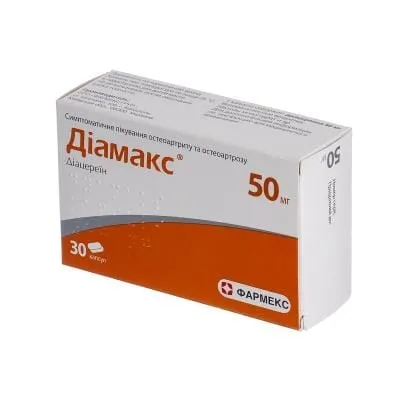
Table of Contents
INSTRUCTION FOR MEDICAL USE OF THE MEDICINAL PRODUCT Diamax® (Diamax®)
Composition:
Active substance: diacerein;
1 capsule contains 50 mg of diacerein;
Excipients: lactose monohydrate, povidone, sodium croscarmellose, colloidal anhydrous silicon dioxide, magnesium stearate;
Capsule shell: gelatin, titanium dioxide (E 171), yellow FCF (E 110).
Pharmaceutical form. Hard capsules.
Main physicochemical properties: hard gelatin capsules size number 1. Body and cap are light orange in color. The contents of the capsules are yellow powder or granules.
Pharmacotherapeutic group. Non-steroidal anti-inflammatory and antirheumatic agents.
ATC code M01AX21.
Pharmacological Properties
Pharmacodynamics
Diacerein exhibits analgesic, antipyretic, and anti-inflammatory properties in the treatment of osteoarthritis. Diacerein is classified as a slow-acting drug, whose therapeutic effect develops over 2–4 weeks of treatment and reaches clinical significance after 4–6 weeks. It has a unique mechanism of action that differs from that of nonsteroidal anti-inflammatory drugs (NSAIDs). Diacerein and its active metabolite, reum, exert anti-inflammatory effects, while they do not inhibit prostaglandin synthesis and therefore do not cause gastroduodenal adverse effects.
Diacerein inhibits the synthesis and release of various pro-inflammatory cytokines (interleukin-1, interleukin-6, interleukin-18, and tumor necrosis factor-alpha), proteolytic enzymes (e.g., stromelysin collagenase), oxygen free radicals, and other factors involved in joint inflammation. Diacerein stimulates the synthesis of proteoglycans, glycosaminoglycans, and hyaluronic acid, which are the main components of cartilage.
Based on the above mechanisms of action, diacerein slows down the progression of synovial fluid and joint destruction.
Pharmacokinetics
After oral administration of 100 mg (2 × 50 mg) diacerein per day for 5 days, the maximum plasma concentration (Cmax) is 4.9 μg/mL and is reached after approximately 2.6 hours. Concomitant intake with food leads to increased bioavailability (AUC increases by approximately 25%) and delayed absorption. All pharmacokinetic parameters are dose-independent for single doses between 50 and 200 mg.
Distribution. Plasma protein binding is very high (99%); reum has a high affinity for binding to albumin.
Biological transformation. Orally administered diacerein is rapidly and completely deacetylated and metabolized into reum.
Elimination. The elimination half-life of reum after repeated administration of diacerein is approximately 7.5 hours. Approximately 30% of the total dose is excreted in urine, of which 20% is unchanged and 80% as sulfated and glucuronide conjugates.
Repeated doses of diacerein result in minimal accumulation. In patients with severe renal impairment (creatinine clearance less than 30 mL/min), AUC and elimination half-life increase by two-fold, and urinary excretion decreases by approximately 50%. Therefore, dose reduction is required for these patients (see section "Dosage and Administration").
Clinical characteristics.
Indications.
Treatment of patients with symptoms of hip or knee osteoarthritis, with delayed effect.
Treatment with diacerein is not recommended in patients with rapidly progressive osteoarthritis of the hip joint, as they may have a weak response to diacerein.
Contraindications.
Individual hypersensitivity to any components of the medicinal product and/or history of hypersensitivity to anthraquinone derivatives; existing or history of liver disease; inflammatory bowel diseases (ulcerative colitis, Crohn's disease); intestinal obstruction or pseudo-obstruction; abdominal pain of undetermined origin; pregnancy or breastfeeding period.
Interaction with other medicinal products and other types of interactions.
Administration of diacerein may lead to the development of diarrhea and hypokalemia. When diacerein is used concomitantly with diuretics (loop and thiazide diuretics) and/or cardiac glycosides (digoxin, digitoxin), the risk of developing arrhythmias increases.
Concomitant use of drugs containing aluminum hydroxide and magnesium should be avoided, as they may affect the absorption of diacerein. Antacids should be taken separately from diacerein, preferably with an interval of 1–2 hours, to ensure better bioavailability of diacerein.
No interactions regarding plasma protein binding of rhein (active metabolite of diacerein) with warfarin, paracetamol, salicylic acid, indomethacin, ibuprofen, diclofenac, phenylbutazone, piroxicam, sulindac, tenoxicam, sodium valproate, phenytoin, tolbutamide, glipizide, or chlorpropamide were observed.
Concomitant administration of diacerein and an H2-histamine receptor blocker (cimetidine) does not lead to modification of rhein pharmacokinetic parameters in plasma and urine.
Special precautions for use.
Diarrhea. Prolonged administration of diacerein may lead to diarrhea, which can result in dehydration and hypokalemia. If diarrhea occurs, treatment with diacerein should be discontinued and the patient should consult a physician to discuss alternative treatment options.
Caution is advised in patients taking diuretics due to the potential risk of dehydration and hypokalemia. Particular caution should also be exercised in patients with hypokalemia who are receiving cardiac glycosides (digoxin, digitoxin) (see section "Interaction with other medicinal products and other forms of interaction").
Concomitant use with laxatives should be avoided.
Hepatotoxicity. During treatment with diacerein, elevations in serum liver enzymes and symptomatic acute liver injury are possible (see section "Undesirable effects").
Prior to initiating diacerein therapy, patients should be questioned about concomitant diseases, particularly liver disorders (current or in medical history), and appropriate examinations should be performed. Diagnosed liver disease is a contraindication to the use of diacerein (see section "Contraindications").
Signs of liver injury should be monitored during the first two months of treatment. Caution is also advised when diacerein is used concomitantly with other medicinal products associated with potential hepatotoxicity. Patients should be advised to limit alcohol consumption during treatment with diacerein.
Treatment with diacerein should be discontinued if elevated liver enzymes or signs or symptoms of liver damage, including neurological symptoms, are observed. In case of symptoms indicating liver injury, immediate medical consultation is required.
Due to the delayed onset of action (after 2–4 weeks), diacerein may be combined with NSAIDs and analgesics during the first month of treatment.
Metabolites of diacerein may impart a brown to red color to urine, depending on pH. This color change is not clinically significant; however, it may interfere with colorimetric diagnostic tests (e.g. glucose urine test strips).
Since discoloration of urine may mask microhematuria, regular laboratory assessment of renal function, including urine sediment analysis, should be performed, especially if the drug is used for prolonged periods.
Diamax capsules contain lactose; therefore, this medicinal product should not be administered to patients with rare hereditary problems of galactose intolerance, Lapp lactase deficiency, or glucose-galactose malabsorption syndrome.
This medicinal product contains the colouring agent Sunset Yellow FCF (E 110), which may cause allergic reactions.
Use during pregnancy or breastfeeding.
Pregnancy.
Due to lack of data, the use of this medicinal product during pregnancy is contraindicated.
There is information that from the 20th week of pregnancy, the use of NSAIDs, including diacerein, may cause oligohydramnios due to fetal renal dysfunction. This may occur soon after initiation of treatment and is usually reversible upon discontinuation of the drug. Additionally, cases of fetal ductus arteriosus constriction have been reported following the use of these medicinal products during the second trimester of pregnancy, most of which resolved after discontinuation of treatment.
Breastfeeding period.
Diacerein is contraindicated in women who are breastfeeding, as a small amount of the drug is excreted in breast milk.
Ability to influence the speed of reactions while driving or operating machinery.
There are no reports on the effect of diacerein on the ability to drive or operate machinery.
Dosage and Administration
Treatment should only be initiated by physicians experienced in the management of osteoarthritis.
During the first 2–4 weeks of treatment, the recommended dose for adults is 1 capsule (50 mg) taken once daily with the evening meal, swallowed with water. Starting from the 2nd to 4th week of treatment, the dose should be increased to 100 mg per day, divided into two doses (1 capsule in the morning and 1 capsule in the evening, taken with meals).
Diacerein has a slow onset of action with a residual effect after discontinuation of treatment. Therefore, the drug should be administered for at least 2–4 weeks before the first positive effects become apparent. The beneficial symptomatic effect persists for up to 3 months after the end of treatment. Due to the chronic nature of the disease, prolonged treatment (for at least 3 months) is recommended and may be repeated if symptoms reappear.
The duration of treatment should be determined individually by the physician.
Elderly patients
Diacerein is not recommended for patients aged 65 years and older due to increased susceptibility of this population to diarrhea-related complications.
No significant changes in pharmacokinetic parameters have been observed in elderly patients receiving diacerein; therefore, no dose adjustment is required (see section "Pharmacological Properties"). However, caution should be exercised. If diarrhea occurs, treatment with diacerein should be discontinued.
Patients with chronic renal impairment
In patients with mild to moderate renal impairment, no dose adjustment is necessary. However, in patients with severe renal impairment (creatinine clearance < 30 mL/min), the daily dose should be reduced by 50% of the recommended dose (corresponding to 50 mg per day).
Children
The safety and efficacy of diacerein have not been established in children and adolescents under 18 years of age.
Overdose
In case of overdose, diarrhea may occur.
There is no specific antidote.
Emergency treatment consists of restoration of electrolyte balance.
Adverse Reactions
The drug is usually well tolerated; however, gastrointestinal disturbances such as frequent bowel movements, soft stools, flatulence, diarrhea, and abdominal pain may occasionally occur. These symptoms usually diminish with continued treatment. In some cases, prolonged diarrhea may lead to complications such as dehydration and disturbances in water-electrolyte balance.
Discoloration of urine has also been observed, which is clinically insignificant. Unlike NSAIDs, diacerhein does not have ulcerogenic effects on the gastrointestinal tract.
This medicinal product contains the colorant tartrazine (E 110), which may cause allergic reactions.
Adverse reactions are classified by frequency as follows: very common: ≥ 1/10; common: ≥ 1/100 to < 1/10; uncommon: ≥ 1/1000 to < 1/100; rare: ≥ 1/10,000 to < 1/1000; very rare: < 1/10,000; frequency not known (cannot be estimated from available data).
Gastrointestinal system
Very common: diarrhea, abdominal pain.
Common: frequent defecation, flatulence.
Rare: pigmentation of intestinal mucosa (pseudomelanosis).
Hepatobiliary system
Uncommon: increased levels of liver enzymes in blood serum.
Renal and urinary system
Very common: discoloration of urine.
Skin and subcutaneous tissue
Common: pruritus, rash, eczema.
Immune system
Frequency not known: allergic reactions.
General
Frequency not known: headache.
Post-marketing data
Hepatobiliary disorders.
Cases of acute liver injury, including elevated liver enzymes in blood serum and cases of hepatitis, have been reported during treatment with diacerhein. Most cases occurred within the first months of treatment. Patients should monitor for signs and symptoms of liver injury (see section "Special precautions").
Shelf life. 3 years.
Storage conditions. Store in original packaging at a temperature not exceeding 25 °C. Keep out of reach of children.
Packaging. 10 capsules in a blister; 3 blisters per carton.
Prescription status. Prescription only.
Manufacturer. PHARMEKS GROUP LLC.
Manufacturer's address. 100 Shevchenka St., Borispol, Kyiv region, Ukraine, 08301.
All cases of adverse reactions should be reported to the manufacturer:
PHARMEKS GROUP LLC, 100 Shevchenka St., Borispol, Kyiv region, Ukraine, 08301. Phone: +38 (044) 391-19-19, fax: +38 (044) 391-19-18, or via the form on the website: http://www.pharmex.com.ua/kontakty/forma-137/o*