Desloratadine
Ukraine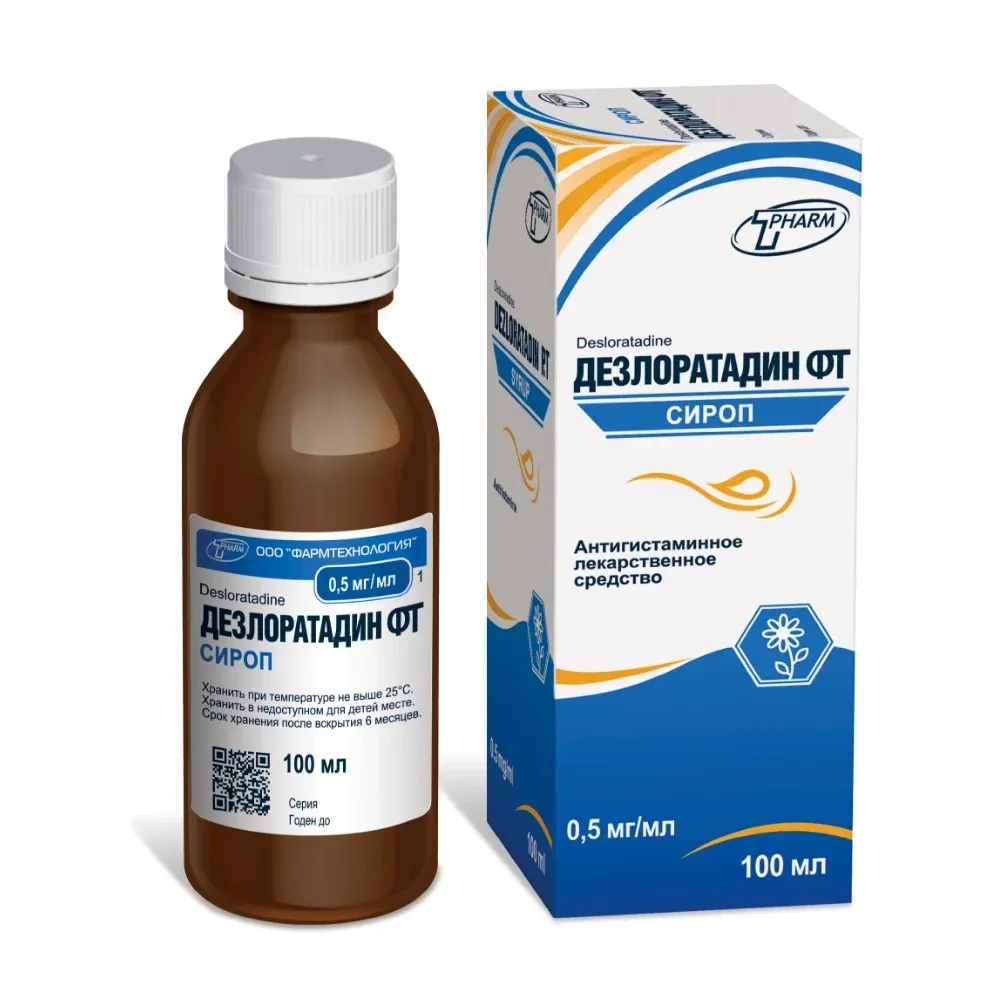
Table of Contents
INSTRUCTIONS FOR MEDICAL USE OF THE MEDICINAL PRODUCT DESLORATADINE
Composition:
Active ingredient: 1 ml of the preparation contains 0.5 mg of desloratadine;
Excipients: sodium benzoate (E 211); disodium edetate; citric acid; sodium citrate; strawberry flavor containing propylene glycol, flavoring substances (natural and nature-identical); colorant Yellow West FCF (E 110); propylene glycol; sorbitol (E 420); sucrose; purified water.
Pharmaceutical form. Syrup.
Main physicochemical characteristics: clear orange-colored liquid with a fruity odor.
Pharmacotherapeutic group. Systemic antihistamines.
ATC code R06A X27.
Pharmacological properties.
Pharmacodynamics.
Desloratadine is a potent, selective blocker of peripheral histamine H1 receptors that does not cause sedative effects. Desloratadine is the principal active metabolite of loratadine.
After oral administration, the drug selectively blocks peripheral H1 histamine receptors, as it barely penetrates the blood-brain barrier.
In addition to its antihistaminic activity, the drug exerts anti-allergic and anti-inflammatory effects. It has been established that the drug suppresses a cascade of various reactions underlying the development of allergic inflammation, namely:
- release of pro-inflammatory cytokines, including IL-4, IL-6, IL-8, IL-13;
- release of pro-inflammatory chemokines, such as RANTES;
- production of superoxide anion by activated polymorphonuclear neutrophils;
- adhesion and chemotaxis of eosinophils;
- expression of adhesion molecules, such as P-selectin;
- IgE-dependent release of histamine, prostaglandin D2, and leukotriene C4;
- acute allergic bronchospasm and allergic cough in animals.
Data indicate that desloratadine treatment was well tolerated in children, as confirmed by clinical laboratory test results, vital function status, and ECG data (including QT interval duration).
Daily administration of desloratadine at doses up to 20 mg for 14 days was not associated with statistically or clinically significant cardiovascular effects. Administration of desloratadine at 45 mg/day (9 times higher than the therapeutic dose) for 10 days did not cause QT interval prolongation.
Desloratadine barely penetrates the blood-brain barrier. At the recommended dose of 5 mg, the incidence of somnolence did not exceed that observed in individuals not taking desloratadine. Desloratadine did not affect psychomotor function at doses up to 7.5 mg.
In addition to the conventional classification of allergic rhinitis into seasonal and perennial forms, allergic rhinitis may alternatively be classified according to symptom duration as intermittent or persistent. Intermittent allergic rhinitis is defined as symptoms occurring for less than 4 days per week or less than 4 weeks. Persistent allergic rhinitis is characterized by symptoms occurring for 4 or more days per week or for more than 4 weeks.
The drug is effective in the treatment of seasonal allergic rhinitis; in patients with allergic rhinitis, desloratadine effectively relieves symptoms such as sneezing, nasal discharge, itching, as well as eye irritation, lacrimation, redness, and palate itching.
Pharmacokinetics.
Desloratadine can be detected in blood plasma within 30 minutes after administration. The drug effectively controls symptoms for 24 hours. Desloratadine is well absorbed. Maximum plasma concentration of desloratadine is reached on average within 3 hours; the elimination half-life averages 27 hours. The extent of desloratadine accumulation corresponds to its half-life (approximately 27 hours) and dosing frequency (once daily). The bioavailability of desloratadine was dose-proportional in the range of 5 to 20 mg.
Desloratadine is moderately (83–87%) bound to plasma proteins. No signs of clinically significant drug accumulation were observed after administration of desloratadine at doses of 5 to 20 mg once daily for 14 days.
Bioequivalence of desloratadine in tablet and syrup formulations has been demonstrated when administered at the same dose.
In pediatric practice, it has been found that AUC and Cmax values of desloratadine (when administered at recommended doses) are comparable to those in adults receiving desloratadine syrup at a dose of 5 mg.
Desloratadine does not inhibit CYP3A4 or CYP2D6 and is neither a substrate nor an inhibitor of P-glycoprotein.
Clinical characteristics.
Indications. For relief of symptoms associated with allergic rhinitis, such as sneezing, nasal discharge, itching, nasal swelling and congestion, as well as itchy and red eyes, tearing, itching of the palate, and cough.
For relief of symptoms associated with urticaria, such as itching and skin rash.
Contraindications. Hypersensitivity to desloratadine, to any excipient of the medicinal product, or to loratadine.
Interaction with other medicinal products and other forms of interaction. No clinically significant changes in plasma concentrations of desloratadine were observed during repeated co-administration with ketoconazole, erythromycin, azithromycin, fluoxetine, or cimetidine. Since the enzyme responsible for desloratadine metabolism has not been identified, interactions with other medicinal products cannot be completely excluded.
Food (high-fat, high-calorie meal) or grapefruit juice do not affect the distribution of desloratadine.
Effect on laboratory test results. Administration of the drug should be discontinued approximately 48 hours before skin testing, as antihistamines may prevent or reduce the manifestation of positive dermatological reactions to allergens.
Special precautions for use
The drug does not enhance alcohol-induced effects such as impairment of psychomotor function and drowsiness. Results of psychomotor tests did not differ significantly between patients taking desloratadine and those not taking it, either alone or in combination with alcohol.
In patients with severe renal impairment, the drug should be administered under medical supervision.
Tartrazine (Yellow West) may cause allergic reactions.
If a patient has known intolerance to certain sugars, medical advice should be sought before taking this medication.
Desloratadine should be prescribed with caution to patients with a history of seizures. Children may be more susceptible to developing a new seizure during treatment with desloratadine. The physician should consider discontinuing desloratadine therapy in patients who experience a seizure while taking the drug.
Use during pregnancy or breastfeeding. The safety of the drug during pregnancy has not been established; therefore, its use during pregnancy is not recommended.
Desloratadine passes into breast milk; therefore, the drug is not recommended for use in breastfeeding women.
Ability to affect reaction speed when driving or operating machinery. Patients should be informed that in very rare cases somnolence may occur, which could impair their ability to drive a car or operate complex machinery.
Dosage and Administration
To relieve symptoms associated with allergic rhinitis (including intermittent and persistent forms) and urticaria, the medication should be taken regardless of food intake at the following doses:
Adults and adolescents (≥ 12 years of age): 10 mL of syrup (5 mg of desloratadine) once daily.
Treatment of intermittent allergic rhinitis (symptoms present less than 4 days per week or less than 4 weeks) should be based on patient history: discontinue after symptoms resolve and restart upon their recurrence. For persistent allergic rhinitis (symptoms present more than 4 days per week or longer than 4 weeks), treatment should continue throughout the entire period of allergen exposure.
Children. The efficacy and safety of the medication in children under 6 months of age have not been established. The medication is not recommended for children under 6 months of age for the treatment of chronic idiopathic urticaria, or for children under 12 months of age for the treatment of allergic rhinitis.
The following dosage regimen should be used for treatment:
- Children 6 to 11 months of age: 2 mL of syrup (1 mg of desloratadine) once daily;
- Children 1 to 5 years of age: 2.5 mL of syrup (1.25 mg of desloratadine) once daily;
- Children 6 to 11 years of age: 5 mL of syrup (2.5 mg of desloratadine) once daily.
Overdose. In case of overdose, standard measures aimed at removing the unabsorbed active substance should be implemented, along with symptomatic treatment.
When desloratadine was administered at doses up to 45 mg (9 times the recommended dose) in adults and adolescents, no clinically significant effects were observed.
Desloratadine is not removed by hemodialysis; the possibility of its removal by peritoneal dialysis has not been established.
Side effects.
The most commonly observed side effects are increased fatigue, dry mouth, and headache. In children aged 6 to 23 months, the most frequently reported adverse events are diarrhea, fever, and insomnia.
There is a risk of psychomotor hyperactivity (abnormal behavior) associated with the use of desloratadine (which may manifest as irritability, aggression, and excitation).
During the post-marketing period, the following adverse reactions have been observed (frequency unknown): QT interval prolongation, arrhythmias, and bradycardia.
Other very rare side effects are listed below.
Psychiatric disorders: hallucinations, depressive mood.
Nervous system disorders: dizziness, somnolence, psychomotor hyperactivity, convulsions.
Eye disorders: dry eyes.
Cardiac disorders: tachycardia, palpitations, QT interval prolongation, supraventricular tachyarrhythmia.
Gastrointestinal disorders: abdominal pain, nausea, vomiting, dyspepsia.
Hepatobiliary disorders: increased liver enzyme levels, elevated bilirubin, hepatitis, jaundice.
Musculoskeletal and connective tissue disorders: myalgia.
Skin and subcutaneous tissue disorders: photosensitivity.
General disorders: hypersensitivity reactions (including anaphylaxis, Quincke's edema, dyspnea, pruritus, rash, and urticaria).
Desloratadine hardly penetrates into the central nervous system. When used at the recommended adult dose of 5 mg, no increase in the incidence of somnolence has been observed compared to individuals not taking desloratadine. The drug administered as a single daily dose of 7.5 mg has no effect on psychomotor performance.
Shelf life. 2 years.
Storage conditions. Store in the original packaging at a temperature not exceeding 25°C.
Keep out of reach of children.
Packaging. 50 ml or 100 ml in a bottle with a dosing syringe-pipette in a carton.
Prescription status. Over-the-counter.
Manufacturer. LIMITED LIABILITY COMPANY "CORPORATION "ZDOROV'YA".
Manufacturer's address and place of business.
22 Shevchenka Street, Kharkiv, Kharkiv Oblast, 61013, Ukraine.