Demoton-b neo
Ukraine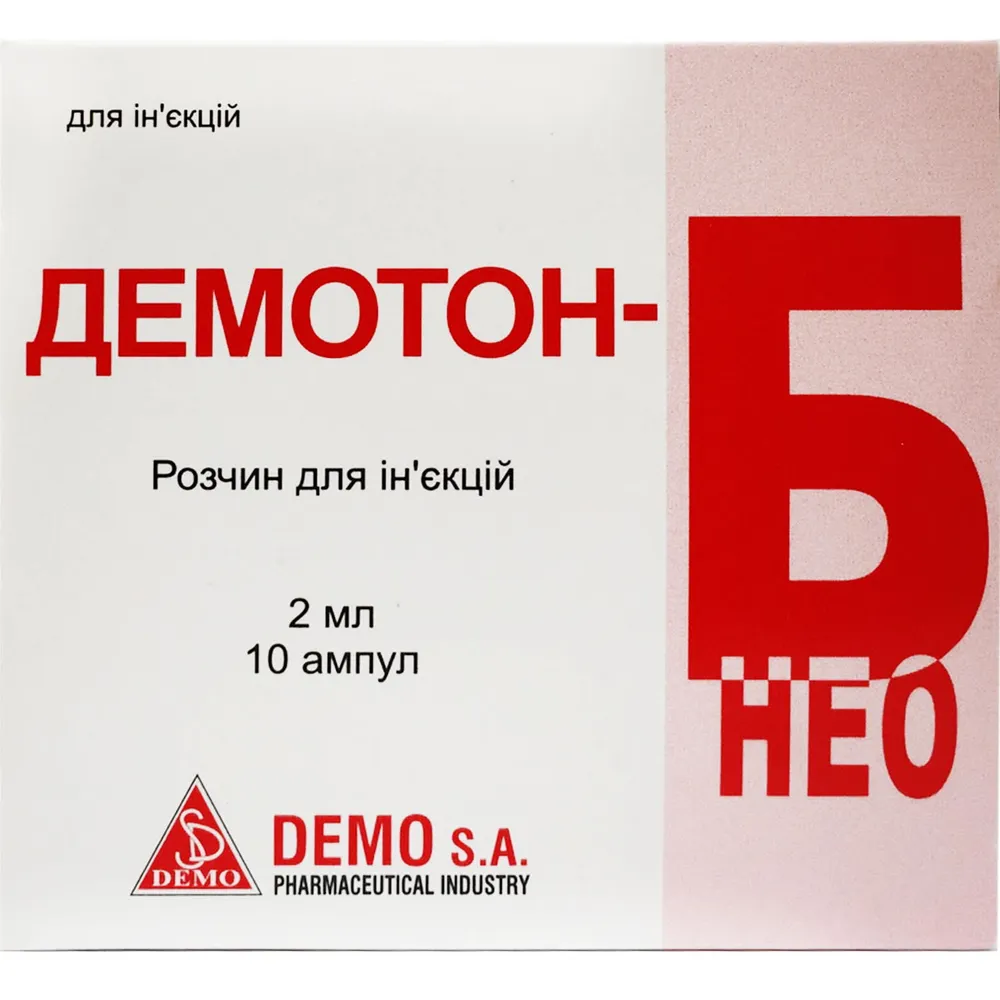
Table of Contents
INSTRUCTION FOR MEDICAL USE OF THE MEDICINAL PRODUCT Demoton-B NEO (Demoton-B NEO)
Composition:
1 ml of solution contains:
Active substances: thiamine hydrochloride (vitamin B1) 5 mg, riboflavin sodium phosphate (equivalent to riboflavin) 2 mg, pyridoxine hydrochloride (vitamin B6) 2 mg, nicotinamide (vitamin PP) 20 mg, dexpanthenol (vitamin B5) 3 mg;
Excipients: phenol, hydrochloric acid diluted, water for injections.
Pharmaceutical form:
Solution for injection.
Basic physicochemical properties:
Clear yellow solution.
Pharmacotherapeutic group:
Vitamin B complex, including combinations.
ATC code: A11E A.
Pharmacological properties
Pharmacodynamics:
Demoton-B NEO solution is an effective combination of vitamins B1, B2, B3, B5, and B6.
Vitamin B1 (thiamine hydrochloride) combines with adenosine triphosphate (ATP) to form thiamine pyrophosphate, a coenzyme. Its role in carbohydrate metabolism involves decarboxylation of pyruvates and α-keto acids. Vitamin B1 plays an important role in the production and release of energy required to meet cellular energy demands.
Vitamin B2 (riboflavin) functions in the body as a coenzyme in the form of flavin adenine dinucleotide (FAD) and flavin mononucleotide (FMN), which play a crucial role in the metabolism of respiratory tissues.
Vitamin B3 (nicotinamide) is used by the body as a source of niacin. This vitamin plays an important role in lipid metabolism, respiratory tissue metabolism, and glycogenolysis.
Vitamin B5 (dexpanthenol) is necessary for the formation of coenzyme A (CoA) and plays a key role in metabolism and the synthesis of carbohydrates, proteins, and fats.
Vitamin B6 (pyridoxine hydrochloride) acts as a coenzyme in the metabolism of proteins, carbohydrates, and fats. In particular, in protein metabolism, it participates in amino acid decarboxylation, conversion of tryptophan to niacin or serotonin, and in deamination and sulfation of amino acids.
Overall, this vitamin complex exerts a stimulating effect on carbohydrate metabolism and is necessary for the normal function of the central nervous system, thyroid gland, liver, hematopoietic organs, gastrointestinal tract, skin, and mucous membranes.
Experimental studies have shown that deficiency of vitamin B complex leads to a significant decrease in the body's resistance to infections.
Pharmacokinetics:
Pyridoxine is rapidly absorbed in the gastrointestinal tract. It is metabolized in the liver and excreted by the kidneys. The elimination half-life is 15–20 days.
Thiamine is metabolized in the liver and excreted by the kidneys in the form of metabolites. In case of thiamine overdose, it is excreted unchanged in urine and sweat.
Riboflavin is rapidly absorbed in the gastrointestinal tract. It is partially excreted by the kidneys in the form of metabolites. With increasing dose, a greater portion is excreted unchanged by the kidneys.
Nicotinamide is rapidly absorbed in the gastrointestinal tract and widely distributed in body tissues. A small amount is excreted unchanged by the kidneys.
Clinical characteristics
Indications:
Prophylaxis of vitamin B deficiency during exclusive parenteral nutrition.
Contraindications:
- Hypersensitivity to the active substance or any of the excipients of the medicinal product.
- Concomitant use with levodopa (see section "Interaction with other medicinal products and other types of interactions").
Interaction with other medicinal products and other types of interactions
Contraindicated combinations:
Levodopa. The medicinal product inhibits the activity of levodopa in the absence of peripheral dopa-decarboxylase inhibitors. Pyridoxine should not be used if levodopa administration is not accompanied by dopa-decarboxylase inhibitors.
Vitamin B1 is compatible with redox substances but is unstable in neutral and alkaline solutions such as carbonates, citrates, barbiturates, and erythromycin lactobionate. Solutions containing hyposulfite salts are incompatible with thiamine.
Vitamin B6 reduces the therapeutic effect of phenobarbital and phenytoin.
Nicotinamide enhances the antihypertensive effect of drugs that suppress the sympathetic system and acts as an agonist of isoniazid.
Combinations not recommended for use:
Urobilinogen: vitamins B1 and B6 may interfere with laboratory tests using Ehrlich's reagent.
Special precautions for use:
Do not exceed the recommended dose. If the patient is already receiving vitamin preparations or other treatments, consult a physician.
There are no specific precautions or warnings regarding the use of the medicinal product in elderly patients.
The medicinal product should be administered with caution to patients with liver, gallbladder, or biliary tract diseases, peptic ulcer, gastritis, gout, especially for prolonged use. Levels of transaminases, alkaline phosphatase, and other liver function tests should be monitored.
Intravenous administration of nicotinamide may cause shock. Prolonged use of high doses may lead to hepatotoxicity.
Special attention should be paid to patients with diabetes and in cases of hyperuricemia.
Repeated intramuscular and intravenous administration of the medicinal product increases the risk of hypersensitivity reactions. Therefore, oral administration should be preferred if possible.
Acute or chronic overdose increases the risk of adverse effects.
The amount of vitamins received with the daily dose of the medicinal product should be considered when these vitamins are also obtained from other sources, including fortified foods, dietary supplements, and other concurrent procedures.
If the patient has severe renal impairment (GFR [glomerular filtration rate] < 30 ml/min), consult a physician before using this medicinal product. Dose adjustment may be necessary.
Special attention should be paid to the dose of vitamin B6.
Vitamins B1 and B6 may interfere with laboratory tests and may lead to false readings of results. If laboratory tests are expected, inform your physician or other healthcare professional about this treatment.
Use during pregnancy or breastfeeding:
The use of Demoton-B NEO in pregnant women and women who are breastfeeding is generally safe provided the recommended dose is not exceeded. However, due to the lack of controlled clinical studies, it is not possible to assess the risks associated with the use of the medicinal product in these patients. Demoton-B NEO should be prescribed by a physician when there are clinical indications. The administered dose should not exceed the recommended dose. Overdose may be harmful to the fetus and newborn.
When the patient concurrently takes vitamins, regardless of their source, daily intake norms should be observed.
The vitamins contained in the medicinal product pass into breast milk. This should be considered during breastfeeding.
Ability to influence reaction rate when driving or operating machinery:
The medicinal product does not affect the ability to drive vehicles or operate machinery.
Method of administration and dosage:
The medicinal product is usually administered intramuscularly, very rarely intravenously.
Adults: depending on the condition, 1 or 2 ampoules daily.
Children: This medicinal product is not used in children.
Overdose:
Overdose has not been observed when the recommended doses of the medicinal product are used. The recommended daily doses should be followed, taking into account vitamin intake from other sources.
All registered cases of overdose were associated with concomitant intake of other mono- or polyvitamin preparations in high doses.
The first nonspecific symptoms of acute overdose are confusion, gastrointestinal disturbances (constipation, diarrhea, nausea, and vomiting). If such symptoms occur, treatment should be discontinued and medical help sought.
Acute or chronic overdoses (i.e., exceeding the recommended dose by more than 10 times) may lead to intoxication, especially if treatment is combined with vitamin C or vitamin B6.
Patients receiving 2 to 7 g/day (or > 0.2 g/day for > 2 months) of vitamin B6 may experience sensory neuropathy with corresponding ataxia and numbness of hands and feet. In such cases, treatment should be discontinued and a physician consulted.
Clinical signs, specific symptoms, laboratory findings, and consequences of overdose vary and depend on patient sensitivity and other circumstances.
Adverse reactions:
During post-marketing use of the medicinal product in clinical practice, the following adverse reactions have been reported. The frequency of events cannot be established as reports are spontaneous.
Gastrointestinal disorders:
Abdominal and gastrointestinal pain, nausea, vomiting, constipation, diarrhea.
Immune system disorders:
Allergic and anaphylactic reactions, anaphylactic shock. Hypersensitivity reactions, including bronchial asthma, as well as moderately expressed reactions affecting the skin, respiratory tract, gastrointestinal tract, and/or cardiovascular system. Symptoms may include rash, urticaria, facial swelling, pruritus, dyspnea, exanthema, cardiorespiratory distress, and severe reactions, including anaphylactic shock. In case of an allergic reaction, treatment must be immediately discontinued and medical advice sought.
Nervous system disorders:
Headache.
Renal and urinary disorders:
Chromaturia: slight discoloration of urine. This effect is not clinically significant and is due to the presence of vitamin B2 in the composition of the medicinal product.
Reactions related to the route of administration:
Mild reactions at the injection site.
Reporting of adverse reactions after medicinal product authorization is of great importance. It allows continuous monitoring of the benefit-risk ratio of the medicinal product. Medical and pharmaceutical professionals, as well as patients or their legal representatives, should report all suspected adverse reactions and lack of efficacy of the medicinal product through the Automated Information System for Pharmacovigilance at the following link: https://aisf.dec.gov.ua
Shelf life:
2 years.
Storage conditions:
Store in a place inaccessible to children, protected from light, at a temperature not exceeding 25 °C, in the original packaging.
Packaging:
2 ml in an ampoule. 10 ampoules in a cardboard pack.
Prescription status:
Prescription only.
Manufacturer:
DEMO SA Pharmaceutical Industry.
Manufacturer's address and location of its operations:
21st km National Road Athens — Lamia, Krioneri Attiki, 14568, Greece.