Dexamethasone-darnitsa
Ukraine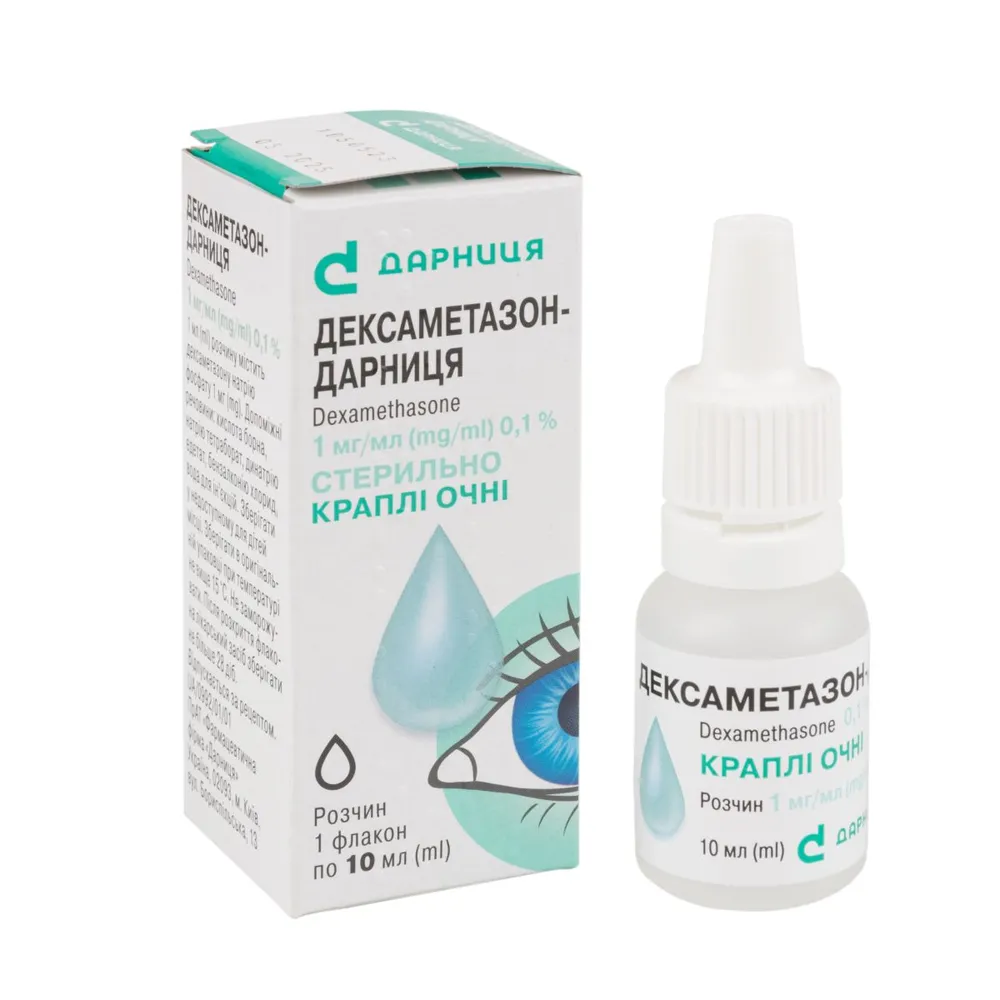
Table of Contents
INSTRUCTION FOR MEDICAL USE OF THE MEDICINAL PRODUCT Dexamethasone-Darnytsia (dexamethasone-DARNYTSIA)
Composition:
Active substance: dexamethasone;
1 ml of solution contains dexamethasone sodium phosphate 1 mg;
Excipients: boric acid, sodium tetraborate, disodium edetate, benzalkonium chloride, water for injections.
Pharmaceutical form. Eye drops, solution.
Main physicochemical properties: clear, colorless liquid, odorless.
Pharmacotherapeutic group. Agents used in ophthalmology. Anti-inflammatory agents. Simple corticosteroids. Dexamethasone.
ATC code S01BA01.
Pharmacological properties.
Pharmacodynamics.
The medicinal product belongs to synthetic fluorinated glucocorticosteroids. It has pronounced anti-inflammatory activity with reduced mineralocorticoid effects compared to some other steroids and is one of the most potent anti-inflammatory agents. The mechanism of action of the drug is similar to the pharmacological action of other fluorinated glucocorticosteroids, differing only by greater potency and longer duration of effect. It exerts anti-inflammatory action by inhibiting vascular endothelial adhesion molecules, cyclooxygenase I or II, and cytokine release. As a result, the formation of inflammatory mediators is reduced and adhesion of leukocytes to vascular endothelium is suppressed, thereby preventing their penetration into inflamed ocular tissues.
Pharmacokinetics.
After instillation into the conjunctival sac, the maximum concentration of dexamethasone in intraocular fluid is observed within 2 hours and amounts to 30 ng/mL. Plasma protein binding (to albumin) ranges from 77% to 84%. The elimination half-life is
3–4 hours. Clearance ranges from 0.111 to 0.225 L/h/kg and volume of distribution ranges from 0.576 to 1.15 L/kg. It is metabolized in the liver. Approximately 60% of the dose is excreted in urine as 6-β-hydroxydexamethasone. The overall systemic absorption of dexamethasone is insignificant.
Clinical characteristics.
Indications.
Treatment of steroid-responsive, non-infectious inflammatory and allergic conditions of the conjunctiva, cornea, and anterior segment of the eye, including inflammatory reactions in the postoperative period.
Contraindications.
Hypersensitivity to the active substance or to any of the excipients of the medicinal product.
Acute untreated bacterial infections of the eye.
Fungal infections of the eye.
Mycobacterial infections of the eye.
Viral infections of the cornea and conjunctiva (acute superficial keratitis caused by herpes simplex, cowpox and varicella, except keratitis caused by herpes zoster).
Interaction with other medicinal products and other forms of interaction.
When several locally applied ophthalmic medicinal products are used simultaneously, the interval between their administration should be at least 15 minutes. Ophthalmic ointments should be applied last.
Concomitant use of the medicinal product with atropine, other anticholinergic agents, and mydriatics may increase intraocular pressure.
Concomitant administration of locally applied steroids and non-steroidal anti-inflammatory drugs (NSAIDs) for local use may increase the risk of corneal wound healing complications.
Concomitant use with ophthalmic medicinal products containing phosphates increases the risk of corneal deposits accumulation or corneal clouding, especially in patients with compromised cornea.
CYP3A4 inhibitors (including ritonavir and cobicistat) may reduce the clearance of dexamethasone, leading to increased systemic effects and development of Cushing's syndrome and/or adrenal cortex suppression. Such combinations should be avoided unless the benefit of treatment outweighs the increased risk of systemic corticosteroid side effects. In such cases, patients should be closely monitored for signs of systemic corticosteroid effects.
Information on the interaction of the medicinal product with other medicinal products is lacking.
Special precautions for use.
The medicinal product is intended for ophthalmic use only.
Adverse effects observed after instillation of the medicinal product disappear within 5–15 seconds and are not an indication for discontinuation.
To prevent possible systemic absorption, after instillation of the medicinal product, the lacrimal sacs should be compressed with fingers for 2–3 minutes.
When using the medicinal product, avoid touching the dropper tip to prevent contamination of the medicinal product.
With prolonged local use of corticosteroids, there is a risk of developing ocular hypertension and/or glaucoma, with subsequent optic nerve damage, decreased visual acuity, visual field defects, and formation of posterior subcapsular cataract of the eye. During prolonged treatment with the medicinal product, intraocular pressure should be monitored regularly.
This is particularly important in children, as the risk of corticosteroid-induced ocular hypertension may be higher in children and may occur earlier than in adults.
The risk of corticosteroid-induced elevation of intraocular pressure and/or corticosteroid-induced cataract formation increases in predisposed patients (e.g., patients with diabetes mellitus).
Topically applied corticosteroids to the eye may delay corneal wound healing and, in the presence of diseases characterized by thinning of the cornea or sclera, may lead to perforation. It is also known that topically applied NSAIDs delay or impair wound healing. Concomitant administration of topically applied NSAIDs and corticosteroids may increase the risk of complications in wound healing (see section "Interaction with other medicinal products and other forms of interaction"). The corneal status should be examined (fluorescein staining tests should be performed) during treatment with the medicinal product.
Corticosteroids may reduce resistance to bacterial, viral, or fungal infections, interfere with the detection of such infections, and mask their clinical signs, thus hindering the recognition of antibiotic inefficacy.
In acute purulent eye diseases, corticosteroids may mask infections or promote the spread of existing infection. If treatment lasts longer than 10 days, intraocular pressure should be monitored.
In cases of persistent corneal ulceration, fungal infection should be considered in patients who are or have been treated with corticosteroids. If a fungal infection develops, treatment with the medicinal product should be discontinued.
The medicinal product should be used with special caution and only in combination with antiviral therapy in the treatment of stromal keratitis or uveitis caused by herpes simplex. Regular biomicroscopy using a slit lamp should be performed.
The medicinal product contains phosphates, which may provoke the accumulation of deposits in the cornea or corneal clouding upon local application. It should be used cautiously in patients with compromised cornea and in cases where the patient is simultaneously receiving treatment with other ophthalmic medicinal products containing phosphates.
Wearing contact lenses during treatment of eye inflammation is not recommended. If necessary, soft contact lenses should be removed before instillation of the medicinal product and reinserted no sooner than 15 minutes after instillation.
The medicinal product contains benzalkonium chloride, which may cause eye irritation and is known to discolor soft contact lenses. Contact with soft contact lenses should be avoided.
After intensive or prolonged continuous therapy, Cushing's syndrome and/or adrenal suppression due to systemic absorption of dexamethasone may occur in susceptible patients, including children and patients receiving CYP3A4 inhibitors (including ritonavir and cobicistat). In such cases, treatment should be gradually discontinued.
Use during pregnancy or breastfeeding.
Pregnancy.
There is only limited data on the use of the medicinal product in pregnant women. Reproductive toxicity has been demonstrated in animal studies—topically applied corticosteroids may be systemically absorbed and cause fetal developmental abnormalities in pregnant animals. The potential risk for humans is unknown; therefore, the medicinal product is not recommended for use during pregnancy.
Breastfeeding.
Glucocorticoids, when administered systemically, are excreted in breast milk in amounts that may affect breastfeeding. However, systemic exposure following topical administration is low. Since it is unknown whether the medicinal product passes into breast milk, the risk to the infant during breastfeeding cannot be excluded. Therefore, the possibility of temporarily discontinuing breastfeeding during treatment with the medicinal product, or discontinuing/withholding treatment with the medicinal product, should be considered, taking into account the potential benefit of the medicinal product for the mother and the benefit of breastfeeding for the infant.
Fertility.
Studies on the effect of dexamethasone instilled into the conjunctival sac on fertility have not been conducted. There are limited clinical data on the effect of dexamethasone on fertility in men or women.
Ability to affect reaction speed when driving or operating machinery.
The medicinal product has no effect or has a negligible effect on the ability to drive or operate machinery. As with other ophthalmic solutions, transient blurred vision or other visual disturbances may occur. If blurred vision occurs after instillation, patients should wait until vision clears before driving or operating machinery.
Method of Administration and Dosage
The bottle is protected by a tamper-evident cap. For first-time use, the cap must be twisted to separate it from the safety ring.
The bottle has a special design that enables controlled dispensing of the solution according to the principle "one squeeze – one drop." The firmness of the bottle walls significantly reduces the risk of uncontrolled stream-like release of the medication—a common cause of overdose with eye drops.
Severe or acute ocular inflammation:
As initial therapy, instill 1–2 drops of the medication into the conjunctival sac(s) of the affected eye(s) every 30–60 minutes.
If a positive response is observed, reduce the dosage to 1–2 drops into the conjunctival sac(s) of the affected eye(s) every 2–4 hours.
Subsequently, the dosage may be further reduced to 1 drop 3–4 times daily, if this dosage is sufficient to control inflammation.
If the desired therapeutic effect is not achieved within 3–4 days, additional systemic or subconjunctival therapy may be considered.
Chronic ocular inflammation:
Instill 1–2 drops of the medication into the conjunctival sac(s) of the affected eye(s) every 3–6 hours, or more frequently if necessary.
Mild inflammation, allergy:
Instill 1–2 drops of the medication into the conjunctival sac(s) of the affected eye(s) every 3–4 hours until the desired effect is achieved.
Regular monitoring of intraocular pressure is recommended.
After instillation, gentle closure of the eyelids or nasolacrimal occlusion is advised. This reduces systemic absorption of ophthalmic medications and lowers the risk of systemic adverse effects.
If several locally acting ophthalmic medications are used simultaneously, an interval of at least 15 minutes should be maintained between administrations. Ophthalmic ointments should be applied last.
Elderly patients.
Dosage adjustment is not required.
Patients with hepatic or renal impairment.
Due to the low systemic absorption of dexamethasone following topical ocular administration, dosage adjustment is not necessary.
Children.
The safety and efficacy of this medication in children have not been established.
Overdose.
The special design of the bottle makes accidental overdose unlikely. There is no reported information on cases of overdose.
In the event of overdose following topical administration, rinse the eye(s) thoroughly with warm water to remove excess medication.
Adverse reactions.
Ocular side effects:
- Keratitis, conjunctivitis, keratoconjunctivitis sicca, eyelid ptosis, corneal pigmentation, photophobia, blurred vision, mydriasis, eye pain, eye irritation, foreign body sensation in the eyes, unusual sensation in the eyes, scaling along the eyelid margins;
- Corneal calcification (due to the use of ophthalmic solutions containing phosphates in some patients with severely damaged corneas);
- Immediately after instillation: transient burning sensation, stinging, ocular discomfort, itching, eye hyperemia, and increased lacrimation may occur;
- With prolonged use – increased intraocular pressure leading to optic nerve damage, decreased visual acuity, visual field defects, development of posterior subcapsular cataract, glaucoma, corneal erosion; in patients with conditions causing corneal or scleral thinning – increased risk of perforation (see section "Precautions").
Endocrine system side effects:
With prolonged therapy, systemic absorption may occur, resulting in suppression of adrenal cortex function and development of Cushing's syndrome.
Nervous system side effects:
Dysgeusia (taste disturbance), headache, dizziness.
Immune system side effects:
Hypersensitivity reactions; in patients hypersensitive to benzalkonium chloride, allergic blepharitis or conjunctivitis may develop.
Glucocorticosteroids may reduce resistance to infections.
Shelf life. 2 years.
After opening the bottle, the medicinal product should not be stored for more than 28 days.
Storage conditions.
Store in the original packaging at a temperature of 2 °C to 8 °C. Do not freeze.
Keep out of reach of children.
Packaging.
5 ml or 10 ml in a bottle; 1 bottle per carton.
Prescription status. Prescription only.
Manufacturer: JSC "Pharmaceutical Company "Darnytsia".
Manufacturer's address and place of business:
13, Boryspylska Street, Kyiv, 02093, Ukraine.