Dexafri
Ukraine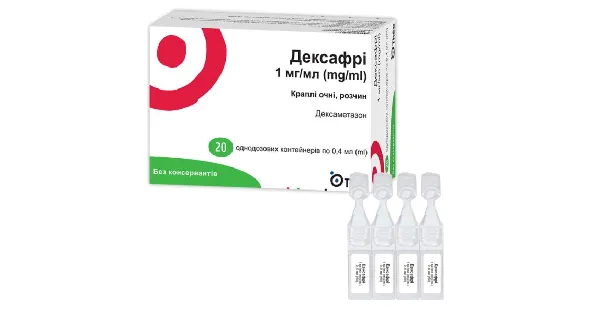
Table of Contents
INSTRUCTIONS for medical use of the medicinal product Dexafree® (Dexafree®)
Composition:
Active substance: dexamethasone;
1 ml of solution contains 1.093 mg of dexamethasone sodium phosphate, equivalent to 1 mg of dexamethasone phosphate;
Excipients: edetate disodium, sodium hydrogen phosphate dodecahydrate, sodium chloride, water for injections.
Pharmaceutical form. Eye drops, solution.
Main physicochemical properties: colourless to slightly brownish, clear solution, practically free from foreign particles.
Pharmacotherapeutic group. Agents acting on sensory organs. Ophthalmological agents. Anti-inflammatory agents. Simple corticosteroids.
ATC code S01B A01.
Pharmacological Properties
Pharmacodynamics
Dexamethasone sodium phosphate is a water-soluble inorganic ester of dexamethasone. It is a synthetic corticosteroid with anti-inflammatory and antiallergic effects. The anti-inflammatory effect of dexamethasone is approximately 25 times stronger than that of hydrocortisone and 5 times stronger than that of prednisolone.
Pharmacokinetics
Due to its hydrophilic properties, dexamethasone sodium phosphate is poorly absorbed through intact corneal epithelium. After topical administration, dexamethasone sodium phosphate is absorbed through the mucous membranes of the eyes and nose and is hydrolyzed in the body to dexamethasone. Subsequently, dexamethasone and its metabolites are primarily excreted via the kidneys.
Preclinical Safety Data
Mutagenic and oncogenic potential
There are no clinically significant data on the genotoxic properties of glucocorticoids.
Reproductive toxicity
Animal experiments have shown that corticosteroids cause fetal resorption and cleft palate. In rabbits, corticosteroids induced fetal resorption and numerous anomalies of the head, ears, limbs, and palate.
In addition, intrauterine growth retardation and alterations in functional development of the central nervous system have been reported.
Clinical characteristics.
Indications.
Treatment of non-infectious inflammatory diseases of the anterior segment of the eye.
Contraindications.
-
Hypersensitivity to the active substance or to any of the excipients.
-
Infectious eye diseases, unless concomitant antibacterial therapy is administered, such as:
- acute bacterial purulent infections, including those caused by Pseudomonas or mycobacteria;
- fungal infections;
- epithelial herpes simplex keratitis (dendritic keratitis), cowpox, varicella, and most other viral infections of the cornea and conjunctiva;
- Acanthamoeba keratitis.
-
Corneal perforations, ulcers, and injuries with incomplete epithelialization (see also
section "Special precautions"). -
Ocular hypertension induced by glucocorticoids.
Interaction with other medicinal products and other forms of interaction.
If concomitant treatment with other eye drops is required, they should not be administered earlier than 15 minutes after instillation of the drug. Superficial stromal calcium phosphate precipitates on the cornea have been observed with combined topical use of corticosteroids and beta-blockers.
Dexamethasone should not be used concomitantly with drugs used in glaucoma treatment, since such use, especially over prolonged periods and in high doses, may lead to an increase in intraocular pressure (IOP).
It is also known that concomitant use of topically applied non-steroidal anti-inflammatory drugs (NSAIDs) and topically applied steroids increases the risk of complications in corneal wound healing.
Concomitant use of dexamethasone with agents affecting ocular accommodation or causing pupillary dilation (e.g., anticholinergic agents such as atropine or related compounds) increases the risk of elevated intraocular pressure (particularly in patients with anatomical ocular features predisposing to narrow-angle glaucoma).
Therapeutic efficacy of dexamethasone may be reduced by phenytoin, phenobarbital, ephedrine, and rifampicin. Glucocorticoids may increase the requirement for salicylates due to increased plasma salicylate clearance.
CYP3A4 inhibitors (including ritonavir and cobicistat) may reduce dexamethasone clearance, leading to enhanced effects and adrenal suppression / Cushing's syndrome.
Concomitant use of corticosteroids should be avoided, except when the benefit outweighs the risk of systemic adverse effects. In such cases, patients should be informed about systemic effects of corticosteroids and monitored accordingly.
Special precautions for use
Dexafree® is a sterile solution that does not contain preservatives and is intended for ophthalmic use only!
Topical steroids should never be used in cases of eye redness without prior diagnosis.
Regular patient monitoring is required during treatment with ophthalmic drops containing dexamethasone. Prolonged use of corticosteroids may lead to ocular hypertension/glaucoma (particularly in patients who have previously experienced elevated intraocular pressure due to corticosteroid use, or in patients with pre-existing high intraocular pressure or glaucoma prior to therapy), as well as the development of cataracts, especially in children and elderly patients.
Corticosteroid therapy may lead to opportunistic ocular infections due to suppression of the host's immune response or delayed wound healing. In addition, topical application of corticosteroids may cause, exacerbate, or mask symptoms of opportunistic eye infections.
Patients with ocular infections should only receive topical corticosteroid treatment when the infection has been controlled with effective anti-infective therapy. Such patients must undergo regular, thorough ophthalmological examinations.
For certain inflammatory conditions such as episcleritis, non-steroidal anti-inflammatory drugs (NSAIDs) are first-line agents. Dexamethasone should only be used if there is a contraindication to the use of NSAIDs.
Topically applied corticosteroids to the eye may delay corneal wound healing.
Patients with corneal ulcers should not receive topical dexamethasone except when inflammation is the primary cause of delayed healing and appropriate etiological treatment is administered concurrently. Such patients must undergo regular, thorough ophthalmological examinations.
Thinning of the cornea and sclera may increase the risk of perforation with topical use of corticosteroids.
This medicinal product contains 80 mcg of phosphates per drop (see section "Side effects").
Cases of corneal calcification requiring corneal transplantation to restore vision have been reported in patients receiving ophthalmic preparations containing phosphates, such as Dexafree®. At the first signs of corneal calcification, treatment with this product must be discontinued and further treatment should be continued with phosphate-free preparations.
Systemic absorption during intensive or prolonged continuous therapy with ophthalmic drops containing dexamethasone may lead to Cushing's syndrome and/or adrenal suppression in susceptible patients, children, and patients receiving CYP3A4 inhibitors (including ritonavir and cobicistat). In such cases, treatment should be tapered off gradually.
Posterior subcapsular cataract may develop with cumulative doses of dexamethasone.
Patients with diabetes mellitus are also more prone to developing subcapsular cataracts following topical corticosteroid use.
The use of topical corticosteroids in the treatment of allergic conjunctivitis is recommended only for severe, treatment-resistant forms and only for a short duration.
Contact lenses should be avoided during treatment with ophthalmic drops containing corticosteroids.
Visual disturbances
Visual disturbances may occur with both systemic and topical use of corticosteroids. If a patient experiences symptoms such as blurred vision or other visual disturbances, they should consult an ophthalmologist to evaluate possible causes, including cataract, glaucoma, or rare conditions such as central serous chorioretinopathy.
Use during pregnancy or breastfeeding
Pregnancy
There are insufficient data to assess the potential risks of using Dexafree® during pregnancy. Corticosteroids cross the placental barrier. Teratogenic effects have been observed in animals (see section "Preclinical safety data"). However, there is currently no evidence of teratogenic effects in humans. There are no data on teratogenic effects of the drug in humans with topical ophthalmic use.
Fetal/neonatal effects have been reported following systemic use of corticosteroids at higher doses (intrauterine growth retardation, suppression of adrenal cortical function). There are no reports of such effects with topical ophthalmic use. As a precautionary measure, use of 1 mg/mL dexamethasone ophthalmic solution should be avoided during pregnancy.
Breastfeeding
There are no data on the passage of the drug into breast milk, but a risk to the breastfed infant cannot be excluded. Therefore, the potential benefit of the therapy to the mother and the benefit of breastfeeding to the infant should be carefully weighed, and either breastfeeding should be temporarily discontinued during treatment, or therapy with the drug should be stopped.
Effect on fertility
There are no data on the potential effect of dexamethasone 1 mg/mL on fertility.
Ability to affect reaction speed when driving or operating machinery
The effect on the ability to drive or operate machinery has not been studied.
As with other ophthalmic drops, transient blurred vision or other visual disturbances may affect the ability to drive or operate machinery. If blurred vision occurs, patients should wait until vision clears before driving or operating machinery.
Method of Administration and Dosage.
The medicinal product should usually be administered as 1 drop into the affected eye 4−6 times daily.
In severe cases, treatment may begin with 1 drop every hour. Then, as a favorable therapeutic response occurs, the dosage should be reduced to 1 drop every 4 hours. A gradual reduction of the dose is recommended to prevent disease recurrence. The duration of treatment may last from several days up to a maximum of 14 days.
This medicinal product should be used only under strict supervision of an ophthalmologist.
Dexafree**®** is a sterile solution that contains no preservatives. The solution from a single-dose container should be used immediately after opening. The container is intended for single use only. Since sterility cannot be maintained after opening the single-dose container and administering the prescribed dose, any remaining solution should be discarded immediately.
Instructions for Use.
- Wash your hands and position yourself comfortably, either standing or sitting.
- Gently pull the lower eyelid of the affected eye downward with your finger.
- Bring the tip of the opened single-dose container as close as possible to the eye without touching it.
- Gently squeeze the container to release one drop into the eye, then release the lower eyelid.
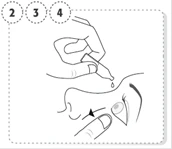
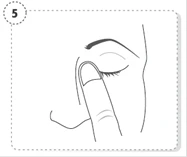
- Close your eyes and press with your finger on the inner corner of the treated eye for 1 minute to minimize potential systemic absorption.
- Repeat all the above steps for the second eye, if prescribed by your doctor.
- Immediately discard the single-dose container with any remaining solution after use.
Contact lenses should be avoided during treatment with ophthalmic drops containing corticosteroids.
When using multiple locally acting ophthalmic agents, they should be administered at intervals of at least 15 minutes.
Children.
The efficacy and safety of the drug for use in children have not been established.
In children, prolonged continuous corticosteroid therapy should be avoided due to the potential risk of adrenal suppression (see section "Special Warnings and Precautions for Use").
Overdose.
In case of overdose with topical administration, treatment should be discontinued and the eye(s) should be irrigated with sterile water.
Symptoms following accidental ingestion are unknown. However, as with ingestion of other corticosteroids, it may be advisable to drink plenty of fluids, perform gastric lavage, or induce vomiting.
Adverse Reactions
Eye disorders
- Very common (≥ 1/10): increased intraocular pressure*.
- Common (≥ 1/100, < 1/10): discomfort*, irritation*, burning*, stinging*, itching*, and blurred vision (see section "Special warnings and precautions for use").
- Uncommon (≥ 1/1,000, < 1/100): allergic reactions and hypersensitivity, delayed wound healing, posterior subcapsular cataract*, opportunistic infections, glaucoma*.
- Very rare (< 1/10,000, including isolated reports): conjunctivitis, mydriasis, facial swelling, ptosis; steroid-induced uveitis, corneal calcification, crystalline keratopathy, changes in corneal thickness*, corneal edema, corneal ulcer, and corneal perforation.
Endocrine system disorders
Frequency unknown (cannot be estimated from available data): Cushing's syndrome, adrenal suppression (see sections "Interaction with other medicinal products and other forms of interaction" and "Special warnings and precautions for use").
* See section "Description of selected adverse reactions"
Description of selected adverse reactions
Elevated intraocular pressure, glaucoma, and cataracts may occur. Prolonged use of corticosteroids may lead to ocular hypertension/glaucoma (particularly in patients who have previously shown increased intraocular pressure after steroid administration, or in patients who already had elevated intraocular pressure prior to corticosteroid use, and in patients with glaucoma), as well as to the development of cataracts. Children and elderly patients are particularly sensitive to corticosteroid-induced elevation of intraocular pressure (see section "Special warnings and precautions for use").
Increased intraocular pressure associated with local corticosteroid therapy usually occurs within 2 weeks of treatment initiation.
Patients with diabetes mellitus are prone to developing subcapsular cataracts with local corticosteroid use.
Immediately after instillation, discomfort, irritation, burning, stinging, itching, and blurred vision may occur. These symptoms are usually mild and transient and do not have consequences.
In conditions causing corneal thinning, local corticosteroid use may in some cases lead to corneal perforation (see section "Special warnings and precautions for use").
With frequent instillations, systemic absorption may occur, potentially leading to suppression of adrenal cortical function (see section "Special warnings and precautions for use").
Isolated cases of corneal calcification have been reported with the use of ophthalmic solutions containing phosphates in certain patients with significant corneal damage.
Reporting of adverse reactions
Reporting suspected adverse reactions after medicine authorization is important. It allows continued monitoring of the benefit-risk balance of the medicine. Healthcare professionals, as well as patients or their legal representatives, should report any suspected adverse reactions and lack of efficacy through the Automated Information System for Pharmacovigilance at the following link: https://aisf.dec.gov.ua.
Shelf life. 3 years.
After first opening of the sachet, use single-dose containers within 15 days.
After first opening of a single-dose container, its contents should be used immediately and the container discarded.
Storage conditions. No special storage conditions required.
Store single-dose containers in sachets to protect from light.
Keep out of reach of children.
Packaging. 0.4 mL in a single-dose container; 5 single-dose containers connected in a strip, in a sachet; 4 or 6 sachets (pack size 20 or 30) in a cardboard box.
Prescription status. Prescription only.
Manufacturer.
EXCELVISION / EXCELVISION.
Manufacturer's address and location of operations.
Zone Industrielle de la Lombardiere, 27 rue de la Lombardiere, ANNONAY, 07100, France.
Marketing Authorization Holder.
LABORATOIRES THEA / LABORATOIRES THEA.
In case of adverse events, adverse reactions, or lack of therapeutic effect, information should be sent to the contact person for LABORATOIRES THEA responsible for pharmacovigilance in Ukraine via email at [email protected] or by phone at (068) 129 18 58, (044) 467-57-70 (24/7).
Address of Marketing Authorization Holder.
12 rue Louis Bleriot, 63100 Clermont-Ferrand Cedex 2, France.