Decasan
Ukraine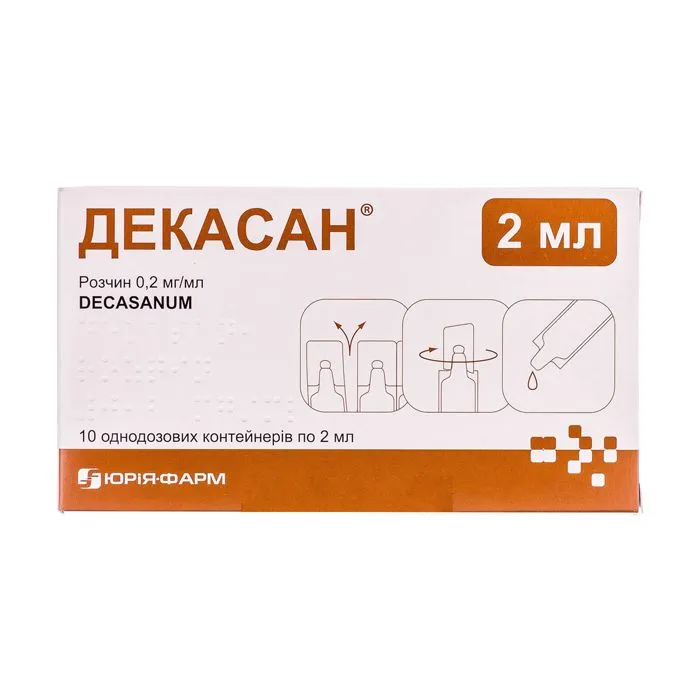
Table of Contents
INSTRUCTION FOR MEDICAL USE OF THE MEDICINAL PRODUCT DEKASAN® (DECASANUM)
Composition:
Active substance: decamethoxine;
1 ml of solution contains 0.2 mg of decamethoxine;
Excipients: sodium chloride, water for injections.
Pharmaceutical form. Solution.
Main physicochemical properties: clear, colorless solution.
Pharmacotherapeutic group. Antiseptics and disinfectants. ATC code D08A.
Pharmacological properties.
Pharmacodynamics.
Decasan exerts antimicrobial and antifungal effects by accumulating at the cytoplasmic membrane (CM) of microbial cells and binding to phosphatidyl groups of membrane lipids, thereby disrupting the permeability of the microbial cytoplasmic membrane. Decamethoxine has a pronounced bactericidal effect against staphylococci, streptococci, Corynebacterium diphtheriae, Pseudomonas aeruginosa, encapsulated bacteria, and a fungicidal effect against yeasts, yeast-like fungi, causative agents of epidermophytia, trichophytia, microsporia, erythrasma, as well as some species of mold fungi (Aspergillus, Penicillium). It also demonstrates protozoacidal activity against trichomonads and Giardia, and virucidal activity against viruses. It is highly active against microorganisms resistant to antibiotics. Resistant forms to decamethoxine develop slowly and in insignificant amounts during prolonged use. Bacteriostatic (fungistatic) concentrations are similar to its bactericidal (fungicidal), virucidal, and protozoacidal concentrations. During treatment with the drug, sensitivity of antibiotic-resistant microorganisms to antibiotics increases.
In vitro studies conducted on VeroE6 cell cultures confirmed that decamethoxine at a concentration of 0.2 mg/mL exerts a pronounced virucidal effect against SARS-CoV-2 coronavirus (the causative agent of coronavirus disease COVID-19) after 60 seconds of exposure, as evidenced by a reduction in the infectious titer of the virus.
Pharmacokinetics.
The drug is practically not absorbed through mucous membranes, intact skin, or wound surfaces.
Clinical Characteristics.
Indications.
Treatment of bacterial and fungal skin infections, microbial eczema, purulent-inflammatory lesions of soft tissues (abscesses, carbuncles, phlegmons, furuncles, purulent wounds, paronychia); stomatological diseases (stomatitis, ulcerative-necrotic gingivitis, dystrophic-inflammatory form of periodontosis stage I-II in exacerbation phase).
Also indicated in lung abscess, bronchiectasis, cystic hypoplasia of the lungs complicated by suppuration, chronic bronchitis in exacerbation phase, chronic tonsillitis, angina, carriage of staphylococci and diphtheria bacilli, ulcerative colitis, periproctitis.
In gynecological practice – for treatment of candidiasis of vaginal mucosa, microbial origin inflammatory genital diseases, pre-delivery sanitation of birth canals, treatment of postpartum endometritis.
Purulent-inflammatory diseases of the abdominal and pleural cavities.
For hygienic disinfection of hands of medical personnel and rubber gloves during patient examination and performance of medical manipulations and minor surgical procedures, pre-sterilization disinfection of medical instruments and diagnostic equipment made of metals, rubber, polymer materials and glass.
Contraindications.
Individual hypersensitivity to the components of the drug.
Interaction with other medicinal products and other types of interactions.
Pharmaceutical: decamethoxine is a cationic surface-active substance; therefore, it is incompatible with soap and other anionic compounds.
Pharmacodynamic: decamethoxine increases the sensitivity of antibiotic-resistant microorganisms to antibiotics.
Special precautions for use.
Decamethoxine at the concentration used in Decasan® has no toxic effects. Prolonged use of Decasan does not cause any toxic reactions. Warming the preparation to 38°C prior to application enhances its effectiveness. In cases of inflammatory conditions or skin irritation, the preparation should be diluted with distilled water in a ratio of 1:1 or 1:2.
Use during pregnancy or breastfeeding.
There are no contraindications regarding use during pregnancy or breastfeeding.
Ability to affect reaction rate while driving or operating machinery.
There are no contraindications regarding the influence on reaction speed while driving or operating machinery.
Method of Administration and Dosage
For purulent and fungal skin lesions, purulent wounds, the solution should be used for irrigation and applications. For the treatment of proctitis and ulcerative colitis, administer warm solution as enemas, 50–100 mL twice daily, until complete disappearance of acute inflammatory signs. In chronic periproctitis, irrigate fistulas daily with Decasan® for 3–4 days. For bladder irrigation in adult patients, use decamethoxine solution after prior dilution 1:7 with purified water, at a dose of 500–600 mL (7–20 irrigations per treatment course).
Treat mucosal lesions of the oral cavity by application of 25–50 mL for 10–15 minutes or by rinsing (100–150 mL). Treat acute-stage I–II degree dystrophic-inflammatory periodontosis by irrigation of pathological gingival pockets with warm solution (50–70 mL) or by applications to the gums until resolution of inflammatory symptoms. For patients with candidal mucosal lesions of the oral cavity and ulcerative-necrotic gingivitis, prescribe oral rinsing (100–150 mL) four times daily for 5–10 days.
Treat candidiasis of the tonsils and chronic tonsillitis by irrigation of tonsillar crypts (50–75 mL per irrigation).
For decolonization of carriers of Staphylococcus, diphtheria bacillus, perform rinsing of the pharynx, irrigation of crypts, and spraying of the nasopharynx and tonsils. Irrigate crypts 3–5 times every other day.
In adults with lung abscess, bronchiectasis, cystic lung hypoplasia complicated by suppuration, and chronic bronchitis in the acute phase, administer Decasan® endobronchially:
- via microtracheostomy, 25–50 mL once or twice daily; via transnasal catheter, 5–10 mL once daily;
- by ultrasonic inhalation method, 5–10 mL once or twice daily;
- by tracheobronchial lavage, 100 mL.
Treatment duration: 2–4 weeks.
For treatment of purulent-inflammatory diseases of the abdominal and pleural cavities, fill the affected area completely with Decasan® and maintain for at least 10 minutes. If necessary, including during closure without drainage ("blind" closure), repeatedly fill the surgical cavity and remove the solution until the irrigation fluid is clear. Perform continuous irrigation and drainage of the cavity using drainage tubes or by puncture technique.
For treatment of bacterial and fungal trichomonal lesions of the vaginal mucosa, use Decasan® as vaginal douching (50–100 mL of the drug warmed to 38°C, three times daily). Perform pre-delivery sanitation of the birth canal in the same manner, as a single procedure. Treat postpartum endometritis by irrigation of the uterine cavity with warm solution (150–200 mL) twice daily.
Disinfect hands and rubber gloves by applying 5–10 mL of the agent onto previously washed surfaces for 5 minutes.
Disinfect cleaned medical instruments, mouthpieces, tubes, and equipment by immersion in the solution for 30 minutes.
Children.
Use for treatment of children aged 12 years and older with chronic bronchitis in the acute phase, by ultrasonic inhalation method, 5–10 mL once or twice daily. Experience with use in children under 18 years of age for other indications is lacking.
Overdose.
Due to lack of systemic absorption, overdose is not observed.
Side effects.
In rare cases, some patients may experience increased individual sensitivity. In such individuals, after administration of the drug, skin rashes, burning, dryness, itching, and other local allergic reactions may occur. When administered endobronchially, a sensation of warmth behind the sternum may appear, which disappears 20–30 minutes after completion of the procedure.
Shelf life. 3 years.
Storage conditions. Store in a place protected from light and inaccessible to children, at a temperature not exceeding 25 °C. Do not freeze.
Packaging.
50 ml, 100 ml, 200 ml, or 400 ml in glass bottles. 50 ml, 100 ml, 250 ml, 500 ml, 1000 ml, 2000 ml, 3000 ml, or 5000 ml in polymer containers. 2 ml or 5 ml in single-dose containers; 4, 8, 10, or 12 containers per pack.
Prescription status. Over-the-counter.
Manufacturer.
LLC "Yuria-Pharm".
Manufacturer's address and location of business activity.
108, Kozbirska St., Cherkasy, Cherkasy region, 18030, Ukraine. Tel.: (044) 281-01-01