De-nol
Ukraine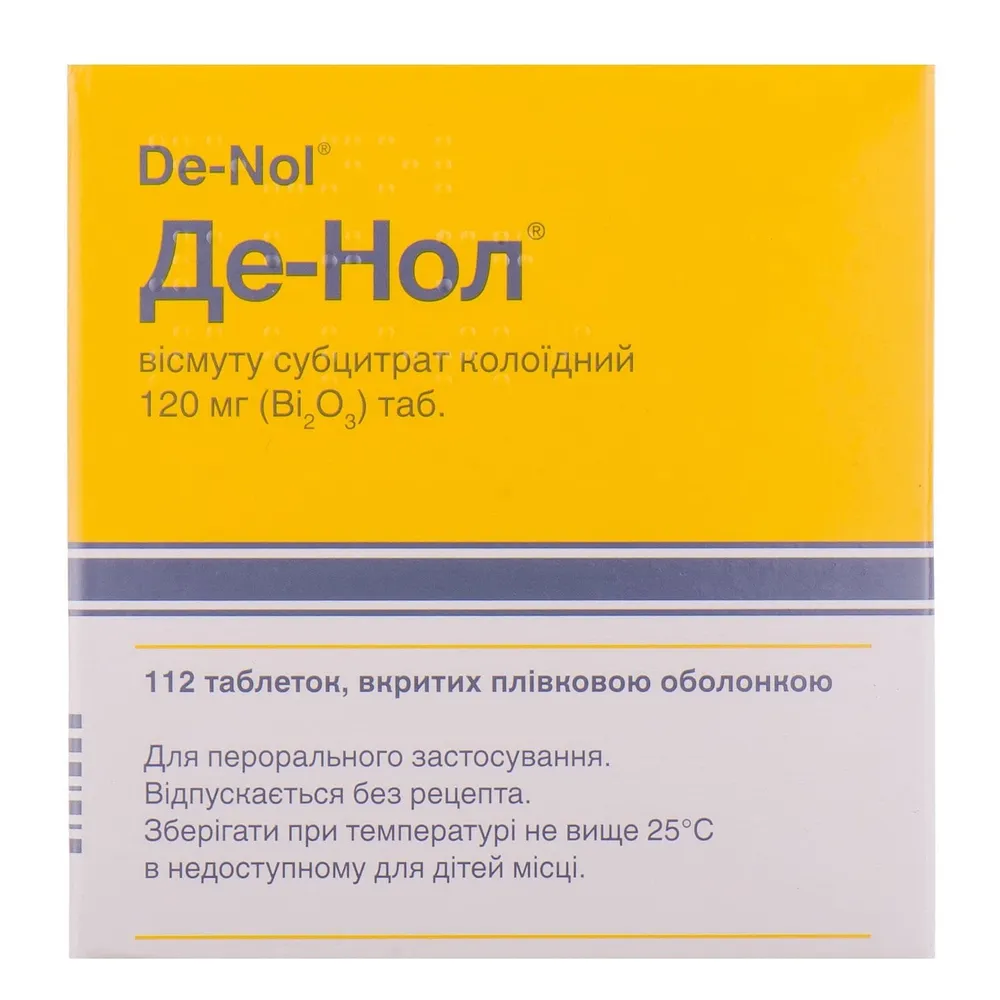
Table of Contents
I N S T R U C T I O N for medical use of the medicinal product DE-NOL® (DE-NOL®)
Composition:
active substance: colloidal bismuth subcitrate;
1 tablet contains colloidal bismuth subcitrate equivalent to 120 mg of Bi₂O₃, contained in the dry bismuth subcitrate solution;
excipients: maize starch, povidone, potassium polacrilin, macrogol 6000, magnesium stearate, hypromellose.
Pharmaceutical form. Film-coated tablets.
Main physicochemical properties. Round, biconvex tablets of white to creamish color, with the imprint “gbr 152” on one side and the company logo on the other.
Pharmacotherapeutic group. Agents for treatment of peptic ulcer and gastroesophageal reflux disease. Bismuth subcitrate. ATC code A02BX05.
Pharmacological properties.
Pharmacodynamics.
In the acidic environment of the stomach, the drug forms a protective film on the surface of ulcers and erosions, promoting their healing and protecting them from the action of gastric juice; increases prostaglandin E2 synthesis, stimulates mucus and bicarbonate production, induces accumulation of epidermal growth factor at the site of the defect, reduces the activity of pepsin and pepsinogen. The drug exhibits bactericidal activity against Helicobacter pylori.
Pharmacokinetics.
The drug is practically not absorbed from the gastrointestinal tract; only a negligible amount of the active substance enters the bloodstream and is excreted in urine, while bismuth concentration in plasma rapidly decreases after completion of treatment. It is excreted predominantly in feces.
Clinical characteristics.
Indications. Peptic ulcer disease of the stomach and duodenum, chronic gastritis, including that caused by Helicobacter pylori (as part of anti-Helicobacter therapy regimens).
Contraindications. Hypersensitivity to the active substance or to any of the excipients. Severe renal impairment.
Interaction with other medicinal products and other forms of interaction. No other medications, food, beverages, antacids, milk, fruits, or fruit juices should be consumed within half an hour before or after taking De-Nol® as they may alter its effect.
Reduces the absorption of tetracyclines; concomitant use of bismuth-containing drugs (e.g., Vikalin, Vikaiр) increases the risk of excessive elevation of bismuth concentration in the blood.
Special precautions for use
A change in stool color to black may occur; in such a case, consult a physician. Do not take antacid agents or consume milk within half an hour before or after taking the medication, as gastric juice is required for the formation of the protective layer.
Prolonged use of high doses of bismuth compounds is not recommended due to the rare occurrence of reversible encephalopathy. When following the recommended dosage regimen, the risk of this adverse effect is very low. However, during treatment with this medication, concomitant use of other bismuth-containing products is not recommended.
Use during pregnancy or breastfeeding. Not recommended.
Ability to affect reaction speed when driving or operating machinery. There are no data on the effect of De-Nol® on the ability to drive or operate machinery. However, such an effect of De-Nol® is unlikely.
Method of Administration and Dosage.
For adults and children aged 14 years and older: administer 1 tablet 4 times daily, 30 minutes before meals and at night, or 2 tablets twice daily.
For children aged 8 to 14 years: administer 1 tablet twice daily, 30 minutes before meals.
For children aged 4 to 8 years: administer at a dose of 8 mg/kg/day; divide the daily dose into 2 doses, but not exceeding 2 tablets per day.
Tablets should be taken with a small amount of water. Treatment duration is 4–8 weeks. During the following 8 weeks, avoid using medications containing bismuth.
In the presence of Helicobacter pylori, use in treatment regimens according to national recommendations.
Children. De-Nol® can be used in children aged 4 years and older.
Overdose.
Symptoms of intoxication.
Acute massive overdose may lead to renal failure with delayed onset up to 10 days.
Treatment of intoxication.
After a single ingestion of a very high dose, treatment includes gastric lavage followed by administration of activated charcoal and osmotic laxatives. This therapy usually reduces bismuth absorption, so additional measures are generally not required.
Blood and urine bismuth concentrations should be measured in cases of acute or chronic intoxication to identify any association between symptoms and elevated bismuth levels.
Chelation therapy with dimercaptosuccinic acid (DMSA) and dimercaptopropanesulfonic acid (DMPS) should be used if symptoms are caused by acute or chronic bismuth overdose.
In cases of severe renal failure, chelation therapy should be accompanied by hemodialysis.
Adverse reactions.
Very common (>1/10)
Gastrointestinal disorders: black stools may occur during the use of De-Nol®, due to the formation of bismuth sulfide. Such stools can be easily distinguished from melena.
Uncommon (>1/1000, <1/100)
Gastrointestinal disorders: nausea, vomiting, constipation, diarrhoea.
Skin and subcutaneous tissue disorders: mild allergic skin reactions (rash, pruritus).
Very rare (<1/10000), frequency unknown (cannot be estimated from available data):
Immune system disorders: anaphylactic reaction.
Shelf life. 4 years.
Do not use the medicinal product after the expiry date stated on the packaging.
Storage conditions. Store at a temperature not exceeding 25 °C in a place inaccessible to children.
Packaging. 8 tablets in a blister; 7 or 14 blisters in a cardboard box.
Availability. Over-the-counter (without prescription).
Manufacturer. Astellas Pharma Europe B.V. / Astellas Pharma Europe B.V.
Manufacturer's address and location of its business operations.
Astellas Pharma Europe B.V.
Hogemaat 2, 7942 JG Meppel, the Netherlands / Hogemaat 2, 7942 JG Meppel, the Netherlands.
Marketing Authorization Holder.
CHEPLAPHARM Arzneimittel GmbH
Address and location of the Marketing Authorization Holder's business operations.
Ziegelhof 24, 17489 Greifswald, Germany