Daveris
Ukraine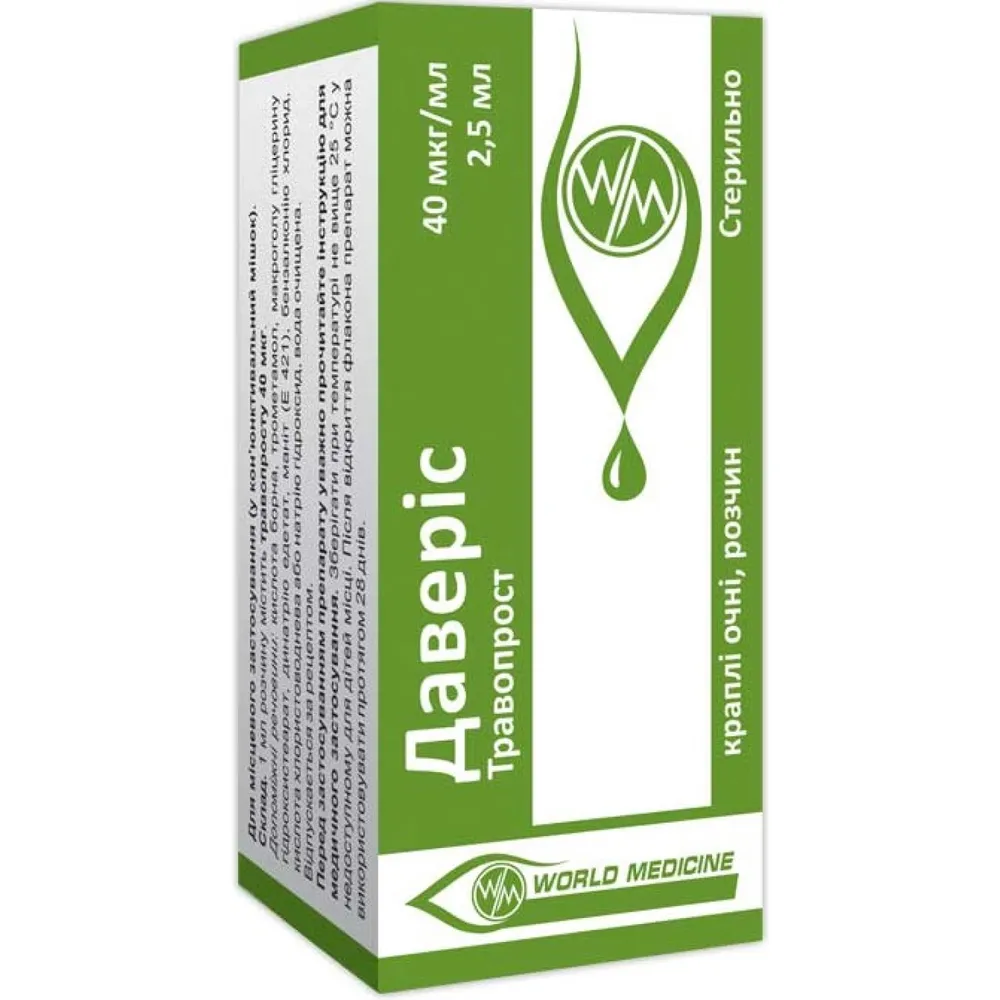
Table of Contents
INSTRUCTIONS FOR MEDICAL USE OF THE MEDICINAL PRODUCT DAVÉRIS (DAVERIS)
Composition:
Active substance: travoprost;
1 ml of solution contains travoprost 40 mcg;
Excipients: boric acid, tromethamine, macrogol glycerides hydroxystearate, edetate disodium, mannitol (E 421), benzalkonium chloride, hydrochloric acid or sodium hydroxide, purified water.
Pharmaceutical form. Eye drops, solution.
Main physicochemical properties: clear, colorless solution (no more opalescent than reference suspension I).
Pharmacotherapeutic group.
Medicinal products used in ophthalmology. Anti-glaucoma preparations and miotics. Prostaglandin analogues. ATC code S01E E04.
Pharmacological Properties.
Pharmacodynamics.
Mechanism of action
Travoprost, a prostaglandin F2α analogue, is a potent and selective agonist of the prostaglandin FP receptors. It reduces intraocular pressure (IOP) by increasing the outflow of aqueous humor through the trabecular meshwork and uveoscleral pathways. In humans, the reduction in IOP begins approximately 2 hours after administration, with maximum effect reached after 12 hours. A significant reduction in IOP may persist for more than 24 hours following a single dose.
Clinical efficacy and safety
Clinical studies using travoprost (with polyquaternium-1 as preservative) in patients with open-angle glaucoma or ocular hypertension, administered once daily in the evening, demonstrated a reduction in IOP of 8–9 mmHg (approximately 33%) from a baseline of 24–26 mmHg. Data on the use of travoprost in combination with 0.5% timolol and limited data on its use in combination with 0.2% brimonidine were obtained from clinical trials, which demonstrated an additive effect of travoprost when used concomitantly with these anti-glaucoma medications. There are no clinical data on concomitant use with other ophthalmic hypotensive agents.
Secondary pharmacology
Travoprost significantly increased blood flow to the optic nerve head in rabbits after 7 days of topical ocular administration (1.4 micrograms once daily).
Pediatric population
The efficacy of travoprost in pediatric patients aged 2 months to 18 years was demonstrated in a 12-week, double-masked, clinical study comparing travoprost with timolol in 152 patients diagnosed with ocular hypertension or childhood glaucoma. Patients received either travoprost 0.004% once daily or timolol 0.5% (or 0.25% for patients under 3 years of age) twice daily. The primary efficacy endpoint was the change in IOP from baseline at 12 weeks. Mean reductions in IOP were similar between the travoprost and timolol groups (see Table 1).
In age groups from 3 to 12 years (n=36) and from 12 to 18 years (n=26), mean IOP reduction with travoprost at 12 weeks was comparable to that with timolol. At 12 weeks, mean IOP reduction in the 2-months-to-3-years age group was 1.8 mmHg in the travoprost group and 7.3 mmHg in the timolol group. The IOP reduction data in the timolol group were based on only 6 patients, compared to 9 patients in the travoprost group. Four patients in the travoprost group, compared to none in the timolol group, did not show a relevant reduction in mean IOP at 12 weeks. Data for infants under 2 months of age are not available.
The IOP-lowering effect was observed after the second week of treatment and was consistently maintained throughout the 12-week study period across all age groups.
Table 1
Comparison of mean change in IOP from baseline (mmHg) at 12 weeks
| N |
Travoprost, mean value (SEM) |
N |
Timolol, mean value (SEM) |
Mean differencea |
(95 % CI) |
| 53 |
-6.4 (1.05) |
60 |
-5.8 (0.96) |
-0.5 |
(-2.1; 1.0) |
| SEM – standard error of the mean; CI – confidence interval. a Mean difference with travoprost/timolol treatment. The estimate is based on least squares means (marginal means) obtained using a statistical model that included correlated ocular pressure measurements within a patient (baseline diagnosis and baseline ocular pressure were accounted for). |
|||||
Non-clinical safety data
In ocular toxicity studies in monkeys, administration of travoprost at a dose of 0.45 mcg twice daily caused an increase in palpebral fissure. Topical application of travoprost at concentrations up to 0.012% to the right eye of monkeys twice daily for one year did not result in systemic toxicity.
Toxicological effects on reproductive function were studied in rats, mice, and rabbits via systemic administration. The findings are related to FP-receptor agonist activity in the uterus, associated with early embryonic lethality, post-implantation fetal loss, and fetal toxicity. In pregnant rats, systemic administration of travoprost at doses 200 times higher than the therapeutic dose during organogenesis caused an increased incidence of developmental abnormalities. Low levels of radioactivity were detected in amniotic fluid and fetal tissues of pregnant rats following administration of 3H-travoprost. Studies on reproductive performance and fetal development revealed an increased risk of fetal loss at high rates in female rats and mice (plasma levels of 180 pg/mL and 30 pg/mL, respectively) at doses 1.2–6 times higher than the therapeutic dose (up to 25 pg/mL).
Pharmacokinetics
Absorption
Travoprost is an isopropyl ester prodrug. It is absorbed through the cornea, where the isopropyl ester is hydrolyzed to the active free acid. Maximum concentration of the free acid in intraocular fluid reaches 20 ng/mL within 1–2 hours after topical administration. Drug concentrations in intraocular fluid decline with an elimination half-life of approximately 1.5 hours.
Distribution
Following ocular instillation of travoprost in healthy volunteers, low systemic exposure to the active free acid was observed. Peak plasma concentrations of the active free acid of 25 pg/mL or less were observed 10–30 minutes after dosing. Plasma concentrations of the compound rapidly decline within 1 hour after administration to levels below the quantification limit of 10 pg/mL. Due to low plasma concentrations and rapid elimination following topical administration, the elimination half-life of the free active acid in humans has not been determined.
Metabolism
Metabolism is the primary route of elimination for both travoprost and its active free acid. Systemic metabolic pathways are similar to those of endogenous prostaglandin F2α, characterized by reduction of the 13–14 double bond, oxidation of the 15-hydroxyl group, and β-oxidative cleavage of the upper side chain.
Elimination
The free acid of travoprost and its metabolites are primarily excreted by the kidneys.
Patients with hepatic and/or renal impairment
The effect of travoprost has been studied in patients with hepatic impairment (mild to severe) and in patients with renal impairment (mild to severe) (creatinine clearance below 14 mL/min). Dose adjustment in these patients is not required.
Pediatric population
A pharmacokinetic study in children aged 2 months to 18 years following travoprost administration demonstrated very low plasma concentrations of the free acid, ranging from less than 10 pg/mL to 54.5 pg/mL, i.e., below the quantification limit. In four previous systemic pharmacokinetic studies in adults, plasma concentrations of the free acid after travoprost administration ranged from below the quantification limit to 52.0 pg/mL. While most data showed plasma concentrations below the detection limit throughout the studies, making statistical comparisons of systemic exposure across age groups impossible, the overall trend indicates that after topical administration of travoprost, plasma levels of the free acid are very low in all age groups evaluated.
Clinical characteristics.
Indications.
For lowering elevated intraocular pressure in patients with ocular hypertension or open-angle glaucoma.
For lowering elevated intraocular pressure in children aged 2 months to 18 years with ocular hypertension or pediatric glaucoma.
Contraindications.
Hypersensitivity to the active substance or to any of the other components of the medicinal product.
Interaction with other medicinal products and other forms of interaction.
Studies on interaction with other medicinal products have not been conducted.
In vitro studies on specific interaction were performed using travoprost and formulations containing thimerosal. No evidence of precipitation was observed.
Special precautions for use.
Change in eye color
Travoprost may gradually change eye color by increasing the number of melanosomes (pigment granules) in melanocytes. Patients should be informed before starting treatment about the possibility of irreversible change in eye color. Treatment of one eye may lead to irreversible heterochromia. Long-term effects and consequences of prolonged influence on melanocytes are still unknown. Change in iris color occurs slowly and may go unnoticed for months or even years. Change in eye color has been observed primarily in patients with mixed iris color, i.e. blue-brown, gray-brown, yellow-brown, and green-brown, although this phenomenon has also been observed in patients with brown eyes. Typically, brown pigmentation spreads concentrically from around the pupil toward the periphery of the iris of the affected eye; however, the entire iris or parts thereof may become more intensely brown. After discontinuation of travoprost, no further increase in brown iris pigmentation has been observed.
Changes in eyelid and periorbital skin
Skin darkening of the eyelid and/or periorbital area has been reported in 0.4% of patients associated with the use of travoprost.
With the use of prostaglandin analogues, changes in the periorbital area and eyelid skin, including deepening of the eyelid sulcus, have been observed.
Travoprost may gradually change the structure of eyelashes of the eye(s) to which it is applied. In clinical trials, such changes were observed in approximately half of patients and included increased length, thickness, pigmentation, and/or number of eyelashes. The mechanism of eyelash structural changes and long-term consequences of this effect are still unknown.
As demonstrated in studies conducted in monkeys, travoprost causes slight enlargement of the palpebral fissure. However, this effect was not observed in clinical trials and is considered species-specific.
There is no experience with the use of travoprost in inflammatory eye diseases, neovascular glaucoma, closed-angle glaucoma, narrow-angle or congenital glaucoma. Experience with the use of the medicinal product in eye disorders associated with thyroid dysfunction, open-angle glaucoma in pseudophakic patients, and in pigmentary or pseudoexfoliative glaucoma is limited. The medicinal product should be used with caution in patients with active ocular infections.
Contact with skin
Avoid contact of the medicinal product with the skin, as transdermal absorption of travoprost has been demonstrated in rabbit studies.
Prostaglandins and their analogues are biologically active substances that may be absorbed through the skin. Therefore, pregnant women or women intending to become pregnant should take appropriate precautionary measures to avoid direct exposure to the contents of the bottle. In case of accidental spillage of a significant amount of the bottle contents, the affected area should be thoroughly washed immediately.
Patients with aphakia
Macular edema has been reported during use of prostaglandin F2α analogues.
The medicinal product should be used with caution in patients with aphakia, pseudophakia, or posterior lens capsule rupture, or with anterior chamber lenses, or in patients with known risk factors for cystoid macular edema.
Patients with known predisposing factors for iritis/uveitis
The medicinal product should be used with caution in such patients.
Patients using contact lenses
Patients should be advised to remove contact lenses before instilling the medicinal product and to wait 15 minutes after instillation before reinserting contact lenses.
Children
Data on efficacy and safety of the product in patients aged 2 months to 3 years (9 patients) are limited (see section "Pharmacological properties"). For children under 2 months of age, data are lacking.
For children under 3 years of age with primary congenital glaucoma, surgical intervention (e.g. trabeculotomy/goniotomy) remains the first-line treatment.
Long-term safety data in children are lacking.
Precautions related to excipients
The medicinal product contains benzalkonium chloride, which may be absorbed by soft contact lenses and may cause discoloration. Contact lenses should be removed before instillation of eye drops and reinserted only 15 minutes after instillation. Benzalkonium chloride may also cause ocular irritation.
Use during pregnancy or breastfeeding
Women of childbearing potential/contraception
The medicinal product should not be used in women of childbearing potential who are not using contraceptive methods (see section "Pharmacological properties").
Pregnancy
Travoprost exerts harmful pharmacological effects on pregnant women and/or the fetus/newborn. The medicinal product should not be used during pregnancy unless clearly necessary.
Breastfeeding
It is unknown whether travoprost from eye drops passes into breast milk. Animal studies have shown that travoprost and its metabolites can pass into breast milk. The medicinal product is not recommended during breastfeeding.
Fertility
There are no data on the effect of travoprost on human reproductive function. Animal studies have demonstrated that travoprost, at a dose 250 times higher than the maximum recommended dose for ophthalmic use, does not have harmful effects on reproductive function.
Ability to influence reaction speed when driving or operating machinery.
Travoprost has no effect or has a negligible effect on the ability to drive or operate machinery. However, as with the use of any eye drops, transient blurred vision or other visual disturbances may affect the ability to drive or operate machinery. If blurred vision occurs after instillation, the patient should wait until vision clears before driving or operating machinery.
Method of Administration and Dosage
The medicinal product is intended for topical administration (into the conjunctival sac).
Adults (including elderly patients)
Instill 1 drop of the solution into the conjunctival sac (sacs) of the affected eye(s) once daily. The optimal effect is achieved when the dose is administered in the evening.
After instillation, it is recommended to press on the nasolacrimal duct or gently close the eyelids. This reduces systemic absorption of ophthalmic medications, which may decrease the likelihood of systemic adverse effects.
If more than one topical ophthalmic agent is being used, the interval between their administration should be at least 5 minutes (see section "Interaction with Other Medicinal Products and Other Forms of Interaction").
If a dose is missed, treatment should be continued with the next scheduled dose. The dose must not exceed 1 drop in the affected eye(s) once daily.
When switching from another ophthalmic anti-glaucoma agent to the medicinal product Daveris, the other medicinal product should be discontinued and treatment with Daveris should be initiated the following day.
To prevent contamination of the dropper tip and the contents of the bottle, care should be taken not to touch the eyelids, surrounding areas, or other surfaces with the tip of the dropper bottle.
Patients with hepatic or renal impairment
The use of travoprost has been studied in patients with hepatic impairment (mild to severe) and in patients with renal impairment (mild to severe) (creatinine clearance below 14 mL/min). Dose adjustment is not required in these patients (see section "Pharmacological Properties").
Patients wearing contact lenses
See section "Special Warnings and Precautions for Use".
Children
The medicinal product can be used in children aged 2 months to 18 years according to the same dosing regimen as in adults. However, data in the age group from 2 months to 3 years (9 patients) are limited (see section "Pharmacological Properties").
Safety and efficacy of travoprost in children under 2 months of age have not been established. Data are lacking.
Overdose
There have been no reports of any cases of overdose. Local overdose is unlikely to result in or be associated with toxic effects.
In case of local overdose with the medicinal product, the eye(s) should be rinsed with warm water.
In the event of accidental ingestion of the medicinal product, symptomatic and supportive therapy should be administered.
Adverse Reactions
The most frequently observed adverse reactions during clinical trials with travoprost were ocular hyperemia and increased pigmentation of the iris, occurring in approximately 20% and 6% of patients, respectively.
The adverse reactions listed below are classified as follows: very common (≥1/10), common (≥1/100, <1/10), uncommon (≥1/1000, <1/100), rare (≥1/10,000, <1/1000), very rare (<1/10,000), frequency not known (cannot be estimated from available data).
Within each frequency category, adverse reactions are listed in order of decreasing severity.
Data on adverse reactions were obtained from clinical trials and post-marketing experience with travoprost.
Immune system disorders:
Uncommon – hypersensitivity, seasonal allergy.
Psychiatric disorders:
Frequency not known – depression, anxiety, insomnia.
Nervous system disorders:
Uncommon – headache; rare – dizziness, visual field defects, dysgeusia.
Eye disorders:
Very common – ocular hyperemia; common – increased pigmentation of the iris, eye pain, eye discomfort, dry eye, eye pruritus, ocular irritation; uncommon – corneal erosion, uveitis, iritis, anterior chamber inflammation, keratitis, punctate keratitis, photophobia, ocular discharge, blepharitis, eyelid erythema, periorbital edema, eyelid pruritus, decreased visual acuity, blurred vision, increased lacrimation, conjunctivitis, ectropion, cataract, scaling of eyelid margins, eyelash growth; rare – iridocyclitis, herpes simplex, eye inflammation, photopsia, eyelid eczema, conjunctival edema, halos around lights, conjunctival follicles, ocular hypoaesthesia, trichiasis, meibomitis, pigmentation of anterior chamber, mydriasis, asthenopia, increased pigmentation of eyelashes, eyelash thickening; frequency not known – macular edema, periorbitopathy/periorbital hollowing.
Ear and labyrinth disorders:
Frequency not known – vertigo, tinnitus.
Cardiac disorders:
Uncommon – palpitations; rare – arrhythmia, bradycardia; frequency not known – chest pain, bradycardia, tachycardia, arrhythmia.
Vascular disorders:
Rare – hypotension, hypertension, decreased blood pressure, increased blood pressure.
Respiratory, thoracic and mediastinal disorders:
Uncommon – cough, nasal congestion, throat irritation; rare – dyspnea, asthma, respiratory disorder, sore throat, dysphonia, allergic rhinitis, dry nose, asthma exacerbation, epistaxis.
Gastrointestinal disorders:
Rare – peptic ulcer exacerbation, gastrointestinal disorder, constipation, dry mouth; frequency not known – diarrhea, stomach pain, nausea, vomiting.
Skin and subcutaneous tissue disorders:
Uncommon – skin hyperpigmentation (around the eye), skin discoloration, hair texture abnormalities, hypertrichosis; rare – allergic dermatitis, contact dermatitis, erythema, rash, hair color changes, madarosis; frequency not known – pruritus, abnormal hair growth.
Musculoskeletal and connective tissue disorders:
Rare – musculoskeletal pain, arthralgia.
Renal and urinary disorders:
Frequency not known – dysuria, urinary incontinence.
General disorders and administration site conditions:
Rare – asthenia.
Investigations:
Frequency not known – increased prostate-specific antigen (PSA) levels.
Paediatric population
In a 3-month Phase 3 study and a 7-day pharmacokinetic study involving 102 paediatric patients treated with travoprost, the type and characteristics of reported adverse reactions were similar to those observed in adult patients. Short-term safety profiles in various paediatric subgroups were also similar to those in adults (see section "Pharmacological properties"). The most common adverse reactions reported in paediatric patients were ocular hyperemia (16.9%) and eyelash growth (6.5%). In a similar 3-month study in adult patients, these adverse reactions occurred at frequencies of 11.4% and 0.0%, respectively.
Additional adverse reactions reported in paediatric patients participating in the 3-month study (n=77) included eyelid erythema, keratitis, increased lacrimation, and photophobia, each reported as single cases with an incidence of 1.3%, compared to 0.0% in adult patients in a similar study (n=185).
Reporting of suspected adverse reactions
Reporting suspected adverse reactions after marketing authorization is important. It allows continued monitoring of the benefit-risk balance of the medicinal product. Healthcare professionals are asked to report any suspected adverse reactions via the national reporting system.
Shelf life.
3 years.
After opening the bottle, the product can be used for up to 28 days.
Storage conditions.
Store at temperatures not exceeding 25°C. Keep out of reach of children.
Packaging.
2.5 mL in a dropper bottle; 1 dropper bottle in a cardboard box.
Prescription status.
Prescription only.
Manufacturer.
K.O. Rompharm Company S.R.L. /
S.C. Rompharm Company S.R.L.
Manufacturer's address and place of business.
Otopeni city, Eroilor str. № 1A, 075100, jud. Ilfov, Romania.
Marketing Authorization Holder.
WORLD MEDICINE, LLC, Ukraine.