Darsil®
Ukraine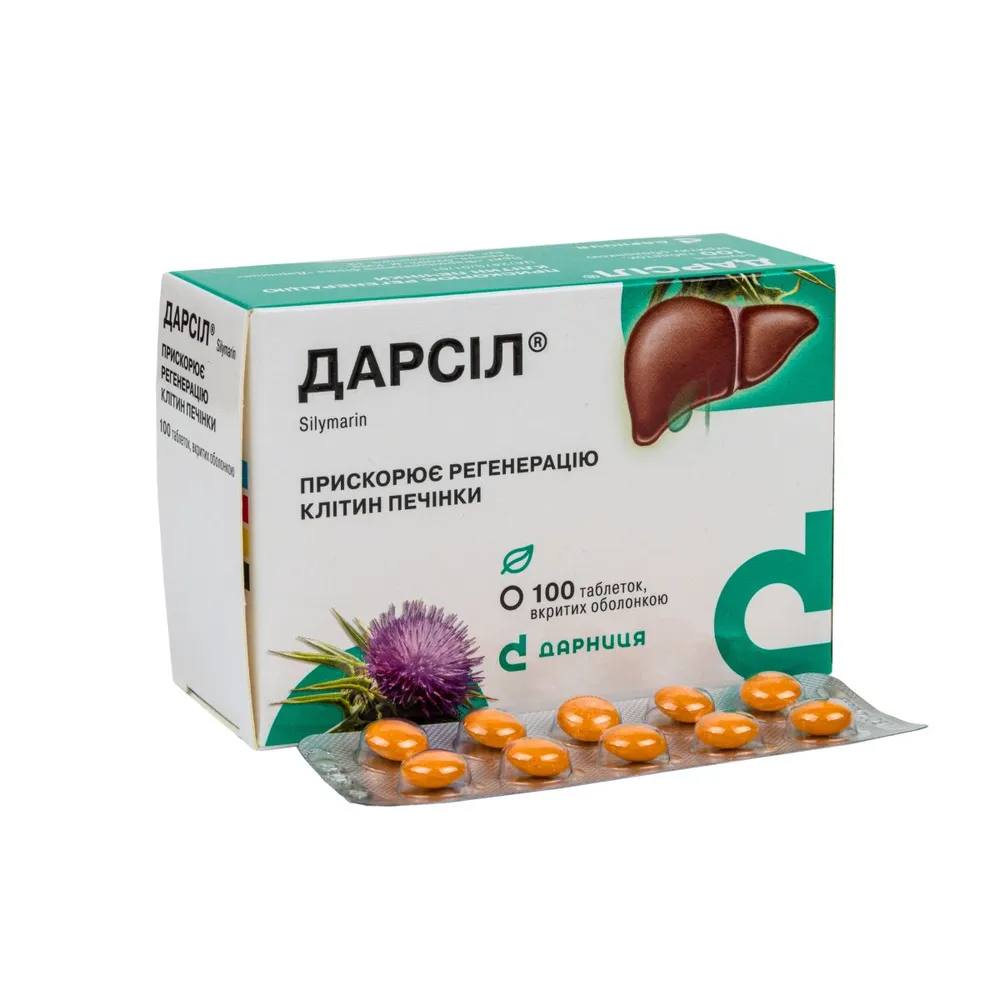
Table of Contents
INSTRUCTIONS FOR MEDICAL USE OF THE MEDICINAL PRODUCT DARSIL® (DARSIL)
Composition:
Active ingredient: silymarin;
1 tablet contains silymarin, calculated as silybin (on the basis of 100% dry substance) 22.5 mg;
Excipients: potato starch, lactose monohydrate, calcium stearate, crystalline sugar, heavy magnesium carbonate, povidone (medical low-molecular polyvinylpyrrolidone), titanium dioxide (E 171), colloidal anhydrous silicon dioxide, yellow FCF (E 110), carnauba wax.
Pharmaceutical form. Coated tablets.
Main physico-chemical characteristics: coated tablets, light orange with yellowish tint to dark orange in color, round-shaped, with a biconvex surface. White specks on the surface of the tablets are permissible.
Pharmacotherapeutic group.
Drugs used in liver diseases, lipotropic agents. Hepatotropic agents. Silymarin. ATC code A05B A03.
Pharmacological properties.
Pharmacodynamics.
The active ingredient of the medicinal product – silymarin – is obtained from the extract of fruits of the milk thistle plant (Silybum marianum).
Bioactive components of silymarin neutralize free radicals in the liver, prevent destruction of cellular structures, in particular stabilize hepatocyte membranes. They specifically stimulate RNA polymerase and activate synthesis of structural and functional proteins and phospholipids in damaged hepatocytes. They prevent leakage of intracellular components (transaminases) and accelerate regeneration of liver cells. They inhibit penetration of certain toxins into hepatocytes, in particular the toxin of the death cap mushroom. They significantly reduce lipid peroxidation activity in hepatocyte membranes, thus contributing to their stabilization.
They improve the general condition of patients with liver disease and reduce subjective symptoms (weakness, feeling of heaviness in the right hypochondrium). They promote normalization of biochemical parameters of liver functional status (transaminase activity, γ-glutamyltransferase, alkaline phosphatase, bilirubin levels).
Pharmacokinetics.
After oral administration, silymarin is slowly and incompletely absorbed from the gastrointestinal tract. It practically does not bind to plasma proteins. It is metabolized in the liver via conjugation, forming sulfates and glucuronides. It is excreted from the body mainly with bile. In the small intestine, it is reabsorbed into the systemic circulation, thus undergoing multiple gradually decreasing enterohepatic circulation. The half-life (T1/2) is 6 hours. It practically does not accumulate in the body.
Clinical characteristics.
Indications.
Toxic liver damage: for supportive treatment of patients with chronic inflammatory liver diseases or liver cirrhosis.
Contraindications.
Hypersensitivity to the active substance or to other components of the medicinal product. Acute poisonings of various etiologies.
Interaction with other medicinal products and other types of interactions.
When silimarin is used concomitantly with other medicinal products, the following interactions are possible:
with oral contraceptives, drugs used in estrogen replacement therapy – reduced efficacy of the latter;
with antiallergic medicinal products (fexofenadine); anticoagulants (clopidogrel, warfarin); antipsychotic medicinal products (alprazolam, diazepam, lorazepam); hypocholesterolemic medicinal products (lovastatin); certain anticancer drugs (vinblastine); antifungal medicinal products (ketoconazole) – enhanced efficacy of the latter (due to inhibition of the cytochrome P450 system by silimarin).
Plant products containing silimarin are widely used as hepatoprotectors in oncological practice concomitantly with cytostatic agents. Clinical studies indicate a low risk of potential pharmacokinetic interactions between silimarin, as an inhibitor of the isoenzymes CYP3A4 and UGT1A1, and cytostatic drugs which are substrates of these enzymes.
Special precautions for use
Treatment with the medicinal product will be effective in liver diseases only if a special diet is followed.
If jaundice develops, medical advice should be sought for therapy adjustment.
The medicinal product should be used with caution in patients with hormonal disorders (endometriosis, uterine fibroids, breast, ovarian or uterine carcinoma, prostate carcinoma) due to the possible estrogen-like effect of silymarin. In such cases, patients should consult their physician.
Alcohol consumption should be avoided during treatment with this medicinal product.
Important information about excipients
The medicinal product contains crystalline sugar (sucrose), which should be taken into account by patients with diabetes mellitus.
The medicinal product contains lactose and therefore should not be used by patients with rare hereditary problems of galactose intolerance, lactase deficiency, or glucose-galactose malabsorption.
The medicinal product contains the colouring agent Sunset Yellow FCF (E 110), which may cause allergic reactions.
Use during pregnancy or breastfeeding
Due to lack of data on safety and efficacy, the medicinal product should not be used during pregnancy or breastfeeding.
Ability to influence reaction rate when driving vehicles or operating machinery
The medicinal product does not affect reaction speed when driving vehicles or operating machinery. However, if any vestibular disturbances occur, patients should refrain from driving vehicles or operating machinery.
Dosage and Administration.
Take Darsil® tablets orally after meals, without chewing, with sufficient amount of liquid.
Adults and children aged 12 years and older: In mild and moderately severe cases, administer 1–2 tablets three times daily; in severe cases, the dose may be increased to 2–4 tablets three times daily.
The duration of treatment is determined individually by a physician depending on the nature and course of the disease. The average duration of treatment is 3 months.
Children.
The use of this medicinal product is not recommended in children under 12 years of age.
Overdose.
Cases of overdose have not been reported.
In case of accidental ingestion of a high dose, induce vomiting, perform gastric lavage, administer activated charcoal, and apply symptomatic treatment as prescribed by a physician.
Adverse Reactions
The medicinal product is well tolerated. Rarely, in individual cases and in the presence of individual hypersensitivity, the following adverse effects may occur.
Ear and labyrinth disorders: worsening of pre-existing vestibular disorders.
Respiratory, thoracic and mediastinal disorders: dyspnea.
Gastrointestinal disorders: digestive disturbances, decreased appetite, dyspepsia, heartburn, abdominal distension, flatulence, anorexia, nausea, vomiting, diarrhea.
Renal and urinary disorders: increased diuresis.
Nervous system disorders: headache.
Immune system disorders: allergic reactions, including hypersensitivity reactions such as rash, pruritus, and anaphylactic shock.
Skin and subcutaneous tissue disorders: alopecia.
Musculoskeletal and connective tissue disorders: arthralgia.
Adverse reactions associated with the use of the medicinal product are transient and disappear after discontinuation of the drug.
Reporting of suspected adverse reactions.
Reporting of suspected adverse reactions after registration of the medicinal product is an important procedure. It enables continuous monitoring of the benefit-risk balance of the medicinal product. Healthcare professionals are required to report any suspected adverse reactions through the national reporting system.
Shelf life. 2 years.
Storage conditions.
Store in the original packaging at a temperature not exceeding 25 °C.
Keep out of reach and sight of children.
Packaging.
10 tablets in a blister pack; 3, 5 or 10 blister packs in a carton.
Supply classification. Over-the-counter.
Manufacturer: JSC "Pharmaceutical Company "Darnytsia".
Manufacturer's address and place of business.
13, Boryspylska Street, Kyiv, 02093, Ukraine.