Bupivacaine spinal
Ukraine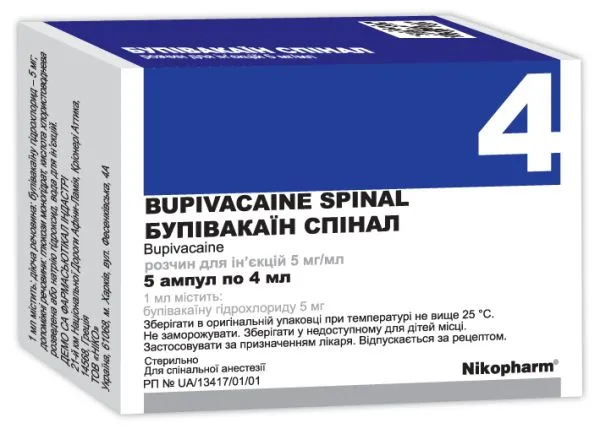
Table of Contents
INSTRUCTIONS FOR MEDICAL USE OF THE MEDICINAL PRODUCT BUPIVACAINE SPINAL (BUPIVACAINE SPINAL)
Composition:
Active substance: bupivacaine hydrochloride;
1 ml of solution contains 5 mg of bupivacaine hydrochloride;
Excipients: glucose monohydrate, diluted hydrochloric acid or sodium hydroxide, water for injections.
Pharmaceutical form. Injection solution.
Main physicochemical properties: clear, colorless liquid.
Pharmacotherapeutic group. Local anesthetics. ATC code N01BB01.
Pharmacological properties.
Pharmacodynamics.
Bupivacaine is a long-acting local anesthetic of the amide type.
Moderate relaxation of lower limb muscles.
Blockade of contractile activity of abdominal muscles.
Bupivacaine spinal is intended for hyperbaric spinal anesthesia; the initial distribution of the drug in the subarachnoid space depends on gravity.
Pharmacokinetics.
Rapid onset and prolonged duration of action: at the T10–T12 segmental level, the duration of action is 2–3 hours.
Relaxation of lower limb muscles lasts 2–2.5 hours.
Blockade of abdominal muscles lasts 45–60 minutes. The duration of blockade of contractile activity of abdominal muscles does not exceed the duration of analgesia.
In children, the pharmacokinetics of the drug is similar to that in adults.
Clinical characteristics.
Indications.
Bupivacaine spinal is indicated for intrathecal (subarachnoid) spinal anesthesia in adults and children of various ages undergoing surgery (urological and lower limb surgeries lasting 2\–3 hours, as well as abdominal surgeries lasting 45\–60 minutes).
Contraindications.
Hypersensitivity to amide-type local anesthetics or to any component of the medicinal product.
Intrathecal anesthesia, regardless of the local anesthetic used, has its own contraindications, including:
- active diseases of the central nervous system (CNS), such as meningitis, poliomyelitis, intracranial hemorrhage, subacute combined degeneration of the spinal cord due to pernicious anemia, and tumors of the brain and spinal cord;
- spinal canal stenosis and active stage diseases (e.g., spondylitis, tuberculosis, tumors) or recent trauma (e.g., fracture) of the spine;
- sepsis;
- purulent skin infection at or near the lumbar puncture site;
- cardiogenic or hypovolemic shock;
- coagulation disorders or ongoing anticoagulant therapy.
Interaction with other medicinal products and other forms of interaction.
Since systemic toxic effects are additive, bupivacaine should be used with caution in patients receiving other local anesthetics or drugs structurally related to amide-type local anesthetics, such as certain antiarrhythmic agents (e.g., lidocaine and mexiletine).
Specific interaction studies between bupivacaine and class III antiarrhythmic agents (e.g., amiodarone) have not been conducted; however, caution should be exercised in such cases.
Special precautions for use.
Intrathecal anesthesia should only be administered by a physician with the necessary knowledge and experience.
Procedures involving regional anesthetics must be performed in departments equipped with equipment for artificial ventilation of the lungs. Equipment for emergency resuscitation and appropriate medications must be readily available for immediate use.
Before initiating intrathecal anesthesia, intravenous access (e.g., for intravenous infusion) should be established. The physician responsible for administering anesthesia must take appropriate precautions to avoid intravascular injection of the drug and must be adequately trained and familiar with the diagnosis and management of adverse effects, systemic toxicity, and other complications. If signs of acute systemic toxicity or complete spinal block appear, administration of the local anesthetic must be stopped immediately.
Like all local anesthetics, bupivacaine may cause acute toxic effects on the central nervous and cardiovascular systems when its use for local anesthesia results in high drug concentrations in the blood. This is particularly relevant in cases following accidental intravascular injection or injection into highly vascularized areas.
Cases of ventricular arrhythmias, ventricular fibrillation, sudden cardiovascular collapse, and fatalities have been reported in association with high systemic concentrations of bupivacaine. In the event of cardiac arrest, prolonged resuscitation efforts may be required to achieve a successful outcome. High systemic concentrations are not expected with doses typically used for intrathecal anesthesia.
Elderly patients and patients in late stages of pregnancy are at increased risk of developing extensive or complete spinal block, which may lead to depression of cardiovascular and respiratory functions. Therefore, the dose of the drug should be reduced in these patients.
Intrathecal anesthesia with any local anesthetic may lead to the development of arterial hypotension and bradycardia. These effects should be anticipated, and appropriate preventive measures should be taken, which may include preloading the circulation with a crystalloid or colloid solution. In the event of arterial hypotension, a vasoconstrictor agent such as ephedrine should be administered intravenously in a dose of 10–15 mg. Severe arterial hypotension may occur due to hypovolemia from bleeding or dehydration, or due to aortocaval compression in patients with massive ascites, large intra-abdominal tumors, or in late pregnancy. Significant arterial hypotension should be avoided in patients with cardiac decompensation.
Severe and sudden arterial hypotension may develop during intrathe cal anesthesia in patients with hypovolemia from any cause.
Intrathecal anesthesia may cause paralysis of intercostal muscles, and patients with pleural effusion may suffer from respiratory insufficiency. Sepsis may increase the risk of developing intraspinal abscess in the postoperative period.
Neurological injuries are rare consequences of intrathecal anesthesia and may result in paresthesia, anesthesia, motor weakness, and paralysis. Sometimes these effects may be long-lasting.
Before initiating treatment, it should be considered that the benefits of therapy must outweigh the potential risks to the patient.
Patients with poor general health due to age or other compromising factors such as partial or complete cardiac conduction block, progressive liver or kidney dysfunction require special attention, although the use of conduction anesthesia may be the optimal choice for surgical procedures in these patients.
Patients receiving class III antiarrhythmic drugs (e.g., amiodarone) should be closely monitored. In addition, ECG monitoring should be considered, as the cardiac effects of these drugs may be additive.
If intolerance to certain sugars has been established, consult a physician before taking this medication. Use with caution in patients with diabetes mellitus.
Use during pregnancy or breastfeeding.
Pregnancy
There is no evidence of adverse effects of the drug on human pregnancy.
There is evidence of reduced fetal survival in rats and embryological effects in rabbits when the drug was administered at high doses during pregnancy. Therefore, Bupivacaine Spinal should not be used in early pregnancy except when the benefits of use are considered to outweigh the risks.
The dose of the drug should be reduced in patients in late stages of pregnancy.
Lactation
Bupivacaine passes into breast milk, but in such small amounts that the risk of effects on the infant following therapeutic doses of the drug is generally absent.
Ability to influence reaction speed when driving or operating machinery.
In addition to the direct effects of anesthetics, local anesthetics may have a very slight effect on mental function and motor coordination, even in the absence of evident central nervous system toxicity, and may also cause temporary impairment of motor activity and attention.
Administration and Dosage
Bupivacaine is a long-acting amide-type local anesthetic. Bupivacaine spinal has a rapid onset and prolonged duration of action. The duration of analgesia in the T10–T12 dermatomes is 2–3 hours.
Administration of Bupivacaine spinal results in moderate muscle relaxation of the lower limbs lasting 2–2.5 hours. The blockade of abdominal muscle contractility facilitates the use of the solution for abdominal surgical procedures lasting 45–60 minutes. The duration of muscle contractility blockade does not exceed the duration of analgesia. The effect of Bupivacaine spinal on the cardiovascular system is similar to or less pronounced than the effects observed with other agents used for spinal anesthesia. Bupivacaine at a concentration of 5 mg/mL with glucose at 80 mg/mL is exceptionally well tolerated by all tissues it contacts.
Route of administration: Intrathecal.
Adults and children aged 12 years and older
The recommended doses below should be considered as guidelines for use in average adult patients. The figures indicate the expected range of average acceptable doses. When factors influencing individual blockade techniques are present, or to meet individual patient requirements, standard dosage recommendations should be taken into account.
The physician's experience and the patient's physical condition are important factors in determining the required dose. The lowest effective dose necessary to achieve adequate anesthesia should be used. Individual variability may occur at the beginning and during anesthesia, and the extent of anesthesia spread may be difficult to predict; however, it will depend on the volume of the administered drug.
Recommended dosage guidelines
Intrathecal anesthesia in surgery:
2–4 mL (10–20 mg bupivacaine hydrochloride).
The dose should be reduced in elderly patients and in pregnant women in late stages of pregnancy.
Neonates, infants, and children with body weight up to 40 kg
Bupivacaine spinal can be used in pediatric practice.
One of the differences between children and adults is the relatively higher volume of cerebrospinal fluid in neonates and infants, which necessitates the use of a relatively higher dose per kilogram of body weight to achieve the same level of blockade compared to adults.
Regional anesthesia procedures in children should be performed by qualified physicians experienced in pediatric regional anesthesia and in the specific anesthetic technique.
The doses listed in Table 1 should be considered as guidelines when using the drug in pediatric practice. Individual variability may occur. Standard dosage recommendations should be considered when factors influencing specific blockade techniques are present or to meet individual patient requirements.
The lowest effective dose required to achieve adequate anesthesia should be used.
Table 1
Recommended dosage guidelines for neonates, infants, and children
| Body weight (kg) |
Dose (mg/kg) |
| < 5 |
0.40 – 0.50 |
| From 5 to 15 |
0.30 – 0.40 |
| From 15 to 40 |
0.25 – 0.30 |
The distribution of the drug during anesthesia depends on several factors, including the volume of the solution and the patient's position during and after injection.
When administered into the L3-L4 interspace of a patient sitting, 3 ml of Bupivacaine Spinal spreads to the spinal cord segments T7-T10. In a patient receiving the injection while lying horizontally and then assuming a supine position, the block extends to spinal cord segments T4-T7. It should be noted that the level of spinal anesthesia achieved with any local anesthetic may be unpredictable in an individual patient.
The recommended injection site is below L3.
The effect of injections in doses exceeding 4 ml has not been studied; therefore, such volumes are not recommended.
The solution should be used as soon as possible after the ampoule has been opened. Any unused solution must be discarded.
Instructions for handling the ampoule
Fig. 1 Fig. 2 Fig. 3 Fig. 4
- Separate one ampoule from the pack and shake it by holding the neck (Fig. 1).
- Squeeze the ampoule in the hand (no drug should be expelled) and twist to remove the top (Fig. 2).
- Immediately connect the syringe to the ampoule through the opening formed (Fig. 3).
- Invert the ampoule and slowly draw the contents into the syringe (Fig. 4).
- Attach the needle to the syringe.
Children
Bupivacaine Spinal may be used in pediatric practice. For further information, see section "Dosage and administration".
Overdose
It is unlikely that administration of Bupivacaine Spinal at recommended doses will result in high plasma concentrations leading to systemic toxicity. However, when used concomitantly with other local anesthetics, systemic toxic reactions may occur, as toxic effects are additive.
Adverse reactions
The adverse reaction profile observed with the use of this medicinal product is similar to the adverse reaction profile associated with other long-acting local anesthetics used for intrathecal anesthesia.
The adverse reactions listed below are classified by system organ classes and their absolute frequency. Frequency is defined as very common (≥ 1/10), common (≥ 1/100 to < 1/10), uncommon (≥ 1/1000 to < 1/100), rare (≥ 1/10000 to < 1/1000), and frequency not known (cannot be estimated from the available data).
Table 2
Adverse reactions occurring with the use of the medicinal product
| Organ system class |
Frequency classification |
Adverse reaction to drug administration |
| Immune system disorders |
rare |
Allergic reactions, anaphylactic shock |
| Nervous system disorders |
common |
Post-dural puncture headache |
| uncommon |
Paresthesia, paresis, dysesthesia |
|
| rare |
Complete unpredictable spinal block, paraplegia, paralysis, neuropathy, arachnoiditis |
|
| Cardiac disorders |
very common |
Arterial hypotension, bradycardia |
| rare |
Cardiac arrest |
|
| Respiratory, thoracic and mediastinal disorders |
rare |
Respiratory depression |
| Gastrointestinal disorders |
very common |
Nausea |
| common |
Vomiting |
|
| Musculoskeletal and connective tissue disorders |
uncommon |
Muscle weakness, back pain |
| Renal and urinary disorders |
common |
Urinary retention, urinary incontinence |
Adverse reactions caused by the drug itself are difficult to distinguish from the physiological effects associated with blockade of nerve fibers (e.g., decreased arterial pressure, bradycardia, temporary urinary retention), conditions directly caused by the procedure (e.g., spinal hematoma), or indirectly by needle puncture (e.g., meningitis, epidural abscess), as well as conditions related to cerebrospinal fluid leakage (e.g., post-dural puncture headache).
Acute systemic toxicity
It is unlikely that administration of the drug at recommended doses will lead to high plasma concentrations sufficient to cause systemic toxicity. However, systemic toxic reactions may occur when the drug is used concomitantly with other local anesthetics, since their toxic effects are additive.
Systemic toxicity is rarely associated with spinal anesthesia but may occur following accidental intravascular injection of the drug. Systemic adverse reactions are characterized by tongue numbness, dizziness, and tremor, followed by seizures and cardiovascular disturbances.
Treatment of acute systemic toxicity
In cases of mild systemic toxicity, no treatment is required. However, if seizures occur, it is essential to ensure adequate oxygenation and to control seizure activity if it persists for more than 15–30 seconds. Oxygen should be administered via face mask, and ventilation should be monitored and supported as needed. Seizures may be controlled by intravenous administration of thiopental in a dose of 100–150 mg or diazepam in a dose of 5–10 mg. Additionally, intravenous succinylcholine in a dose of 50–100 mg may be administered, but only if the physician is capable of performing endotracheal intubation and managing a fully paralyzed patient.
Manifestations of extensive or complete spinal block leading to respiratory paralysis should be treated by ensuring and maintaining a patent airway. Oxygen should be provided to assist or control lung ventilation.
Arterial hypotension should be managed with vasopressor agents, such as intravenous ephedrine 10–15 mg, repeated as necessary until the desired blood pressure level is achieved. Intravenous administration of fluids, electrolytes, and colloidal solutions may also rapidly alleviate arterial hypotension.
Paediatric population
Adverse reactions to the drug in children are similar to those observed in adults. However, early signs of local anesthetic toxicity may be difficult to detect in children when the block is performed under sedation or general anesthesia.
Reporting of suspected adverse reactions
Reporting suspected adverse reactions after drug authorization is of great importance. It enables continuous monitoring of the benefit-risk balance of the medicinal product. Healthcare professionals, pharmacists, patients, and their legal representatives are encouraged to report all suspected adverse reactions and lack of efficacy via the Automated Pharmacovigilance Information System at the following link: https://aisf.dec.gov.ua.
Shelf life. 2.5 years.
After opening the ampoule, the drug must not be stored.
Storage conditions.
Store in the original packaging at a temperature not exceeding 25 °C. Do not freeze. Keep out of reach of children.
Incompatibilities.
The drug must not be mixed with other medicinal products in the same container.
Packaging. 4 ml in ampoules, pack of 5.
Prescription status. Prescription only.
Manufacturer.
LLC "FARMASEL".
Manufacturer's address and location of operations.
3 Pryrizna St., Kvitneve, Brovary District, Kyiv Oblast, 07408, Ukraine.