Brimonal 0.2 %
Ukraine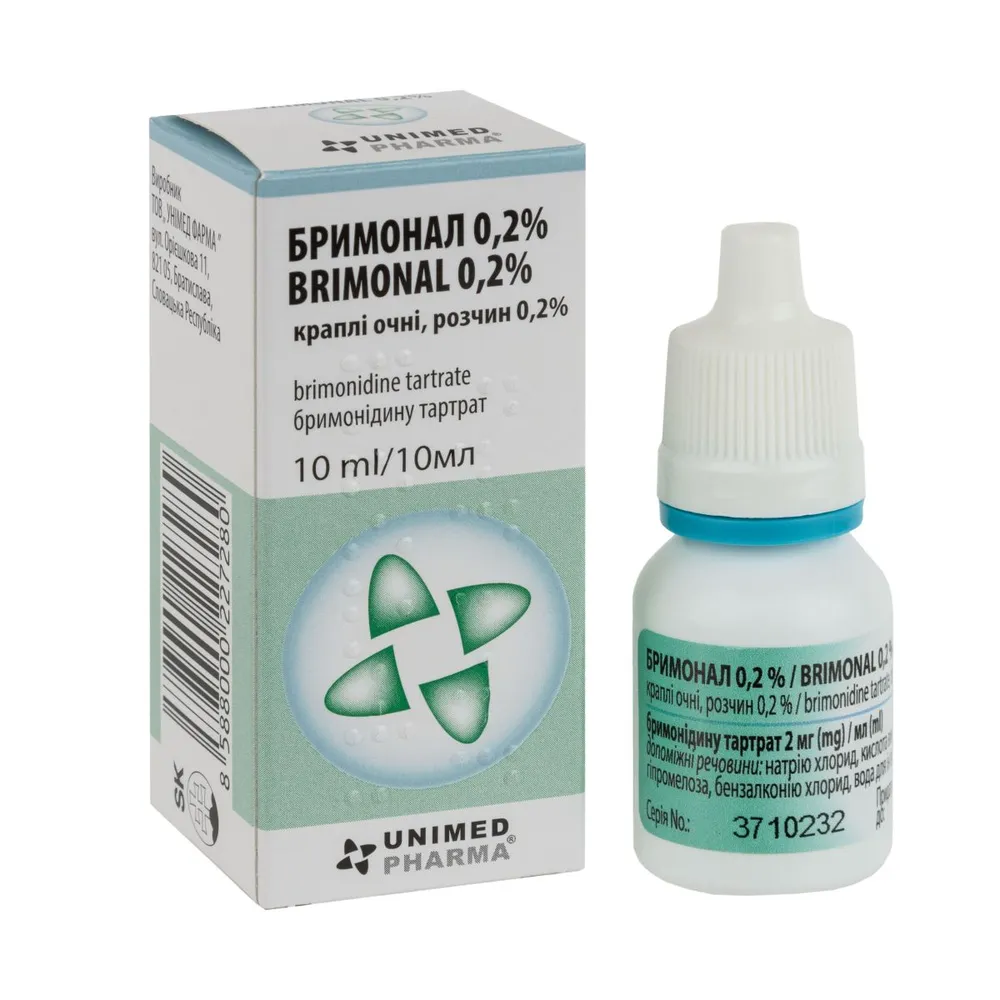
Table of Contents
INSTRUCTIONS FOR MEDICAL USE OF THE MEDICINAL PRODUCT BRIMONAL 0.2% (BRIMONAL 0.2%)
Composition:
Active substance: 1 ml of solution contains 2 mg of brimonidine tartrate;
1 ml contains 23 drops;
Excipients: sodium chloride, tartaric acid, sodium tartrate, hypromellose, benzalkonium chloride, sodium hydroxide, water for injections.
Pharmaceutical form. Eye drops, solution.
Main physicochemical properties: clear, slightly viscous greenish-yellow solution without visible mechanical particles.
Pharmacotherapeutic group. Anti-glaucoma and miotic agents.
ATC code: S01E A05.
Pharmacological properties.
Pharmacodynamics.
Brimonidine is an alpha-2 adrenergic receptor agonist that is approximately one thousand times more selective for alpha-2 adrenergic receptors than for alpha-1 adrenergic receptors.
This selectivity accounts for the absence of mydriasis and microvascular constriction associated with human retinal xenografts.
Topical application of brimonidine tartrate in humans reduces intraocular pressure with minimal effects on cardiovascular and pulmonary parameters.
Brimonidine tartrate 0.2% has a rapid onset of action, with peak ocular hypotensive effect achieved within 2 hours after administration. In clinical studies, brimonidine tartrate 0.2% reduced intraocular pressure by an average of 4–6 mm Hg.
Results from animal and human studies indicate that brimonidine tartrate has a dual mechanism of action. Brimonidine tartrate 0.2% is believed to reduce intraocular pressure (IOP) by decreasing aqueous humor production and increasing uveoscleral outflow.
Pharmacokinetics.
After ophthalmic administration of 0.2% brimonidine tartrate twice daily for 10 days, plasma concentrations were low (mean Cmax was 0.06 ng/mL). Repeated dosing (twice daily for 10 days) resulted in minimal systemic accumulation. The area under the plasma concentration-time curve over 12 hours at steady state (AUC0–12h) was 0.31 ng·h/mL compared to 0.23 ng·h/mL after the first dose. The mean systemic elimination half-life in humans following topical administration was approximately 3 hours. Plasma protein binding of brimonidine following topical administration in humans is approximately 29%.
In ocular tissues, brimonidine reversibly binds to melanin in vitro and in vivo. After two weeks of ocular administration, brimonidine concentrations in the iris and ciliary body were 3–17 times higher than after a single dose. No accumulation occurs in the absence of melanin.
The significance of binding to melanin is not fully understood. However, slit-lamp examinations of patients treated with brimonidine tartrate 0.2% for up to 1 year revealed no significant ocular adverse reactions. In monkeys receiving doses approximately four times higher than the recommended human dose of brimonidine tartrate, no significant ocular toxicity was observed.
In humans, brimonidine is well absorbed and rapidly eliminated after oral administration. A substantial portion of the dose (approximately 75%) is excreted in urine as metabolites within 5 days. In vitro studies using animal and human liver tissues indicate that its metabolism is primarily mediated by aldehyde oxidase and cytochrome P450 enzymes. Systemic clearance is believed to be predominantly due to hepatic metabolism. Renal excretion is the main route of elimination for brimonidine and its metabolites.
Elderly patients:
Cmax, AUC, and elimination half-life of brimonidine after single-dose administration in elderly patients aged 65 years and older were similar to those in younger adults, indicating that age does not significantly affect systemic absorption or elimination of the drug.
Clinical characteristics.
Indications.
Open-angle glaucoma or elevated intraocular pressure (IOP).
- Monotherapy in patients for whom topical beta-blockers are contraindicated.
- As part of combination therapy with other agents to reduce IOP when monotherapy is insufficient.
Contraindications.
- Hypersensitivity to the active substance or to any of the excipients.
- Concomitant use with monoamine oxidase inhibitors and antidepressants affecting noradrenergic transmission (e.g., tricyclic and tetracyclic antidepressants, mianserin).
- Pediatric use (under 18 years of age).
- Breastfeeding period.
Interaction with other medicinal products and other forms of interaction.
Concomitant use with monoamine oxidase inhibitors and antidepressants affecting noradrenergic transmission (e.g., tricyclic and tetracyclic antidepressants, mianserin) is contraindicated.
Although specific drug interactions with brimonidine have not been studied, the possibility of additive or potentiating effects should be considered when using brimonidine with agents that depress the central nervous system (e.g., alcohol, barbiturates, opioids, sedatives, and anesthetics).
Data on plasma catecholamine levels after administration of brimonidine are lacking.
However, caution is advised when prescribing the drug to patients receiving medicinal products that may affect metabolism and increase plasma amine concentrations (e.g., chlorpromazine, methylphenidate, reserpine).
Clinically insignificant lowering of blood pressure has been observed in some patients after administration of brimonidine tartrate; therefore, caution is advised when using brimonidine concomitantly with antihypertensive agents and cardiac glycosides.
Monitoring is recommended at the beginning of treatment (or when increasing the dose) during combination therapy with systemic agents (regardless of pharmaceutical form) that may interact with alpha-adrenergic receptor agonists or affect their efficacy (e.g., isoprenaline, prazosin).
Special precautions for use
The drug should be used with caution in patients with severe, unstable, and uncontrolled cardiovascular diseases.
Dosage adjustment is not required for elderly patients.
Ocular allergic reactions have been observed in some patients treated with 0.2% brimonidine tartrate. If an allergic reaction occurs, use of Brimonol 0.2% should be discontinued.
Brimonol 0.2% should be used with caution in patients with depression, cerebral circulatory insufficiency, coronary insufficiency, Raynaud's syndrome, orthostatic hypotension, and thromboangiitis obliterans.
The effect of Brimonol 0.2% in patients with hepatic or renal insufficiency has not been studied; therefore, caution should be exercised when administering the drug to patients with such conditions.
Brimonol 0.2% contains the preservative benzalkonium chloride, which is absorbed by soft contact lenses. When using soft (hydrophilic) contact lenses, they should not be worn for at least 15 minutes after instillation of Brimonol 0.2%. If more than one topical ophthalmic product is used, the interval between administration of different drugs should be 5–15 minutes.
Use during pregnancy or breastfeeding
Safety studies of brimonidine tartrate use in pregnant women have not been conducted; therefore, Brimonol 0.2% should not be used during pregnancy.
It is unknown whether brimonidine is excreted in human breast milk; therefore, the drug should not be used during breastfeeding.
Ability to affect reaction speed when driving or operating machinery
Brimonidine may cause dizziness, drowsiness, and visual disturbances, which may impair the ability to drive or operate machinery. Such activities should not be undertaken earlier than 15 minutes after instillation of the drops and only after vision has cleared.
Method of Administration and Dosage
The drug is intended for use in adults.
It is recommended to instill one drop of BrimonAL 0.2% solution into the affected eye twice daily, with an interval of 12 hours between doses.
Dosage adjustment in elderly patients is not required.
As with any ophthalmic drops, it is recommended to apply digital pressure on the tear sac area (nasolacrimal duct) at the inner corner of the eye for approximately one minute to reduce systemic absorption. This should be done immediately after instillation of each drop. If more than one type of ophthalmic drop is prescribed, they should be administered with an interval of 5–15 minutes between applications.
Children
The efficacy and safety of brimonidine in children have not been established.
Overdose
Local (ophthalmic) overdose
Cases of local overdose with brimonidine have not been reported in adults.
Systemic overdose following accidental oral ingestion
There have been two reported cases of adverse effects following accidental oral ingestion of 9–10 drops of brimonidine by adult patients. In these cases, a significant decrease in arterial blood pressure was observed. In one patient, an increase in arterial blood pressure occurred approximately 8 hours after ingestion. Both patients fully recovered within 24 hours. Another patient who orally ingested an unknown amount of the drug did not experience any adverse effects.
Serious adverse effects have been reported in children following accidental oral ingestion of brimonidine. Symptoms observed included central nervous system (CNS) depression, transient coma or loss of consciousness, arterial hypotension, bradycardia, hypothermia, and apnea, requiring intensive therapy including intubation. All patients fully recovered within 6–24 hours.
With oral overdose of other alpha-2 agonists, symptoms such as arterial hypotension, asthenia, vomiting, lethargy, sedation, bradycardia, arrhythmia, miosis, apnea, hypothermia, respiratory depression, and seizures have been reported.
Treatment is symptomatic.
Children:
Adverse reactions following accidental ingestion of brimonidine in children have also been reported. These included CNS depression, transient coma, impaired consciousness, lethargy, somnolence, arterial hypotension, bradycardia, hypothermia, pallor, respiratory depression, and apnea, requiring intensive therapy and intubation as appropriate.
All symptoms resolved completely within 6–24 hours in all affected individuals.
Adverse reactions.
Within each group, adverse events are listed in decreasing order of severity. Frequency is defined as follows: very common (> 1/10); common (≥ 1/10 to < 1/10); uncommon (< 1/100); rare (< 1/1000); very rare (< 1/10000); unknown (frequency cannot be estimated from available data):
Cardiovascular disorders.
Uncommon: palpitations, arrhythmias (including bradycardia and tachycardia).
Nervous system disorders.
Very common: headache, somnolence.
Common: dizziness, taste disturbances.
Very rare: syncope.
Eye disorders.
Very common: eye irritation (ocular hyperemia, burning and stinging sensation, foreign body sensation, conjunctival follicles, eye itching), blurred vision, allergic blepharitis, allergic blepharoconjunctivitis, allergic conjunctivitis, allergic eye reactions, and follicular conjunctivitis.
Common: local irritation (eyelid hyperemia, eyelid edema, blepharitis, eye pain and lacrimation, discharge from conjunctiva, conjunctival edema), photophobia, erosion, dry eyes, conjunctival pallor, visual disturbances, conjunctivitis.
Very rare: iritis (anterior uveitis), miosis.
Respiratory, thoracic and mediastinal disorders.
Common: upper respiratory tract symptoms.
Uncommon: nasal dryness.
Rare: dyspnea.
Gastrointestinal disorders.
Very common: dry mouth.
Common: gastrointestinal symptoms.
Vascular disorders.
Very common: arterial hypertension, hypotension.
General disorders and administration site conditions.
Very common: fatigue.
Common: asthenia.
Immune system disorders.
Uncommon: systemic allergic reactions.
Psychiatric disorders.
Uncommon: depression.
Very rare: insomnia.
During post-marketing use of brimonidine in clinical practice, the following adverse reactions have been reported (frequency unknown, as they were reported spontaneously in a population of unknown size):
Eye disorders:
iritocyclitis (anterior uveitis), eyelid itching.
Skin and subcutaneous tissue disorders:
skin reactions including erythema, facial swelling, pruritus, rash, and vasodilation.
Shelf life.
2 years.
Storage conditions.
Store in a place protected from light and inaccessible to children, at a temperature not exceeding 25 °C. Do not freeze. After first opening, do not store for more than 28 days.
Packaging.
5 ml or 10 ml in a plastic dropper bottle closed with a tamper-evident cap.
1 dropper bottle per cardboard box.
Prescription category.
Prescription only.
Manufacturer.
LLC "UNIMED PHARMA" / "UNIMED PHARMA Ltd".
Manufacturer's address and location of business activity.
Orieskova 11, 821 05, Bratislava, Slovak Republic /
Orieskova 11, 821 05 Bratislava, Slovak Republic.