Bronhostop® syrup
Ukraine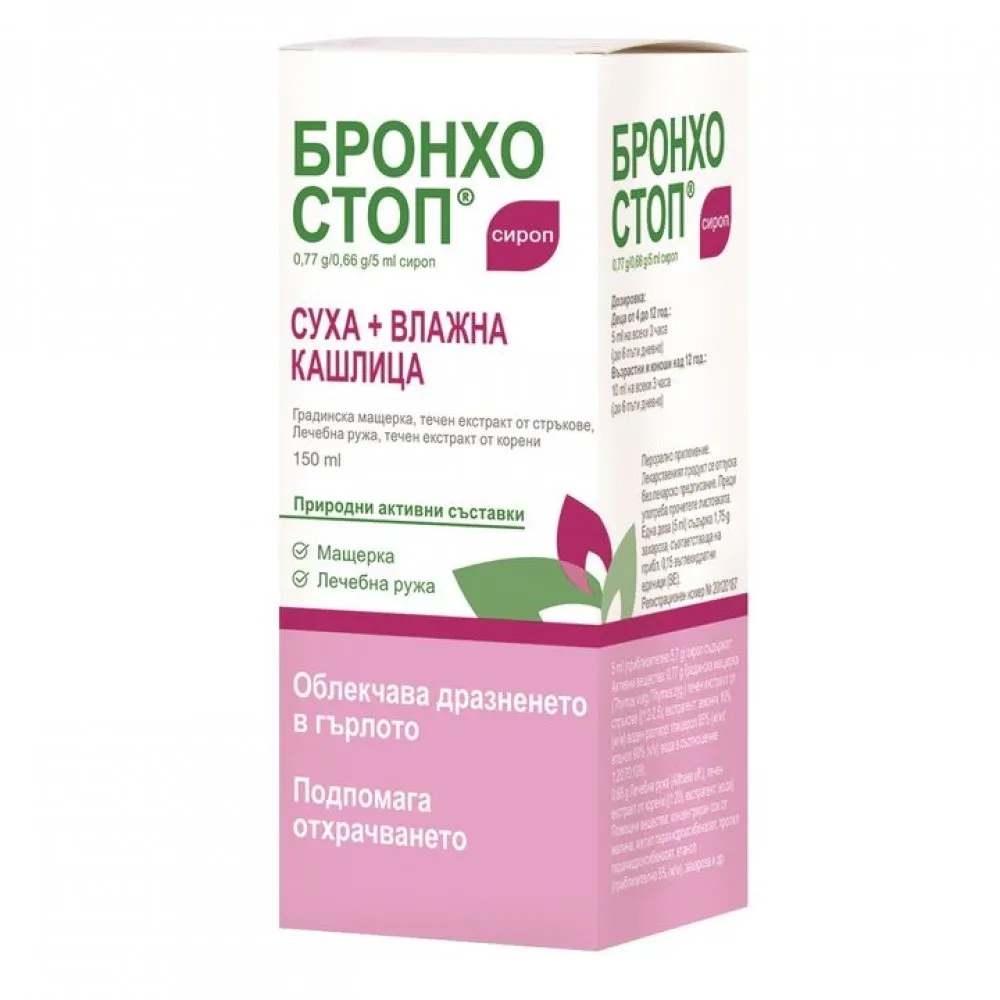
Table of Contents
INSTRUCTIONS FOR MEDICAL USE OF THE MEDICINAL PRODUCT BRONHOSTOP® SYRUP
Composition:
Active substances: dry extract of thyme herb (Thymi herba extractum siccum), liquid extract of marshmallow root (Althaea radicis extractum fluidum);
15 ml of syrup contain: 0.12 g of dry extract of thyme herb (Thymi herba extractum siccum) (7–13:1) (extractant: water), 0.83 g of liquid extract of marshmallow root (Althaea radicis extractum fluidum) (1 : 13) (extractant: water);
Excipients: raspberry juice (containing sucrose, glucose and fructose); xylitol; maltodextrin; acacia; xanthan gum; citric acid monohydrate; methylparaben (E 218); propylparaben (E 216); raspberry flavoring (containing propylene glycol); glycerin (E 422); sodium saccharin (E 954); neohesperidine dihydrochalcone; purified water.
Pharmaceutical form. Syrup.
Main physicochemical properties: viscous, brown liquid with characteristic odor (thyme); flocculation, precipitation and cloudiness may occur.
Pharmacotherapeutic group.
Combination preparations used in cough and colds.
ATC code R05C A10.
Pharmacological properties.
Pharmacodynamics.
The herbal components (thyme herb and marshmallow root) of the medicinal product belong to traditional herbal remedies used as expectorants in cough associated with colds, primarily for long-term therapy. The essential oils and flavonoids of thyme herb exert broncholytic, secretolytic and antibacterial effects, promote rapid liquefaction of mucus accumulated in the respiratory tract, reduce cough and ease breathing.
The marshmallow root contains polysaccharides that exert soothing, anti-inflammatory and demulcent effects, and are used in the treatment of inflammatory diseases of the respiratory tract.
The natural base (gum) ensures slow release of the active substance, resulting in gradual cessation of secretion from the mucous membranes, thereby reducing mucosal irritation and suppressing cough. It rapidly and for a prolonged period protects the receptors of the respiratory mucosa from irritation.
Pharmacokinetics.
Flavonoids of thyme herb (apigenin, luteolin) are metabolized by intestinal microflora and are well absorbed. They are excreted from the body mainly in urine, either unchanged or as metabolites.
Clinical characteristics.
Indications.
- Symptomatic treatment of inflammatory respiratory tract diseases accompanied by cough and difficulty in expectorating thick mucus.
- Relief of dry cough.
Contraindications.
- Hypersensitivity to the active substance or any of the excipients, or to other plants of the Lamiaceae family, as well as to celery and birch pollen (cross-reactivity possible);
- Contraindicated in children with a history of acute obstructive laryngotracheitis (croup);
- Children under 2 years of age.
Interaction with other medicinal products and other forms of interaction.
Interaction studies have not been conducted.
Concomitant use with antitussive agents (e.g., codeine) is not recommended, as it may lead to mucus accumulation in the respiratory tract.
Special precautions for use
If symptoms worsen and/or dyspnea, fever, or purulent sputum occur during treatment, medical advice must be sought. If symptoms persist for 5 days, a physician should be consulted.
Persistent or recurrent cough in children aged 2 to 4 years requires medical diagnosis prior to treatment.
The medicinal product contains methylparaben (E 218) and propylparaben (E 216), which may cause allergic reactions (possibly delayed).
The raspberry juice contained in the medicinal product includes sucrose, glucose, and fructose (total sugar content: 131 mg per dose (15 mL)). If you have been diagnosed with intolerance to certain sugars, consult your doctor before taking this medicinal product. This medicinal product should not be used by patients with hereditary fructose intolerance.
The additive effect of concurrently administered products containing fructose (or sorbitol) and dietary intake of fructose (or sorbitol) should be taken into account.
The medicinal product contains up to 38.9 mg of propylene glycol per dose (15 mL).
BROCHOSTOP® SYRUP contains less than 1 mmol of sodium (23 mg) per 15 mL dose; therefore, the product can be considered essentially sodium-free.
Absorption of concomitantly administered medicinal products may be delayed. Therefore, BROCHOSTOP® SYRUP should not be taken within ½–1 hour before or after other medicinal products.
Rare cases of hypersensitivity reactions have been reported after using products containing thyme (Thymus serpyllum), including severe reactions with angioneurotic edema, dyspnea, and shock, which may require emergency medical intervention. If the first signs of hypersensitivity occur, treatment must be discontinued (see section "Adverse reactions").
Patients with a history of asthma or allergic reactions have an increased risk of developing hypersensitivity reactions, which may also be severe (see section "Adverse reactions"). Such patients should consult a physician before using this medicinal product.
Use during pregnancy or breastfeeding
The safety of using this medicinal product during pregnancy and breastfeeding has not been established; therefore, its use is not recommended during these periods.
Data regarding fertility are lacking.
Effect on ability to drive or operate machinery
Not established.
Dosage and Administration.
Adults and children aged 12 years and older: 15 ml every 3–4 hours (4–6 times daily; maximum daily dose – 90 ml);
Children aged 4 to 12 years: 7.5 ml every 3–4 hours (4–6 times daily; maximum daily dose – 45 ml);
Children aged 2 to 4 years: after consultation with a physician – 7.5 ml every 3–4 hours (4–6 times daily; maximum daily dose – 45 ml).
The measuring cup provided in the package ensures convenient and more accurate dosing according to the recommended dose.
The duration of treatment should not exceed 5 days; further use must be determined by a physician.
If necessary, BROMHEXINE® SYRUP may be taken diluted in water or warm tea.
Children.
For use in children from 2 years of age.
Do not use in children under 2 years of age due to lack of data.
Overdose.
Symptoms: nausea, vomiting, headache. Treatment: discontinue the drug, gastric lavage.
In case of accidental overdose, seek medical advice immediately.
Adverse reactions.
Summary table of adverse reactions
Table 1 lists adverse reactions reported during post-marketing experience with the medicinal product.
Adverse reactions are listed by organ systems and frequency using the following categories:
Very common (≥1/10), common (≥1/100, <1/10), uncommon (≥1/1,000, <1/100), rare (≥1/10,000, <1/1,000), very rare (<1/10,000), not known (cannot be estimated from the available data).
Table 1
| Organ systems according to MedDRA [Medical Dictionary for Regulatory Activities] |
Adverse reactions |
Frequency |
| Immune system disorders |
Anaphylactic reaction, hypersensitivity (including angioneurotic oedema, dyspnoea and shock) (see section "Special precautions for use") |
Not known |
| Gastrointestinal disorders |
Nausea, vomiting, diarrhoea, abdominal discomfort, abdominal pain, gastrointestinal disorders |
Not known |
| Skin and subcutaneous tissue disorders |
Rash, urticaria, pruritus |
Not known |
Adverse reactions categorized as "gastrointestinal disorders" and "skin and subcutaneous tissue disorders" may also occur as symptoms of hypersensitivity.
If any adverse reactions occur, treatment should be discontinued and a physician should be consulted.
Reporting suspected adverse reactions
Reporting suspected adverse reactions after marketing authorization is of great importance. It allows continuous monitoring of the benefit-risk balance of the medicinal product. Medical and pharmaceutical professionals, as well as patients or their legal representatives, should report cases of suspected adverse reactions and lack of efficacy to the State Expert Centre of the Ministry of Health of Ukraine via the following link: https://aisf.dec.gov.ua.
Shelf life.
3 years.
After first opening, store for no more than 4 weeks.
Storage conditions.
Store at a temperature not exceeding 25°C. Keep out of reach of children.
Store in the original packaging to protect the contents from light. After use, close the bottle tightly.
Packaging.
120 ml amber glass bottle in a cardboard box, supplied with a measuring cup.
Supply category.
Over-the-counter.
Manufacturer.
Quisda Pharma GmbH.
Manufacturer's address and place of business.
Effingerstrasse 21, 1160 Vienna, Austria.