Broncho-munal®
Ukraine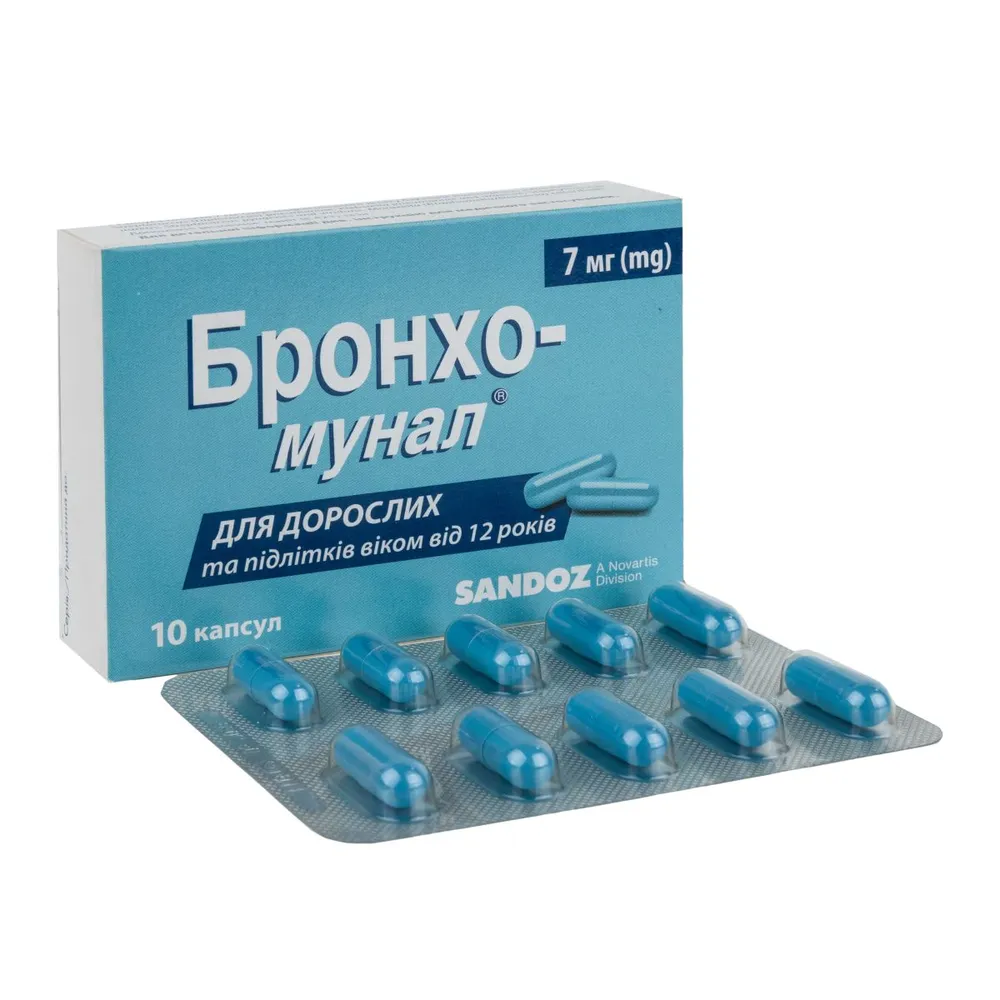
Table of Contents
INSTRUCTIONS FOR MEDICAL USE OF THE MEDICINAL PRODUCT BRONCHO-MUNAL® (BRONCHO-MUNAL®)
Composition:
Active substances: 1 capsule contains 7 mg of lyophilized bacterial lysate of Haemophilus influenzae, Streptococcus (Diplococcus) pneumoniae, Klebsiella pneumoniae and ozaenae, Staphylococcus aureus, Streptococcus pyogenes and viridans, Moraxella (Branhamella/Neisseria) catarrhalis;
Excipients: propyl gallate, sodium glutamate, mannite (E 421), magnesium stearate, pregelatinized starch;
Capsule shell: indigo carmine (E 132), titanium dioxide (E 171), gelatin.
Pharmaceutical form. Hard capsules.
Main physicochemical properties: opaque blue No. 3 hard gelatin capsule containing a slightly beige-colored powder.
Pharmacotherapeutic group.
Other drugs acting on the respiratory system. ATC code: R07AX.
Pharmacological properties.
Pharmacodynamics.
The medicinal product contains lyophilized bacterial lysate from bacteria most commonly causing respiratory tract infections, including Streptococcus pneumoniae, Haemophilus influenzae, Klebsiella pneumoniae, Klebsiella ozaenae, Staphylococcus aureus, Streptococcus viridans, Streptococcus pyogenes, Moraxella catarrhalis.
The product stimulates the body's natural defenses against respiratory tract infections, reducing the frequency, duration, and severity of respiratory infectious diseases, as well as decreasing the need for antibiotic prescription.
The product activates cellular and humoral immune responses of the respiratory mucosa and other immunocompetent structures of the body. It also stimulates the body's nonspecific immune response. The following effects on the body's defense mechanisms have been demonstrated in preclinical and clinical studies:
- stimulates alveolar macrophages, which secrete cytokines protecting the body from infections;
- increases the population of CD4 T-lymphocytes;
- activates peripheral mononuclear cells performing protective functions;
- increases the concentration of secretory IgA on the mucous membranes of the respiratory and gastrointestinal tracts;
- stimulates the formation of protective adhesive molecules;
- reduces IgE levels in blood plasma, which may suppress the development of hypersensitivity reactions.
Pharmacokinetics.
Following oral administration, the bacterial lysate accumulates in the Peyer's patches of the gastrointestinal mucosa.
The cells of Peyer's patches take up the antigen and transfer it to subepithelial lymphoid cells, thereby inducing a humoral immune response, leading to increased IgA production in the mucosa and preventing microbial invasion.
The antigen also stimulates lymphoid cells via interaction with Peyer's patches. These cells then migrate through regional lymph nodes into the thoracic duct and subsequently into the bloodstream.
Through the bloodstream, they migrate to the gastrointestinal mucosa, respiratory tract, and mucous membranes of other organs, where they perform protective functions, enhancing immune defense against bacteria and viruses.
Clinical characteristics.
Indications.
For the prevention of recurrent respiratory tract infections.
Contraindications.
Hypersensitivity to the active substance or to any of the excipients contained in the medicinal product.
Interaction with other medicinal products and other forms of interaction.
Interaction of the drug with other medicinal products is currently unknown.
Special precautions for use.
The drug may cause hypersensitivity reactions. If allergic reactions or signs of intolerance to the drug occur, treatment must be discontinued immediately.
Administration of the drug should not begin earlier than 4 weeks after vaccination with a live vaccine.
The excipient mannitol may exert a mild laxative effect.
The drug contains less than 1 mmol (23 mg)/dose of sodium in the form of sodium glutamate, i.e. it is practically sodium-free.
The use of this medicinal product for the prevention of pneumonia is not recommended, due to lack of relevant clinical study data.
Use during pregnancy or breastfeeding.
The medicinal product should not be used during the first three months of pregnancy.
Patients who are planning pregnancy or who become pregnant should inform their physician.
The safety of use during pregnancy has not been established; therefore, it is advisable to avoid using this medicinal product during pregnancy.
No studies have been conducted in breastfeeding women. Therefore, caution should be exercised during breastfeeding.
Ability to influence reaction rate while driving or operating machinery.
Does not affect the ability to drive or operate machinery.
Method of Administration and Dosage
Adults and adolescents aged 12 years and older
Prophylactic treatment cycle for recurrent respiratory tract infections:
1 capsule per day on an empty stomach for 10 consecutive days per month, for 3 consecutive months.
Treatment may be initiated during the acute phase of respiratory tract infections, in combination with other therapeutic methods.
The medication should be taken in the morning on an empty stomach.
If a patient misses a dose, the capsule should be taken the following morning.
Children
This dosage form may be used in children aged 12 years and older.
Overdose
No clear clinical symptoms of overdose have been observed. Cases of overdose have not been reported. In the event of overdose, medical advice should be sought.
Side effects
Adverse reactions reported are classified below by MedDRA system organ classes and frequency: very common (≥ 1/10), common (≥ 1/100 to < 1/10), uncommon (≥ 1/1,000 to < 1/100), rare (≥ 1/10,000 to < 1/1,000), very rare (< 1/10,000), including isolated cases, frequency not known (cannot be estimated from the available data).
Immune system disorders:
Uncommon – hypersensitivity reactions (erythematous rashes, generalized skin rashes, erythema, swelling, eyelid edema, facial swelling, peripheral edema, swelling, facial swelling, pruritus, generalized pruritus, dyspnea).
Nervous system disorders:
Common – headache.
Respiratory, thoracic and mediastinal disorders:
Common – cough.
Gastrointestinal disorders:
Common – diarrhea, abdominal pain; uncommon – nausea, vomiting.
Skin and subcutaneous tissue disorders:
Common – rash; uncommon – urticaria; frequency not known – angioneurotic edema.
General disorders:
Uncommon – increased fatigue; rare – fever.
If prolonged gastrointestinal or respiratory disorders occur, treatment should be discontinued. Treatment should also be discontinued in case of skin reactions, as these symptoms may be of allergic nature.
Shelf life.
5 years.
Storage conditions.
Store at temperatures not exceeding 25 °C in the original packaging to protect from moisture.
Keep out of the reach of children.
Packaging.
10 capsules in a blister, 1 (10 × 1) or 3 (10 × 3) blisters in a cardboard box.
Pharmaceutical category.
Over-the-counter.
Manufacturer.
Lek Pharmaceuticals d. d.
or
Novartis Pharmaceuticals Manufacturing LLC
Manufacturer's name and address.
Verovskova ulica 57, Ljubljana 1526, Slovenia
or
Verovskova ulica 57, Ljubljana 1000, Slovenia.