Bromhexine-darnitsa
Ukraine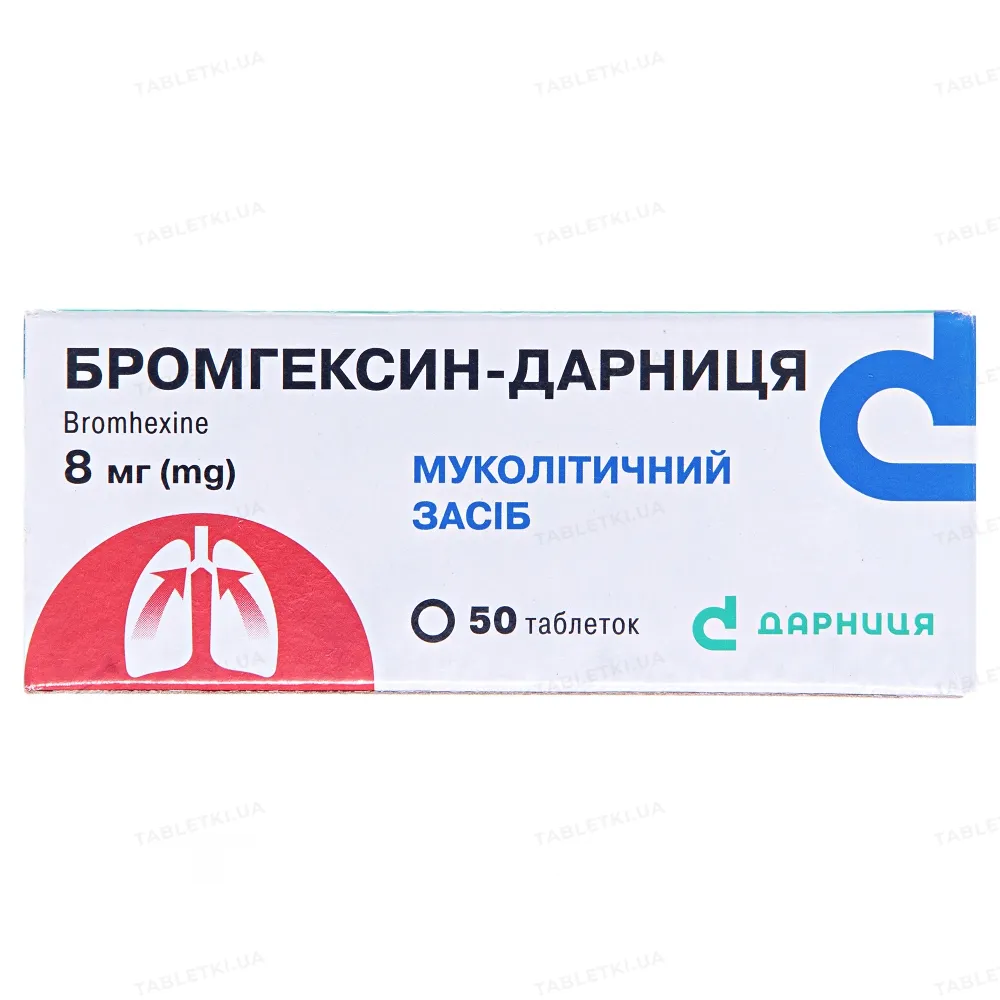
Table of Contents
INSTRUCTION FOR MEDICAL USE OF THE MEDICINAL PRODUCT BROMHEXINE-DARNITSA (BROMHEXINE-DARNITSA)
Composition:
Active substance: bromhexine;
One tablet contains bromhexine hydrochloride 8 mg;
Excipients: lactose monohydrate, potato starch, calcium stearate.
Pharmaceutical form. Tablets.
Main physico-chemical properties: white, flat cylindrical tablets with bevelled edges.
Pharmacotherapeutic group. Medicinal products used for cough and colds. Mucolytic agents. ATC code R05C B02.
Pharmacological Properties
Pharmacodynamics
The medicinal product exerts a mucolytic (secretolytic) and expectorant effect. The mucolytic effect is associated with depolymerization and liquefaction of mucoprotein and mucopolysaccharide fibers. One of the important features of bromhexine action is its ability to stimulate surfactant production – a surface-active substance of lipoprotein-mucopolysaccharide nature synthesized in alveolar cells; surfactant biosynthesis is impaired in various bronchopulmonary diseases, leading to instability of alveolar cells and weakened response to adverse influences.
Pharmacokinetics
Bromhexine is rapidly absorbed from the gastrointestinal tract. Bioavailability is approximately 20%. In healthy volunteers, maximum plasma concentration (Cmax) is reached within 1 hour. Plasma protein binding of bromhexine is high. It is widely distributed in body tissues. Bromhexine crosses the blood-brain barrier. It passes in small amounts through the placenta. Cumulative effects may occur with prolonged repeated administration. It undergoes extensive metabolism during first-pass through the liver. In the liver, it is subject to demethylation and oxidation. The main metabolite of bromhexine is ambroxol. Approximately 85–90% is excreted from the body via urine, mainly as metabolites. Elimination half-life (T1/2) is 12–15 hours due to slow tissue-to-plasma reverse diffusion.
Clinical characteristics.
Indications.
Mucolytic therapy in acute and chronic bronchopulmonary diseases associated with difficulty in expectoration of sputum.
Contraindications.
Hypersensitivity to the components of the medicinal product; hereditary forms of galactose intolerance, Lapp lactase deficiency, or glucose-galactose malabsorption syndrome; gastric and duodenal ulcer disease or history of peptic ulcer; respiratory diseases whose course is associated with the production of large amounts of liquid sputum.
The medicinal product Bromhexine-Darnitsya must not be used in women during breastfeeding.
Bromhexine-Darnitsya is contraindicated for use in children under 6 years of age due to the high content of active substance. For this age group, medicinal products with reduced dosage should be prescribed.
Interaction with other medicinal products and other types of interactions.
Antibiotics (amoxicillin, cefuroxime, erythromycin, doxycycline), sulfonamide medicinal products – when used concomitantly with bromhexine, concentrations of antibiotics and sulfonamides in bronchopulmonary secretions and sputum are increased.
Antitussive agents – concomitant use with bromhexine leads to accumulation of mucus in the airways and impaired elimination of sputum from the bronchi due to suppressed cough reflex. This combination is not recommended.
Medicinal products that irritate the gastrointestinal tract (e.g., nonsteroidal anti-inflammatory drugs) – concomitant use with bromhexine may result in mutual enhancement of mucosal irritation effects.
Bromhexine-Darnitsya may be prescribed in combination with bronchodilators, antibacterial agents, and medicinal products used in cardiology.
Special precautions for use
During treatment, it is necessary to consume an adequate amount of fluid, which enhances the expectorant effect of bromhexine.
Bromhexine may affect the gastrointestinal mucosa; therefore, the drug should not be administered to patients with peptic ulcer disease of the stomach or duodenum or a history of peptic ulcers. In patients with a history of gastrointestinal bleeding, bromhexine should be used under physician supervision.
The drug should be used with caution in patients suffering from bronchial asthma and in patients with renal or severe hepatic impairment (i.e., by increasing the intervals between doses or reducing the dosage).
In cases of impaired bronchial motility associated with the production of large amounts of bronchial secretions (e.g., in rare conditions such as primary ciliary dyskinesia), Bromhexine-Darnytsia should be used with particular caution due to the potential for secretion accumulation.
In acute renal failure, the possible accumulation of bromhexine metabolites in the liver should be taken into account.
During prolonged use of the drug, periodic monitoring of liver function is recommended.
The drug contains lactose; therefore, it should not be administered to patients with rare hereditary forms of galactose intolerance, lactase deficiency, or glucose-galactose malabsorption syndrome.
At the first signs of any skin or mucous membrane disorders during administration of bromhexine hydrochloride, the drug should be discontinued immediately (this may indicate the onset of severe complications such as Stevens–Johnson syndrome, Lyell’s syndrome, erythema multiforme, or acute generalized exanthematous pustulosis).
Use during pregnancy or breastfeeding.
During pregnancy, the drug should be prescribed only after careful consideration of the benefit-to-risk ratio for mother and fetus; its use is not recommended during the first trimester of pregnancy.
Bromhexine is contraindicated during breastfeeding because it passes into breast milk.
Ability to influence reaction rate while driving or operating machinery.
The drug has no effect or has a negligible effect on the ability to drive or operate machinery.
Method of Administration and Dosage.
The medicinal product should be taken orally, regardless of food intake. The duration of treatment depends on the indications and the course of the disease, and is determined individually.
Adults and children aged 14 years and older: 1–2 tablets (8–16 mg) three times daily. Treatment duration: 4–5 days.
Children aged 6 to 14 years, and patients with body weight less than 50 kg: 1 tablet (4–8 mg) three times daily. Treatment duration: 4–5 days.
In cases of renal function impairment or severe liver disease, the dose of the medicinal product should be reduced.
Children.
The medicinal product is intended for children aged 6 years and older. For children under 6 years of age, other dosage forms should be used.
Overdose.
Symptoms: dyspeptic disorders, nausea, vomiting, diarrhea, dizziness, headache, diplopia, ataxia, mild metabolic acidosis, tachypnea. When up to 40 mg of bromhexine was administered to young children, no symptoms were observed even without decontamination procedures. No chronic toxic effects on humans have been identified.
Treatment: induce vomiting, perform gastric lavage (within the first 1–2 hours after ingestion), and provide symptomatic therapy. In cases of significant overdose, cardiovascular monitoring is recommended. Due to the high degree of plasma protein binding, large volume of distribution, and slow redistribution of bromhexine from tissues into blood, enhanced elimination of the drug should not be expected with hemodialysis or forced diuresis.
Side effects.
From the nervous system: headache (migraine-like), dizziness.
From the respiratory system, thoracic organs and mediastinum: increased cough, bronchospasm, breathing disorders, respiratory distress.
From the gastrointestinal tract: dyspeptic symptoms, nausea, vomiting, diarrhea, abdominal pain, exacerbation of gastric and duodenal ulcer, transient increase in serum aminotransferase activity.
From the immune system: hypersensitivity reactions, including skin rashes, erythematous and urticarial rashes, pruritus, urticaria; very rarely – Quincke's edema, anaphylactic reactions, including anaphylactic shock; extremely rarely, severe skin reactions have been reported: Stevens–Johnson syndrome, Lyell's syndrome, erythema multiforme, and acute generalized exanthematous pustulosis associated with the use of mucolytic agents such as bromhexine. Most often, these could be explained by the severity of the underlying disease or concomitant use of other medicinal products. If skin or mucosal reactions occur, the patient should discontinue the medicinal product and consult a physician.
General disorders and administration site conditions: increased sweating, hyperhidrosis, transient increase in serum aspartate aminotransferase levels.
Reporting of suspected adverse reactions.
Reporting of suspected adverse reactions after medicinal product authorization is an important procedure. It allows continuous monitoring of the benefit-risk balance of the medicinal product. Healthcare professionals are required to report any suspected adverse reactions through the national reporting system.
Shelf life. 3 years.
Storage conditions.
Store in the original packaging at a temperature not exceeding 25 °C. Keep out of reach of children.
Packaging.
10 tablets in a blister pack; 5 blisters per carton; 10 or 20 tablets in blister packs.
Dispensing category. Over-the-counter.
Manufacturer. JSC "Pharmaceutical Company "Darnytsia".
Manufacturer's address and place of business.
13, Borispilska Street, Kyiv, 02093, Ukraine.