Bromhexine 4 berlin-chemi
Ukraine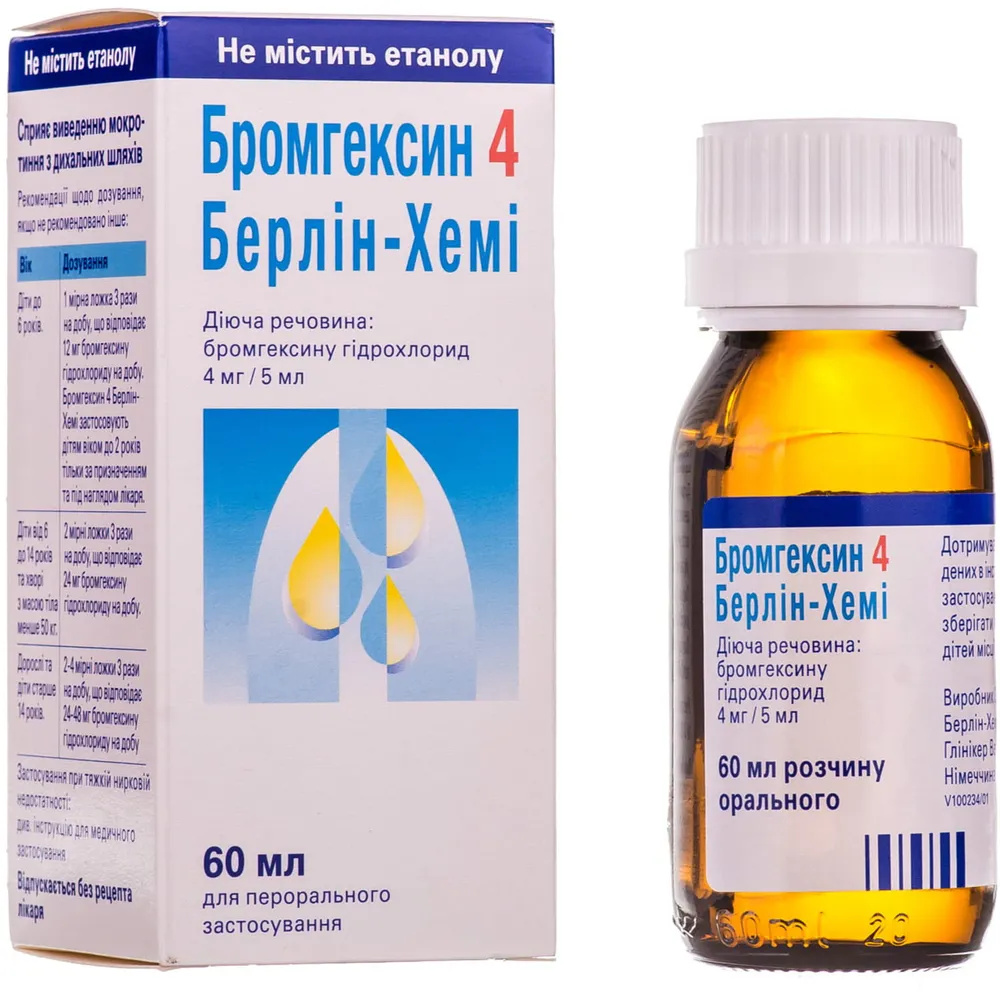
Table of Contents
INSTRUCTIONS FOR MEDICAL USE OF THE MEDICINAL PRODUCT BROMHEXIN 4 BERLIN-CHEMIE (BROMHEXIN 4 BERLIN-CHEMIE)
Composition:
Active substance: bromhexine hydrochloride;
1 ml of oral solution contains 0.8 mg of bromhexine hydrochloride;
5 ml of solution (1 measuring spoon) contains 4 mg of bromhexine hydrochloride;
Excipients: maltitol (E965), benzoic acid (E210), anhydrous citric acid, apricot flavoring powder, purified water.
Pharmaceutical form. Oral solution.
Main physico-chemical properties: clear, colorless, slightly viscous, odorless solution or with a slight apricot odor.
Pharmacotherapeutic group. Medicinal products used for cough and colds. Mucolytic agents. ATC code R05CB02.
Pharmacological properties.
Pharmacodynamics.
Bromhexine is a synthetic derivative of the plant active substance vasicine. It exerts a secretolytic and secretomotor effect in the bronchi. Studies in animals have shown that the drug increases the proportion of serous bronchial secretion. It is believed that mucus clearance is stimulated due to a reduction in its viscosity and activation of ciliated epithelium. After administration of bromhexine, the concentration of amoxicillin, erythromycin, and oxytetracycline antibiotics increases in sputum and bronchial secretions. The clinical significance of this effect has not been established.
Pharmacokinetics.
After oral administration, bromhexine is almost completely absorbed, with a half-life of approximately 0.4 hours. Following oral administration, Tmax (time to reach maximum plasma concentration) is 1 hour. The presystemic effect is approximately 80%. Biologically active metabolites are formed.
Plasma protein binding is 99%. Plasma concentration decline is multiphasic. The half-life after which the effect ceases is about 1 hour. Additionally, a terminal half-life of approximately 16 hours has been established. This is due to redistribution of small amounts of bromhexine from tissues. The volume of distribution is about 7 L per kg of body weight. Bromhexine does not accumulate in the body. Bromhexine crosses the placenta and penetrates into cerebrospinal fluid and breast milk. It is primarily excreted by the kidneys, as metabolites are formed in the liver. Due to high plasma protein binding, large volume of distribution, and slow redistribution from tissues into blood, significant elimination of bromhexine during dialysis or forced diuresis is not expected. In severe liver impairment, clearance of the active substance may be reduced. In severe renal insufficiency, an increased half-life of bromhexine metabolites cannot be excluded. Nitrosation of bromhexine may occur in the stomach under physiological conditions.
Preclinical safety data
Chronic toxicity
Studies in various animal species (rats, mice, dogs) using very high doses and long-term treatment did not reveal any significant toxic potential for humans under normal therapeutic use.
Mutagenic and carcinogenic potential
Studies in vitro (Ames test) and in vivo/in vitro (mammalian-mediated mutagenicity test) showed no mutagenic effects. Carcinogenicity studies conducted in rats did not reveal any carcinogenic potential of bromhexine.
Toxicity to reproductive organs
Bromhexine crosses the placenta. Animal studies did not show any signs of teratogenic effects in rats, mice, or rabbits. Bromhexine at therapeutic doses did not affect offspring development or behavior. No effect of bromhexine on fertility has been observed.
Clinical characteristics.
Indications.
Secretolytic therapy in acute and chronic diseases of the bronchi and lungs associated with impaired formation and movement of sputum.
Contraindications.
Hypersensitivity to the active substance or to any of the excipients (see section "Composition"). Should not be used in patients with gastric or duodenal ulcers or in patients with a history of peptic ulcer disease, since bromhexine may affect the mucous membrane of the gastrointestinal tract.
Interaction with other medicinal products and other forms of interaction.
When Bromhexine 4 Berlin-Chemie is used concomitantly with antitussive agents (cough suppressants), there may be a dangerous accumulation of secretions due to suppression of the cough reflex; therefore, such combination should be used with particular caution.
Concomitant use of bromhexine and substances that irritate the gastrointestinal tract may result in mutual enhancement of the irritating effect on the gastric mucosa.
Special precautions for use.
Skin reactions
Severe skin reactions associated with bromhexine use have been reported, including erythema multiforme, Stevens-Johnson syndrome/toxic epidermal necrolysis, and acute generalized exanthematous pustulosis. If symptoms or signs of progressive skin rash (sometimes with blisters or mucosal lesions) occur, medical advice must be sought immediately and treatment with bromhexine should be discontinued.
Gastric and duodenal ulcers
Bromhexine 4 Berlin-Chemie should not be used in patients with gastric or duodenal ulcers or in patients with a history of peptic ulcer disease, as bromhexine may affect the barrier function of the gastrointestinal mucosa.
Lungs and respiratory tract
Bromhexine 4 Berlin-Chemie should be used with particular caution in patients with impaired bronchial motility accompanied by excessive bronchial secretion (e.g., in rare conditions such as primary ciliary dyskinesia) due to the potential for secretion accumulation.
Hepatic and renal impairment
Bromhexine 4 Berlin-Chemie should be used with particular caution (e.g., with longer intervals or lower doses) in patients with renal dysfunction or severe hepatic disease.
In severe renal insufficiency, accumulation of bromhexine metabolites formed in the liver may occur. Periodic monitoring of liver function is recommended, especially during prolonged treatment.
Pediatric population
Bromhexine 4 Berlin-Chemie should be administered to children under 2 years of age only under medical supervision.
Benzoic acid, maltitol
One measuring spoon (5 ml) of Bromhexine 4 Berlin-Chemie contains 5 mg of benzoic acid and 1.5 g of maltitol.
Benzoic acid may exacerbate jaundice (yellowing of the skin and eyes) in neonates (up to 4 weeks of age).
This medicinal product contains maltitol. Patients with rare hereditary fructose intolerance should not take this product. Maltitol may have a mild laxative effect. The caloric value of maltitol is 2.3 kcal/g.
Use during pregnancy or breastfeeding.
Pregnancy
Currently, there is no clinical experience with the use of bromhexine during pregnancy. Therefore, Bromhexine 4 Berlin-Chemie should be used during pregnancy only after careful assessment by the physician of the benefit-risk ratio. Use during the first trimester of pregnancy is not recommended.
Breastfeeding period
Since the active substance passes into breast milk, Bromhexine 4 Berlin-Chemie must not be used during breastfeeding.
Fertility
Animal studies have not shown any harmful effects of bromhexine on fertility (see section "Preclinical safety data").
Ability to influence reaction speed when driving vehicles or operating machinery.
Bromhexine 4 Berlin-Chemie has no effect or has a negligible effect on the ability to drive vehicles or operate machinery.
Method of Administration and Dosage
Dosing
If otherwise not prescribed, the recommended dosage of the medicinal product Bromhexine 4 Berlin-Chemie is as follows:
Adults and adolescents aged 14 years and older: 2–4 measuring spoons of Bromhexine 4 Berlin-Chemie three times daily (corresponding to 24–48 mg of bromhexine hydrochloride per day).
Children and adolescents aged 6 to 14 years, as well as patients with body weight below 50 kg: 2 measuring spoons of Bromhexine 4 Berlin-Chemie three times daily (corresponding to 24 mg of bromhexine hydrochloride per day).
Children under 6 years of age: 1 measuring spoon of Bromhexine 4 Berlin-Chemie three times daily (corresponding to 12 mg of bromhexine hydrochloride per day). The use of Bromhexine 4 Berlin-Chemie in children under 2 years of age is permitted only under medical supervision.
Recommendations for special patient groups:
Bromhexine 4 Berlin-Chemie should be used with particular caution (e.g., with longer intervals or in lower doses) in patients with impaired renal function or severe hepatic disorders (see section "Special Warnings and Precautions for Use").
Method of Administration
Oral solution.
It is recommended to consume sufficient fluids during administration.
The duration of treatment depends on the indication and course of the disease and should be determined individually.
The medicinal product Bromhexine 4 Berlin-Chemie should not be used for more than 4–5 days without consulting a physician.
Children
The product is used in pediatric practice. Bromhexine 4 Berlin-Chemie should be administered to children under 2 years of age only on medical prescription and under medical supervision.
Overdose
Symptoms
No serious cases of overdose in humans have been reported to date. There has been a report in which vomiting was observed in 4 out of 25 cases of high-dose bromhexine administration, and impaired consciousness, ataxia, diplopia, mild metabolic acidosis, and rapid breathing were observed in 3 young children. No symptoms were observed in young children after administration of up to 40 mg of bromhexine, even without decontamination procedures.
There is no evidence of chronic toxic effects in humans.
Treatment
In cases of significant overdose, monitoring of the cardiovascular system is recommended, and symptomatic therapy should be administered if necessary. Due to the low toxicity of bromhexine, more invasive measures to reduce absorption or accelerate elimination are usually not required. Furthermore, considering the pharmacokinetic characteristics (high volume of distribution, slow redistribution from tissues into blood, and high protein binding), significant elimination of the drug is not expected during dialysis or forced diuresis. In children aged 2 years and older, only mild symptoms may occur even after administration of high doses; therefore, decontamination may not be necessary after ingestion of up to 80 mg of bromhexine hydrochloride (e.g., 100 mL of Bromhexine 4 Berlin-Chemie); for younger children, the acceptable limit is 60 mg of bromhexine hydrochloride (6 mg/kg body weight).
Warning. When higher doses are administered, the effects of excipients should also be considered (see section "Special Warnings and Precautions for Use").
Side effects
Adverse reactions are classified according to their frequency of occurrence as follows:
Very common (≥ 1/10), common (≥ 1/100 to < 1/10), uncommon (≥ 1/1000 to < 1/100), rare (≥ 1/10,000 to < 1/1000), very rare (< 1/10,000), unknown: cannot be estimated from the available data.
Immune system disorders
Rare: hypersensitivity reactions.
Unknown: anaphylactic reactions, including anaphylactic shock, angioedema, and pruritus.
Gastrointestinal disorders
Uncommon: nausea, stomach pain, vomiting, diarrhea.
Unknown: exacerbation of gastric or duodenal ulcer.
Skin and subcutaneous tissue disorders
Rare: rash, urticaria.
Unknown: severe skin reactions (including erythema multiforme, Stevens-Johnson syndrome/toxic epidermal necrolysis, and acute generalized exanthematous pustulosis).
Respiratory system disorders
Unknown: bronchospasm, leading to respiratory distress, may occur as a manifestation of hypersensitivity/anaphylaxis.
General disorders and administration site conditions
Uncommon: fever.
Unknown: dizziness, headache, chills, transient increase in serum aspartate aminotransferase (AST) levels, increased sweating.
If hypersensitivity reactions, anaphylactic reactions, or any skin or mucous membrane disorders occur, bromhexine should be discontinued immediately and medical advice should be sought.
Reporting of suspected adverse reactions
Reporting of suspected adverse reactions after authorization of the medicinal product is important. It allows continued monitoring of the benefit-risk balance of the medicinal product. Healthcare professionals are encouraged to report any suspected adverse reactions.
Shelf life: 3 years. After opening the bottle – 6 months.
Storage conditions: No special storage conditions required. Keep out of reach and sight of children.
Packaging: Amber glass bottle closed with a child-resistant plastic cap, 60 ml; 1 bottle and a measuring spoon in a cardboard box.
Classification of supply: Over-the-counter (without prescription).
Manufacturer:
BERLIN-CHEMIE AG
Manufacturer's name and address of the place of business:
Glienicker Weg 125, 12489 Berlin, Germany