Bramitob
Ukraine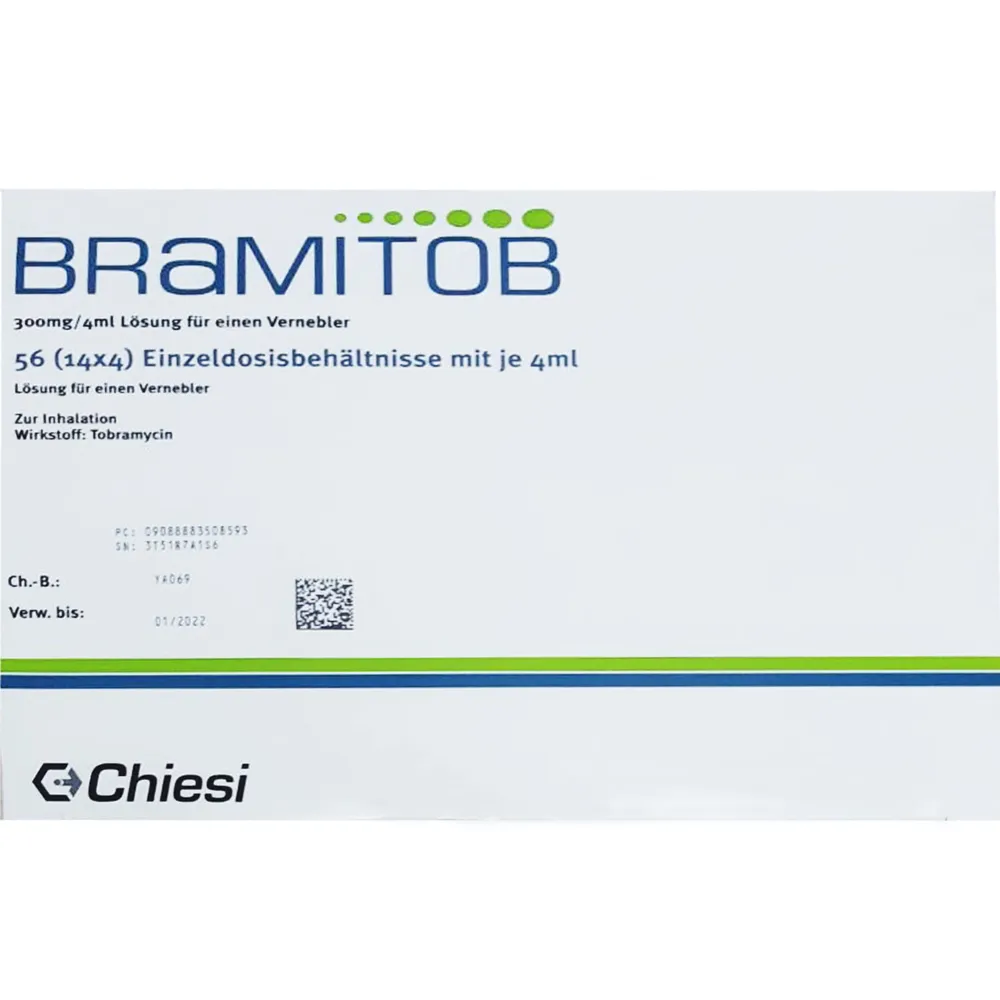
Table of Contents
INSTRUCTIONS for medical use of the medicinal product BRAMITOB (BRAMITOB®)
Composition:
active substance: tobramycin;
1 ampoule (4 ml) contains 300 mg of tobramycin;
excipients: sodium chloride, sulfuric acid, sodium hydroxide (for pH adjustment), water for injections.
Pharmaceutical form. Solution for inhalation.
Main physical and chemical properties: clear yellowish solution.
Pharmacotherapeutic group. Antibacterial aminoglycosides.
ATC code J01G B01.
Pharmacological properties.
Pharmacodynamics.
Tobramycin is an aminoglycoside antibiotic produced by the microorganisms Streptomyces tenebrarius. Its primary mechanism of action involves disruption of protein synthesis, leading to altered cell membrane permeability, progressive degradation of the cell wall, and ultimately, cell death. The drug exerts a bactericidal effect at concentrations equal to or slightly higher than inhibitory concentrations.
Pharmacokinetics.
Absorption and distribution
Systemic absorption following inhaled administration of tobramycin is very low, and the amount of drug reaching the systemic circulation after inhalation is limited. Approximately 10% of the administered dose via nebulizer reaches the lungs, while the remaining 90% remains either in the nebulizer or deposits on the walls of the oropharynx; this portion is either swallowed by the patient or exhaled into the air.
Elimination
Elimination of tobramycin following inhaled administration has not been studied. Unabsorbed tobramycin is likely eliminated primarily via expectoration in sputum.
Clinical Characteristics.
Indications.
Treatment of chronic pulmonary infection caused by Pseudomonas aeruginosa in patients with cystic fibrosis.
Official recommendations on the appropriate use of antibacterial agents should be taken into account.
Contraindications.
Bramitob is contraindicated in patients with hypersensitivity to tobramycin, other aminoglycosides, or to any component of the medicinal product.
Concomitant treatment with potent diuretics such as furosemide or ethacrynic acid, which have ototoxic effects, is contraindicated.
Interaction with other medicinal products and other forms of interaction.
Concomitant and/or sequential use of Bramitob with other potentially nephrotoxic or ototoxic medicinal products should be avoided. Some diuretics may enhance the toxicity of aminoglycosides due to changes in antibiotic concentration in serum and tissues. Concomitant administration of Bramitob with furosemide, ethacrynic acid, urea, or intravenous or oral mannitol is not recommended.
Other medicinal products that may increase the potential toxicity of aminoglycosides when administered parenterally: amphotericin B, cephalothin, cyclosporine, tacrolimus, polymyxins (risk of increased nephrotoxicity), platinum-containing agents (risk of increased nephrotoxicity and ototoxicity). Concomitant use of tobramycin with anticholinesterases and botulinum toxin should be avoided due to their neuromuscular effects.
Others: clinical study data show that patients receiving inhaled tobramycin concomitantly with dornase alfa, mucolytics, beta-agonists, inhaled corticosteroids, and other oral or parenteral antipseudomonal antibiotics experienced similar adverse reactions as those in the control group.
Special precautions for use.
General warnings
Tobramycin should be used with caution in patients with established or suspected renal function impairment, vestibular and auditory function disorders, neuromuscular dysfunction, or active pulmonary haemorrhage. Continuous monitoring of renal function and the eighth cranial nerve is required in patients with established or suspected renal impairment, as well as in patients with initially normal renal function who develop signs of renal dysfunction during treatment. If signs of nephrotoxicity or vestibular and/or auditory toxicity occur, administration of the drug should be discontinued or the dosage adjusted. To monitor serum tobramycin concentrations, blood samples should be obtained via venipuncture rather than fingerstick, as the latter method is not validated. Skin contamination of fingers from preparation and nebulization of tobramycin may lead to falsely elevated serum drug levels. Hand washing immediately before blood sampling does not completely eliminate residual drug.
Bronchospasm
Bronchospasm may occur during inhalation of tobramycin, as with other inhaled medications. The first dose of Bramitob should be administered under medical supervision, with prior administration of a bronchodilator if it is already part of the patient’s treatment regimen. Forced expiratory volume in 1 second (FEV1) should be measured before and after inhalation. If bronchospasm occurs in a patient not receiving a bronchodilator, the drug should be re-administered separately with a bronchodilator. Development of bronchospasm despite bronchodilator therapy may indicate an allergic reaction. If an allergic reaction is suspected, administration of Bramitob should be discontinued. Appropriate therapy should be initiated to manage bronchospasm.
Neuromuscular disorders
Tobramycin should be used with caution in patients with neuromuscular disorders such as Parkinson’s disease or other conditions associated with myasthenia, including myasthenia gravis, since aminoglycosides may exacerbate muscle weakness due to their potential curare-like effect on neuromuscular function.
Nephrotoxicity
Although nephrotoxicity is primarily associated with parenteral administration of aminoglycosides, nephrotoxic effects were not observed during clinical studies of tobramycin. The drug should be used with caution in patients with established or suspected renal dysfunction, and serum tobramycin concentrations should be monitored. Quantitative serum concentration measurements should be performed after two or three doses, with intervals of three to four days during treatment, allowing for dose adjustment if necessary. If changes in renal function are detected, serum tobramycin levels should be monitored more frequently, and dosage levels or intervals should be adjusted accordingly. Patients with acute renal failure (i.e., serum creatinine level >2 mg/dL [176.8 µmol/L]) were not included in clinical trials.
Current clinical practice recommends baseline assessment of renal function. Additionally, periodic reassessment of renal function through regular monitoring of blood urea nitrogen and creatinine levels should be performed at least every 6 full treatment cycles (180 days of inhaled tobramycin therapy).
If signs of nephrotoxicity occur, tobramycin therapy should be discontinued until serum drug concentrations fall below 2 µg/mL. Thereafter, treatment with tobramycin may be resumed based on clinical need. Patients receiving concomitant parenteral therapy with other aminoglycosides should be closely monitored due to the potential for cumulative toxicity. Monitoring of renal function is particularly important in elderly patients, who may have reduced renal function not detectable by routine screening tests such as serum urea or creatinine levels. Measurement of creatinine clearance is preferable. Urinalysis should be performed to detect increased excretion of protein, cells, and casts. Periodic quantitative determination of serum creatinine or creatinine clearance (preferable to blood urea nitrogen) is required.
Ototoxicity
Ototoxicity, affecting both auditory and vestibular functions, has been reported with parenteral administration of aminoglycosides. Vestibular toxicity may manifest as vertigo, ataxia, or dizziness.
Controlled clinical studies of inhaled tobramycin have reported cases of mild hearing loss and vertigo. However, in controlled clinical trials of other inhaled tobramycin formulations, no evidence of auditory toxicity was observed based on patient reports of hearing loss or audiometric evaluations.
In open-label studies and post-marketing use, some patients with a history of prolonged prior or concomitant intravenous aminoglycoside therapy have experienced hearing loss.
Clinicians should be aware of the potential for aminoglycosides to cause vestibular and auditory toxicity and should therefore assess hearing function during treatment with Bramitob. Patients with risk factors due to prior prolonged systemic aminoglycoside use should undergo audiometric testing before initiating tobramycin therapy. Tinnitus should be considered as a possible sign of ototoxicity. If a patient reports tinnitus or hearing loss during aminoglycoside therapy, audiologic evaluation should be considered. Where feasible, periodic audiograms are recommended for patients undergoing long-term treatment, due to the increased risk of ototoxicity. Patients receiving concomitant parenteral aminoglycoside therapy should be closely monitored due to the risk of cumulative toxicity.
Haemoptysis
Inhalation of nebulized solutions may trigger a cough reflex. Administration of inhaled Bramitob in patients with acute active haemoptysis should only be considered if the therapeutic benefit outweighs the risk of further bleeding.
Microbial resistance
Clinical studies have shown an increase in the minimum inhibitory concentration of aminoglycosides against isolated strains of P. aeruginosa in some patients receiving inhaled tobramycin. There is a theoretical risk that patients receiving inhaled tobramycin may develop resistance of P. aeruginosa strains to intravenous tobramycin (see section "Pharmacological properties. Pharmacodynamics"). Clinical trial data are not available for patients with cystic fibrosis.
Use during pregnancy or breastfeeding
Bramitob may be used during pregnancy or breastfeeding only if the expected benefit to the mother outweighs the potential risks to the fetus or infant.
Pregnancy. Adequate data on the use of inhaled tobramycin in pregnant women are not available. Animal studies have not shown teratogenic effects of tobramycin. However, aminoglycosides may pose a risk to the fetus (e.g., congenital deafness) if high systemic concentrations are achieved in pregnant women. If Bramitob is used during pregnancy or if pregnancy occurs during treatment, the patient should be informed of the potential risks to the fetus.
Breastfeeding. Tobramycin is excreted in breast milk following systemic administration. It is not known whether inhaled tobramycin reaches sufficient serum concentrations to be detected in breast milk. Due to the potential risk of ototoxicity and nephrotoxicity in neonates associated with tobramycin, a decision should be made whether to discontinue breastfeeding or to discontinue Bramitob therapy.
Ability to affect reaction speed when driving or operating machinery
No studies have been conducted on the effect of tobramycin on the ability to drive or operate machinery. Based on reported adverse reactions, tobramycin is unlikely to impair such abilities. However, patients should exercise caution when driving or operating machinery due to the potential occurrence of dizziness and/or vertigo.
Method of Administration and Dosage
Bramitob is intended for inhalation use only and not for parenteral administration.
Treatment must be conducted under the supervision of a physician experienced in managing patients with cystic fibrosis.
Recommended dose for adults and children aged 6 years and older: one single-dose ampoule (300 mg) twice daily (morning and evening) for 28 days. The interval between doses should be maintained at approximately 12 hours. After 28 days of treatment with Bramitob, a 28-day treatment break should be observed. Treatment should follow alternating 28-day cycles of active therapy followed by a 28-day break (28 days of drug administration followed by a 28-day interruption).
Children under 6 years of age
The efficacy and safety of Bramitob in patients under 6 years of age have not been established.
Elderly patients
Tobramycin should be used with caution in elderly patients who may have reduced renal function (see section "Special precautions").
Patients with renal impairment
Tobramycin should be administered with caution to patients with known or suspected renal dysfunction. If signs of nephrotoxicity occur, treatment with Bramitob should be suspended until serum tobramycin concentrations fall below 2 mcg/mL (see section "Special precautions").
Patients with hepatic impairment
No dosage adjustment of Bramitob is required for patients with hepatic impairment.
The dosing regimen does not vary by body weight. All patients should receive one single-dose ampoule of Bramitob (300 mg tobramycin) twice daily.
Treatment with tobramycin should continue on a cyclical basis; the duration of treatment should be determined by the physician based on the patient's clinical improvement resulting from the inclusion of Bramitob in the treatment regimen. In case of evident clinical worsening of pulmonary status, additional antibacterial therapy should be considered.
Method of Administration
The single-dose ampoule should be opened immediately before use. Any unused portion of the solution after administration must be discarded and not stored for subsequent use.
Administration of Bramitob should follow general hygiene standards. The device used must be clean and in proper working condition. The nebulizer, intended for personal use only, should be kept clean and regularly disinfected (refer to the nebulizer instructions for cleaning and disinfection procedures).
Maximum recommended daily dose
The maximum recommended daily dose of Bramitob has not been established.
Instructions for opening the ampoule:
- Bend the single-dose ampoule in both directions;
- Separate the ampoule from the strip, starting with the top part, then the middle;
- Open the ampoule by twisting its top part in the direction indicated by the arrow;
- Gently squeeze the ampoule walls to pour the medicinal solution into the nebulizer glass chamber.
The contents of one single-dose ampoule (300 mg), transferred into the nebulizer, are administered via inhalation over 15 minutes using the reusable PARI LC PLUS nebulizer with PARI TURBO BOY compressor (drug delivery rate 6.2 mg/min, total delivered dose 92.8 mg, mean aerodynamic particle size: D10 0.65 µm, D50 3.15 µm, D90 8.99 µm) or PARI LC SPRINT nebulizer with PARI BOY Sx compressor (drug delivery rate 6.7 mg/min, total delivered dose 99.8 mg, mean aerodynamic particle size: D10 0.70 µm, D50 3.36 µm, D90 9.41 µm).
Bramitob inhalations should be performed while the patient is sitting or standing, breathing normally through the mouthpiece of the nebulizer. Nasal clips may help the patient breathe through the mouth. Patients should continue their standard chest physiotherapy regimen. Appropriate bronchodilators should be continued if clinically necessary. When multiple respiratory treatments are used, the recommended sequence is: bronchodilator, chest physiotherapy, other inhaled medications, and finally Bramitob.
Bramitob must not be mixed with other inhaled medicinal products.
Children
The product is indicated for use in children aged 6 years and older.
Overdose
Symptoms
Inhalation administration of tobramycin results in low systemic bioavailability. Symptoms of overdose may include severe hoarseness.
Accidental oral ingestion of Bramitob is unlikely to result in toxic effects, as tobramycin is poorly absorbed from the intact gastrointestinal tract. However, accidental intravenous administration of Bramitob may lead to signs and symptoms of parenteral tobramycin overdose, such as dizziness, tinnitus, vertigo, hearing loss, respiratory distress and/or neuromuscular blockade, and renal function impairment.
Treatment
In cases of acute toxicity, administration of Bramitob should be immediately discontinued and baseline renal function parameters should be assessed. Monitoring serum tobramycin levels may be helpful in managing overdose. In any case of overdose, potential drug interactions should be considered, and Bramitob or other medicinal products should be sequentially withdrawn as appropriate.
Adverse reactions
Based on controlled clinical studies (4) and uncontrolled clinical studies (1) evaluating the medicinal product Bramitob (565 patients receiving treatment), the most commonly reported reactions were those affecting the respiratory tract (cough and dysphonia). Adverse reactions observed during clinical studies (see below) are listed according to the following frequency classification: common (≥1/100 to <1/10); uncommon (≥1/1000 to <1/100); rare (≥1/10000 to <1/1000); very rare (<1/10000).
Table 1
System organ classes |
Adverse reaction |
Frequency |
| Infections and infestations |
Fungal infection, oral candidiasis |
Uncommon |
| Nervous system disorders |
Headache |
Uncommon |
| Ear and labyrinth disorders |
Vertigo, hypoacusis, sensorineural deafness (see section "Special precautions") |
Uncommon |
| Respiratory, thoracic and mediastinal disorders |
Cough, dysphonia |
Common |
| Decreased forced expiratory volume, dyspnea, wheezing, haemoptysis, throat pain, productive cough |
Uncommon |
|
| Gastrointestinal disorders |
Increased salivation, glossitis, upper abdominal pain, nausea |
Uncommon |
| Skin and subcutaneous tissue disorders |
Rash |
Uncommon |
| General disorders and administration site conditions |
Asthenia, chest discomfort, dryness of mucous membranes |
Uncommon |
| Investigations |
Increased transaminase levels |
Uncommon |
According to controlled clinical studies with other inhaled formulations containing tobramycin, dysphonia and tinnitus were the only adverse effects reported in a significantly higher number of patients compared to those receiving tobramycin treatment (13% in the tobramycin group versus 7% in the control group) and (3% in the tobramycin group versus 0% in the control group), respectively. Episodes of tinnitus were transient, did not require discontinuation of tobramycin treatment, and were not associated with permanent hearing loss based on audiometric testing results. The risk of developing tinnitus did not increase with repeated cycles of tobramycin administration.
Additional adverse effects, some of which are common consequences of the underlying disease, but for which a causal relationship with tobramycin administration cannot be excluded, included: discolored sputum, respiratory tract infections, myalgia, nasal polyps, and otitis media.
Adverse reactions (listed according to the frequency classification stated above) known from cumulative post-marketing data on inhaled tobramycin-containing products.
Table 2
| System organ classes |
Adverse reaction |
Frequency |
| Infections and infestations |
Laryngitis |
Uncommon |
| Fungal infection, oral candidiasis |
Very rare |
|
| Blood and lymphatic system disorders |
Lymphadenopathy |
Very rare |
| Immune system disorders |
Increased sensitivity |
Very rare |
| Metabolism and nutrition disorders |
Anorexia |
Uncommon |
| Nervous system disorders |
Dizziness, headache, aphonia |
Uncommon |
| Somnolence |
Very rare |
|
| Ear and labyrinth disorders |
Tinnitus, hearing loss (see section "Special safety warnings") |
Uncommon |
| Ear disorders, ear pain |
Very rare |
|
| Respiratory, thoracic and mediastinal disorders |
Cough, pharyngitis, dysphonia, dyspnea |
Uncommon |
| Bronchospasm, chest discomfort, worsening of lung function, haemoptysis, epistaxis, rhinitis, asthma, productive cough |
Uncommon |
|
| Hyperpnoea, hypoxia, sinusitis |
Very rare |
|
| Gastrointestinal disorders |
Dysgeusia, mouth ulcers, vomiting, nausea |
Uncommon |
| Diarrhoea, abdominal pain |
Very rare |
|
| Skin and subcutaneous tissue disorders |
Rash |
Uncommon |
| Urticaria, pruritus |
Very rare |
|
| Musculoskeletal and connective tissue disorders |
Back pain |
Very rare |
| General disorders and administration site conditions |
Asthenia, pyrexia, chest pain, pain, nausea |
Uncommon |
| Weakness |
Very rare |
|
| Investigations |
Decreased lung function |
Uncommon |
In open-label studies and post-marketing experience, some patients with a history of prolonged prior or concomitant intravenous aminoglycoside use have experienced hearing loss (see section "Special precautions").
Parenteral aminoglycosides have been associated with hypersensitivity, ototoxicity, and nephrotoxicity (see sections "Contraindications" and "Special precautions").
Reporting of suspected adverse reactions
Reporting suspected adverse reactions after a medicinal product is authorized is important. It allows continued monitoring of the benefit-risk balance of the medicinal product. Healthcare professionals and patients, as well as legal representatives, should report any suspected adverse reactions and lack of efficacy through the Automated Information System for Pharmacovigilance at: https://aisf.dec.gov.ua.
Shelf life. 2 years.
After first opening of the ampoule, the solution should be used immediately.
Shelf life during use: strips of ampoules (closed or opened) may be stored for up to 3 months at a temperature not exceeding 25 °C.
Storage conditions.
Store in a refrigerator (2–8 °C) in the original packaging to protect from light. Keep out of reach of children.
The solution in the ampoule is usually yellowish; slight color changes may occur, which do not in any way indicate loss of efficacy of the product when stored according to the instructions.
Packaging.
4 ml in an ampoule, 4 ampoules in a hermetically sealed strip; 16, 28 or 56 ampoules in a cardboard box.
Prescription status. Prescription only.
Manufacturer.
Chiesi Farmaceutici S.p.A.
Manufacturer's address and location of operations.
Via San Leonardo 96, 43122, Parma, Italy.
Marketing Authorization Holder.
Chiesi Pharmaceuticals GmbH.
Address of the Marketing Authorization Holder and/or its representative.
Gonzagagasse 16/16, 1010 Vienna, Austria.