Borizol
Ukraine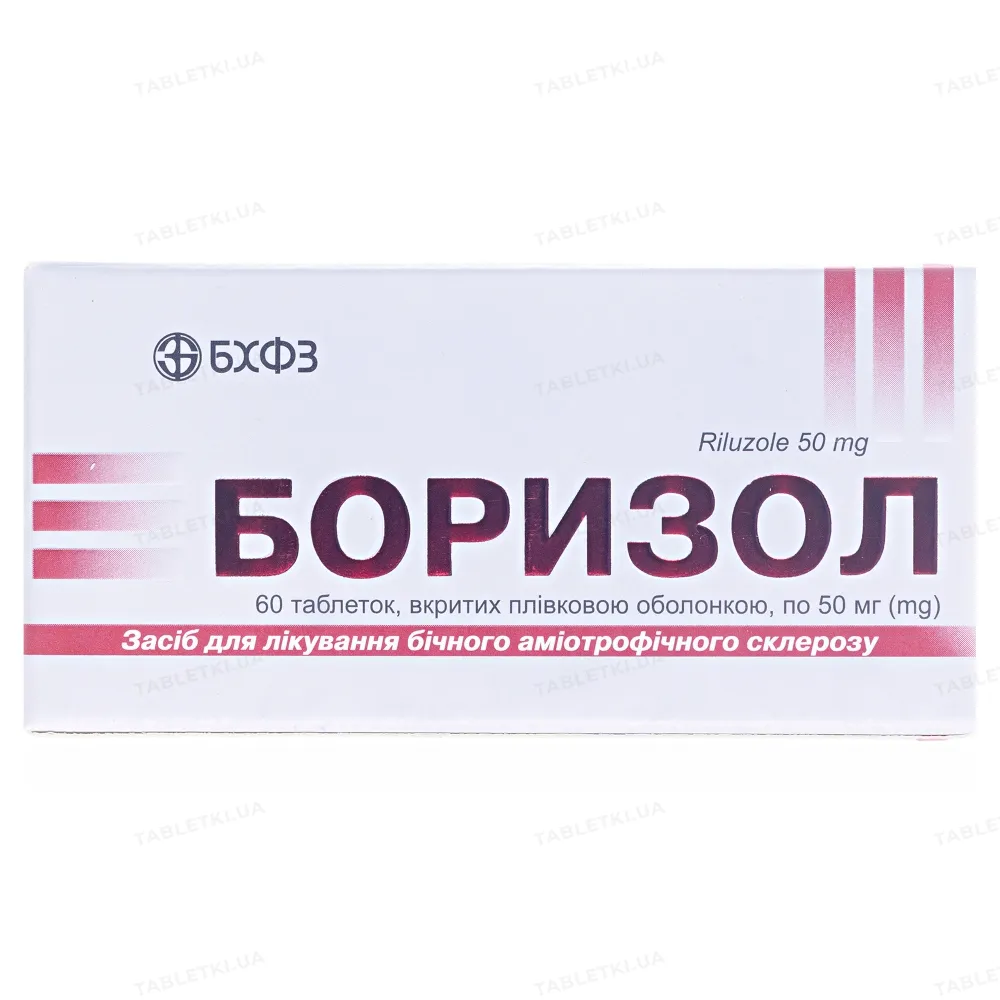
Table of Contents
INSTRUCTIONS FOR MEDICAL USE OF THE MEDICINAL PRODUCT BORIZOL (BORI ZOL)
Composition:
Active substance: riluzole;
1 tablet contains riluzole 50 mg;
Excipients: calcium hydrogen phosphate, microcrystalline cellulose, colloidal anhydrous silicon dioxide, sodium croscarmellose, magnesium stearate;
film coating: hydroxypropylmethylcellulose, lactose monohydrate, titanium dioxide (E 171), macrogol, triacetin.
Pharmaceutical form. Film-coated tablets.
Main physicochemical properties: round, biconvex film-coated tablets, white or white with cream shade.
Pharmacotherapeutic group. Agents acting on the nervous system. Riluzole. ATC Code N07X X02.
Pharmacological properties.
Pharmacodynamics.
Riluzole is a benzothiazole derivative that exerts a multifaceted effect on the glutamate neurotransmission mechanism. Riluzole affects nerve transmission processes in brain structures controlling motor and sensory functions of the body. Its exact mechanism of action has not been fully elucidated. It is presumed that riluzole inhibits the release of glutamate. Glutamate (the primary excitatory neurotransmitter in the central nervous system) plays a significant role in neuronal cell death. Activation of glutamate synthesis has pathogenetic significance in neurodegenerative diseases of the brain; thus, glutamate exerts damaging effects on neurons and may mediate cell death in various types of injury. Activation of glutamatergic transmission leads to reduced spontaneous locomotion, whereas decreasing glutamatergic influences enhances motor activity.
The use of riluzole may help maintain independent mobility, activates motor functions, and delays the need for tracheostomy and mechanical ventilation in patients with amyotrophic lateral sclerosis.
Pharmacokinetics.
Riluzole is rapidly absorbed in the gastrointestinal tract. Maximum plasma concentration is reached within 60–90 minutes after administration. The absorption of riluzole is 90%, and its absolute bioavailability is 60%.
The extent and rate of absorption are reduced when the drug is taken with a high-fat meal.
Riluzole is distributed throughout all body tissues. It crosses the blood-brain barrier and is excreted into breast milk. In the blood, 97% of riluzole is bound to plasma proteins, primarily to albumins and lipoproteins.
Riluzole metabolism occurs in the liver in two steps: hydroxylation by cytochrome P450, followed by glucuronidation.
The elimination half-life ranges from 9 to 15 hours.
Approximately 90% of riluzole is excreted in the urine (60% as glucuronides), and 10% is excreted in feces.
Clinical characteristics.
Indications.
For prolongation of life or delaying the time to mechanical ventilation in patients with amyotrophic lateral sclerosis (ALS).
Contraindications.
- Hypersensitivity to riluzole or to any of the excipients;
- Hepatic impairment or alanine aminotransferase (ALT) levels exceeding the upper limit of normal by three times.
Interaction with other medicinal products and other forms of interaction.
Clinical studies to evaluate the interaction of riluzole with other medicinal products have not been conducted.
In vitro studies using human liver microsomes indicate that the main isoenzyme involved in the initial oxidative metabolism of riluzole is CYP1A2.
Inhibitors of CYP1A2 (e.g., caffeine, diclofenac, diazepam, nicergoline, clomipramine, imipramine, fluvoxamine, phenacetin, theophylline, amitriptyline, and quinolones) may potentially slow the elimination of riluzole, thereby enhancing its effects and increasing the risk of riluzole-associated adverse reactions.
Inducers of CYP1A2 (e.g., cigarette smoke, charcoal-broiled food, rifampicin, omeprazole) may accelerate riluzole elimination and lead to reduced efficacy.
Special precautions for use.
Clinical studies have shown that riluzole prolongs survival in patients with ALS (see section "Pharmacodynamics"). Survival was defined as the time during which patients remained alive and had not undergone intubation for mechanical ventilation or tracheostomy.
There is no evidence that riluzole exerts a therapeutic effect on motor function, lung function, fasciculations, muscle strength, or motor symptoms. Riluzole has not demonstrated efficacy when administered at later stages of ALS.
The safety and efficacy of riluzole have been studied only in patients with ALS. Therefore, the drug should not be used in patients with any other forms of motor neuron diseases.
Hepatic impairment.
Riluzole should be administered with caution in patients with a history of hepatic dysfunction or in patients with mild elevations of serum transaminases (ALT, AST up to 3 times the upper limit of normal) and/or serum bilirubin and/or gamma-glutamyl transferase (GGT).
Initial increases in liver function parameters (especially bilirubin) should preclude the use of riluzole.
Due to the risk of hepatitis, serum transaminase levels, including ALT, should be monitored before initiating treatment and throughout therapy with riluzole. ALT levels should be measured monthly during the first 3 months of treatment, every 3 months during the remainder of the first year, and periodically thereafter.
ALT levels should be monitored more frequently in patients who develop elevated ALT levels.
Riluzole should be discontinued if ALT levels increase to 5 times the upper limit of normal. There is no experience with dose reduction or re-administration in patients who have had ALT levels exceeding 5 times the upper limit of normal. Re-administration of riluzole in such cases is not recommended.
Neutropenia.
Patients should be advised to immediately inform their physician of any illness accompanied by fever. The presence of fever requires immediate blood count analysis with leukocyte count, and riluzole should be discontinued if neutropenia is detected.
Interstitial lung disease.
Cases of interstitial lung disease have been reported in patients receiving riluzole, some of which were severe. If respiratory symptoms such as dry cough and/or dyspnea develop, a chest X-ray should be performed.
If findings suggestive of interstitial lung disease are detected (e.g., bilateral diffuse pulmonary opacities), riluzole should be discontinued immediately. In most reported cases, symptoms resolved after discontinuation of riluzole and with symptomatic treatment.
Patients with renal impairment.
Studies with repeated doses of riluzole in this patient population have not been conducted.
Excipients.
The use of this medicinal product is not recommended for patients with carbohydrate intolerance disorders such as congenital galactosemia, glucose-galactose malabsorption syndrome, or lactase deficiency, due to the presence of lactose in the tablet film coating.
Use during pregnancy or breastfeeding.
The use of this medicinal product during pregnancy or breastfeeding is contraindicated.
Ability to affect reaction speed when driving or operating machinery.
No studies on the effects of riluzole on the ability to drive or operate machinery have been conducted. However, patients should be warned about the possible occurrence of dizziness or loss of consciousness during treatment. Therefore, patients should not drive or operate machinery while being treated with this medicinal product.
Method of Administration and Dosage
Treatment should be prescribed only by a physician experienced in managing motor neuron diseases.
The recommended daily dose for adults or elderly patients is 100 mg (50 mg every 12 hours). No significant increase in therapeutic effect is expected with higher daily doses. The duration of treatment is determined by the physician.
Patients with renal impairment: Borizol is not recommended for use in patients with impaired renal function, as multiple-dose riluzole studies have not been conducted in this patient population (see section "Special Warnings and Precautions for Use").
Elderly patients: Based on pharmacokinetic data, no special dosage recommendations are required for this patient group.
Patients with hepatic impairment: Borizol is contraindicated in patients with hepatic insufficiency or in those with liver transaminase levels exceeding the upper normal limit by three times (see section "Contraindications"). The drug should be administered with caution in patients with liver disease (see section "Special Warnings and Precautions for Use" and "Pharmacokinetics").
There are no specific dosage recommendations for riluzole in patients of different racial groups.
Children
The safety and efficacy of riluzole in children have not been established; therefore, the drug should not be used in pediatric practice.
Overdose
Symptoms: In isolated cases, overdose has been associated with neurological and psychiatric symptoms, acute toxic encephalopathy with stupor and coma, as well as methemoglobinemia.
Treatment: There is no specific antidote. In case of overdose, symptomatic and supportive therapy is recommended.
Adverse reactions.
The most commonly observed adverse reactions were asthenia, nausea, and abnormalities in liver function tests.
The adverse reactions listed below are classified by system organ class and frequency of occurrence: very common (≥ 10%); common (≥ 1% and < 10%); uncommon (≥ 0.1% and < 1%); rare (≥ 0.01% and < 0.1%); very rare (< 0.01%); frequency not known (cannot be estimated from available data).
Blood and lymphatic system: uncommon – anaemia; frequency not known – severe neutropenia.
Immune system: uncommon – anaphylactoid reactions, anaphylactic reactions, including angioneurotic oedema.
Nervous system: common – headache, dizziness, perioral paraesthesia, somnolence, vertigo.
Cardiac system: common – tachycardia; uncommon – increased blood pressure.
Respiratory system: uncommon – decreased lung function, interstitial lung disease, including hypersensitivity pneumonitis.
Gastrointestinal system: very common – nausea; common – diarrhoea, abdominal pain, vomiting; uncommon – pancreatitis. Anorexia is possible.
Hepatobiliary system: very common – increased levels of liver enzymes, including ALT, in blood serum, usually during the first 3 months of riluzole treatment; these elevations were generally transient. Such increases may be associated with jaundice. With continuous treatment for 2–6 months, ALT levels may gradually decrease to values less than twice the upper limit of normal. Frequency not known – hepatitis.
In patients participating in clinical trials of riluzole who had ALT levels exceeding five times the upper limit of normal, treatment was discontinued. In most cases, these levels returned within 2–4 months to values less than twice the upper limit of normal.
Data from riluzole studies indicate a higher risk of liver function impairment in patients of Mongoloid race: abnormal liver test results occurred in 3.2% (194/5995) of Mongoloid race patients and in 1.8% (100/5641) of Caucasian patients.
Skin and subcutaneous tissue: frequency not known – rash.
General disorders: very common – asthenia; common – pain of various localization; cases of muscle rigidity development have been reported.
Shelf life. 3 years.
Do not use after the expiry date stated on the packaging.
Storage conditions.
Store in the original packaging at a temperature not exceeding 25 °C.
Keep out of reach of children.
Packaging.
10 tablets per blister, 6 blisters per carton.
Prescription status. Prescription only.
Manufacturer.
Public Joint-Stock Company "Scientific and Production Center "Boryspil Chemical and Pharmaceutical Plant".
Manufacturer's address.
17 Miru Street, Kyiv, 03134, Ukraine.
Date of last review.
APPROVED
Order of the Ministry of
Healthcare of Ukraine
___12.06.2017__ № ___651___
Registration certificate
№ ___UA/12163/01/01__
CHANGES MADE
Order of the Ministry of
Healthcare of Ukraine
________ № _______