Bonspri
Ukraine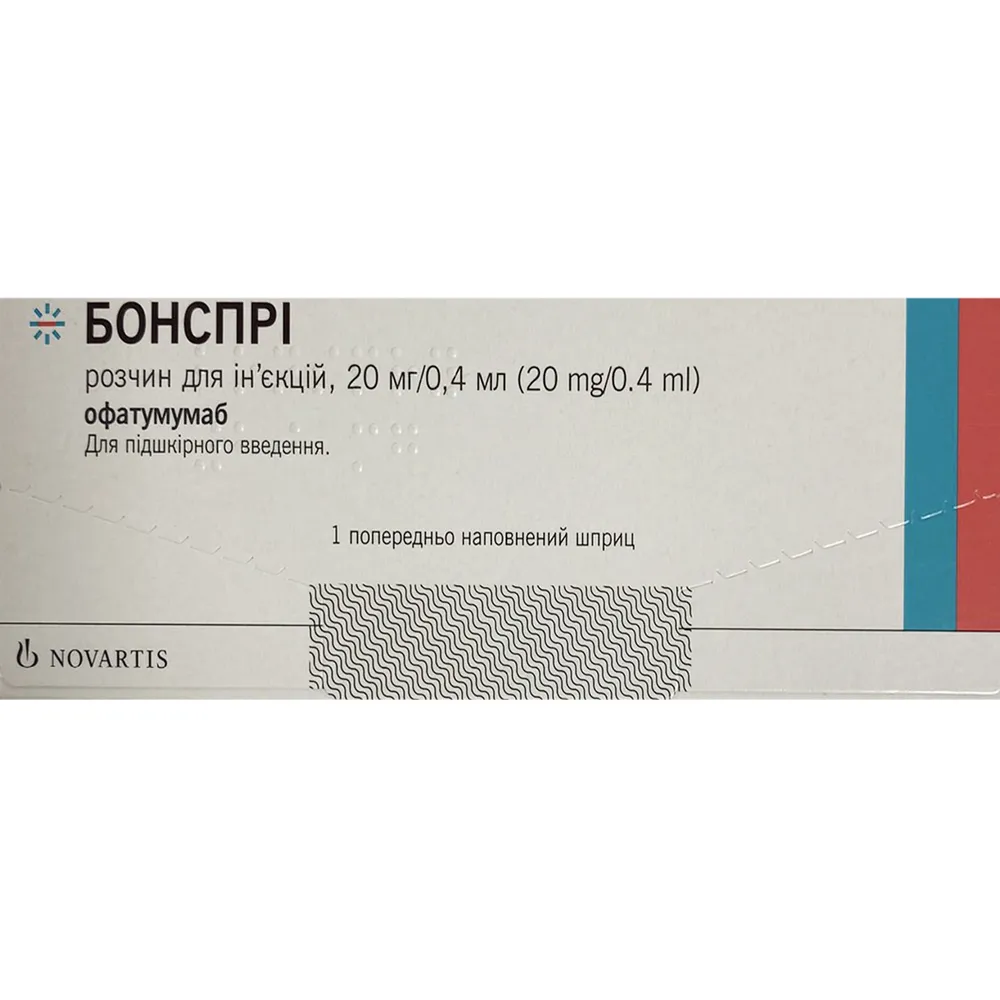
Table of Contents
INSTRUCTIONS FOR MEDICAL USE OF THE MEDICINAL PRODUCT BONSPRI (BONSPRI)
Composition:
Active substance: ofatumumab;
1 pre-filled syringe contains 20 mg of ofatumumab in 0.4 ml of solution (50 mg/ml);
Ofatumumab is a fully human monoclonal antibody produced in mouse cell line (NS0) using recombinant DNA technology.
Excipients: arginine; sodium acetate, trihydrate; sodium chloride; polysorbate 80; edetate disodium; hydrochloric acid, diluted; water for injections.
Pharmaceutical form. Solution for injection, 20 mg/0.4 ml.
Main physicochemical properties: from transparent to slightly opalescent, colorless or slightly brownish-yellow solution.
Pharmacotherapeutic group. Antineoplastic and immunomodulating agents. Immunosuppressants. Selective immunosuppressants. ATC code L04A A52.
Pharmacological Properties
Pharmacodynamics
Mechanism of Action
Ofatumumab is a fully human anti-CD20 monoclonal antibody of the immunoglobulin G1 (IgG1) isotype with a theoretical average molecular mass of 145 kDa. The CD20 molecule is a transmembrane phosphoprotein expressed on B-lymphocytes from the pre-B-cell stage through to mature B-cells. CD20 is also expressed on a small fraction of activated T-cells. Subcutaneous administration of ofatumumab and subsequent release/absorption from tissue enables gradual interaction with B-cells.
Binding of ofatumumab to CD20 induces lysis of CD20+ B-cells, primarily through complement-dependent cytotoxicity (CDC) and, to a lesser extent, through antibody-dependent cellular cytotoxicity (ADCC). Ofatumumab has also been shown to induce lysis of cells with both high and low CD20 expression. Ofatumumab also causes depletion of CD20-expressing T-cells. Subcutaneous administration of ofatumumab and subsequent release/absorption from tissue enables gradual interaction with B-cells.
Pharmacodynamic Effects
B-cell Depletion
In clinical studies involving patients with relapsing-remitting multiple sclerosis (RRMS) receiving ofatumumab 20 mg every 4 weeks following an initial loading dose of 20 mg on Days 1, 7, and 14, treatment resulted in rapid and sustained reduction of B-cells to levels below the lower limit of quantification (LLOQ), defined as 40 cells/µL, within just 2 weeks of treatment initiation. By the start of the maintenance phase at Week 4, 94% of patients achieved total B-cell counts <10 cells/µL, increasing to 98% by Week 12 and maintained up to Week 120 (i.e., throughout the treatment period within the study).
B-cell Repopulation
Results from Phase III clinical studies in patients with RRMS indicate that the median time to B-cell repopulation to LLOQ or baseline levels was 24.6 weeks after treatment discontinuation. Pharmacokinetic (PK) modeling and B-cell repopulation data confirm these findings, with a predicted median time to B-cell repopulation to LLOQ of 23 weeks after treatment cessation.
Immunogenicity
In Phase III clinical studies involving patients with RRMS, the overall incidence of anti-drug antibodies (ADA) was 0.2% (2 out of 914) in patients treated with ofatumumab, with no cases of ADA enhancement or neutralization observed. The impact of positive ADA titers on pharmacokinetics, safety profile, or B-cell kinetics could not be evaluated due to the low incidence of ADA associated with ofatumumab.
Clinical Efficacy and Safety
The efficacy and safety of ofatumumab were evaluated in two randomized, double-blind, active-controlled Phase III studies with identical designs (Study 1 [ASCLEPIOS I] and Study 2 [ASCLEPIOS II]) involving patients with relapsing forms of multiple sclerosis (RRMS) aged 18 to 55 years, with disability scores on the Expanded Disability Status Scale (EDSS) ranging from 0 to 5.5, and who had documented at least one relapse in the prior year or two relapses in the previous two years, or a positive gadolinium-enhanced MRI scan in the prior year. The studies included both patients with newly diagnosed disease and those switching from current treatment regimens.
In both studies, 927 and 955 RRMS patients were randomized in a 1:1 ratio to receive either ofatumumab 20 mg administered as subcutaneous injections every 4 weeks, starting from Week 4 after an initial three-dose loading regimen of 20 mg weekly during the first 14 days (on Days 1, 7, and 14), or oral teriflunomide 14 mg once daily. Patients also received corresponding placebo regimens to maintain study blinding (double dummy).
Treatment duration for each patient varied depending on meeting study completion criteria. In both studies, the median duration of treatment was 85 weeks: 33.0% of patients in the ofatumumab group compared to 23.2% in the teriflunomide group received treatment for more than 96 weeks.
Demographic and baseline characteristics were balanced across treatment groups in both studies (see Table 1). Mean age was 38 years, mean disease duration was 8.2 years from first symptom onset, and mean EDSS score was 2.9; 40% of patients had not previously received disease-modifying therapy (DMT), and 40% had gadolinium-enhancing lesions on baseline T1-weighted MRI scans.
The primary efficacy endpoint in both studies was the annualized relapse rate (ARR) based on the EDSS disability scale. Key secondary efficacy endpoints included time to confirmed disability progression on the EDSS (confirmed at 3 and 6 months), defined as an increase in EDSS score of ≥1.5, ≥1, or ≥0.5 from baseline in patients with baseline EDSS scores of 0, 1–5, or ≥5.5, respectively. Other key secondary endpoints included the number of gadolinium-enhancing lesions on T1-weighted MRI and the annualized rate of new or enlarging T2-weighted lesions. Key disability-related secondary endpoints were assessed in a meta-analysis of pooled data from the ASCLEPIOS studies (Study 1 and Study 2), as specified in the study protocols.
Demographic and Baseline Characteristics
Table 1
| Characteristics |
Study 1 (ASCLEPIOS I) |
Study 2 (ASCLEPIOS II) |
||
| Ofatumumab (N=465) |
Teriflunomide (N=462) |
Ofatumumab (N=481) |
Teriflunomide (N=474) |
|
| Age (mean ± standard deviation; years) |
39±9 |
38±9 |
38±9 |
38±9 |
| Sex (female; %) |
68.4 |
68.6 |
66.3 |
67.3 |
| Duration of MS since diagnosis (mean/median; years) |
5.77/3.94 |
5.64/3.49 |
5.59/3.15 |
5.48/3.10 |
| Prior disease-modifying therapy (%) |
58.9 |
60.6 |
59.5 |
61.8 |
| Number of relapses in the prior 12 months |
1.2 |
1.3 |
1.3 |
1.3 |
| EDSS score (mean/median) |
2.97/3.00 |
2.94/3.00 |
2.90/3.00 |
2.86/2.50 |
| Mean total lesion volume on T2-weighted MRI (cm³) |
13.2 |
13.1 |
14.3 |
12.0 |
| Patients with gadolinium-enhancing lesions on T1-weighted MRI (%) |
37.4 |
36.6 |
43.9 |
38.6 |
| Number of gadolinium-enhancing lesions on T1-weighted MRI (mean) |
1.7 |
1.2 |
1.6 |
1.5 |
The efficacy results from both studies are presented in Table 2 and Figure 1.
In both Phase III studies, ofatumumab demonstrated a significant reduction in annualized relapse rates by 50.5% and 58.4%, respectively, compared to teriflunomide.
A pre-specified meta-analysis of pooled data showed that ofatumumab significantly reduced the risk of confirmed disability progression at 3 months by 34.3% and at 6 months by 32.4% compared to teriflunomide (see Figure 1).
Ofatumumab significantly reduced the number of gadolinium-enhancing lesions on T1-weighted MRI by 95.9% and the frequency of new or enlarging lesions on T2-weighted MRI by 83.5% compared to teriflunomide (these values represent the mean reduction across the combined studies).
Similar effects of ofatumumab compared to teriflunomide were observed across key efficacy outcomes in both Phase III studies within predefined subgroups defined by sex, age, body weight, prior non-steroidal immunomodulatory therapy for MS, baseline disability level, and disease activity.
Overview of main results from Phase III studies in RRMS
Table 2
| Endpoints |
Study 1 (ASCLEPIOS I) |
Study 2 (ASCLEPIOS II) |
||
| Ofatumumab 20 mg (n=465) |
Teriflunomide 14 mg (n=462) |
Ofatumumab 20 mg (n=481) |
Teriflunomide 14 mg (n=474) |
|
| Endpoints in individual studies |
||||
| Annualized relapse rate (ARR) (primary endpoint)1 |
0.11 |
0.22 |
0.10 |
0.25 |
| Rate reduction |
50.5 % (p<0.001) |
58.4 % (p<0.001) |
||
| Mean number of gadolinium-enhancing T1-weighted lesions on MRI Relative reduction |
0.0115 |
0.4555 |
0.0317 |
0.5172 |
| 97.5 % (p<0.001) |
93.9 % (p<0.001) |
|||
| Number of new or enlarging T2-weighted lesions per year |
0.72 |
4.00 |
0.64 |
4.16 |
| Relative reduction |
81.9 % (p<0.001) |
84.5 % (p<0.001) |
||
| Endpoints based on pre-specified meta-analysis |
||||
| Patients with confirmed disability progression at 3 months, %2 Risk reduction |
10.9 % of patients in the ofatumumab group vs. 15.0 % of patients in the teriflunomide group 34.3 % (p=0.003) |
|||
| Patients with confirmed disability progression at 6 months, %2 Risk reduction |
8.1 % of patients in the ofatumumab group vs. 12.0 % of patients in the teriflunomide group 32.4 % (p=0.012) |
|||
|
||||
Fig. 1. Time to first confirmed disability progression due to
- months after treatment (Combined Studies 1 and 2 ASCLEPIOS, full analysis set of patients)
| Kaplan-Meier estimated cumulative event rate |
| Teriflunomide |
| Ofatumumab |
| Reduction of risk: |
Month of the study
Number of patients at risk
Ofatumumab 944 908 878 844 810 784 533 319 176 49 1 0
Teriflunomide 932 901 841 804 756 718 477 297 146 41 1 0
1 The numbers on the curves represent Kaplan–Meier estimates of event risk over 24 months (indicated by the vertical dashed line).
In phase III studies, the percentage of patients with adverse events (AEs) (83.6 % vs. 84.2 %) and AEs leading to discontinuation of treatment (5.7 % vs. 5.2 %) was similar in the ofatumumab and teriflunomide groups.
Children
The European Medicines Agency has waived the obligation for the company to submit the results of studies with Bonspri in one or more pediatric subpopulations for the treatment of multiple sclerosis (for information on use in children, see section "Posology and method of administration").
Pharmacokinetics
Absorption
After subcutaneous administration, ofatumumab has a prolonged release/absorption profile (Tmax 4.3 days) and is predominantly absorbed via the lymphatic system.
Subcutaneous administration of a 20 mg monthly dose results in a mean AUCtau of 483 µg*h/mL and a mean Cmax of 1.43 µg/mL at steady state.
Distribution
The estimated volume of distribution at steady state was 5.42 litres after repeated subcutaneous administration of 20 mg ofatumumab.
Metabolism
Ofatumumab is a protein, and its expected metabolic pathway is degradation into small peptides and amino acids by ubiquitous proteolytic enzymes.
Elimination
Ofatumumab is eliminated via two pathways: target-mediated clearance related to B-cell binding, and target-independent clearance mediated by non-specific endocytosis followed by intracellular catabolism, as with other IgG molecules.
Baseline B-cells led to greater target-mediated clearance of ofatumumab at the beginning of treatment. Administration of ofatumumab results in significant B-cell depletion, leading to reduced overall clearance.
The terminal half-life at steady state was approximately 16 days after repeated subcutaneous administration of ofatumumab 20 mg.
Linearity/Non-linearity
The pharmacokinetics of ofatumumab are non-linear due to decreasing clearance over time.
Special patient groups
Elderly patients (aged 55 years and older)
No specific pharmacokinetic studies of ofatumumab in patients aged 55 years and older were conducted due to limited clinical experience (see section "Posology and method of administration").
Children
Pharmacokinetic studies of ofatumumab in pediatric patients under 18 years of age have not been conducted.
Gender
In a population cross-study analysis, the effect of gender (12 %) on the volume of distribution of the central compartment was minor, with higher Cmax and AUC values observed in women (in this analysis, 48 % of patients were male and 52 % female); these effects are not considered clinically significant, and dose adjustment is not required.
Body weight
Based on the results of a population pharmacokinetic analysis, body weight was identified as a covariate influencing ofatumumab exposure (Cmax and AUC) in patients with RRMS. However, body weight did not affect safety and efficacy outcomes assessed in clinical studies; therefore, dose adjustment is not required.
Renal impairment
No specific studies of ofatumumab in patients with renal impairment have been conducted.
Patients with mild renal impairment were included in clinical trials. There is no experience with ofatumumab in patients with moderate or severe renal impairment. However, since ofatumumab is not excreted in urine, dose adjustment in patients with renal impairment is not required.
Hepatic impairment
Ofatumumab has not been studied in patients with hepatic impairment.
Since hepatic metabolism of monoclonal antibodies such as ofatumumab is negligible, hepatic impairment is not expected to affect its pharmacokinetics. Therefore, dose adjustment in patients with hepatic impairment is not required.
Preclinical safety data
Preclinical data obtained from traditional repeated-dose toxicity studies, including pharmacological safety studies, do not indicate any specific hazard for humans.
Carcinogenicity or mutagenicity studies of ofatumumab have not been conducted. Since ofatumumab is an antibody, direct interaction of ofatumumab with DNA is not expected.
Embryo-fetal development (EFD) studies and extended pre- and postnatal development (ePPND) studies in monkeys showed that intravenous administration of ofatumumab during pregnancy did not result in maternal toxicity, teratogenicity, or adverse effects on embryo-fetal and pre- and postnatal development.
In these studies, ofatumumab was detected in fetal and neonatal blood, confirming its ability to cross the placenta and demonstrating that the effect of ofatumumab on the fetus persists after birth (due to the long half-life of monoclonal antibodies). Ofatumumab administration during pregnancy caused expected depletion of CD20+ B-cells in female animals, their fetuses, and offspring, as well as reduced spleen weight (without histological correlation) in fetuses and reduced humoral immune response to keyhole limpet hemocyanin in offspring after high-dose administration. All these changes may be reversible within a six-month postnatal period. Early postnatal mortality in offspring was observed at doses exceeding the therapeutic dose by 160 times (based on AUC), likely related to possible infection due to immunomodulation. The exposure level at which no adverse effect was observed (NOAEL) related to the pharmacological activity of ofatumumab in offspring in the ePPND study established a safety margin based on AUC at least 22 times higher than that in mothers, with maternal exposure within the NOAEL range, comparable to human exposure at the therapeutic dose of 20 mg monthly.
In a dedicated fertility study in monkeys, no effects on fertility endpoints in male and female animals were observed.
Clinical characteristics.
Indications.
BONSPRI is indicated for the treatment of adult patients with relapsing forms of multiple sclerosis (RMS) with active disease, defined by clinical or imaging features.
Contraindications.
Hypersensitivity to the active substance or to any of the excipients listed in the section "Composition".
Patients with severe immunodeficiency (see section "Special precautions").
Severe active infection until resolved (see section "Special precautions").
Known active malignancy.
Interaction with other medicinal products and other forms of interaction.
Interaction studies have not been conducted, as no interactions involving cytochrome P450 enzymes, other metabolizing enzymes, or transporters are expected.
Immunization
The safety or ability to elicit primary or anamnestic (secondary) immune response to vaccination with live, live-attenuated, or inactivated vaccines during ocrelizumab treatment has not been studied. Immune response to vaccines may be impaired when B-cells are depleted. Patients are recommended to complete vaccination prior to starting ocrelizumab treatment (see section "Special precautions").
Other immunosuppressive or immunomodulatory therapies
Concomitant use of immunosuppressive agents with ocrelizumab may result in additive immunosuppressive effects; therefore, such combination should be considered with caution.
If initiating ocrelizumab therapy after prior immunosuppressive therapy with prolonged immune system effects, or initiating another immunosuppressive therapy with prolonged immune system effects after ocrelizumab, the duration and mechanism of action of these medicinal products should be taken into account due to potential additive immunosuppressive effects (see section "Pharmacodynamics").
Special precautions for use.
Traceability
In order to improve the traceability of biological medicinal products, the name and batch number of the administered medicinal product should be clearly recorded.
Injection-related reactions
Patients should be informed about the possible occurrence of (systemic) injection-related reactions, generally within 24 hours and mainly after the first injection (see section "Side effects").
Limited benefit of premedication with steroids has been observed in RRMS studies. In case of injection-related reactions, they can be managed with symptomatic treatment. Therefore, premedication is not required.
Symptoms of (local) injection site reactions observed in clinical trials included erythema, swelling, pruritus, and pain (see section "Side effects").
The first injection should be administered under the direct supervision of a properly trained healthcare professional (see section "Dosage and administration").
Infections
Immune status assessment of patients is recommended prior to initiation of treatment.
Due to the mechanism of action and available clinical experience, ofatumumab may increase the risk of infections (see section "Side effects").
Administration of ofatumumab should be postponed in patients with active infection until complete resolution.
Ofatumumab should not be administered to patients with severe immunodeficiency (e.g., profound neutropenia or lymphopenia).
Progressive multifocal leukoencephalopathy
Cases of infection with John Cunningham virus (JCV), leading to progressive multifocal leukoencephalopathy (PML), have been observed in patients treated with anti-CD20 monoclonal antibodies, other MS treatments, and ofatumumab at much higher doses for cancer treatment. Therefore, physicians should carefully monitor for a history of PML and any clinical symptoms or MRI findings suggestive of PML. If PML is suspected, ofatumumab treatment should be discontinued until PML is completely ruled out.
Hepatitis B reactivation
Hepatitis B virus reactivation may occur in patients receiving anti-CD20 monoclonal antibody therapy, which in some cases may lead to fulminant hepatitis, liver failure, and fatal outcomes.
Ofatumumab should not be administered to patients with active hepatitis B. All patients should be screened for hepatitis B prior to initiation of treatment. Screening should at minimum include testing for hepatitis B surface antigen (HBsAg) and hepatitis B core antibody (HBcAb). These tests may be supplemented with other specific markers according to local guidelines. Patients with positive serological tests for hepatitis B (HBsAg or HBcAb) should consult a hepatologist prior to initiating treatment and require close monitoring and management according to medical standards to prevent hepatitis B reactivation.
Treatment of patients with severe immunodeficiency
The medicinal product should not be administered to patients with severe immunodeficiency until their condition improves (see section "Contraindications").
Concomitant use of immunosuppressants with ofatumumab, other than corticosteroids, for symptomatic treatment of relapses is not recommended.
Vaccination
All live or live attenuated vaccines should be administered in accordance with vaccination recommendations at least 4 weeks prior to initiation of ofatumumab treatment, and, if possible, inactivated vaccines at least 2 weeks prior to starting ofatumumab treatment.
Ofatumumab may affect the efficacy of inactivated vaccines.
The safety of vaccination with live or live attenuated vaccines after ofatumumab administration has not been studied. Vaccination with live or live attenuated vaccines is not recommended during and after discontinuation of treatment until B-cell counts have recovered (see section "Interaction with other medicinal products and other forms of interaction"). Based on phase III study results, the median time to B-cell count recovery to the lower limit of normal (LLN, defined as 40 cells/µL) or baseline level was 24.6 weeks after treatment discontinuation (see section "Pharmacodynamics").
Vaccination of infants born to mothers who received ofatumumab during pregnancy
Live or live attenuated vaccines should not be administered to infants born to mothers who received ofatumumab during pregnancy until B-cell recovery is confirmed. B-cell depletion in these infants may increase the risk associated with the use of live or live attenuated vaccines.
Inactivated vaccines may be administered according to clinical indications even before recovery of depleted B-cell counts; however, assessment of immune response to vaccination should be considered, including consultation with a qualified specialist, to determine whether a protective immune response has been achieved (see section "Use during pregnancy or breastfeeding").
Sodium content
This medicinal product contains less than 1 mmol sodium (23 mg) per dose, i.e., essentially "sodium-free".
Use during pregnancy or breastfeeding.
Women of childbearing potential
Women of childbearing potential should use effective contraception (methods resulting in less than 1% pregnancy rate) during treatment with BONSPRI and for 6 months after the last dose of BONSPRI.
Pregnancy
Currently, there are limited data on the use of ofatumumab in pregnant women. Animal studies indicate that ofatumumab can cross the placenta and cause B-cell depletion in the fetus, based on studies in animals. Teratogenicity was not observed in pregnant monkeys after intravenous administration of ofatumumab during organogenesis.
Transient depletion of peripheral B-cells and lymphopenia have been reported in infants born to mothers who received other anti-CD20 monoclonal antibodies during pregnancy. The duration of B-cell depletion in infants exposed to ofatumumab in utero and the impact of B-cell depletion on the safety and efficacy of vaccines are unknown (see sections "Special precautions for use" and "Pharmacodynamics").
Ofatumumab may be prescribed for treatment during pregnancy only if the potential benefit to the mother outweighs the potential risks to the fetus.
To help determine the effects of ofatumumab in pregnant women, healthcare professionals are recommended to report any cases of pregnancy and complications occurring during treatment or within 6 months after the last dose of ofatumumab to the local representative of the marketing authorization holder, enabling continued monitoring of these patients through the Pregnancy Registry and Intensive Monitoring (PRIM) program. Additionally, all adverse reactions occurring during pregnancy must be reported through the national reporting system.
Breastfeeding
The use of ofatumumab in women during breastfeeding has not been studied. It is unknown whether ofatumumab passes into human breast milk. In humans, IgG antibodies pass into breast milk during the first few days after birth and then rapidly decline to low levels. Therefore, a risk to the infant during this short period cannot be excluded. Thereafter, ofatumumab may be used during breastfeeding according to clinical indications. However, if patients received ofatumumab during the last few months of pregnancy, breastfeeding may be initiated immediately after delivery.
Fertility
There are no data on the effect of ofatumumab on human fertility.
Preclinical data do not indicate a potential hazard to humans with regard to male and female fertility parameters studied in monkeys.
Ability to affect reaction speed when driving or operating machinery.
BONSPRI has no or negligible effect on the ability to drive and use machines.
Method of Administration and Dosage
BONSPRY must be administered under the supervision of a physician experienced in the management of neurological disorders.
Dosage
The recommended dose is 20 mg of ofatumumab administered as subcutaneous injections as follows:
- Initially, administer the drug at Week 0, Week 1, and Week 2, followed by subsequent dosing;
- Once monthly, starting from Week 4.
Missed Dose
If a scheduled dose is missed, administration should be carried out as soon as possible, without waiting for the next scheduled dose. Subsequent doses should be administered according to the established dosing schedule.
Special Populations
Elderly Patients (aged 55 years and older)
Clinical studies in patients aged 55 years and older with MS have not been conducted. Based on the limited available data, dose adjustment in patients aged 55 years and older is not required (see section "Pharmacokinetics").
Renal Impairment
Dose adjustment is not required for patients with renal impairment (see section "Pharmacokinetics").
Hepatic Impairment
Dose adjustment is not required for patients with hepatic impairment (see section "Pharmacokinetics").
Method of Administration
This medicinal product is intended for self-administration as a subcutaneous injection.
The most common sites for subcutaneous injection are the abdomen, thigh, and upper arm.
The first injection should be performed under direct supervision of a healthcare professional (see section "Special Warnings and Precautions for Use").
Children
The safety and efficacy of BONSPRY in children aged 0 to 18 years have not been established. Data are lacking.
Overdose
Doses up to 700 mg without dose-limiting toxic effects have been administered in clinical trials to patients with multiple sclerosis. In the event of overdose, monitoring of the patient for the development of signs or symptoms of adverse reactions is recommended, along with appropriate symptomatic treatment.
Ofatumumab has previously been used in the treatment of chronic lymphocytic leukemia (CLL) at doses up to 2000 mg, which should be administered via intravenous infusion. Subcutaneous administration of ofatumumab has not been studied and is not approved for these indications. Ofatumumab should not be used for the treatment of cancer.
Adverse reactions.
Summary of safety profile
The most important and most common adverse reactions include upper respiratory tract infections (39.4%), systemic reactions related to injection (20.6%), injection site reactions (10.9%), and urinary tract infections (11.9%) (for additional information, see section "Special warnings and precautions for use" and subsection "Description of selected adverse reactions" below).
List of adverse reactions in tabular form
Adverse reactions associated with ofatumumab use reported in the main clinical trials in RRMS are listed in Table 3 according to MedDRA terminology by System Organ Class. Within each System Organ Class, adverse reactions are sorted by frequency, with the most frequent ones listed first. Within each frequency category, adverse reactions are presented in order of decreasing severity. Additionally, based on the incidence of occurrence, adverse reactions were categorized as follows: very common (≥1/10); common (≥1/100 to <1/10); uncommon (≥1/1000 to <1/100); rare (≥1/10000 to <1/1000); very rare (<1/10000).
List of adverse reactions in tabular form
Table 3
| Infections and infestations |
|
| Very common |
Upper respiratory tract infections1 Urinary tract infections2 |
| Common |
Oral herpes |
| Systemic and administration site conditions |
|
| Very common |
Injection site reactions (local) |
| Injury, poisoning and procedural complications |
|
| Very common |
Injection-related reactions (systemic) |
| Abnormal laboratory test results |
|
| Common |
Decreased blood immunoglobulin M levels |
|
|
Description of individual adverse reactions
Infections
In phase III clinical studies in patients with RRMS, the overall incidence of infections and serious infections was similar in patients receiving ofatumumab compared to those receiving teriflunomide (51.6% vs. 52.7% and 2.5% vs. 1.8%, respectively). Two patients (0.2%) discontinued treatment, and 11 patients (1.2%) had treatment interrupted due to a serious infection.
Upper respiratory tract infections
In these studies, upper respiratory tract infections occurred in 39.4% of patients receiving ofatumumab compared to 37.8% of patients receiving teriflunomide. Infections were mainly mild to moderate in severity, with nasopharyngitis, upper respiratory tract infection, and influenza being the most commonly reported.
Injection-related reactions
In phase III clinical studies in patients with RRMS, injection-related (systemic) reactions were observed in 20.6% of patients receiving ofatumumab.
The frequency of injection-related reactions was highest with the first injection (14.4%), decreased substantially with subsequent injections (4.4% after the second injection, <3% after the third injection), and were predominantly mild to moderate in severity (99.8%). Two patients (0.2%) with MS receiving ofatumumab reported serious, but non-life-threatening, injection-related reactions. The most commonly reported symptoms (≥2%) included fever, headache, myalgia, chills, and fatigue.
Injection site reactions
In phase III clinical studies in patients with RRMS, injection-related (local) reactions were observed in 10.9% of patients receiving ofatumumab.
Local reactions at the injection site were very common. Injection site reactions were generally mild to moderate in severity and non-serious. The most commonly reported symptoms (>2%) included erythema, pain, pruritus, and swelling.
Laboratory abnormalities
Immunoglobulins
In phase III clinical studies in patients with RRMS, a reduction in mean immunoglobulin M (IgM) concentrations was observed (a decrease of 30.9% at 48 weeks and 38.8% at 96 weeks), but no association was observed with the risk of developing infections, including serious infections.
In 14.3% of patients, ofatumumab treatment led to a reduction in IgM levels below 0.34 g/L.
Ofatumumab was associated with a transient reduction in mean immunoglobulin G (IgG) concentrations by 4.3% at 48 weeks of treatment, followed by a 2.2% increase at 96 weeks.
Reporting of suspected adverse reactions
Reporting suspected adverse reactions after authorization of the medicinal product is important. It allows continued monitoring of the benefit-risk balance of the medicinal product. Healthcare professionals, as well as patients or their legal representatives, should report any suspected adverse reactions and lack of efficacy of the medicinal product via the Automated Information System for Pharmacovigilance at the following link: https://aisf.dec.gov.ua.
Shelf life. 3 years.
Storage conditions.
Store in a refrigerator (2–8 °C). Do not freeze.
When necessary, the medicinal product BONSPRY may be stored outside the refrigerator for a single period of up to 7 days at room temperature (not above 30 °C). If the medicinal product BONSPRY is not used within this period, it may be returned to the refrigerator for up to 7 days.
Keep the pre-filled syringe in its outer packaging to protect from light.
Packaging.
0.4 mL of solution in a pre-filled syringe; 1 pre-filled syringe in a plastic blister tray; 1 or 3 blister trays in a cardboard box.
Prescription status.
Prescription only.
Manufacturer.
Novartis Pharma Stein AG.
Manufacturer's address and location of its business operations.
Schaffhauserstrasse, 4332 Stein, Switzerland.