Blissel
Ukraine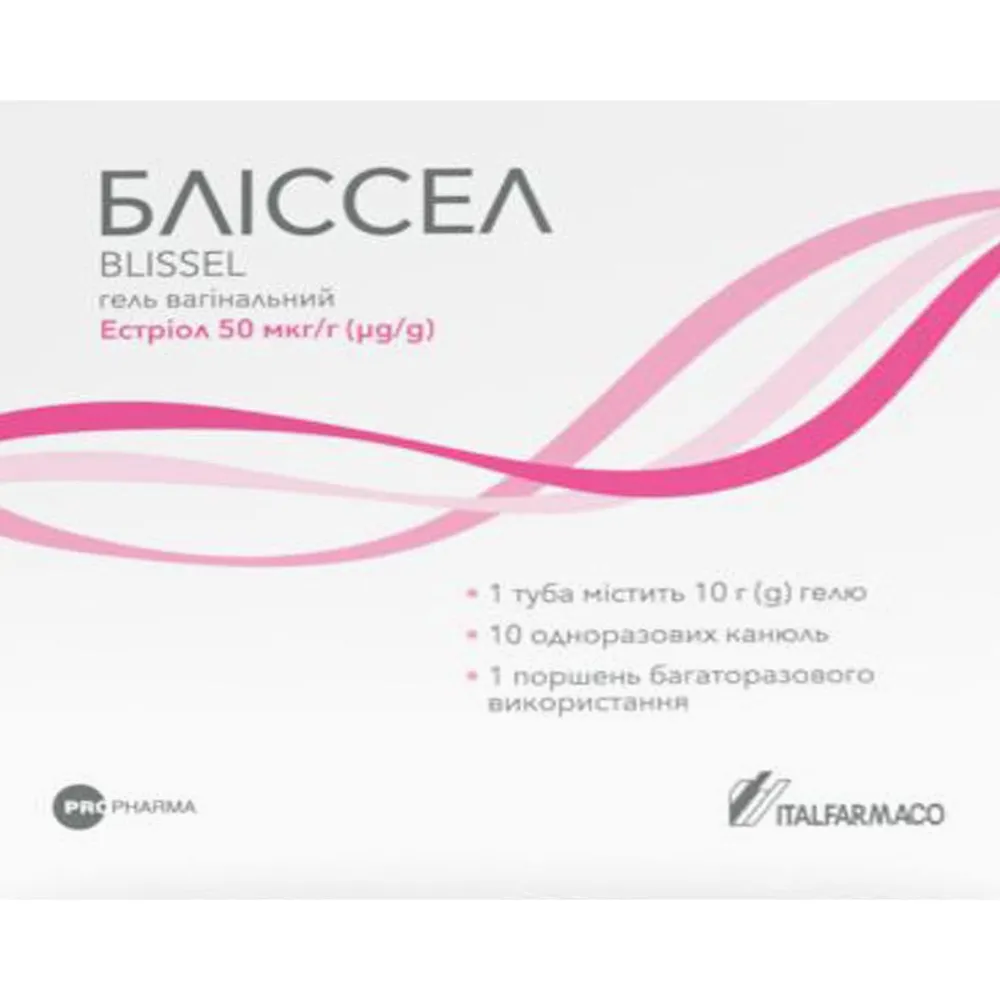
Table of Contents
INSTRUCTIONS FOR MEDICAL USE OF THE MEDICINAL PRODUCT BLISSEL (BLISSEL)
Composition:
Active substance: estriol;
1 g of vaginal gel contains 50 μg of estriol;
Excipients: polycarbophil, carbopol 971P, glycerin, sodium methylparahydroxybenzoate (E 219), sodium propylparahydroxybenzoate (E 217), hydrochloric acid, sodium hydroxide, purified water.
Pharmaceutical form. Vaginal gel.
Main physicochemical properties: homogeneous, colorless, from transparent to slightly opalescent gel, free from visible or palpable particles.
Pharmacotherapeutic group. Sex hormones and drugs used in disorders of the reproductive system. Natural and semisynthetic estrogens. Estriol.
ATC code G03C A04.
Pharmacological Properties
Pharmacodynamics
Treatment of vaginal symptoms of estrogen deficiency: vaginal administration of estrogen alleviates symptoms of vaginal atrophy in postmenopausal women due to estrogen deficiency.
Clinical efficacy and safety
The efficacy of the medicinal product Blissel, vaginal gel, 50 µg/g, was evaluated in a multicenter, randomized, double-blind, placebo-controlled study involving postmenopausal women with symptoms and signs of vulvovaginal atrophy.
Intravaginal administration of a low dose of estriol (50 micrograms per application) resulted in significant improvement in vaginal epithelial maturation indices, vaginal pH, and reduction in signs of vaginal atrophy such as friability/fragility, dryness, pallor of the mucosa, and flattening of mucosal folds. In the symptom-based responder analysis (secondary endpoint), statistical significance was achieved for vaginal dryness, but not for dyspareunia (p = 0.095), vaginal itching, burning, or dysuria after 12 weeks of treatment.
Pharmacokinetics
After a single administration of the medicinal product Blissel, vaginal gel, 50 µg/g, estriol is readily absorbed and peak plasma concentrations of estriol reach 106 ± 63 pg/mL at 2 (range 0.5–4) hours.
After 21 days of daily treatment with Blissel vaginal gel, 50 µg/g, the mean peak plasma concentration of estriol (± standard deviation) was 22.80 (±15.78) pg/mL. After reaching peak levels, estriol plasma concentration declines monoexponentially with a mean elimination half-life of 1.65 ± 0.82 hours; no accumulation occurs.
Systemic exposure to estriol during administration of Blissel, vaginal gel, 50 µg/g, twice weekly has not been investigated.
In plasma, estriol is almost entirely (90%) bound to albumin and shows almost no interaction with sex hormone-binding globulin. The metabolism of estriol primarily involves conjugation and deconjugation during enterohepatic circulation. Estriol is predominantly excreted in urine in conjugated form. Only a minor fraction (≤ 2%) is excreted in feces, mainly as unconjugated estriol.
Preclinical safety data
The toxicity profile of estriol is well known. There are no additional preclinical safety data beyond those already discussed in other sections.
Clinical characteristics.
Indications.
For the treatment of symptoms of vaginal atrophy related to estrogen deficiency in postmenopausal women.
Contraindications.
- Established, previous, or suspected breast cancer.
- Established or suspected estrogen-dependent malignant tumors (e.g., endometrial cancer).
- Vaginal bleeding of unknown etiology.
- Untreated endometrial hyperplasia.
- Previous idiopathic or current venous thromboembolism (deep vein thrombosis, pulmonary embolism).
- Active or recent arterial thromboembolism (e.g., angina pectoris, myocardial infarction).
- Established thrombophilic disorders (e.g., protein C deficiency, protein S deficiency, or antithrombin deficiency) (see «Special precautions»).
- Acute liver disease or liver disease in medical history until liver function tests return to normal levels.
- Hypersensitivity to the active substance or to any of the excipients.
- Porphyria.
Interaction with other medicinal products and other forms of interactions.
No interaction studies between the medicinal product Blisseal, vaginal gel, 50 mcg/g, and other medicinal products have been conducted. Due to local administration and minimal systemic absorption, it is unlikely that any clinically significant drug interaction with Blisseal will occur. However, potential interactions with other locally acting vaginal medicinal products should be considered.
Special precautions for use.
For the treatment of postmenopausal symptoms, local estrogen therapy should only be initiated if symptoms negatively affect quality of life.
In all cases, the risks and benefits should be carefully evaluated at least once a year, and hormone replacement therapy (HRT) should only be continued as long as the benefits of treatment outweigh the risks.
The medicinal product Blissel, vaginal gel, 50 mcg/g, must not be combined with systemic estrogen preparations, as safety and risk data regarding estrogen concentrations achieved with combined therapy are lacking.
The intravaginal applicator, consisting of a single-use cannula and a reusable plunger, may cause minor local trauma, particularly in women with severe vaginal atrophy.
Medical examination / follow-up
Before initiating or restarting/repeating treatment with estriol, a complete personal and family medical history should be obtained. A physical examination (including pelvic organs and breasts) should be performed, taking into account the patient's history, contraindications, and warnings related to the use of the medicinal product. During treatment, periodic medical examinations of the patient are recommended, the frequency and nature of which depend on individual characteristics. Women should be informed about which changes in the breasts they should report to their physician or nurse (see "Breast cancer").
Screening examinations, including mammography, should be performed according to current screening practices, adjusted according to the individual clinical needs of the patient. If vaginal infections are present, they should be treated prior to initiating therapy with Blissel vaginal gel, 50 mcg/g.
Conditions requiring medical monitoring
If any of the conditions listed below are present, have occurred previously, and/or worsened during pregnancy or previous hormonal therapy, careful monitoring of the patient is required, as these conditions may recur or worsen during treatment with vaginal gel:
- leiomyoma (uterine fibroids) or endometriosis;
- risk factors for thromboembolic disorders (see "Venous thromboembolism");
- risk factors for estrogen-dependent tumors, e.g., family history of breast cancer in first-degree relatives;
- hypertension;
- liver disease (e.g., hepatoadenoma);
- diabetes mellitus with or without diabetic angiopathy;
- gallstone disease;
- migraine or severe headache;
- systemic lupus erythematosus (SLE);
- history of endometrial hyperplasia (see "Endometrial hyperplasia and carcinoma");
- epilepsy;
- asthma;
- otosclerosis.
Reasons for immediate discontinuation of treatment
Treatment should be immediately discontinued if any contraindication is detected, or in the following situations:
- jaundice or worsening liver function;
- significant increase in blood pressure;
- new onset of migraine-type headache;
- pregnancy.
Blissel, vaginal gel, 50 mcg/g, is a locally acting medicinal product with a low dose of estriol; therefore, the occurrence of the conditions listed below is less likely than with systemic estrogen therapy.
Endometrial hyperplasia and carcinoma
- In women with an intact uterus, the risk of endometrial hyperplasia and carcinoma increases with prolonged use of systemic estrogens alone.
- Progestogen-containing medicinal products are not recommended in combination with estrogen-containing vaginal preparations when systemic estrogen exposure remains within the normal postmenopausal range.
- The endometrial safety of long-term (more than one year) or repeated use of estrogen-containing vaginal products is unknown. Therefore, if repeated treatment courses are required, the need for continued therapy should be reviewed at least annually.
- If breakthrough bleeding or spotting occurs during therapy, the cause should be investigated, including diagnostic procedures such as endometrial biopsy, to exclude malignant endometrial tumors.
- Unopposed estrogen stimulation may lead to premalignant transformation of residual endometriosis foci. Therefore, caution should be exercised when prescribing this medicinal product to women who have undergone hysterectomy due to endometriosis, especially if residual endometriosis is present.
The risks listed below are associated with systemic HRT and are less relevant to estrogen-containing vaginal preparations where systemic estrogen exposure remains within the normal postmenopausal range. However, these risks should be considered in cases of long-term or repeated use of this medicinal product.
Breast cancer
Epidemiological data from a large meta-analysis indicate no increased risk of breast cancer with the use of low-dose estrogen-containing vaginal preparations in women without a history of breast cancer. It is unknown whether low-dose estrogen-containing vaginal preparations stimulate the recurrence of breast cancer.
Ovarian cancer
Ovarian cancer occurs much less frequently than breast cancer. Epidemiological data from a large meta-analysis indicate a slightly increased risk in women receiving systemic HRT containing only estrogens, which becomes evident after 5 years of use and decreases over time after discontinuation of such therapy.
Venous thromboembolism (VTE)
Hormone replacement therapy increases the risk of VTE—i.e., deep vein thrombosis or pulmonary embolism—by 1.3 to 3 times. This risk is more likely during the first year of HRT than in subsequent years (see "Adverse reactions").
- Patients with established conditions associated with thrombophilic disorders have an increased risk of VTE, and hormone replacement therapy may further increase this risk. Therefore, HRT is contraindicated in such patients (see "Contraindications").
- Well-known risk factors for VTE include estrogen use, advanced patient age, major surgery, prolonged immobilization, obesity (body mass index > 30 kg/m²), pregnancy, postpartum period, systemic lupus erythematosus (SLE), and cancer. There is no consensus on the role of varicose veins in the development of VTE.
Ischemic heart disease (IHD)
Hormone replacement therapy with systemically acting medicinal products is associated with an increased risk of ischemic heart disease.
Ischemic stroke
Hormone replacement therapy with systemically acting medicinal products is associated with an increased risk of ischemic stroke. However, since the baseline absolute risk of ischemic stroke is highly age-dependent, the overall risk of stroke in women receiving HRT increases with age (see "Adverse reactions").
Other conditions
Systemic estrogens may cause fluid retention or increase plasma triglyceride concentrations. Therefore, patients with cardiovascular disease, renal insufficiency, or pre-existing hypertriglyceridemia should be closely monitored during the first weeks of treatment. Blissel, vaginal gel, 50 mcg/g, contains a low dose of estriol and is intended for local use; therefore, systemic effects are not expected. However, patients with severe renal insufficiency should be carefully monitored, as they may have increased blood concentrations of estriol.
Exogenous estrogens may induce or exacerbate symptoms of hereditary or acquired angioedema.
Warning about excipients
Blissel, vaginal gel, 50 mcg/g, contains sodium methyl parahydroxybenzoate (E 219) and sodium propyl parahydroxybenzoate (E 217), which may cause allergic reactions (possibly delayed).
Use during pregnancy or breastfeeding.
Fertility
There are no data on the effect of the medicinal product on fertility.
Pregnancy
The medicinal product is not used during pregnancy. If a woman becomes pregnant during treatment, therapy should be discontinued immediately.
Clinical data on the effects of estriol on pregnancy outcomes are lacking.
To date, results from most epidemiological studies on inadvertent fetal exposure to estrogens do not indicate teratogenic or fetotoxic effects.
Lactation
The medicinal product is not used during lactation.
Ability to influence reaction speed when driving or operating machinery.
Blissel, vaginal gel, 50 mcg/g, does not affect the ability to drive or operate machinery.
Method of administration and dosage
For intravaginal use.
The medicinal product is administered into the vagina using an applicator consisting of a single-use cannula with a filling mark and a reusable plunger, strictly following the "Instructions for use" provided below. Administration is best performed before bedtime.
One dose (cannula filled to the mark) contains 1 g of gel, corresponding to 50 μg of estriol.
Treatment may be initiated at any time following the onset of vaginal atrophy symptoms.
Initial treatment: One dose of vaginal gel daily for 3 weeks.
Maintenance treatment: The recommended dose is one dose of vaginal gel twice a week. A physician should evaluate the need for continued treatment after 12 weeks.
For initial and ongoing treatment of postmenopausal symptoms, the lowest effective dose for the shortest duration should be used (see "Special precautions for use").
Concomitant use of medicinal products containing progestogens with vaginal estrogen-containing products, in which systemic estrogen exposure remains within the normal postmenopausal range, is not recommended (see "Special precautions for use").
If a dose is missed, it should be administered as soon as remembered, provided that no more than 12 hours have passed since the scheduled administration time. If more than 12 hours have passed, the missed dose should not be administered; treatment should continue according to the regular schedule.
Instructions for use
| Tube with cap |
Multi-dose syringe |
| Single-use cannula |
|
| Filling mark |
|
|
|
|
|
|
Children.
The medicinal product is not used in children.
Overdose.
The toxicity of estriol is very low, therefore overdose with Blissel vaginal gel, 50 mcg/g, following intravaginal administration is unlikely. Symptoms that may occur in case of accidental ingestion of a high dose include nausea, vomiting, and vaginal bleeding in women. There is no known specific antidote. If necessary, symptomatic treatment should be administered.
Adverse reactions.
Adverse reactions are usually reported in 3−10% of patients receiving treatment.
At the beginning of treatment, when the vaginal mucosa is still atrophic, local irritation may occur in the form of a burning sensation and/or itching.
Adverse reactions identified in clinical studies of the medicinal product Blisseal, vaginal gel, 50 mcg/g, classified according to frequency of occurrence:
| System organ class |
Common (≥1/100 to <1/10) |
Uncommon (≥1/1000 to <1/100) |
Rare (≥1/10000 to < 1/1000) |
| Reproductive system and breast disorders |
Genital pruritus |
Pelvic pain, genital rash |
|
| General disorders and administration site conditions |
Application site pruritus |
Application site irritation |
|
| Infections and infestations |
Candidiasis |
||
| Nervous system disorders |
Headache |
||
| Skin and subcutaneous tissue disorders |
Pruritus |
Prurigo |
Blissel, vaginal gel, 50 mcg/g, is a topical medicinal product containing a very low dose of oestriol and, consequently, has limited systemic activity (practically negligible after repeated administration). Therefore, it is unlikely that the use of this medicinal product will cause more serious adverse reactions than those associated with oral oestrogen replacement therapy.
Effects associated with systemic HRT, which are specific to this class of drugs
The risks listed below are related to systemic HRT and, to a lesser extent, to oestrogen preparations when administered vaginally, in which systemic exposure to oestrogen remains within the normal postmenopausal range.
Ovarian cancer
Systemic HRT use has been associated with a slightly increased risk of ovarian cancer diagnosis (see "Special warnings and precautions for use").
A meta-analysis of 52 epidemiological studies showed an increased risk of developing ovarian cancer in women using systemic HRT compared to women who have never used HRT (OR 1.43, 95% CI 1.31–1.56). In women aged 50 to 54 years who have used HRT in the past 5 years, this leads to approximately one additional case per 2,000 users. In women aged 50 to 54 years who do not use HRT, approximately 2 out of 2,000 women will be diagnosed with ovarian cancer over a 5-year period.
Risk of venous thromboembolism (VTE)
When using HRT, the relative risk of developing VTE, i.e. deep vein thrombosis or pulmonary embolism, is increased by 1.3–3 times (see "Special warnings and precautions for use"). The results of the Women's Health Initiative (WHI) study are presented below.
WHI study: additional risk of VTE over 5 years of treatment use
| Age group (years) |
Number of cases per 1000 women in the placebo group over 5 years |
Risk ratio and 95% CI |
Additional cases per 1000 women receiving ET |
| Oral estrogen-only HRT* |
|||
| 50−59 |
7 |
1.2 (0.6−2.4) |
1 (-3−10) |
* Study in women with hysterectomy.
Risk of ischemic stroke
The use of systemic HRT is associated with a 1.5-fold increase in the relative risk of ischemic stroke. The risk of hemorrhagic stroke is not increased during HRT.
This relative risk does not depend on the patient's age or duration of treatment, but because the baseline risk is largely age-dependent, the overall risk of stroke increases with advancing age in individuals using HRT (see "Special precautions").
Combined WHI studies: additional risk of ischemic stroke* over 5 years of treatment
| Age group (years) |
Number of cases per 1000 women in the placebo group over 5 years |
Risk ratio and 95% CI |
Additional cases per 1000 individuals receiving HRT |
| 50−59 |
8 |
1.3 (1.1−1.6) |
3 (1−5) |
*Differentiation between ischemic and hemorrhagic stroke was not performed.
Other adverse reactions occurred during systemic estrogen/progestogen therapy:
- Gallbladder disease.
- Skin and subcutaneous tissue disorders: chloasma, erythema multiforme, nodular erythema, hemorrhagic purpura.
- Possible dementia in patients aged 65 years and older.
Reporting of suspected adverse reactions.
Reporting suspected adverse reactions after authorization of the medicinal product is important. It allows ongoing monitoring of the benefit/risk balance of the medicinal product. Medical and pharmaceutical personnel, as well as patients or their legal representatives, should report all suspected adverse reactions and lack of efficacy through the Automated Pharmacovigilance Information System at the following link: https://aisf.dec.gov.ua.
Shelf life. 2 years.
Storage conditions.
Store in the original packaging at a temperature not exceeding 25 °C. Keep out of the reach of children.
Packaging.
10 g of vaginal gel in an aluminum tube with cap. One aluminum tube with cap, together with 1 blister containing 10 single-use cannulas and 1 reusable piston, in a cardboard box.
Prescription status.
Prescription only.
Manufacturer.
ITALFARMACO, S.A.
Manufacturer's address and location of its business operations.
C/San Rafael 3, Pol. Ind. Alcobendas, Alcobendas, Madrid, 28108, Spain.