Bleocin-s
Ukraine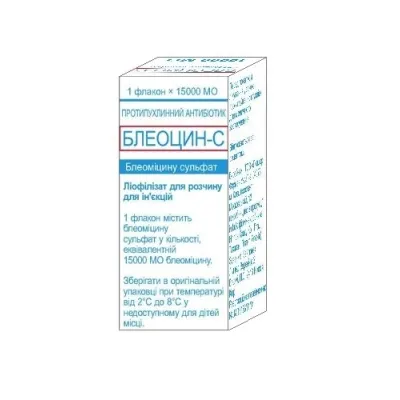
Table of Contents
INSTRUCTIONS FOR MEDICAL USE OF THE MEDICINAL PRODUCT BLEOCIN-S (BLEOCIN-S)
Composition:
Active substance: bleomycin sulfate;
1 vial contains bleomycin sulfate equivalent to 15000 IU of bleomycin.
Pharmaceutical form. Lyophilisate for solution for injection.
Main physicochemical properties: lyophilized powder or porous mass of white or yellowish-white color.
Pharmacotherapeutic group.
Antineoplastic agents. Cytotoxic antibiotics and related agents. Other cytotoxic antibiotics.
ATC code L01D C01.
Pharmacological properties.
Pharmacodynamics.
Bleomycin belongs to the group of cytotoxic antibiotics. It is an alkaline water-soluble mixture of structurally related glycopeptide antibiotics with cytostatic activity.
The action of bleomycin is explained by intercalation into single and double strands of DNA, causing single- and double-strand breaks. As a result, DNA synthesis and cell division are inhibited. Bleomycin also affects RNA and protein synthesis, but to a lesser extent. The most important factor determining the selectivity of bleomycin's action on various tissues is intracellular inactivation. Squamous epithelial cells have low levels of bleomycin hydrolase and are the most sensitive to bleomycin. Chromosomal aberrations (fragmentation, chromatid breaks, and translocations) are frequently observed in sensitive tissues (both normal and neoplastic).
In contrast to most other cytostatics, bleomycin has low myelotoxicity, does not cause immunosuppression, and is not neuro- or cardiotoxic. This toxicity profile of bleomycin allows its use in combination with other antineoplastic agents.
Pharmacokinetics.
Bleomycin is administered parenterally. After intravenous bolus injection at a dose of 15×10³ IU/m² body surface area, plasma concentrations of bleomycin ranged from 1 to 10 IU/mL. Following intramuscular injection at a dose of 15×10³ IU/m² body surface area, maximum plasma concentrations of bleomycin were reached within 30 minutes and amounted to approximately 1 IU/mL. When administered by continuous infusion at a dose of 30×10³ IU per day for 4–5 days, the average steady-state plasma concentration of bleomycin was 0.1–0.3 IU/mL.
Distribution. Bleomycin rapidly distributes into body tissues, with the highest concentrations observed in the skin, lungs, peritoneum, and lymph nodes. Low concentrations are found in the bone marrow. Bleomycin was not detected in cerebrospinal fluid after intravenous administration. The volume of distribution of bleomycin in humans is approximately 22 L, exceeding the volume of extracellular fluid. Bleomycin is only minimally bound to plasma proteins.
Biotransformation. The mechanism of bleomycin biotransformation has not yet been fully elucidated. Inactivation of bleomycin occurs via enzymatic degradation by bleomycin hydrolase, primarily in blood plasma, liver, and other organs, and to a lesser extent in the skin and lungs.
Elimination. The elimination half-life of bleomycin is 2–3 hours. During continuous intravenous infusion, this value may increase up to 9 hours. Approximately two-thirds of the administered dose is excreted unchanged in urine, likely via glomerular filtration. The majority of the dose is eliminated within 8–12 hours.
The elimination rate is highly dependent on renal function. When standard doses are administered, plasma concentrations of bleomycin are significantly higher in patients with impaired renal function.
Clinical experience indicates that bleomycin is difficult to remove from the body by dialysis.
Clinical characteristics.
Indications.
- Squamous cell carcinoma of the head and neck, esophagus, and cervix.
- Hodgkin's disease and non-Hodgkin's lymphomas.
- Testicular cancer (non-seminomatous and seminomatous tumors).
- Palliative intrapleural therapy for malignant pleural effusion.
Bleomycin is almost always used in combination with other antineoplastic agents and/or radiation therapy.
Contraindications.
- Acute pulmonary infections.
- Marked impairment of lung function and pulmonary circulation disorders.
- Ataxia-telangiectasia.
- Hypersensitivity to bleomycin.
Interaction with other medicinal products and other types of interactions.
When bleomycin is used concomitantly with carmustine, mitomycin C, cyclophosphamide, and methotrexate, the risk of pulmonary toxicity increases.
Prior or concurrent radiation therapy to the chest area increases the frequency and severity of toxic lung damage. In patients treated with bleomycin, the risk of developing pulmonary toxicity increases when oxygen is administered during surgical procedures. Therefore, oxygen concentrations in breathing mixtures should be reduced both during and after surgery.
In patients with testicular cancer receiving combined therapy with bleomycin and vinca alkaloids, a Raynaud's-like syndrome has been observed: ischemia of peripheral body parts, which over time may lead to necrosis of these areas (fingers and toes, nose).
Special precautions for use.
Treatment with bleomycin should be carried out under the close supervision of a qualified oncologist experienced in the use of antineoplastic chemotherapeutic agents, preferably in a specialized medical facility.
During treatment with bleomycin, regular monitoring of lung function and chest X-rays are required.
Although pulmonary toxicity of bleomycin increases significantly when the cumulative dose exceeds 400×10³ IU (225×10³ IU/m² body surface area), it may occur at much lower doses, particularly in elderly patients, patients with impaired renal function, individuals with pre-existing lung diseases, patients who have received radiation therapy to the lung area, and patients receiving oxygen therapy.
If cough, dyspnea, basal crepitations on lung auscultation, or diffuse reticular pattern on chest X-ray (any of these symptoms) appear, administration of the drug should be discontinued until it is determined that these manifestations are not due to bleomycin toxicity.
There is no specific therapy for bleomycin-induced pulmonary toxic effects. In some cases, administration of corticosteroids may provide some beneficial effect.
Elderly patients are more sensitive to bleomycin.
Due to the potential teratogenic effects of bleomycin, patients (both men and women) should use reliable contraceptive methods during treatment and for at least 3 months after completion of therapy.
When handling cytostatic agents, standard safety precautions must be observed. Contact of bleomycin solutions with skin or mucous membranes should be avoided. If the drug does come into contact with skin or mucous membranes, the affected area should be immediately rinsed thoroughly with large amounts of water.
Unused drug residues and waste materials should be destroyed by incineration at a temperature of 800°C.
Use during pregnancy or breastfeeding.
There are insufficient data to assess the potential risk of using bleomycin during pregnancy. Bleomycin crosses the placental barrier. Given the pharmacological properties of bleomycin, it may cause harm to the fetus when administered during pregnancy. Therefore, bleomycin should be avoided during pregnancy, especially during the first trimester.
Breastfeeding must be discontinued during bleomycin treatment.
Ability to affect reaction speed when driving or operating machinery.
The effect of bleomycin on the ability to drive or operate machinery has not been studied. Based on the pharmacological profile of the drug, such an effect is not expected.
Dosage and Administration
The drug is administered parenterally: by intramuscular, intravenous, intraarterial, and intrapleural injections/infusions, as well as by subcutaneous injections.
Doses should be calculated according to the patient's body surface area.
Treatment regimen for squamous cell carcinoma
- The drug is administered by intramuscular or intravenous injection at a dose of 10–15×10³ IU/m² of body surface area once weekly.
- The drug is administered by intravenous infusions lasting 6–24 hours at a dose of 10–15×10³ IU/m² of body surface area daily for 4–7 consecutive days every 3–4 weeks.
Treatment regimen for Hodgkin’s disease and non-Hodgkin’s lymphomas
- The drug is administered by intramuscular or intravenous injection at a dose of 5–10×10³ IU/m² of body surface area once weekly. Due to the risk of anaphylactic reactions, the initial dose in patients with lymphoma may be reduced to 2–3×10³ IU. If no acute reaction occurs after administration, further therapy may continue at the standard dose.
Treatment regimen for testicular cancer (non-seminomatous and seminomatous tumors)
- The drug is administered by intramuscular or intravenous injection at a dose of 10–15×10³ IU/m² of body surface area once or twice weekly.
- The drug is administered by intravenous infusions lasting 6–24 hours at a dose of 10–20×10³ IU/m² of body surface area daily for 5–6 consecutive days every 3–4 weeks.
Palliative intrapleural therapy for malignant pleural effusion
- When bleomycin is used as monotherapy, the drug is administered intrapleurally as a single dose of up to 60×10³ IU. Detailed treatment information can be found in specialized literature (various treatment protocols exist, some of which recommend higher doses of bleomycin).
The total cumulative dose of bleomycin should not exceed 400×10³ IU (225×10³ IU/m² of body surface area). Exceeding this dose is permissible only if a thorough evaluation of lung function indicates that further therapy is feasible.
Dosage adjustment recommendations for elderly patients are provided in the table.
| Age (years) |
Total dose |
Weekly dose |
| 80 and older |
100×103 IU |
15×103 IU |
| 70-79 |
150-200×103 IU |
30×103 IU |
| 60-69 |
200-300×103 IU |
30-60×103 IU |
| Under 60 |
400×103 IU |
30-60×103 IU |
When radiotherapy is administered concurrently, bleomycin doses should be reduced because irradiated tissues are more sensitive to bleomycin.
Dosage adjustments are also required when bleomycin is used in combination with other chemotherapy.
Dosage should be adjusted in patients with impaired renal function as follows:
- When serum creatinine concentration is 177–354 µmol/L (2–4 mg/100 mL), doses should be reduced by 50%.
- When serum creatinine concentration exceeds 354 µmol/L (4 mg/100 mL), doses should be reduced by more than 50%.
Intramuscular injections
The vial contents should be dissolved in 1–5 mL of 0.9% sodium chloride solution.
Repeated intramuscular injections at the same site may cause local reactions. Therefore, it is recommended to alternate injection sites for bleomycin administration.
Intravenous injections
The vial contents should be dissolved in 5–10 mL of 0.9% sodium chloride solution and administered slowly intravenously over 5–10 minutes.
The drug should not be administered too rapidly, as this results in high concentrations of bleomycin in the blood and increases the risk of lung damage when blood with high bleomycin content passes through the pulmonary circulation.
Intravenous infusions
The required dose of the drug should be dissolved in 200–1000 mL of 0.9% sodium chloride solution and administered either as a short intravenous infusion lasting approximately 30 minutes or as a continuous infusion over several days.
Intraarterial injections
The vial contents should be dissolved in 5 mL or a larger volume of 0.9% sodium chloride solution and administered intraarterially over 5–10 minutes.
Intraarterial infusions
The required dose of the drug should be dissolved in 200–1000 mL of 0.9% sodium chloride solution and administered via intraarterial infusion lasting from several hours to several days. To prevent thrombosis at the infusion site, heparin should be used, especially during prolonged infusions.
Injections or infusions of bleomycin into the artery supplying the tumor are more effective compared to other systemic administration routes. Toxic effects in this case are similar to those observed with intravenous injections or infusions.
Intrapleural injections and infusions
60×10³ IU of bleomycin should be dissolved in 100 mL of 0.9% sodium chloride solution and administered intrapleurally as a single dose. The procedure may be repeated if necessary.
Subcutaneous injections
The vial contents should be dissolved in no less than 15 mL of 0.9% sodium chloride solution (the concentration of the solution should not exceed 1000 IU/mL).
Repeated subcutaneous injections at the same site may cause local reactions. Therefore, it is recommended to alternate injection sites for bleomycin administration.
In most cases, extravasation of bleomycin does not require specific intervention. In doubtful cases (e.g., when a concentrated solution was administered or sclerotic tissues are present), the affected area should be infiltrated with 0.9% sodium chloride solution.
Children.
Since there is insufficient data on the use of bleomycin in pediatric practice, the drug should be prescribed to children only in exceptional cases; doses should be calculated based on the patient's body surface area.
Overdose.
Due to the mode of administration and precautionary measures, bleomycin overdose is rare. Acute overdose reaction manifests as arterial hypotension, fever, tachycardia, and general signs of shock. Treatment is symptomatic. In case of respiratory complications, corticosteroids and broad-spectrum antibiotics should be administered.
Adverse reactions.
Like most antineoplastic agents, bleomycin may cause acute and delayed toxic effects. Symptoms of acute toxicity may include anorexia and increased fatigue. Pain at the injection site or in the tumor area, arterial hypotension, and venous occlusion may occur following intravenous administration.
Lung
The most serious adverse effect (occurring in 2–10% of patients during or after completion of bleomycin therapy) is interstitial pneumonia. If not diagnosed promptly and appropriate treatment is not initiated, this may lead to irreversible pulmonary fibrosis. The risk of pulmonary toxicity increases with higher cumulative doses of bleomycin; however, it may also occur at low cumulative doses, especially in elderly patients, those who have received radiation therapy to the chest area, and those receiving oxygen therapy.
Changes in pulmonary blood vessels may develop, including reduced vessel wall elasticity.
If cough, dyspnea, basilar crackles on lung auscultation, or diffuse reticular pattern on chest X-ray (any of these symptoms) appear, administration of the drug should be discontinued until it is determined whether bleomycin toxicity is the cause of these manifestations.
There is no specific therapy for pulmonary toxic effects caused by bleomycin. In some cases, corticosteroid administration may provide a certain beneficial effect.
Pyretic reaction
Fever may develop 2–6 hours after the first administration of bleomycin. In cases of persistent fever, antipyretic agents may be required. The frequency of pyretic reactions decreases with subsequent doses of bleomycin.
Skin and mucous membranes
The most common adverse effects during bleomycin therapy (occurring in approximately half of patients) are skin and mucous membrane reactions (skin thickening and induration, hyperkeratosis, erythema, increased sensitivity and swelling of skin on fingertips, nail discoloration, skin edema in pressure areas such as elbows, alopecia, stomatitis). These adverse effects are rarely serious and usually resolve after completion of the treatment course. The severity of mucosal involvement may increase when bleomycin is used in combination with chemotherapy or concomitant radiotherapy.
Gastrointestinal tract
Nausea and vomiting may occur, particularly during high-dose therapy. In such cases, antiemetics are prescribed.
Hematopoietic system
Bleomycin therapy causes only minimal bone marrow suppression.
Cardiovascular system
Episodes of arterial hypotension have been reported in patients with Hodgkin’s disease who received high initial doses of bleomycin.
Coronary artery damage has been observed in patients with testicular tumors who received bleomycin.
Shelf life.
The medicinal product in the original packaging – 3 years.
The reconstituted solution is physically and chemically stable for 7 days if stored at a temperature not exceeding 25°C.
From a microbiological standpoint, the reconstituted solution or injection/infusion solution should be used immediately. If not used immediately, storage duration and conditions must be controlled by the responsible person. Generally, the storage period for solutions should not exceed 24 hours at a temperature of 2 to 8°C, except in cases where preparation and dilution were performed under controlled and validated aseptic conditions.
Storage conditions.
Store in the original packaging at a temperature of 2 to 8°C.
Keep out of reach of children.
Incompatibilities.
Bleomycin solutions must not be mixed with solutions containing essential amino acids, riboflavin, ascorbic acid, dexamethasone, aminophylline, or furosemide.
Packaging.
15,000 IU in a vial made of colorless glass, stoppered with a butyl rubber plug and sealed with an aluminum cap; 1 vial in a cardboard box.
Prescription status.
Prescription only.
Manufacturer.
LLC "Lumier Pharma", Ukraine (production from bulk drug substance manufactured by Nippon Kayaku Co., Ltd., Takasaki Plant, Japan).
Manufacturer’s address.
13 Stepan Bandera Avenue, Kyiv, 04073, Ukraine.
Marketing Authorization Holder.
Zylotech Limited.
Address of the Marketing Authorization Holder.
Nestoros 42, Kaimakli, 1026, Nicosia, Cyprus.
Nestoros 42, Kaimakli, 1026, Nicosia, Cyprus.