Bicyclol
Ukraine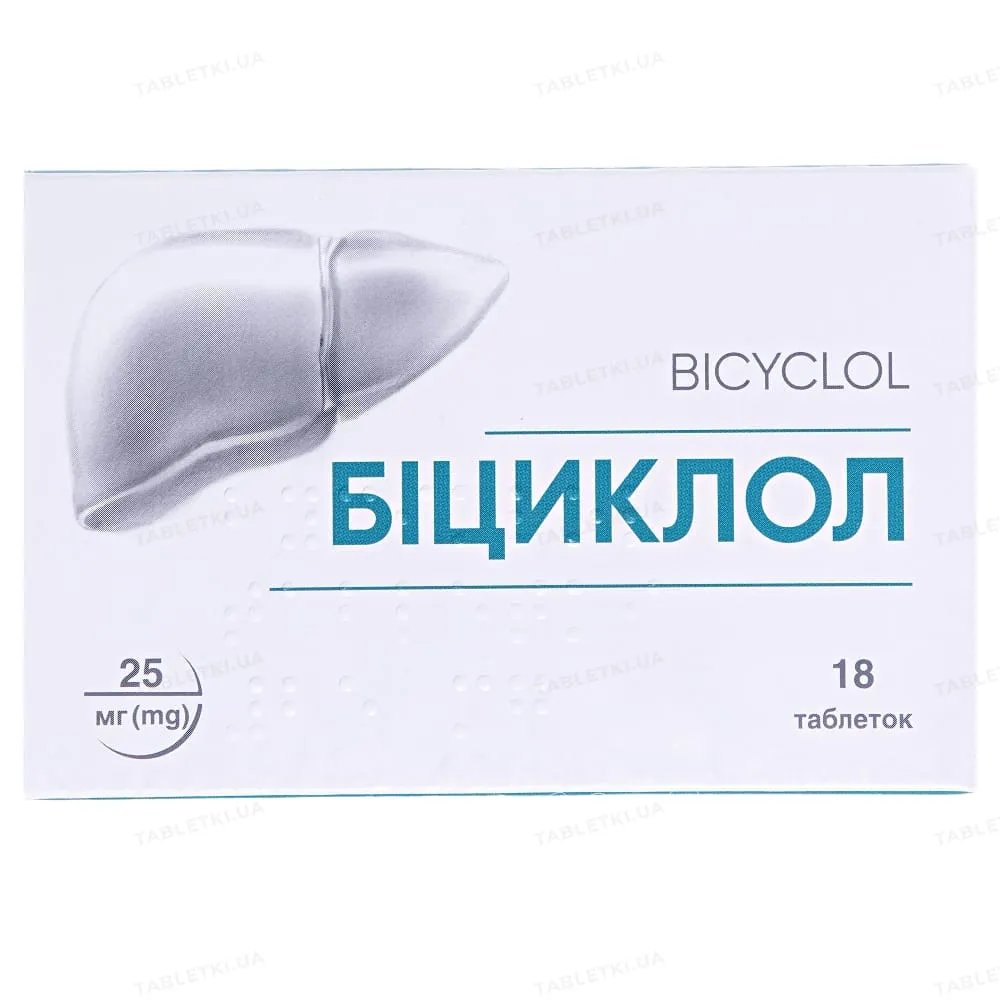
Table of Contents
INSTRUCTION FOR MEDICAL USE OF THE MEDICINAL PRODUCT BICYCLOL (BICYCLOL)
Composition:
Active substance: bicyclol;
1 tablet contains bicyclol 25 mg;
Excipients: corn starch, sucrose, sodium starch glycolate (type A), magnesium stearate.
Pharmaceutical form. Tablets.
Main physical and chemical properties: white, round, biconvex tablets.
Pharmacotherapeutic group.
Agents used in liver diseases, lipotropic substances. Hepatotropic agents. ATC code A05B.
Pharmacological Properties
Pharmacodynamics. Chemically, bicyclol is structurally similar to bifendate. Pharmacodynamic studies have demonstrated that bicyclol effectively reduces elevated transaminase levels in cases of hepatitis and liver damage induced by carbon tetrachloride, D-galactosamine, and acetaminophen, while also restoring liver tissue structure impaired to varying degrees of severity. In vitro experiments using 2.2.15 cell lines have shown that bicyclol inhibits the secretion of hepatitis B surface antigen (HBsAg), hepatitis B e-antigen (HBeAg), hepatitis B viral DNA, and hepatitis C viral RNA. Bicyclol suppresses the production of tumor necrosis factor (TNF) by activated neutrophils, Kupffer cells, and macrophages, and also scavenges free radicals within cells. Thus, bicyclol inhibits oxidative stress caused by mitochondrial dysfunction in hepatocytes, thereby preventing hepatocyte necrosis and apoptosis. Additionally, bicyclol inhibits hepatocyte apoptosis induced by tumor necrosis factor and cytotoxic T-cells, leading to the restoration of damaged hepatocyte nuclei and DNA.
Pharmacokinetics. The elimination half-life during the first phase of the two-phase model (t(½)ka) is 0.84 hours, while the half-life during the second phase (t(½)ke) is 6.26 hours. The time to reach maximum plasma concentration (t(peak)) is 1.8 hours, and the maximum plasma concentration (Cmax) is 50 ng/mL. Cmax and the area under the concentration-time curve (AUC) are directly proportional to the administered dose. However, other pharmacokinetic parameters—such as t(½)ka, t(½)ke, Vd/F [the ratio of the volume of distribution (Vd) to bioavailability (F)], CL/F, and t(peak)—remain largely unchanged regardless of dose, consistent with linear pharmacokinetic behavior.
Maximum plasma concentration may increase when the drug is administered after food intake.
Bicyclol is metabolized in the liver via the cytochrome P450 system, forming the primary metabolites 4′-OH-bicyclol and 4-OH-bicyclol.
The unchanged drug is detectable in human blood within 15 minutes after oral administration. Maximum concentration of bicyclol in the liver is observed 4 hours after drug intake. Plasma protein binding reaches up to 78%. Less than 30% of bicyclol is excreted unchanged via the gastrointestinal tract in feces within 24 hours. Approximately 1.3% of the drug is excreted in urine and 0.03% in bile.
Clinical characteristics.
Indications.
Hepatitis accompanied by increased liver transaminase activity:
- chronic viral hepatitis B;
- chronic viral hepatitis C;
- non-alcoholic steatohepatitis;
- alcoholic hepatitis;
- toxic (including drug-induced) hepatitis.
Contraindications.
Hypersensitivity to the components of the medicinal product. Acute hepatitis. Pregnancy and lactation period. Pediatric age under 12 years.
Interaction with other medicinal products and other types of interactions.
There are no study data demonstrating any interactions with other medicinal products.
Special precautions for use.
During treatment with the drug Biytsikhol, the patient's condition and liver function should be continuously monitored.
Use the drug with caution in patients with hypoalbuminemia, liver cirrhosis, esophageal varices, hepatic encephalopathy, severe forms of hepatitis, renal insufficiency, significantly elevated bilirubin levels, ascites, or hepatorenal syndrome. The drug should be prescribed with particular caution in patients with autoimmune hepatitis.
The drug contains sucrose. If you have been diagnosed with intolerance to certain sugars, consult your doctor before taking this medication.
Use during pregnancy or breastfeeding.
Do not use.
Ability to affect reaction rate when driving or operating machinery.
Dizziness is very rarely observed during treatment; therefore, caution should be exercised when driving or operating machinery.
Method of Administration and Dosage.
For adults and children aged 12 years and older, the recommended dose is 25 mg (1 tablet) three times daily. If necessary, the dose may be increased to 50 mg (2 tablets) three times daily.
Bicyclol should be taken orally 2 hours after meals.
The minimum treatment duration is 6 months, or as otherwise directed by a physician.
For elderly patients (over 70 years of age), the dosage should be individually determined.
Children.
Do not use in children under 12 years of age.
Overdose.
During clinical trials, administration of Bicyclol at a dose of 150 mg three times daily did not result in any cases of overdose. Furthermore, a 400-fold exceedance of the normal human dose did not cause any toxic reactions.
Adverse reactions.
Bicyclol is generally well tolerated. If adverse reactions occur, they are usually temporary, mild to moderate in severity, and resolve spontaneously after discontinuation of the drug or with symptomatic therapy. Dizziness, skin rash, abdominal distension, and vomiting may occur with an incidence of less than 0.5%. In a small number of patients (<0.1%), headache, sleep disturbances, epigastric discomfort, increased transaminase activity, decreased platelet count, and elevated blood glucose and creatinine levels are possible.
Shelf life. 3 years.
Storage conditions.
Store in the original packaging at a temperature not exceeding 30 °C.
Keep out of reach of children.
Packaging.
9 tablets in a blister made of polyvinyl chloride film and aluminum foil; 2 blisters per carton.
Prescription status. Prescription only.
Manufacturer.
Beijing Union Pharmaceutical Factory Ltd.
Manufacturer's address. No. 37, Yunguang Road, Biomedicine Industry Park, Daxing District, Beijing, China.