Bisacodyl grindex
Ukraine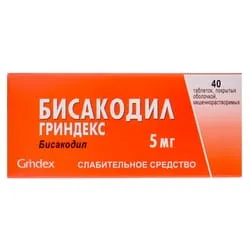
Table of Contents
INSTRUCTIONS FOR MEDICAL USE OF THE MEDICINAL PRODUCT BISACODYL GRINDEKS (BISACODYL GRINDEKS)
Composition:
Active substance: bisacodyl;
Each 1 g tablet contains 5 mg of bisacodyl;
Excipients: sucrose; lactose monohydrate; potato starch; talc; calcium stearate; methylcellulose; polysorbate 80;
Coating: methacrylic acid copolymer (type A); talc; titanium dioxide (E 171); triethyl citrate; yellow FCF (E 110).
Dosage form. Enteric-coated tablets.
Main physicochemical properties: round, biconvex tablets with a light-orange coating; the core is white when broken.
Pharmacotherapeutic group.
Contact laxatives. ATC code A06AB02.
Pharmacological Properties
Pharmacodynamics
Bisacodyl is a laxative that stimulates colonic peristalsis by irritating the mucosa or by direct stimulation of nerve endings in the submucosal and mucosal nerve plexuses. When taken during the day, laxative effect usually occurs within 6–10 hours; when taken before bedtime, it occurs within 8–12 hours.
Bisacodyl produces a laxative effect characterized by softening or liquefaction of fecal masses. The mechanism of its laxative action is due to increased water influx into the intestinal lumen and reduced water absorption, as well as accelerated intestinal peristalsis.
An important role in the mechanism of action is played by the cleavage of bisacodyl in the alkaline intestinal environment, leading to the formation of substances that stimulate mucosal receptors. This results in stimulation of intestinal peristalsis.
Pharmacokinetics
Under the influence of intestinal and bacterial enzymes, bisacodyl is rapidly converted into its active desacetyl metabolite. Only 5% of the oral dose is absorbed into systemic circulation, metabolized in the liver, and excreted in feces. A small amount of the absorbed drug is excreted in urine as an inactive metabolite (glucuronide).
Clinical characteristics.
Indications.
Short-term treatment of constipation of various etiologies.
Clinical necessity to facilitate defecation in hemorrhoids, anal fistulas, and anal fissures.
Preparation for diagnostic procedures and prior to surgical interventions (under medical supervision).
Contraindications.
- Hypersensitivity to bisacodyl and/or to any excipient of the drug;
- acute proctitis, acute hemorrhoids, spastic constipation, intestinal obstruction;
- gastrointestinal bleeding, uterine bleeding;
- acute abdomen syndrome; peritonitis, appendicitis, and other inflammatory processes in the abdominal cavity, incarcerated hernia;
- abdominal pain, nausea and vomiting of unknown etiology, colitis, Crohn's disease;
- severe dehydration;
- disturbances in water-electrolyte balance.
Interaction with other medicinal products and other types of interactions.
Bisacodyl enhances the potassium-excreting effect of diuretics and glucocorticoids.
Use with caution in combination with agents causing hypokalemia: diuretics, corticosteroids (mineralocorticoids and glucocorticoids), amphotericin B (intravenous), tetracosactide.
Concomitant use of any laxative should not be combined with simultaneous administration of diuretics (potassium-sparing or others) — bisacodyl may affect excretion or retention of potassium ions.
Bisacodyl potentiates the action of cardiac glycosides due to decreased serum potassium levels; therefore, when used with digitalis preparations, there is a risk of hypokalemia and digitalis toxicity.
Concomitant use with H₂-blockers and antacids (within one hour) is not recommended — there is a risk of rapid dissolution of the outer coating, irritation of gastric and duodenal mucosa, and consequently, impaired efficacy.
Combination of bisacodyl with astemizole, terfenadine, erythromycin, amiodarone, sotalol, and quinidine preparations is not recommended.
Alkaline products should not be consumed during administration of the drug and within 1 hour before and after administration.
Special precautions for use
Like all laxatives, bisacodyl should not be taken daily for more than 5 days without first determining the cause of constipation. Prolonged use (more than 7 days) and systematic administration of the drug should be avoided, as this may lead to intestinal atony and inability to defecate without stronger laxatives.
Laxatives do not assist with weight loss.
During treatment with bisacodyl, a diet rich in dietary fiber should be followed: whole grain bread, legumes such as beans, fruits, and vegetables. It is also necessary to consume 1.5–2 liters of fluid daily, maintain physical activity, and avoid sweets, chocolate, and fatty cheeses.
Inadequate response to the drug may indicate an organic cause of constipation.
Dizziness and syncope (loss of consciousness) may occur during defecation; defecation syncope and vascular reactions may arise during abdominal pain, which may be associated with constipation for which the patient took a laxative.
There have been isolated reports of abdominal pain and bloody diarrhea associated with bisacodyl use, possibly due to intestinal mucosal ischemia. Tablets must not be chewed, as this may irritate the gastric mucosa and cause abdominal pain.
Fluid loss from the intestine may lead to dehydration, manifested by symptoms such as thirst and oliguria. Bisacodyl should be discontinued in patients experiencing intestinal fluid loss that may lead to dangerous dehydration (e.g., in renal insufficiency or elderly patients), and treatment should be resumed only under medical supervision.
In elderly patients, frequent use of bisacodyl may exacerbate asthenia, cause orthostatic hypotension, and coordination disorders related to electrolyte loss. The drug may reduce serum potassium levels. Dehydration may lead to the development of renal failure.
In patients with chronic liver or kidney disease, the drug should be prescribed only by a physician.
Bisacodyl Grindeks contains lactose and sucrose; therefore, it should not be used in patients with lactase deficiency, galactosemia, or glucose-galactose malabsorption syndrome, as well as in patients with rare hereditary fructose intolerance or sucrase-isomaltase deficiency.
Swallowing a tablet with a damaged coating (i.e., after chewing) may irritate the gastric mucosa and cause abdominal pain.
Use during pregnancy or breastfeeding.
Pregnancy.
Bisacodyl is not recommended during pregnancy, especially in the first trimester, unless the expected benefit to the mother outweighs the potential risk to the fetus. Use is possible only upon medical advice. Adequate controlled clinical studies in pregnant women have not been conducted. However, long-term use experience has not revealed any evidence of harmful or adverse effects on pregnancy.
Breastfeeding.
Bisacodydil is not recommended during breastfeeding, except when the expected benefit to the mother outweighs the potential risk to the infant, and only upon medical advice. There are no data on whether bisacodyl is excreted in breast milk.
Ability to affect reaction speed when driving or operating machinery.
Studies evaluating the effect of the drug on the ability to drive or operate machinery have not been conducted.
However, patients should be informed that vasovagal reactions (i.e., during abdominal pain – intestinal colic) may cause dizziness and/or syncope (loss of consciousness). During treatment, caution should be exercised when driving or operating machinery. If abdominal colic occurs, patients should refrain from potentially hazardous activities requiring high concentration and rapid reaction.
Method of Administration and Dosage
For effective morning bowel movement, bisacodyl should be taken orally before bedtime, regardless of food intake. Tablets should be swallowed whole, without chewing, with a full glass of water.
For short-term treatment of constipation and for clinical necessity of easing defecation in hemorrhoids, anal fistulas, and anal fissures.
Adults and children over 10 years of age: 1–2 tablets (5–10 mg) once daily.
Children aged 4 to 10 years: 1 tablet (5 mg) once daily.
For preparation for diagnostic procedures and prior to surgical interventions (under medical supervision).
Adults and children over 10 years of age: 2–4 tablets (10–20 mg) once daily in the evening.
Children aged 4 to 10 years: 1 tablet (5 mg) in the evening.
The drug should not be used for more than 7 days. Daily prolonged use is not recommended.
Children.
Do not administer the drug to children under 4 years of age.
For children aged 4 to 10 years, the drug should be used only as prescribed by a physician.
Overdose.
Symptoms. High doses may cause diarrhea, abdominal cramps, and electrolyte imbalance (including symptoms of hypokalemia and functional colonic atony). Chronic overdose may lead to chronic diarrhea, abdominal pain, hypokalemia, secondary hyperaldosteronism, and nephrolithiasis. Cases of renal tubular damage, metabolic alkalosis, and muscle weakness due to hypokalemia have been reported.
Treatment. Discontinue the drug and consult a physician. Gastric lavage or induction of emesis may be necessary. Correction of fluid and electrolyte imbalance is recommended, along with symptomatic treatment.
Side effects.
Allergic reactions: anaphylactic reactions (including angioneurotic edema).
Gastrointestinal disorders: abdominal cramping; abdominal colic; flatulence; nausea; diarrhea with blood, which may lead to dehydration and electrolyte imbalance; vomiting; abdominal discomfort; intestinal atony; colitis.
Nervous system disorders: dizziness; syncope (including defecation syncope).
Metabolic disorders: hypokalemia.
As a consequence of dehydration, muscle weakness, cramps, arterial hypotension, and orthostatic hypotension may occur.
In elderly patients who frequently use the drug, weakness, impaired coordination, and arterial hypotension are possible.
Prolonged use of the drug may lead to chronic diarrhea, abdominal pain, hypokalemia, secondary hyperaldosteronism, urolithiasis, and development of melanosis of the colon. Cases of renal tubular damage, metabolic alkalosis, and muscle weakness due to hypokalemia have been reported.
If adverse effects occur, the drug should be discontinued and medical advice should be sought.
Shelf life: 5 years.
Do not use after the expiry date.
Storage conditions.
Store in the original packaging at a temperature not exceeding 25 °C.
Keep out of reach of children.
Packaging.
10 tablets in a blister; 4 blisters in a cardboard box.
Supply category.
Over-the-counter.
Manufacturer.
JSC "Grindeks".
Manufacturer's address and place of business.
53 Krustpils Street, Riga, LV-1057, Latvia.
Applicant.
JSC "Grindeks".
Address of applicant and/or applicant's representative.
53 Krustpils Street, Riga, LV-1057, Latvia.
Tel./Fax: +371 67083205 / +371 67083505.
E-mail: [email protected]