Bioven mono®
Ukraine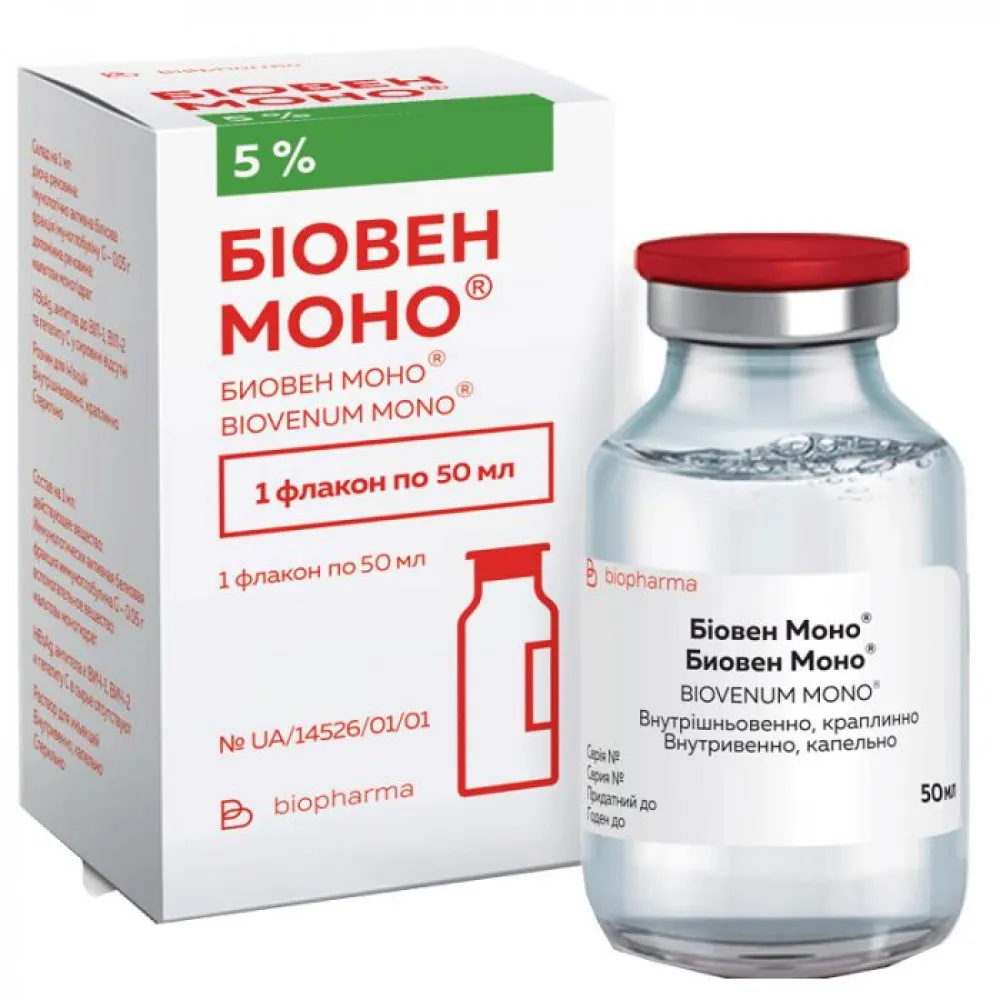
Table of Contents
I N S T R U C T I O N for medical use of the medicinal product BIEVENE MONO® (BIOVEN MONO®)
Composition:
Active substance: human normal immunoglobulin / human normal immunoglobulin;
1 ml of the preparation contains 0.05 g of human normal immunoglobulin (including immunoglobulin G (IgG) not less than 95%);
1 vial of 50 ml contains 2.5 g of human normal immunoglobulin (IVIg);
1 vial of 100 ml contains 5.0 g of human normal immunoglobulin (IVIg).
Distribution of IgG subclasses (approximate values):
IgG1 ............ 65.6%
IgG2 ............ 22.1%
IgG3 ............ 10.8%
IgG4 ............ 1.5%
Maximum IgA content is 25 μg/ml.
Produced from plasma of human donors.
Excipients: glycine; water for injections.
Pharmaceutical form. Solution for infusion.
Main physicochemical properties: clear or slightly opalescent, colorless or pale yellow liquid.
Pharmacotherapeutic group. Normal human immunoglobulin for intravenous administration. ATC code J06BA02.
Pharmacological Properties
Pharmacodynamics
Human normal immunoglobulin contains IgG antibodies present in a healthy organism. It is obtained from a pool of plasma collected from at least 1000 donors.
The distribution of IgG subclasses in the drug is approximately proportional to that in native human blood plasma.
Appropriate doses of this medicinal product can restore abnormally low IgG levels to the normal range. The mechanism of action when used for indications other than replacement therapy is not fully understood.
The active component of the drug is antibodies possessing specific activity against various disease-causing agents—viruses and bacteria—including hepatitis A and B, herpes, varicella, influenza, measles, mumps, poliomyelitis, rubella, pertussis, staphylococcus, Escherichia coli, and pneumococcus.
The drug is a native immunoglobulin G that retains all biological properties: complement activation, effector and opsono-phagocytic functions; it also has non-specific activity manifested by increased organism resistance. It has low spontaneous anti-complement activity.
The drug is an immunologically active protein fraction isolated from human serum or plasma tested for the absence of antibodies to HIV-1, HIV-2, hepatitis C virus, and hepatitis B surface antigen, purified and concentrated by alcohol-water fractionation, and subjected to viral inactivation steps using solvent-detergent method and nanofiltration.
Clinical Studies
Open-label, single-center, uncontrolled prospective phase 4 clinical study on the safety and tolerability of BIOVEN MONO® in adult patients with secondary immunodeficiencies (BMV-BF-04/17)
The clinical study included 30 patients aged over 18 years with secondary antibody deficiency syndrome—secondary hypogammaglobulinemia and recurrent infections associated with chronic lymphocytic leukemia (47%) and multiple myeloma (53.3%).
The drug was administered as a single intravenous infusion at a dose of 0.3 g/kg/day at a rate of 1–1.5 mL/min.
During the study, two mild adverse events (AEs) were recorded in one patient, both possibly related to the investigational drug. One AE belonged to the category "Gastrointestinal disorders"—nausea developed in the patient. The other AE belonged to the category "General disorders and administration site conditions"—the patient experienced weakness.
Based on the incidence of AEs, their relationship to the investigational drug, and assessment of vital signs dynamics, tolerability was rated as good in 96.7% of patients and satisfactory in 3.3%. Evaluation of vital sign dynamics revealed no statistically significant changes in heart rate, systolic, or diastolic blood pressure.
Thus, the drug demonstrated a high safety and tolerability profile.
Open-label study on the efficacy and tolerability of BIOVEN MONO®, infusion solution, in children after completion of intensive polychemotherapy for acute lymphoblastic leukemia
The study included 60 children aged 3 to 16 years at high risk of infectious complications, following completion of intensive polychemotherapy for acute lymphoblastic leukemia. At enrollment, patients exhibited immunodeficiency with IgG levels below 5.7 g/L. The main group consisted of 30 children who received the drug in addition to maintenance chemotherapy (Purinethol, methotrexate). The control group included 30 children receiving only maintenance chemotherapy. The observation period lasted 6 months.
After completion of intensive polychemotherapy according to the ALL IC-BFM-2009 protocol, patients in both groups were switched to maintenance chemotherapy (Purinethol, methotrexate). Additionally, patients in the main group received the drug intravenously at a rate of 0.1 mL/min and a dose of 0.5 g/kg body weight daily for 5 days, whenever IgG levels were 25% below the lower normal limit after completion of polychemotherapy.
During the clinical study, the frequency of infectious complications, including febrile neutropenia, was evaluated. Additionally, IgG levels in both groups were monitored over time.
The results of the clinical trial demonstrated superior efficacy of combination therapy including the drug compared to standard maintenance chemotherapy. The frequency of infectious complications was 20.0% in the main group versus 56.7% in the control group. Moreover, recurrent infectious complications were observed in the control group.
In patients of the main group, after five administrations of the investigational drug, IgG levels increased from 5.22 ± 1.47 to 10.31 ± 2.11 g/L (in the control group, IgG levels were 5.37 ± 1.24 and 5.46 ± 1.32 g/L at screening and on day 5, respectively).
The investigational drug was well tolerated, with no negative changes in patient status, as confirmed by objective examination and clinical laboratory blood and urine parameters. No serious or unexpected adverse reactions or adverse events occurred during the study. A total of 5 participants in the main group (16.67%) experienced adverse reactions: body temperature rise up to 37.5°C lasting up to 1 day—3 cases; local reaction in the form of hyperemia lasting up to 3 hours—1 case; moderate headache—1 case; nausea during the first infusion—1 case. All adverse reactions were considered expected, non-serious, and probably related to administration of the investigational drug.
Therefore, BIOVEN MONO®, infusion solution, reduces the risk of infectious complications and is effective and safe for the prevention of infectious complications in immunodeficient states.
Pharmacokinetics
Absorption
Normal human immunoglobulin is immediately and completely bioavailable in the bloodstream following intravenous administration.
Distribution
Normal human immunoglobulin distributes relatively rapidly between plasma and extravascular fluid, with equilibrium between intravascular and extravascular compartments reached approximately within 3–5 days.
Elimination
Normal human immunoglobulin has a half-life of approximately 40 days. This half-life may vary among individual patients, particularly in those with primary immunodeficiency.
IgG and IgG complexes are degraded in reticuloendothelial system cells.
Preclinical Safety Data
Immunoglobulins are normal constituents of the human body.
Single-dose toxicity studies were conducted in rats and mice. No animal deaths occurred after doses up to 2500 mg/kg. No adverse effects on the respiratory, cardiovascular, or central nervous systems of test animals were observed, confirming the safety of BIOVEN MONO®. Toxicity testing with repeated doses and embryofetal toxicity studies are not feasible due to antibody induction in animals.
Clinical Characteristics
Indications
Replacement therapy in adults, children, and adolescents (0–18 years of age) in the following conditions:
- Primary immunodeficiency syndromes (PID) with impaired antibody production;
- Secondary immunodeficiencies (SID) in patients with severe or recurrent infections, ineffective antibacterial treatment, proven specific antibody deficiency (PSAD)*, or serum IgG levels < 4 g/L (including secondary hypogammaglobulinemia due to oncological/oncohematological diseases, chemotherapy, and immunosuppressive therapy, including following hematopoietic stem cell transplantation, treatment with monoclonal antibodies, Bruton tyrosine kinase inhibitors, and proteasome inhibitors).
* PSAD – inability to achieve at least a two-fold increase in IgG antibody titers in response to pneumococcal polysaccharide vaccine and polypeptide antigen.
Severe bacterial-toxic and viral infections in adults and children (including surgical complications associated with bacteremia and septicopyemic states, and in preparation of surgical patients for surgery);
Immunomodulation in adults, children, and adolescents (aged 0–18 years) in the following conditions:
- Primary immune thrombocytopenia (ITP) in patients with high risk of bleeding or prior to surgical procedures to correct platelet count;
- Guillain-Barré syndrome;
- Kawasaki disease (in combination with acetylsalicylic acid, see section "Dosage and Administration");
- Chronic inflammatory demyelinating polyradiculoneuropathy (CIDP);
- Multifocal motor neuropathy (MMN);
- Inflammatory myopathy;
- Granulomatosis with polyangiitis (Wegener’s granulomatosis);
- Dermatomyositis;
- Systemic connective tissue diseases (rheumatoid arthritis).
Contraindications
Hypersensitivity to the active substance (normal human immunoglobulin) or to any of the excipients (see sections "Special Precautions", "Composition").
Contraindicated in patients with selective IgA deficiency who have developed antibodies to IgA, as administration of a product containing IgA may lead to anaphylaxis.
Special safety precautions
BIOVEN MONO® must be administered only in a hospital setting under strict aseptic conditions. Prior to use, the product should be equilibrated to a temperature of (20±2) °C for at least 2 hours. The solution should be clear or slightly opalescent, colorless or slightly yellowish. Solutions that are cloudy, contain particulate matter, or have a precipitate must not be used.
A separate infusion system must be used for administration of this product.
Any unused product or waste material must be disposed of in accordance with applicable legislation.
Interaction with other medicinal products and other types of interactions
Live attenuated viral vaccines
Administration of immunoglobulin may reduce the efficacy of live attenuated viral vaccines, such as measles, rubella, mumps, and varicella vaccines, for a period of at least 6 weeks to 3 months. At least 3 months should elapse after administration of this medicinal product before live attenuated viral vaccines are given. For measles vaccination, this reduction in vaccine efficacy may last up to 1 year. Therefore, antibody status should be checked in patients receiving measles vaccine.
Loop diuretics
Concomitant use of loop diuretics should be avoided.
Medicinal products and dietary supplements containing glycine
BIOVEN MONO® contains 15.4 g/L of the amino acid glycine as an excipient. Medicinal products and dietary supplements containing glycine should be used with caution to avoid glycine overdose.
Children
The above-mentioned interactions apply to both adults and children.
Special precautions for use
Traceability
To improve traceability of biological medicinal products, the name and batch number of the administered product should be clearly recorded in the patient's medical records.
Warnings for use
Potential complications can often be avoided by ensuring that patients:
- are not hypersensitive to human normal immunoglobulin provided the initial infusion rate is slow (0.5–1.0 ml/kg/h);
- are under close monitoring for the occurrence of any symptoms throughout the entire infusion period.
In particular, patients should be closely observed during the first infusion and for at least one hour thereafter if human normal immunoglobulin is administered for the first time, or if switching from another alternative intravenous immunoglobulin (IVIg) product, or after a prolonged interval since the previous infusion. For other patients, monitoring should continue for at least 20 minutes after administration of this medicinal product.
For all patients receiving IVIg, the following measures are required:
- adequate hydration prior to starting the infusion;
- monitoring of diuresis;
- monitoring of serum creatinine levels;
- avoidance of concomitant use of loop diuretics (see section "Interaction with other medicinal products and other forms of interaction").
If an adverse reaction occurs, the infusion rate should be reduced or the infusion stopped. Required treatment depends on the nature and severity of the adverse reaction.
Infusion-related reactions
Some adverse reactions (e.g. headache, feeling of warmth, chills, myalgia, wheezing, tachycardia, back pain, nausea, and arterial hypotension) may be related to the infusion rate. The recommended infusion rate as stated in the section "Dosage and method of administration" must be strictly observed. Patients should be under close supervision for the appearance of any symptoms throughout the entire administration period.
Some adverse reactions may occur more frequently:
- when human normal immunoglobulin is administered for the first time, or in rare cases when switching from one human normal immunoglobulin product to another, or after a prolonged interval since the previous infusion;
- in patients with active infection or underlying chronic inflammatory conditions.
Hypersensitivity
Hypersensitivity reactions are rare.
Anaphylaxis may develop in patients:
- with undetectable IgA who have antibodies to IgA;
- who have previously been treated with human normal immunoglobulin.
In case of shock, standard medical treatment for shock should be applied.
Thromboembolism
Clinical evidence indicates an association between IVIg administration and the development of thromboembolic complications such as myocardial infarction, acute cerebrovascular accidents (including stroke), pulmonary embolism, and deep vein thrombosis, which are presumed to be related to relative increase in blood viscosity due to the infusion of large amounts of immunoglobulin in patients at risk. Caution should be exercised when prescribing and administering IVIg to patients with excess body weight and to patients with risk factors for thrombotic events (such as advanced age, arterial hypertension, diabetes mellitus, vascular disease or history of thrombotic episodes, acquired or hereditary thrombophilic disorders, prolonged immobilization, severe hypovolemia, or conditions increasing blood viscosity).
IVIg products should be administered at the lowest possible infusion rate and in the smallest possible doses to patients at risk of thromboembolic adverse reactions.
Acute renal failure
Cases of acute renal failure have been reported in patients receiving IVIg therapy. In most cases, risk factors such as pre-existing renal insufficiency, diabetes mellitus, hypovolemia, excess body weight, concomitant use of nephrotoxic medicinal products, or age over 65 years were identified.
Renal parameters should be evaluated prior to IVIg infusion, especially in patients with potentially increased risk of acute renal failure, and re-evaluated at appropriate intervals. IVIg products should be administered at the lowest possible infusion rate and dose in patients at risk of acute renal failure. If renal function impairment occurs, discontinuation of IVIg should be considered.
Although reports of renal dysfunction and acute renal failure have been associated with the use of many licensed IVIg products containing various excipients such as sucrose, glucose, and maltose, those containing sucrose as a stabilizer have accounted for a disproportionate share of the total. For patients at risk, consideration may be given to using IVIg products that do not contain these excipients.
BIOVEN MONO® does not contain sucrose, maltose, or glucose.
Aseptic meningitis syndrome
Cases of aseptic meningitis syndrome (AMS) associated with IVIg administration have been reported. AMS usually begins within several hours to 2 days after IVIg infusion. Cerebrospinal fluid (CSF) analysis is often positive, showing pleocytosis up to several thousand cells/mm³, predominantly granulocytic, and elevated protein levels up to several hundred mg/dL.
AMS may occur more frequently with high-dose IVIg treatment (2.0 g/kg).
Patients presenting with these signs and symptoms should undergo a thorough neurological evaluation, including CSF analysis, to exclude other causes of meningitis.
Discontinuation of IVIg therapy has led to AMS remission within several days without sequelae.
Hemolytic anemia
IVIg products may contain blood group antibodies capable of acting as hemolysins and inducing in vivo immunoglobulin coating of erythrocytes, resulting in a positive direct antiglobulin reaction (Coombs test) and, rarely, hemolysis. Hemolytic anemia may develop after IVIg therapy due to enhanced erythrocyte sequestration. Patients receiving immunoglobulin therapy should be monitored for clinical signs of hemolysis (see section "Overdose").
Neutropenia/leukopenia
Reports of transient decreases in neutrophil count and/or episodes of neutropenia, sometimes severe, have been received following treatment with intravenous immunoglobulins (IVIg). This typically occurs within several hours or days after IVIg administration and resolves spontaneously within 7–14 days.
Transfusion-related acute lung injury (TRALI)
Cases of acute non-cardiogenic pulmonary edema [transfusion-related acute lung injury (TRALI)] have been reported in patients receiving IVIg. TRALI is characterized by severe hypoxia, dyspnea, tachypnea, cyanosis, fever, and hypotension. TRALI symptoms usually develop during or within 6 hours after infusion, often within 1–2 hours. Therefore, patients should be monitored during administration and IVIg infusion should be immediately stopped if pulmonary adverse reactions occur. TRALI is a potentially life-threatening condition requiring immediate intensive care treatment.
Changes in serological parameters
Following immunoglobulin administration, transient elevation of various passively transferred antibodies in the patient's blood may lead to false-positive serological test results.
Passive transfer of antibodies to erythrocyte antigens, such as A, B, D, may affect certain serological tests for erythrocyte antibodies, for example, the direct antiglobulin test (direct Coombs test).
Transmissible agents
Standard measures to prevent infections caused by medicinal products derived from human blood or plasma include donor selection, screening of individual donations and plasma pools for specific infection markers, and inclusion of effective manufacturing steps for virus inactivation/removal. Nevertheless, the possibility of transmitting infectious agents by products derived from human blood or plasma cannot be completely excluded. This also applies to unknown or emerging viruses and other pathogens.
The measures taken are considered effective against enveloped viruses such as human immunodeficiency virus (HIV), hepatitis B virus (HBV), and hepatitis C virus (HCV), as well as against non-enveloped viruses such as hepatitis A virus (HAV) and parvovirus B19.
There is reassuring clinical experience regarding the absence of transmission of hepatitis A or parvovirus B19 with immunoglobulins, and it is presumed that antibody content contributes significantly to viral safety.
Children
There is no pediatric-specific risk for any of the adverse reactions mentioned above. Pediatric patients may be more susceptible to volume overload (see section "Overdose").
Use during pregnancy or breastfeeding
Pregnancy
The safety of this medicinal product during pregnancy has not been established in controlled clinical trials; therefore, it should be used with caution in pregnant women. It has been shown that IgG crosses the placenta, particularly in the third trimester.
Clinical experience with immunoglobulins indicates no harmful effects on pregnancy or on the fetus and newborn.
Breastfeeding
The safety of this medicinal product during breastfeeding has not been established in controlled clinical trials; therefore, it should be used with caution in breastfeeding women. Immunoglobulins are excreted in breast milk. A negative effect on breastfed infants/newborns is not expected.
Fertility
Clinical experience with immunoglobulins indicates that a harmful effect on fertility is not expected.
Ability to influence the ability to drive and use machines
BIOVEN MONO® has no effect or has a negligible effect on the ability to drive and use machinery.
Administration and Dosage
IVIg therapy must be administered under the supervision of a physician experienced in the treatment of immune system disorders.
Administration method
For intravenous use.
Normal human immunoglobulin should be administered intravenously at an initial rate of 0.5 ml/kg/hour for 30 minutes. If no adverse reactions occur, the infusion rate may be gradually increased to a maximum of 1.0–1.5 ml/kg/hour. For pediatric patients, the infusion rate should be 0.08 to 0.5 ml/minute, depending on body weight. More rapid infusion may lead to the development of collapse-like reactions.
If an adverse reaction occurs, the infusion rate should be reduced or the infusion stopped.
For additional safety measures, see section "Special precautions for use".
Dosage
The dose and treatment regimen depend on the indication.
Individual dose adjustment may be required for each patient based on clinical response. Patients with underweight or overweight may require dose adjustment according to body weight. The dose for patients with excess body weight should be based on physiological standard body weight.
The treatment regimens below are provided as general guidance.
Replacement therapy in primary immunodeficiency syndromes
The dosing regimen should maintain a minimum IgG level (measured just before the next intravenous infusion) of at least 6.0 g/L or within the normal reference range for individuals of the corresponding age. It may take 3–6 months after initiation of therapy to achieve steady-state (equilibrium) IgG levels. The recommended initial dose is 0.4–0.8 g/kg as a single dose, followed by at least 0.2 g/kg every 3–4 weeks.
The dose required to achieve a minimum IgG level of 6.0 g/L ranges from 0.2–0.8 g/kg/month. After steady-state is achieved, the interval between infusions typically ranges from 3 to 4 weeks.
Trough (minimum residual) IgG levels should be measured and evaluated in relation to the frequency of infections. To reduce the frequency of bacterial infections, dose increases and attainment of higher minimum residual IgG concentrations may be necessary.
Replacement therapy in secondary immunodeficiencies (as indicated in section "Indications")
The recommended dose is 0.2–0.4 g/kg every 3–4 weeks.
The minimum residual concentration of the drug should be measured and evaluated considering the frequency of infections.
The dose should be adjusted as needed to achieve optimal protection against infections; patients with persistent infections may require higher doses. Dose reduction may be considered when the patient is free of infections.
Severe bacterial-toxic and viral infections in adults and children (including surgical complications associated with bacteremia and septicemic states, and in preparation of surgical patients for surgery) – 0.4 g/kg/day for 1–4 days.
Immunomodulatory use in the following conditions:
Primary immune thrombocytopenia
Two alternative treatment regimens are available:
- 0.8–1.0 g/kg/day for two consecutive days
- 0.4 g/kg daily for 2–5 days.
If relapse occurs, the treatment course may be repeated.
Guillain-Barré syndrome
0.4 g/kg/day for 5 days (repeat dosing may be considered in case of relapse).
Kawasaki disease
2.0 g/kg as a single dose. Patients should receive concomitant therapy with acetylsalicylic acid.
Chronic inflammatory demyelinating polyradiculoneuropathy (CIDP)
Initial dose: 2.0 g/kg, divided over 2–5 consecutive days.
Maintenance dose: 1.0 g/kg, divided over 1–2 consecutive days, every 3 weeks.
Therapeutic response should be evaluated after each cycle; if no therapeutic effect is observed within 6 months, treatment should be discontinued.
If treatment is effective, further duration of therapy should be determined by the physician based on the patient's response to maintenance therapy. Dosing and intervals may be adapted according to the individual course of the disease.
Multifocal motor neuropathy (MMN)
Initial dose: 2.0 g/kg, divided over 2–5 consecutive days.
Maintenance dose: 1.0 g/kg every 2–4 weeks or 2.0 g/kg every 4–8 weeks (divided doses over 2–5 days).
Therapeutic response should be evaluated after each cycle; if no therapeutic effect is observed within 6 months, treatment should be discontinued.
If treatment is effective, further duration of therapy should be determined by the physician based on the patient's response to maintenance therapy. Dosing and intervals may be adapted according to the individual course of the disease.
Inflammatory myopathy, Wegener's granulomatosis – 0.2–0.4 g/kg/day for 3–7 days; if necessary, 5-day treatment courses may be repeated at 4-week intervals.
Dermatomyositis – 1.0 g/kg/day for 3–5 days.
Systemic connective tissue diseases (rheumatoid arthritis, etc.) – 0.2–0.5 g/kg/day for 5 days.
Recommended treatment regimens are summarized in Table 1.
Table 1
| Indications |
Dose |
Frequency of administration |
| Replacement therapy |
||
| Primary immunodeficiency syndrome (PID) |
Initial dose: 0.4 – 0.8 g/kg |
Every 3 – 4 weeks |
| Secondary immunodeficiencies (SID) (see section "Indications") |
0.2 – 0.4 g/kg |
Every 3 – 4 weeks |
| Severe bacterial-toxic and viral infections |
0.4 g/kg/day |
For 1 – 4 days |
| Immunomodulation |
||
| Primary immune thrombocytopenia |
0.8 – 1 g/kg/day or |
For 2 consecutive days |
| 0.4 g/kg/day |
For 2 – 5 days |
|
| Guillain-Barré syndrome |
0.4 g/kg/day |
For 5 days |
| Kawasaki disease |
2.0 g/kg |
Single dose, |
| Chronic inflammatory demyelinating polyradiculoneuropathy (CIDP) |
Initial dose: 2.0 g/kg |
Divided over 2 – 5 consecutive days |
| Maintenance dose: 1.0 g/kg |
Divided over 1 – 2 consecutive days every 3 weeks |
|
| Multifocal motor neuropathy (MMN) |
Initial dose: 2.0 g/kg |
Divided over 2 – 5 consecutive days |
| Maintenance dose: 1.0 g/kg or |
Every 2 – 4 weeks |
|
| Maintenance dose: 2.0 g/kg |
Every 4 – 8 weeks, divided doses over 2 – 5 days |
|
| Inflammatory myopathy, Wegener's granulomatosis |
0.2 – 0.4 g/kg/day |
For 3 – 7 days; if necessary, 5-day treatment courses repeated at 4-week intervals |
| Dermatomyositis |
1.0 g/kg/day |
For 3 – 5 days |
| Systemic connective tissue diseases (rheumatoid arthritis, etc.) |
0.2 – 0.5 g/kg/day |
For 5 days |
Hepatic impairment
There are no data regarding the need for dose adjustment.
Renal impairment
Clinically no dose adjustment is warranted; see section "Special precautions for use".
Elderly patients
Clinically no dose adjustment is warranted; see section "Special precautions for use".
Children
Dosing for children and adolescents (0–18 years) does not differ from that for adults, since the dose for each indication is based on body weight and should be adjusted according to clinical efficacy.
Overdose
Overdose may lead to fluid overload and increased blood viscosity, particularly in high-risk patients, including infants, elderly patients, and patients with cardiac or renal insufficiency (see section "Special precautions for use").
Adverse Reactions
Summary of Safety Profile
Adverse reactions associated with normal human immunoglobulins (in order of decreasing frequency) may include the following manifestations (see also section "Dosage and Administration"):
- Chills, headache, dizziness, fever, vomiting, allergic reactions, nausea, arthralgia, decreased blood pressure, and mild back pain;
- Reversible hemolytic reactions; particularly in patients with blood groups A, B, and AB, and (rarely) hemolytic anemia requiring blood transfusion;
- (Rarely) sudden drop in blood pressure and (in isolated cases) anaphylactic shock, even if the patient had not previously shown hypersensitivity upon prior administration;
- (Rarely) transient skin reactions (including cutaneous lupus erythematosus, frequency unknown);
- (Very rarely) thromboembolic events such as myocardial infarction, stroke, pulmonary embolism, deep vein thrombosis;
- Cases of reversible aseptic meningitis;
- Cases of increased serum creatinine levels and/or development of acute renal failure;
- Cases of transfusion-related acute lung injury (TRALI).
List of adverse reactions in tabular form
The table below is organized according to the MedDRA system organ classification (using preferred terms).
Frequency is categorized as follows: very common (≥ 1/10); common (≥ 1/100 to < 1/10); uncommon (≥ 1/1,000 to < 1/100); rare (≥ 1/10,000 to < 1/1,000); very rare (< 1/10,000), not known (cannot be estimated from available data).
Source of safety database: BIOVEN MONO® – data from clinical trials and spontaneous reports.
Table 2
| System organ class by MedDRA classification |
Adverse reaction |
Frequency per patient |
Frequency per infusion |
| Infections and infestations |
Upper respiratory tract infection, bronchitis |
Unknown |
Unknown |
| Kidney and urinary tract infection |
Unknown |
Unknown |
|
| Mycosis |
Unknown |
Unknown |
|
| Blood and lymphatic system disorders |
Hemolysis, hemolytic anemia |
Unknown |
Very rare |
| Anemia |
Unknown |
Very rare |
|
| Leukopenia, neutropenia |
Unknown |
Unknown |
|
| Lymphadenopathy |
Unknown |
Unknown |
|
| Immune system disorders |
Allergic reaction |
Unknown |
Very rare |
| Hypersensitivity |
Unknown |
Unknown |
|
| Anaphylactic reaction, anaphylactic shock |
Unknown |
Unknown |
|
| Anaphylactoid reaction |
Unknown |
Unknown |
|
| Angioneurotic edema |
Unknown |
Unknown |
|
| Facial swelling |
Unknown |
Very rare |
|
| Endocrine disorders |
Thyroid function disorders |
Unknown |
Unknown |
| Psychiatric disorders |
Agitation, anxiety, insomnia |
Unknown |
Very rare |
| Nervous system disorders |
Headache, migraine |
Unknown |
Uncommon |
| Dizziness, balance disorder |
Unknown |
Very rare |
|
| Aseptic meningitis |
Unknown |
Unknown |
|
| Cerebrovascular disorder, transient ischemic attack, stroke |
Unknown |
Unknown |
|
| Paresthesia, hyposthesia, burning sensation |
Unknown |
Very rare |
|
| Tremor |
Unknown |
Very rare |
|
| Amnesia, dysarthria, dysgeusia |
Unknown |
Unknown |
|
| Eye disorders |
Conjunctivitis |
Unknown |
Unknown |
| Eye pain |
Unknown |
Unknown |
|
| Eye swelling |
Unknown |
Unknown |
|
| Ear and labyrinth disorders |
Fluid in the inner ear |
Unknown |
Unknown |
| Vertigo |
Unknown |
Unknown |
|
| Cardiac disorders |
Myocardial infarction |
Unknown |
Unknown |
| Tachycardia, palpitations |
Unknown |
Very rare |
|
| Vascular disorders |
Arterial hypotension |
Unknown |
Unknown |
| Arterial hypertension |
Unknown |
Very rare |
|
| Thromboembolic reactions, deep vein thrombosis |
Unknown |
Unknown |
|
| Phlebitis |
Unknown |
Unknown |
|
| Peripheral vascular insufficiency, peripheral coldness, cyanosis |
Unknown |
Unknown |
|
| Respiratory, thoracic and mediastinal disorders |
Pulmonary embolism |
Unknown |
Unknown |
| Respiratory failure |
Unknown |
Unknown |
|
| Dyspnea, increased respiratory rate |
Unknown |
Very rare |
|
| Cough |
Unknown |
Very rare |
|
| Lung edema |
Unknown |
Unknown |
|
| Bronchospasm, asthma |
Unknown |
Unknown |
|
| Gastrointestinal disorders |
Nausea, vomiting, diarrhea |
Unknown |
Very rare |
| Abdominal pain |
Unknown |
Unknown |
|
| Skin and subcutaneous tissue disorders |
Rash, erythematous rash, pruritus, urticaria, eczema, dermatitis, alopecia, photosensitivity reactions |
Unknown |
Uncommon |
| Transient skin reactions (including cutaneous lupus erythematosus) |
Unknown |
Unknown |
|
| Hyperhidrosis |
Unknown |
Unknown |
|
| Musculoskeletal and connective tissue disorders |
Back pain, mild lumbar pain |
Unknown |
Very rare |
| Limb pain |
Unknown |
Unknown |
|
| Arthralgia |
Unknown |
Very rare |
|
| Myalgia, muscle cramps, muscle twitching |
Unknown |
Very rare |
|
| Renal and urinary disorders |
Acute renal failure |
Unknown |
Unknown |
| Proteinuria |
Unknown |
Unknown |
|
| General disorders and administration site conditions |
Fever |
Unknown |
Uncommon |
| Chills |
Unknown |
Uncommon |
|
| Asthenia, weakness, increased fatigue |
Unknown |
Very rare |
|
| Hyperemia |
Unknown |
Very rare |
|
| Cold sweat, night sweats |
Unknown |
Unknown |
|
| Influenza-like symptoms, including malaise, feeling of warmth, nasal congestion, pharyngolaryngeal pain, oropharyngeal swelling, rhinorrhea |
Unknown |
Uncommon |
|
| Chest discomfort, chest tightness |
Unknown |
Very rare |
|
| Peripheral edema |
Unknown |
Unknown |
|
| Administration site reactions, including pain, increased sensitivity, hyperemia, swelling, phlebitis, pruritus |
Unknown |
Very rare |
|
| Investigations |
Increased blood creatinine concentration |
Unknown |
Unknown |
| Increased blood urea concentration |
Unknown |
Unknown |
|
| Elevated liver enzymes in blood |
Unknown |
Unknown |
|
| Increased blood cholesterol concentration |
Unknown |
Unknown |
|
| Positive direct Coombs test |
Unknown |
Unknown |
|
| Decreased hematocrit |
Unknown |
Unknown |
|
| Decreased erythrocyte count |
Unknown |
Unknown |
|
| Decreased blood oxygen saturation |
Unknown |
Unknown |
|
| Injury, poisoning and procedural complications |
Transfusion-related acute lung injury (TRALI) |
Unknown |
Unknown |
Children
In clinical studies of the medicinal product BIOVEN MONO®, most adverse reactions in children were assessed as mild and rapidly resolved spontaneously or in response to simple interventions (reduction of the intravenous infusion rate or its temporary discontinuation).
The frequency, type, and severity of adverse reactions in children are expected to be the same as in adults.
Reporting of adverse reactions after marketing authorization is of great importance. It enables continuous monitoring of the benefit-risk balance of the medicinal product. Medical and pharmaceutical professionals, as well as patients or their legal representatives, should report all suspected adverse reactions and lack of efficacy through the Automated Information System on Pharmacovigilance at the following link: https://aisf.dec.gov.ua.
Shelf life. 3 years.
Storage conditions.
Store in the original packaging protected from light at a temperature of 2 to 8 °C.
Keep out of the reach of children.
Any unused product or waste should be disposed of in accordance with applicable legislation.
Incompatibilities.
The medicinal product must not be mixed with other medicinal products or with any other intravenous IgG products.
Packaging. 50 ml or 100 ml in a vial. 1 vial per carton.
Prescription status. Prescription only.
Manufacturer. BIOFARMA PLAZMA LLC, Ukraine.
Manufacturer's address and address of the site of manufacturing activity.
Legal address: 37-V Kyivska Street, Bila Tserkva, Kyiv Oblast, 09100, Ukraine.
Site of manufacturing activity:
37-V Kyivska Street, Bila Tserkva, Kyiv Oblast, 09100, Ukraine.