Bioson
Ukraine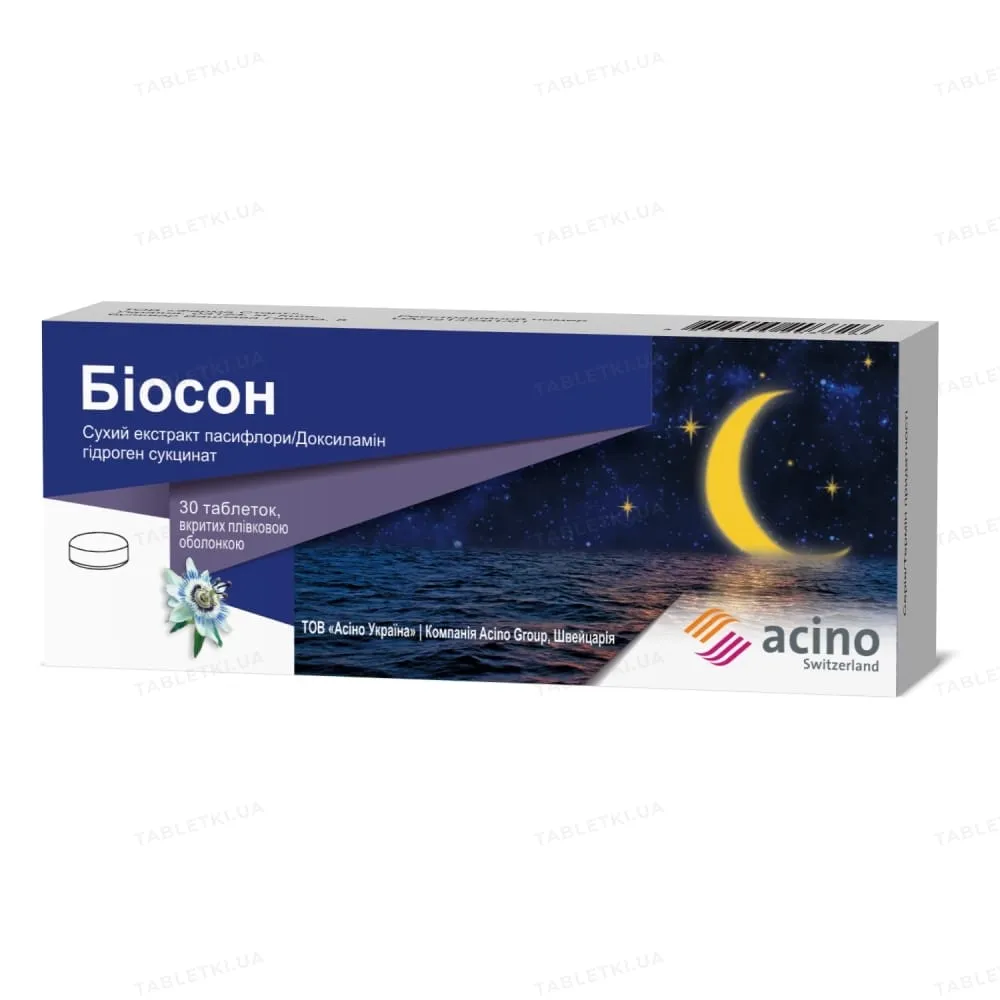
Table of Contents
INSTRUCTION for medical use of the medicinal product BION (Bioson)
Composition:
Active substances: passionflower herb (Passiflorae herba), doxylamine (doxylamine);
1 tablet contains 300 mg of dry extract of passionflower (Passiflorae herba), 3.75 mg of doxylamine hydrogen succinate;
Excipients: glycine, microcrystalline cellulose, copovidone, crospovidone, pregelatinized starch, colloidal anhydrous silicon dioxide, magnesium stearate, film-coating Opadry II Blue (polyvinyl alcohol, titanium dioxide (E 171), polyethylene glycol, talc, indigo carmine (E 132), brilliant blue (E 133), iron oxide black (E 172)).
Pharmaceutical form. Film-coated tablets.
Main physicochemical properties: film-coated tablets ranging from light blue to blue in color, with a biconvex surface, round-shaped, with a characteristic odor.
Pharmacotherapeutic group. Hypnotics and sedatives. ATC code N05CM50.
Antihistamines for systemic use. ATC code R06AA09.
Pharmacological Properties
Pharmacodynamics
The components of passionflower extract inhibit the transmission of nerve impulses in the spinal cord and brain, reduce excitability of the central nervous system, thereby producing a pronounced sedative effect, mild anxiolytic and hypnotic effects without causing symptoms of depression upon awakening. It has a calming effect during premenopausal and menopausal periods. It is used for vegetative symptoms associated with disorders of the nervous and cardiovascular systems (in hypertension, during the recovery period after cerebrovascular crises, neurocirculatory dystonia, asthenic conditions following infections and other severe illnesses). Passionflower alleviates vegetative symptoms such as palpitations and excessive sweating.
Doxylamine succinate is an H1-histamine receptor antagonist of the ethanolamine class, which has sedative, hypnotic, and antiallergic effects. It has been demonstrated to reduce the time required to fall asleep and to improve both duration and quality of sleep.
Pharmacokinetics
Absorption
Maximum plasma concentration (Cmax) is reached on average within 2 hours (Tmax) after administration of doxylamine succinate.
Metabolism and Elimination
The average elimination half-life from plasma (T½) is 10 hours.
Doxylamine succinate is partially metabolized in the liver via demethylation and N-acetylation. The elimination half-life may significantly increase in elderly individuals and in patients with renal or hepatic impairment. Various metabolites formed during breakdown are not quantitatively significant, as 60% of the administered dose is excreted in urine in the unchanged form of doxylamine.
Clinical characteristics.
Indications.
Intermittent and transient insomnia.
Contraindications.
- Hypersensitivity to the components of the medicinal product;
- Pregnancy and breastfeeding;
- History or family history of acute angle-closure glaucoma;
- Urethroprostatic disorders with risk of urinary retention.
Interaction with other medicinal products and other forms of interactions.
When used concomitantly with drugs that depress the central nervous system (CNS), such as barbiturates and tranquilizers, the sedative and hypnotic effects of the medicinal product are enhanced.
Concomitant use with benzodiazepines is not recommended. Concomitant use with disulfiram should be avoided.
Combinations not recommended
Alcohol (as a beverage or as an excipient)
Alcohol enhances the sedative effect of most H1-antihistamines. Reduced alertness may make driving and operating machinery hazardous. Consumption of alcoholic beverages and use of medicinal products containing ethanol should be avoided.
Sodium oxybate causes central nervous system (CNS) depression. Reduced alertness may make driving and operating machinery hazardous.
Combinations to be considered
Acetylcholinesterase inhibitors
There is a risk of reduced efficacy of acetylcholinesterase inhibitors due to antagonistic effects on M-cholinergic receptors.
Other anticholinergic medicinal products (tricyclic antidepressants, most H1-antihistamines with anticholinergic activity, anticholinergic antiparkinsonian agents, atropine-like spasmolytics, disopyramide, phenothiazine neuroleptics, and clozapine) are associated with an increased risk of anticholinergic adverse effects due to blockade of M-cholinergic receptors.
Other CNS-active antidepressants
Opioid derivatives (analgesics; antitussives; drugs used in substitution therapy), neuroleptics, barbiturates, benzodiazepines, non-benzodiazepine anxiolytics (e.g., meprobamate), hypnotics, sedative antidepressants (amitriptyline, doxepin, mianserin, mirtazapine, trimipramine), sedative H1-antihistamines, centrally acting antihypertensives, baclofen, and thalidomide enhance central nervous system depression. Reduced alertness may make driving and operating machinery hazardous.
Other hypnotic agents cause CNS depression.
Opioid-like substances/opioids pose a significant risk of intestinal akinesia with severe constipation.
Special precautions for use.
Special warnings
Insomnia may have various causes that do not necessarily require drug treatment; therefore, consultation with a physician is recommended before starting the medication.
Use with caution in patients with severe organic gastrointestinal disorders.
Like all hypnotics or sedatives, doxylamine hydrogen succinate may exacerbate sleep apnea syndrome (increasing the number and duration of breathing pauses).
The risk of abuse and drug dependence is low; however, cases of abuse and dependence have been reported. Careful monitoring for signs indicating abuse or dependence is necessary. The use of this medicinal product is not recommended in patients with substance use disorders.
Accumulation risk
Doxylamine succinate remains in the body for approximately 5 elimination half-lives (see section "Pharmacokinetics").
In elderly patients or in individuals with impaired renal or hepatic function, the elimination half-life may be significantly prolonged. With repeated administration, the drug or its metabolites reach a steady state much later and at considerably higher levels. Only after reaching a steady state can the efficacy and safety of the medicinal product be properly assessed.
Dosage adjustment may be required.
Elderly patients
H1-antihistamines should be used with caution in elderly patients, as cognitive disturbances, drowsiness, delayed reaction time, and/or dizziness may occur, increasing the risk of falls (e.g., when getting up at night), which can have serious consequences in this patient group.
Safety precautions
Elderly patients, patients with impaired renal or hepatic function
Treatment in elderly patients should begin with the lowest possible dose.
Increased plasma concentrations and reduced plasma clearance have been observed. Dose reduction is recommended.
To prevent daytime drowsiness, it is important to ensure that sleep duration after taking the medication is at least 7 hours.
Use during pregnancy or breastfeeding
Do not use during pregnancy or breastfeeding.
Ability to affect reaction speed when driving or operating machinery
The risk of daytime drowsiness, which may occur during treatment with this drug, especially in individuals driving vehicles or operating machinery, should be considered. Patients should be advised not to use sedatives, sodium oxybate, alcoholic beverages, or medicinal products containing alcohol as concomitant therapy. If such combinations are used, the sedative effect of antihistamines should be taken into account. Insufficient sleep duration increases the risk of reduced attention and concentration.
During treatment with this drug, patients should refrain from driving vehicles and operating potentially hazardous machinery.
Dosage and Administration.
For oral use.
The recommended dose is 1 tablet. If necessary, the dose may be increased to 2 tablets. Take the medication 30 minutes before bedtime.
In elderly patients and patients with renal or hepatic impairment, a reduced dose is recommended.
Treatment duration – up to 10 days. If symptoms persist, consult a physician.
If insomnia persists for more than 5 days, a physician should be consulted regarding the appropriateness of continued use of the drug.
Children. The efficacy and safety of the drug in children under 15 years of age have not been established; therefore, use in this patient group is not recommended.
Overdose.
Symptoms
The initial signs of acute poisoning are drowsiness and anticholinergic effects: excitation, mydriasis, accommodation paralysis, dry mouth, facial and neck flushing, hyperthermia, and sinus tachycardia. Delirium, hallucinations, and athetoid movements are more commonly observed in children and may sometimes precede seizures – a rare complication of severe poisoning or even coma. Even in the absence of seizures, acute doxylamine poisoning may occasionally cause rhabdomyolysis, which can lead to acute renal failure. This muscular disorder is relatively common and requires systematic screening by measuring creatine phosphokinase activity.
Treatment
Treatment is symptomatic. In early stages of poisoning, activated charcoal is recommended (50 g for adults, 1 g/kg for children).
Adverse reactions.
The medicinal product is generally well tolerated.
In individual cases, adverse reactions may occur and the disorders listed below may be observed.
Gastrointestinal disorders: dry mouth, nausea, vomiting, abdominal pain, constipation.
Cardiovascular system disorders: bradycardia, tachycardia, ventricular tachycardia.
Central nervous system disorders: headache, drowsiness, daytime drowsiness, fatigue, dizziness, confusion, hallucinations, cognitive disorders, and psychomotor disturbances.
Immune system disorders: pruritus, skin rashes, vasculitis, possible allergic reactions.
Eye disorders: visual disturbances (impaired visual acuity, accommodation disorders, blurred vision).
Urinary system disorders: urinary retention.
Rhabdomyolysis, increased blood creatine phosphokinase (CPK) levels.
Adverse reactions such as constipation, urinary retention, dry mouth, visual disturbances (accommodation disorders, blurred vision, impaired visual acuity), tachycardia, confusion, and hallucinations are manifestations of the drug's anticholinergic effects.
Fatigue, cognitive disorders, and psychomotor disturbances are caused by the effect of doxylamine (a first-generation H1-antihistamine) on the central nervous system.
If daytime drowsiness occurs, the dose of the medicinal product should be reduced.
Cases of drug abuse and dependence have been reported.
Shelf life. 2 years. Do not use the medicinal product after the expiry date stated on the packaging.
Storage conditions. Store in the original packaging, out of reach of children, at a temperature not exceeding 25 °C.
Packaging. 10 tablets in a blister; 1, 2, 3, and 10 blisters per cardboard box.
Prescription status. Over-the-counter.
Manufacturer. LLC "Farma Start".
Manufacturer's address and place of business.
8, Vatslava Havela Boulevard, Kyiv, 03124, Ukraine.
In case of adverse reactions or questions regarding the safety and efficacy of the medicinal product, please contact the Pharmacovigilance Department of LLC "ASINO UKRAINA" at: 8, Vatslava Havela Boulevard, Kyiv, 03124, Tel/Fax: +38 044 281 2333.