Bioselac
Ukraine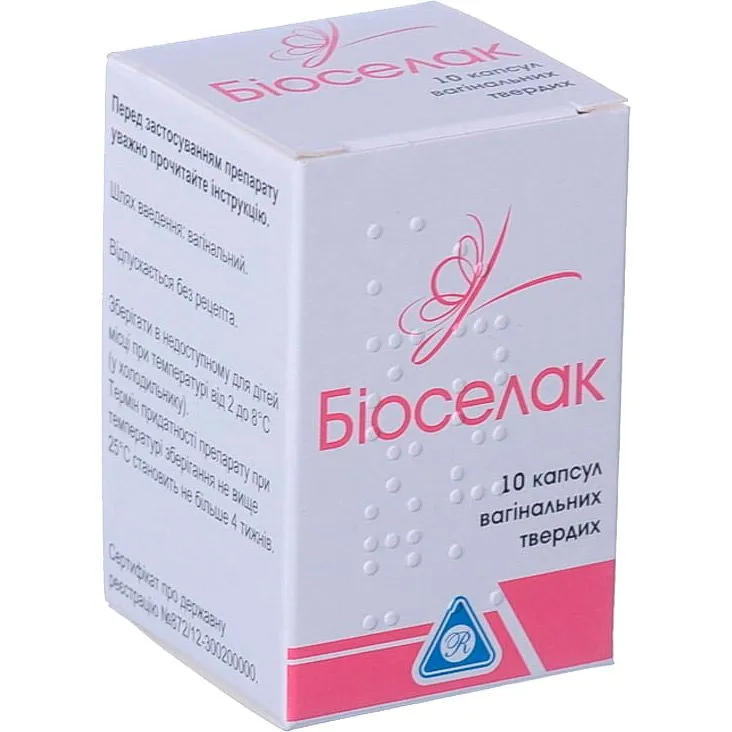
Table of Contents
INSTRUCTIONS FOR MEDICAL USE OF THE MEDICINAL PRODUCT BİOSELAC (BIOSELAC®)
Composition:
Active substance: Lactobacillus rhamnosus 573;
1 capsule contains approximately 1010 (not less than 108) CFU of Lactobacillus rhamnosus 573;
Excipients: skimmed milk powder, sucrose, sodium glutamate, potato starch, magnesium stearate, mannitol (E 421);
Capsule shell: titanium dioxide (E 171), gelatin.
Pharmaceutical form.
Vaginal hard capsules.
Main physicochemical characteristics: white hard gelatin capsules containing a homogeneous beige-cream colored powder.
Pharmacotherapeutic group.
Agents used in gynecology. ATC code G02C X.
Pharmacological properties.
Pharmacodynamics.
Lactobacillus rhamnosus (L. rhamnosus) are Gram-positive, rod-shaped, anaerobic, non-spore-forming bacteria. They belong to the normal obligate flora of the female vulva and vagina and, together with other species of lactobacilli (including L. acidophilus, L. casei, L. fermentum, and L. cellobiosum), are present in the normal flora of the female vulva and vagina, providing a protective function.
The acidic environment of the vagina is one of the main factors for the normal condition and function of the organ. The acidity of vaginal contents is determined by the presence of lactic acid, acetic acid, and low-molecular-weight fatty acids, which are produced from carbohydrates of epithelial cells. Lactobacillus species ferment carbohydrates into aliphatic fatty acids and maintain their levels. Under normal conditions, vaginal pH corresponds to the acidic range and is within 3.7–4.5.
Thus, the protective properties of Lactobacillus are realized through maintaining sufficient concentrations of lactic acid, which creates unfavorable conditions for colonization and growth of pathogenic and conditionally pathogenic microorganisms and ensures optimal conditions for Lactobacillus themselves, as well as through direct antibacterial action of hydrogen peroxide produced by them against conditionally pathogenic microorganisms.
In an acidic environment, lactobacilli actively compete with other microorganisms for adhesion to vaginal epithelial cells, exert a stimulating effect on the immune system, and promote the production of secretory SIgA, lysozyme, complement, and other factors of local immunity.
Vaginal pH may vary depending on age (increasing with age), under the influence of ovarian steroid hormones, during the menstrual cycle in the same woman, and during pregnancy. Changes may also occur under the influence of other factors: body mass index, diseases of the cervix and vagina, level of sexual activity, use of hormonal contraceptives, presence of infectious processes in the body, systemic diseases, systemic or local antibacterial therapy, violations of personal hygiene, etc., as well as under the influence of exogenous and endogenous factors, including temperature and oxygenation.
The therapeutic effect of Lactobacillus is achieved through direct colonization of the vagina by lactic acid bacteria, rapid reduction of vaginal pH to 4.0–4.7, active suppression of the viability and reproduction of pathogenic and conditionally pathogenic bacteria, restoration of the body's own vaginal microflora, and physiological balance in the vagina.
L. rhamnosus exhibits antagonistic activity against a broad spectrum of pathogenic and conditionally pathogenic bacteria (including Staphylococcus spp., Proteus spp., enteropathogenic Escherichia coli), and yeast-like fungi of the genus Candida (due to secretion of antifungal substances, inhibition of adhesion to vaginal epitheliocytes, and suppression of growth and reproduction). It also improves local metabolic processes and promotes the restoration of natural local immunity.
Pharmacokinetics.
When administered intravaginally, the components of the medicinal product are not absorbed into the systemic circulation; therefore, pharmacokinetic data are unavailable.
Clinical characteristics.
Indications.
The medicinal product is used for restoration and maintenance of normal vaginal microflora in the following cases:
- prevention and complex therapy of vaginal infections of various etiologies;
- prevention of vulvovaginal candidiasis;
- prevention of vaginal dysbiosis of various etiologies, including bacterial vaginosis;
- prevention of vaginal dysbiosis in individuals who are sexually active;
- cases of mild to moderate bacterial vaginosis, candidiasis, when antimicrobial therapy is not strictly necessary;
- after local and/or systemic use of antimicrobial or chemotherapeutic agents;
- during use of systemic, particularly oral, or vaginal contraceptives;
- vaginal sanitation prior to local gynecological interventions;
- in the presence of vaginal discharge;
- as a preventive measure when using tampons, local contraceptives, or in cases of inadequate hygiene.
Contraindications.
Hypersensitivity to the active substance and/or to any of the excipients of the medicinal product.
Interaction with other medicinal products and other forms of interaction.
In vitro studies have confirmed the resistance of L. rhamnosus 573 to co-trimoxazole and metronidazole; therefore, the medicinal product can be used during treatment with drugs containing these substances.
The medicinal product should not be used simultaneously with antibacterial, trichomonacidal, or antifungal agents (except metronidazole and co-trimoxazole). Vaginal douching with antiseptic solutions should be avoided due to the potential reduction in efficacy of the medicinal product.
Special precautions for use.
The medicinal product should be used with caution in cases of severe immune disorders.
Use during pregnancy or breastfeeding.
The medicinal product may be used during pregnancy or breastfeeding upon physician's recommendation. Bioselak should be prescribed with caution to women during the first trimester of pregnancy.
Ability to affect reaction speed when driving or operating machinery.
The medicinal product does not affect reaction speed when driving or operating machinery.
Method of Administration and Dosage
The medicinal product is intended for topical use (intravaginally).
The capsule should be inserted deeply into the vagina, following all rules of personal hygiene.
Apply the medicinal product once or twice daily (once in the morning and once in the evening before bedtime) for 7–10 days.
If necessary, treatment may be repeated (after consultation with a physician).
Children
The medicinal product in the form of capsules for intravaginal administration is not intended for use in children.
Overdose
Cases of overdose have not been reported. Overdose does not pose a risk to the patient's condition.
Adverse reactions.
The medicinal product is generally well tolerated. In individual cases, local allergic reactions (itching, burning, increased vaginal discharge) may occur.
Reporting of suspected adverse reactions.
Reporting of adverse reactions following registration of the medicinal product is of great importance. It enables ongoing monitoring of the benefit-risk balance of the medicinal product. Healthcare and pharmaceutical professionals, as well as patients or their legal representatives, should report all suspected adverse reactions and lack of efficacy of the medicinal product via the Automated Information System for Pharmacovigilance at the following link: https://aisf.dec.gov.ua.
Shelf life.
2 years.
Storage conditions.
Store at a temperature of 2 to 8 °C, in a place inaccessible to children.
At storage temperatures not exceeding 25 °C, the shelf life of the medicinal product is no more than 4 weeks.
Packaging.
10 capsules in a blister, 1 blister in a cardboard box;
10 capsules in a bottle, 1 bottle in a cardboard box.
Availability.
Over-the-counter (without prescription).
Manufacturer.
Institute of Serum and Vaccine Biotechnology BIOMED S.A. (IBSV BIOMED S.A.), Poland/
Instytut Biotechnologii Surowic i Szczepionek BIOMED Spolka Akcyjna (IBSS BIOMED S.A.), Poland.
Manufacturer's address and place of business.
Al. Sosnowa, 8, 30-224 Krakow, Poland/
Al. Sosnowa, 8, 30-224 Krakow, Poland.
Marketing Authorization Holder.
WORLD MEDICINE, LLC, Ukraine.