Biolic tuberculin ppd-l
Ukraine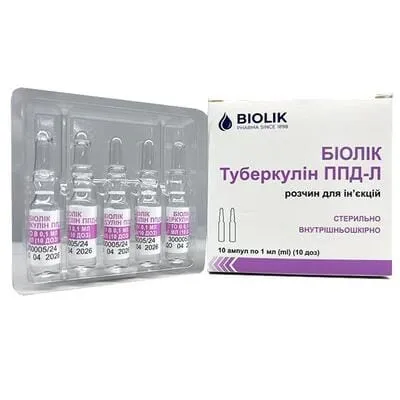
Table of Contents
Instructions for Medical Use of the Medicinal Product BIOLIK Tuberculin PPD-L
Composition:
Active substance: allergen-tuberculoprotein;
one dose of the preparation 0.1 ml contains allergen-tuberculoprotein – 2 TU (tuberculin units);
Excipients: disodium phosphate dodecahydrate – 0.783 mg; potassium dihydrogen phosphate – 0.063 mg; sodium chloride – 0.457 mg; polysorbate 80 – 0.005 mg; phenol – 0.25 mg; water for injections – up to 0.1 ml.
Pharmaceutical form. Solution for injection.
Main physicochemical properties: the preparation is a filtrate of heat-killed cultures of human and bovine types of Mycobacterium tuberculosis, purified by ultrafiltration or another method, precipitated with trichloroacetic acid, treated with ethyl alcohol and anesthetic ether, and dissolved in a stabilizing solvent (phosphate-buffered saline solution with polysorbate 80).
The preparation is a colorless clear liquid free from sediment or foreign impurities.
Pharmaco-therapeutic group. Diagnostic agents. Preparations for diagnosis of tuberculosis. Tuberculin.
ATC code V04CF01.
Pharmacological properties.
Pharmacodynamics.
The active substance of the medicinal product – allergen-tuberculoprotein – induces a specific delayed-type allergic reaction when performing an intradermal tuberculin test in an organism infected with tuberculosis mycobacteria or vaccinated with BCG, manifested as a local reaction – hyperemia and infiltration (papule).
Pharmacokinetics.
Assessment of pharmacokinetic data is not applicable.
Clinical characteristics.
Indications.
The drug is intended for performing the intradermal tuberculin Mantoux test with 2 TU in 0.1 ml for diagnosis of infection with Mycobacterium tuberculosis, as well as for determining the need for BCG vaccination.
Contraindications.
- Skin diseases;
- acute, chronic infectious and somatic diseases during exacerbation;
- allergic conditions (bronchial asthma, pronounced skin manifestations of idiosyncrasies, rheumatism in acute and subacute phases);
- epilepsy;
- presence of a severe allergic reaction to components of the drug or occurrence of a severe skin reaction after previous Mantoux test;
- presence of quarantine due to an infectious disease in a children's group.
The Mantoux diagnostic test should not be performed earlier than 1 month after the disappearance of the above-mentioned clinical symptoms or the end of quarantine due to an infectious disease in a children's group.
Special safety precautions.
Prior to performing the Mantoux test, a mandatory examination by a physician and body temperature measurement must be conducted. The Mantoux test must be performed strictly under aseptic conditions as follows: the skin of the middle third of the inner surface of the forearm should be disinfected with 70° ethyl alcohol and dried with sterile cotton. Before performing tuberculin diagnostics, carefully inspect the ampoule, shake it, wipe it with gauze moistened with 70° ethyl alcohol, then score the neck of the ampoule with a file and break it off.
After opening, the drug in the ampoule must be stored under aseptic conditions for no longer than 2 hours.
When using the drug from a multidose vial for a second time, a new single-use auto-disabled syringe with a sterile needle must be used, and the drug must be withdrawn from the vial under strict adherence to aseptic techniques. If the medicinal product is not used immediately, the storage time and conditions must not exceed 24 hours at a temperature of 2 °C to 8 °C.
Interaction with other medicinal products and other types of interactions.
It should be noted that previous illnesses and prophylactic vaccinations may enhance or reduce the child's skin sensitivity to tuberculin. This complicates the assessment of the reaction and may lead to its misinterpretation.
False-negative reactions may result from:
- age-related immune insufficiency, malnutrition, renal failure, diabetes mellitus, immunosuppression due to medicinal drugs (e.g., corticosteroids);
- oncological diseases, HIV infection, sarcoidosis;
- severe forms of tuberculosis (e.g., miliary tuberculosis);
- viral infections (measles, mumps, infectious mononucleosis, chickenpox, and influenza) may lead to reduced reactivity to tuberculin for several months;
- co-infection with HIV and Mycobacterium tuberculosis leads to anergy to tuberculin;
- immunization with live vaccines (against measles, mumps, and rubella) may lead to reduced reactivity to tuberculin.
The interval between any prophylactic vaccination and the biological diagnostic Mantoux test should be at least 1 month. Scheduled vaccinations may be administered after recording the results of the Mantoux test—after 72 hours.
False-positive reactions may result from:
- previous BCG vaccination;
- infection with nontuberculous mycobacteria.
In individuals vaccinated with BCG, sensitivity to tuberculin may decrease over time. In cases of administering the drug to such individuals, the reaction to the test may be diminished or absent. Performing the Mantoux test in these individuals at intervals shorter than one year from the previous test may lead to a booster effect and result in a positive test outcome.
Special precautions.
In order to identify contraindications, the physician must perform a medical history interview and physical examination of individuals scheduled for tuberculin testing on the day of tuberculin test administration.
Healthcare workers (physician, paramedic, junior medical specialist) involved in tuberculin testing must have undergone special training and be knowledgeable about the organization and technique of tuberculin testing, as well as possess skills in providing emergency care in case of reactions or complications.
Prior to performing the Mantoux diagnostic test, the physician must carefully review the instructions for use of the medicinal product and inform the individual, as well as the parents or other legal representatives of a child, about the possibility of adverse effects following tuberculin testing.
Although the probability of anaphylactic reactions occurring during the Mantoux test is extremely low, readiness to provide medical assistance in such cases is essential.
The test should be performed with the patient in a sitting position. After administration of the Mantoux test, the patient must remain under medical supervision (physician or nurse) for at least 30 minutes to monitor for possible allergic reactions.
This medicinal product contains less than 1 mmol (23 mg)/dose of sodium, i.e., practically sodium-free, and less than 1 mmol (39 mg)/dose of potassium, i.e., practically potassium-free.
Use during pregnancy and breastfeeding.
Data are lacking.
Ability to influence the speed of reactions when driving vehicles or operating other machinery.
Data are lacking.
Method of administration and dosage.
The Mantoux tuberculin test should be performed as prescribed by a physician. The dose size is 2 tuberculin units (TU) contained in 0.1 ml of the stabilizing diluent. The route of administration is intradermal (Mantoux method). A separate syringe and needle must be used for each individual being tested.
When using the preparation in an ampoule. Draw 0.2 ml of the preparation using a single-use 1 ml syringe (with scale divisions of 0.1 ml) with a sterile needle № 08x40. Then attach a sterile needle for intradermal administration № 04x13 to the syringe, expel the excess amount of the preparation into a sterile swab, and administer 0.1 ml intradermally. When using autodisable syringes, it is possible to draw 0.1 ml of tuberculin solution directly into the syringe.
When using the preparation in a vial. Draw 0.1 ml (1 dose) of the preparation using an autodisable syringe and administer strictly intradermally.
With proper injection technique, a white-colored infiltrate approximately 8 mm in diameter—known as a "lemon peel"—should form at the injection site.
The administration and evaluation of the Mantoux test must be performed by a physician or a specially trained nurse under a physician's supervision. Test results should be evaluated after 72 hours. The size of the papule should be measured using a transparent millimeter ruler. Record the maximum transverse diameter (perpendicular to the long axis of the arm) of the papule; do not include the area of hyperemia in the measurement. The reaction is considered negative if there is only a puncture reaction (0–1 mm); doubtful if there is a papule from 2 to 4 mm in size, or any degree of hyperemia; positive if the papule is 5 mm or larger. A hyperergic reaction is defined as a papule of 17 mm or larger in children and adolescents, or 21 mm or larger in adults, or the presence of a vesiculonecrotic reaction, lymphangitis, or regional lymphadenitis, regardless of papule size (see section "Adverse Reactions").
Children.
To be used in children aged 2 months and older.
Overdose.
No cases of overdose have been reported.
Adverse reactions.
Reactions observed 72 hours after tuberculin administration depend on the level of specific reactivity of the organism:
- in the absence of specific reactivity, no local or general symptoms are observed; the reaction to the drug is negative;
- in cases of infection or presence of post-vaccination allergy, a local reaction in the form of an infiltrate (papule) and hyperemia is observed. In some cases, in individuals with a high degree of allergy to tuberculin, local reactions, along with a large papule and hyperemia, may be accompanied by lymphangitis and lymphadenitis (see section "Instructions for use and dosage").
Adverse reactions following tuberculin administration are listed based on post-marketing surveillance data. The following criteria were used to assess the frequency of adverse reactions: very common (≥ 1/10); common (from ≥ 1/100 to < 1/10); uncommon (from ≥ 1/1000 to < 1/100); rare (from ≥ 1/10000 to < 1/1000); very rare (< 1/10000); frequency not known (frequency cannot be estimated based on available data).
| System organ class |
Frequency |
Adverse reaction |
| General disorders and administration site reactions |
Uncommon |
Malaise, increased body temperature |
| Frequency unknown |
Pain, swelling in the limb |
|
| Common |
Pain, painful sensitivity or discomfort at the injection site immediately after injection |
|
| Nervous system disorders |
Uncommon |
Headache |
| Immune system disorders |
Isolated |
Allergic reactions |
| Skin and subcutaneous tissue disorders |
Frequency unknown |
Rash |
Shelf life.
2 years.
Storage conditions. Store in a light-protected place at a temperature of 2 °C to 8 °C. Freezing and heating above 18 °C are not permitted. Keep out of reach of children.
Incompatibility. Data not available.
Packaging.
0.6 ml (6 doses) with activity of 2 TO/dose in vials, pack of 10;
1 ml (10 doses) with activity of 2 TO/dose in vials, pack of 10 or 5 vials per blister, 2 blisters per carton;
3 ml (30 doses) with activity of 2 TO/dose in vials, pack of 10;
or: 1 ml (10 doses) in vials, 5 vials per blister, 2 blisters per carton;
or kits:
1 vial of 0.6 ml (6 doses) with activity of 2 TO/dose, 3 syringes with extraction needles, 3 administration needles;
1 vial of 1 ml (10 doses), 5 syringes with extraction needles, 5 administration needles;
1 vial of 1 ml (10 doses), 10 self-locking syringes.
Prescription category. Prescription only.
Manufacturer. LLC "Biolyk PHARMA".
Location of manufacturer and address of its business activity.
Legal entity location:
Ukraine, 61070, Kharkiv region, city of Kharkiv, Pomyrky, building 70.
Address of business activity location:
Ukraine, 61070, Kharkiv region, city of Kharkiv, Pomyrky-70, building b/n.