Bilobil® intens 120 mg
Ukraine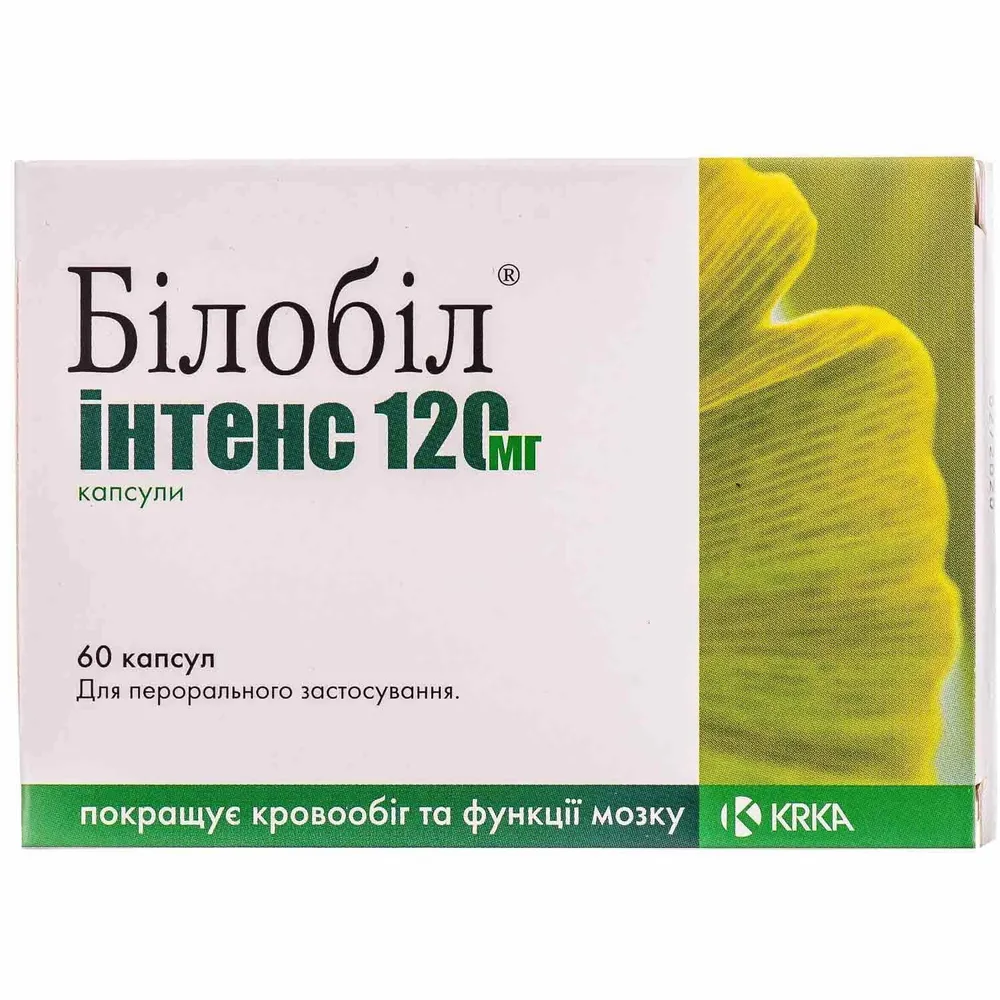
Table of Contents
INSTRUCTIONS FOR MEDICAL USE OF THE MEDICINAL PRODUCT BILIBOL® INTENSE 120 MG (BILOBIL® INTENSE 120 MG)
Composition:
Active substances: 1 capsule contains dry extract of Ginkgo biloba L., folium (35–67:1) containing:
- 26.4–32.4 mg flavonoids as flavonoid glycosides;
- 3.36–4.08 mg ginkgolides A, B, C;
- 3.12–3.84 mg bilobalides – 120 mg;
Extraction solvent – acetone.
Excipients: lactose monohydrate, corn starch, talc, colloidal anhydrous silicon dioxide, magnesium stearate, glucose solution.
Capsule shell: gelatin, titanium dioxide (E 171), black iron oxide (E 172), red iron oxide (E 172), yellow iron oxide (E 172).
Pharmaceutical form. Capsules.
Main physicochemical properties: brown capsules. The capsule contains a powder ranging from light to dark brown in color, with visible dark particles and possible small granules.
Pharmacotherapeutic group.
Agents used in dementia. Ginkgo biloba. ATC code N06DX02.
Pharmacological properties.
Pharmacodynamics.
A plant-derived preparation that normalizes cellular metabolism, blood rheological properties, and microcirculation.
Improves cerebral circulation and supplies the brain with oxygen and glucose, prevents erythrocyte aggregation, and inhibits platelet-activating factor. Exhibits a dose-dependent regulatory effect on the vascular system by stimulating the production of endothelium-derived relaxing factor (nitric oxide – NO), dilates small arteries, increases venous tone, thereby regulating vascular blood filling. Reduces vascular wall permeability (exerts anti-edematous effect both in the brain and peripherally). Possesses antithrombotic activity (due to stabilization of platelet and erythrocyte membranes, influence on prostaglandin synthesis, reduction of biologically active substances and platelet-activating factor activity). Prevents formation of free radicals and lipid peroxidation of cell membranes. Normalizes release, reuptake, and catabolism of neurotransmitters (norepinephrine, dopamine, acetylcholine) and their ability to bind to receptors. Exerts anti-hypoxic effects, improves metabolism in organs and tissues, promotes accumulation of macroergic compounds in cells, enhances utilization of oxygen and glucose, and normalizes mediator processes in the central nervous system.
Pharmacokinetics.
Active ingredient – standardized dry extract of Ginkgo biloba: 24% heterosides and 6% ginkgolides-bilobalide (ginkgolide A, B and bilobalide C).
After oral administration, bioavailability of ginkgolides A, B and bilobalide C is 80–90%. Maximum concentration is reached within 1–2 hours after administration. Elimination half-lives are approximately 4 hours (bilobalide, ginkgolide A) and 10 hours (ginkgolide B).
These substances are not metabolized in the body and are almost completely excreted in urine; a minor amount is excreted in feces.
Clinical characteristics.
Indications.
- Cognitive deficit of various origins (dyscirculatory encephalopathy, following stroke, traumatic brain injury, in elderly age), manifesting as attention and/or memory disorders, reduced intellectual abilities, feelings of fear, sleep disturbances; and neurosensorial deficit of various origins (age-related macular degeneration, diabetic retinopathy);
- Intermittent claudication in chronic obstructive arterial disease of the lower limbs (Stage II according to Fontaine);
- Visual disturbances of vascular origin, decreased visual acuity;
- Hearing disturbances, tinnitus, dizziness, and coordination disorders, predominantly of vascular origin;
- Raynaud's syndrome.
Contraindications.
Hypersensitivity to Ginkgo biloba extract or to any inactive component of the medicinal product. Pregnancy.
Interaction with other medicinal products and other types of interactions.
Concomitant use of the medicinal product with anticoagulants (phenprocoumon, warfarin) or antiplatelet agents (clopidogrel, acetylsalicylic acid, and other nonsteroidal anti-inflammatory drugs) may influence the effects of these agents.
In conducted studies, no interaction between warfarin and Ginkgo-containing medicinal products was observed; however, appropriate monitoring is recommended when warfarin is used concomitantly with Ginkgo-based products, especially at the beginning and end of treatment or upon changing the medicinal product.
Interaction studies with talinolol suggest that Ginkgo may inhibit P-glycoproteins in the small intestine, potentially increasing gastrointestinal exposure to P-glycoprotein-sensitive drugs, such as dabigatran etexilate. Concomitant use of Ginkgo with dabigatran should be done with caution.
Interaction studies have shown that nifedipine Cmax may increase by up to 100% during Ginkgo use in some patients, who experienced dizziness and increased flushing.
Concomitant use of Ginkgo-containing medicinal products and efavirenz is not recommended due to the potential for decreased plasma concentrations of efavirenz resulting from induction of cytochrome CYP3A4 (see section "Special precautions for use").
Special precautions for use
The first signs of improvement appear one month after starting treatment.
If symptoms worsen during use of the medicinal product, consult a physician.
Patients with a tendency to bleeding (hemorrhagic tendency) who are receiving concomitant therapy with anticoagulants or antiplatelet medicinal agents should consult their physician before using this medicinal product.
Medicinal products containing ginkgo may increase the risk of bleeding. As a precautionary measure, treatment with this medicinal product should be discontinued 3–4 days prior to surgical intervention.
In patients with epilepsy, the occurrence of additional seizures during treatment with ginkgo-containing medicinal products cannot be excluded.
Concomitant use of ginkgo-containing medicinal products with efavirenz is not recommended (see section "Interaction with other medicinal products and other forms of interaction").
If an allergic reaction occurs, the patient should discontinue the drug.
Excipients
The medicinal product contains lactose and glucose. Patients with rare hereditary forms of galactose intolerance, Lapp lactase deficiency, or glucose-galactose malabsorption should not take this medicinal product.
Use during pregnancy or breastfeeding
Pregnancy
Ginkgo extract may reduce platelet aggregation ability. The tendency to bleeding may increase. Animal studies are insufficient to draw conclusions regarding reproductive toxicity.
The medicinal product is contraindicated during pregnancy.
Breastfeeding
There are no data indicating that ginkgo metabolites are excreted in human breast milk. Risk to newborns and infants cannot be ruled out.
Due to the lack of sufficient data, use of this medicinal product during breastfeeding is not recommended.
Fertility
No specific studies on the effect of ginkgo on human fertility have been conducted. However, certain effects have been observed in female mice.
Effect on the ability to drive and use machines
No studies on the effect on the ability to drive or operate machinery have been conducted.
During treatment, caution should be exercised when driving or engaging in other potentially hazardous activities requiring high concentration and rapid psychomotor reaction speed.
Dosage and Administration
Administer 1 capsule 1–2 times daily during meals. Swallow with ½ glass of water. The average duration of treatment is 3 months.
Cognitive disorders: administer 1 capsule of 120 mg 1–2 times daily. The duration of treatment should be at least 8 weeks. After 3 months of therapy, a physician must evaluate the need for continued use of the drug.
Peripheral occlusive arterial disease, as well as vascular and involutional dizziness: administer 1 capsule of 120 mg once daily. The duration of treatment should be at least 8 weeks.
In cases of dizziness, the duration of therapy should not exceed 6–8 weeks.
The duration of tinnitus treatment should be at least 12 weeks.
Children
There is insufficient experience with the use of the drug in children; therefore, treatment of this patient group is not recommended.
Overdose.
Following single or repeated overdose, dyspeptic disorders, impaired consciousness, and headache may occur. Treatment is symptomatic.
Side effects
Very common: ≥ 1/10.
Common: ≥ 1/100 to < 1/10.
Uncommon: ≥ 1/1000 to < 1/100.
Rare: ≥ 1/10000 to < 1/1000.
Very rare: < 1/10000.
Frequency not known: cannot be estimated from the available data.
| System of organs |
Very common |
Common |
Frequency unknown |
| Blood and lymphatic system |
Bleeding (gastrointestinal, ocular, cerebral) |
||
| Immune system |
Hypersensitivity reactions (anaphylactic shock) |
||
| Nervous system |
Headache |
Dizziness |
|
| Gastrointestinal tract |
Diarrhea, abdominal pain, nausea, vomiting |
||
| Skin and subcutaneous tissue |
Allergic skin reactions (erythema, edema, pruritus, rash) |
If any adverse reactions not listed above occur, consult a physician.
Reporting of suspected adverse reactions.
Reporting of suspected adverse reactions after registration of the medicinal product is important. It allows continuous monitoring of the benefit-risk balance of the medicinal product. Healthcare professionals should report any suspected adverse reactions via the national reporting system.
Shelf life. 3 years.
Storage conditions. Store at temperatures not above 25 °C in the original packaging to protect from moisture. Keep out of reach and sight of children.
Packaging.
10 capsules in a blister; 2 or 6 blisters in a cardboard box.
Supply category. Over-the-counter.
Manufacturer.
KRKA, d.d., Novo mesto, Slovenia / KRKA, d.d., Novo mesto, Slovenia.
Manufacturer's address and place of business.
Smarjeska cesta 6, 8501 Novo mesto, Slovenia / Smarjeska cesta 6, 8501 Novo mesto, Slovenia.