Bilobil® forte
Ukraine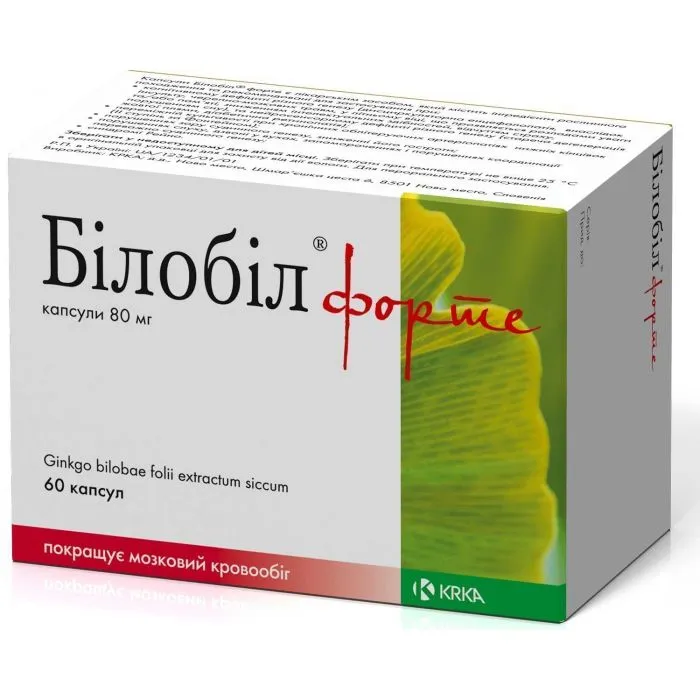
Table of Contents
INSTRUCTION for medical use of the medicinal product Bilobil® forte (Bilobil® forte)
Composition:
Active substance: 1 capsule contains dry extract of Ginkgo biloba L., folium (Ginkgo biloba L., folium) (ratio of starting material to extract 35–67:1) containing:
- 17.6–21.6 mg flavonoids as flavonoid glycosides;
- 2.24–2.72 mg ginkgolides A, B, C;
- 2.08–2.56 mg bilobalides – 80 mg;
Extraction solvent – acetone.
Excipients: lactose monohydrate, corn starch, talc, colloidal anhydrous silicon dioxide, magnesium stearate, glucose solution;
Capsule shell: gelatin, titanium dioxide (E 171), azorubine colorant (E 122), iron oxide red (E 172), iron oxide black (E 172).
Pharmaceutical form. Capsules.
Main physicochemical properties: pink-colored capsules. The capsule contains powder from light to dark brown in color with visible dark particles; the presence of small agglomerates is possible.
Pharmacotherapeutic group.
Agents used in dementia. Ginkgo biloba. ATC code N06DX02.
Pharmacological properties.
Pharmacodynamics.
The exact mechanism of action is unknown. Pharmacological data indicate increased alertness in elderly patients based on electroencephalography findings, reduced blood viscosity, and enhanced vascularization in certain areas of the brain in healthy men (aged 60–70 years), as well as reduced platelet aggregation. In addition, vasodilatory effects on forearm blood vessels have been observed, enhancing regional blood flow.
Pharmacokinetics.
After oral administration of 120 mg of ginkgo extract (in solution form), the mean bioavailability of terpene lactones was 80% for ginkgolide A, 88% for ginkgolide B, and 79% for bilobalide. Following administration of the medicinal product in tablet form, maximum plasma concentrations of terpene lactones reached 16–22 ng/mL for ginkgolide A, 8–10 ng/mL for ginkgolide B, and 27–54 ng/mL for bilobalide. The corresponding elimination half-life of ginkgolides A and B and bilobalide was 3–4, 4–6, and 2–3 hours, respectively. Plasma concentrations after administration of a solution containing 120 mg of ginkgo extract were 25–33 ng/mL for ginkgolide A, 9–17 ng/mL for ginkgolide B, and 19–35 ng/mL for bilobalide. The elimination half-life of ginkgolide A was 5 hours, ginkgolide B was 9–11 hours, and bilobalide was 3–4 hours.
Clinical characteristics.
Indications.
Bilobil® Forte capsules — a herbal medicinal product for improving (age-related) cognitive disorders and quality of life in mild dementia.
Contraindications.
Hypersensitivity to Ginkgo biloba extract or to any other component of the medicinal product.
Pregnancy (see section "Use during pregnancy or breast-feeding").
Interaction with other medicinal products and other forms of interaction.
Concomitant use of the medicinal product with anticoagulants (phenprocoumon, warfarin) or antiplatelet agents (clopidogrel, acetylsalicylic acid and other non-steroidal anti-inflammatory drugs) may affect the action of these agents.
In clinical studies with warfarin, no interaction between warfarin and Ginkgo-containing medicinal products was observed; however, appropriate monitoring is recommended when initiating or discontinuing concomitant treatment with warfarin and Ginkgo-based medicinal products, or when changing the medicinal product.
An interaction study with talinolol indicates a potential ability of Ginkgo to inhibit P-glycoproteins in the small intestine, which may increase exposure to P-glycoprotein-sensitive medicinal products in the gastrointestinal tract, such as dabigatran etexilate. Ginkgo should be used with caution when taken concomitantly with dabigatran.
An interaction study demonstrated that the Cmax of nifedipine may increase by up to 100% under Ginkgo administration in some patients, who experienced dizziness and increased frequency of hot flushes.
Concomitant use of Ginkgo-containing medicinal products with efavirenz is not recommended due to the potential decrease in efavirenz plasma concentrations resulting from induction of cytochrome CYP3A4 (see section "Special precautions for use").
Special precautions for use
Before starting treatment with Bilobil® forte, it is important to ensure that the symptoms present are not due to other diseases requiring specific treatment.
If symptoms worsen during treatment with the medicinal product, a physician should be consulted.
Patients with a pathologically increased tendency to bleeding (haemorrhagic diathesis) and those receiving concomitant anticoagulant or antiplatelet therapy should take Bilobil® forte only after consultation with a physician.
Medicinal products containing Ginkgo biloba may increase the tendency to bleeding. As a precautionary measure, treatment with this medicinal product should be discontinued 3–4 days prior to any surgical intervention.
In patients with epilepsy, the occurrence of additional seizures during treatment with Ginkgo biloba-containing medicinal products cannot be excluded.
Concomitant use of medicinal products containing Ginkgo biloba with efavirenz is not recommended (see section "Interaction with other medicinal products and other forms of interaction").
Children
There are no established indications for the use of Bilobil® forte capsules in children under 18 years of age. Therefore, Bilobil® forte capsules should not be used in this age group.
Special warnings regarding inactive ingredients
The product contains lactose and glucose. Patients with rare hereditary forms of galactose intolerance, Lapp lactase deficiency, or glucose-galactose malabsorption should not take this product. The product contains the azorubine dye (E 122), which may cause allergic reactions.
Use during pregnancy or breastfeeding
Pregnancy
Ginkgo biloba extract may reduce platelet aggregation ability. The tendency to bleeding may therefore increase. Animal studies are insufficient to draw conclusions regarding reproductive toxicity.
The medicinal product is contraindicated during pregnancy (see section "Contraindications").
Breastfeeding
There are no data on whether Ginkgo biloba metabolites are excreted in human breast milk. A risk to newborns and infants cannot be excluded.
Due to the lack of clinical data, the product is not recommended during breastfeeding.
Fertility
No specific studies on the effect of Ginkgo biloba on human fertility have been conducted. However, certain effects have been observed in female mice.
Ability to affect reaction speed when driving or operating machinery
No adequate studies on the effect of the medicinal product on the ability to drive or operate machinery have been conducted.
Dosage and Administration.
Dosage
Adults and elderly patients: should take 1 capsule of 80 mg three times a day.
Duration of treatment
The duration of treatment should be at least 8 weeks.
If no symptomatic improvement is observed after 3 months, or if pathological symptoms worsen, the physician should reassess the need for continued use of the medicinal product.
Administration method
For oral administration.
The capsule should be swallowed with a small amount of liquid, independent of meal times.
Children
There are no appropriate indications for use in children under 18 years of age (see section "Special precautions for use").
Overdose.
Cases of overdose have not been reported.
Side effects.
Very common: ≥ 1/10.
Common: ≥ 1/100 to < 1/10.
Uncommon: ≥ 1/1000 to < 1/100.
Rare: ≥ 1/10000 to < 1/1000.
Very rare: < 1/10000.
Not known: cannot be estimated from the available data.
| System organ |
Very common |
Common |
Unknown |
| Blood and lymphatic system |
Bleeding (ocular, nasal, cerebral, gastrointestinal) |
||
| Immune system |
Hypersensitivity reactions (anaphylactic shock) |
||
| Nervous system |
Headache |
Dizziness |
|
| Gastrointestinal tract |
Diarrhea, abdominal pain, nausea, vomiting |
||
| Skin and subcutaneous tissue |
Skin allergic reactions (erythema, swelling, itching, rash) |
The product contains the colouring agent azorubine (E 122), which in rare cases may cause allergic reactions and bronchospasm.
If any adverse reactions occur, the use of the product should be discontinued and medical advice must be sought immediately.
Reporting suspected adverse reactions
Reporting of suspected adverse reactions after authorization of the medicinal product is of great importance. It allows continuous monitoring of the benefit-risk balance of the medicinal product. Healthcare professionals, as well as patients or their legal representatives, are encouraged to report all suspected adverse reactions and lack of efficacy through the Automated Information System for Pharmacovigilance at the following link: https://aisf.dec.gov.ua.
Shelf life. 3 years.
Storage conditions.
Store at temperatures not exceeding 25 °C in the original packaging to protect from moisture. Keep out of reach of children.
Packaging.
10 capsules per blister; 2 or 6 blisters per cardboard box.
Availability. Over-the-counter (without prescription).
Manufacturer.
KRKA, d.d., Novo mesto, Slovenia.
Manufacturer's address and location of operations.
Smarjeska cesta 6, 8501 Novo mesto, Slovenia.