Bicalutamide-teva
Ukraine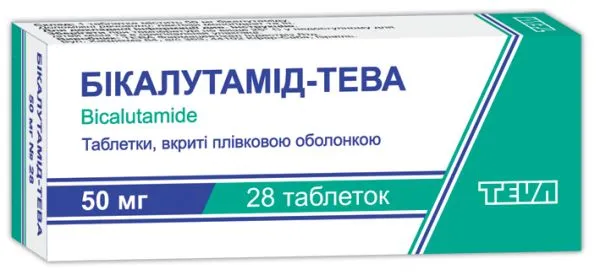
Table of Contents
INSTRUCTION FOR MEDICAL USE OF THE MEDICINAL PRODUCT BICALUTAMIDE-TEVA (BICALUTAMIDE-TEVA)
Composition:
Active substance: bicalutamide;
One film-coated tablet contains 150 mg of bicalutamide;
Excipients: microcrystalline cellulose, povidone, sodium croscarmellose, sodium lauryl sulfate, lactose monohydrate, colloidal anhydrous silicon dioxide, magnesium stearate, hypromellose, polidextrose, titanium dioxide (E 171), polyethylene glycol.
Pharmaceutical form. Film-coated tablets.
Main physicochemical properties: white or almost white, round, biconvex, film-coated tablets, embossed with "BCL" on one side and smooth on the other; free from cracks and chips.
Pharmacotherapeutic group. Antiandrogen agents. ATC code L02B B03.
Pharmacological properties.
Pharmacodynamics.
Mechanism of action
Bicalutamide is a non-steroidal antiandrogen agent devoid of other endocrine activity. It binds to androgen receptors without activating gene expression, thereby blocking androgen stimulation. This leads to regression of prostate tumors. In some patients, discontinuation of bicalutamide therapy may trigger a withdrawal syndrome.
It is a racemic compound; antiandrogenic activity is exhibited exclusively by the (R)-enantiomer.
Clinical efficacy and safety
Bicalutamide 150 mg was investigated as a treatment for patients with localized (T1–T2, N0 or NX, M0) or locally advanced (T3–T4, any N, M0; T1–T2, N+, M0) prostate cancer without metastases in a combined analysis of three placebo-controlled, double-blind studies involving 8113 patients. Bicalutamide was administered as immediate hormonal therapy or as adjuvant therapy following radical prostatectomy or radiotherapy (mostly external beam radiation therapy). At a median follow-up of 9.7 years, objective disease progression was observed in 36.6% of patients receiving bicalutamide and 38.17% of those receiving placebo.
A reduction in the risk of objective disease progression was observed in the majority of patients across groups, but this reduction was most pronounced in patients at high risk of disease progression. Therefore, clinicians may consider that the optimal treatment strategy for patients at low risk of disease progression—particularly when the drug is used adjuvantly after radical prostatectomy—may be to defer hormonal therapy until signs of disease progression appear.
At a median observation period of 9.7 years, no difference in overall survival was observed, with mortality rates of 31.4% in both groups (relative risk (RR) = 1.01; 95% confidence interval (CI) = 0.94–1.09). However, subgroup analyses revealed certain trends.
Data on progression-free survival and overall survival, based on Kaplan–Meier analysis, in patients with locally advanced prostate cancer are presented in the following tables:
Table 1
Proportion of patients with locally advanced prostate cancer and disease progression in subgroups according to different treatment regimens
| Population analysis |
Treatment group |
Events at 3 years, % |
Events at 5 years, % |
Events at 7 years, % |
Events at 10 years, % |
| Watchful waiting (n=657) |
Bicalutamide 150 mg |
19.7 |
36.3 |
52.1 |
73.2 |
| Placebo |
39.8 |
59.7 |
70.7 |
79.1 |
|
| Radiotherapy (n=305) |
Bicalutamide 150 mg |
13.9 |
33.0 |
42.1 |
62.7 |
| Placebo |
30.7 |
49.4 |
58.6 |
72.2 |
|
| Radical prostatectomy (n=1719) |
Bicalutamide 150 mg |
7.5 |
14.4 |
19.8 |
29.9 |
| Placebo |
11.7 |
19.4 |
23.2 |
30.9 |
Table 2
Overall survival of patients with locally advanced disease
in subgroups with different treatment regimens
| Population analysis |
Treatment group |
Events at 3 years, % |
Events at 5 years, % |
Events at 7 years, % |
Events at 10 years, % |
| Watchful waiting (n=657) |
Bicalutamide 150 mg |
14.2 |
29.4 |
42.2 |
65.0 |
| Placebo |
17.0 |
36.4 |
53.7 |
67.5 |
|
| Radiotherapy (n=305) |
Bicalutamide 150 mg |
8.2 |
20.9 |
30.0 |
48.5 |
| Placebo |
12.6 |
23.1 |
38.1 |
53.3 |
|
| Radical prostatectomy (n=1719) |
Bicalutamide 150 mg |
4.6 |
10.0 |
14.6 |
22.4 |
| Placebo |
4.2 |
8.7 |
12.6 |
20.2 |
In patients with localized disease who received bicalutamide alone, there was no significant difference in progression-free survival. Also, in patients with localized disease who received bicalutamide as adjuvant therapy after radiotherapy (HR 0.98; 95% CI 0.80–1.20) or radical prostatectomy (HR 1.03; 95% CI 0.85–1.25), no significant difference in overall survival was observed. In patients with localized disease who would otherwise have been managed with a watchful waiting approach, there remains a trend toward reduced survival compared to patients receiving placebo (HR 1.15; 95% CI 1.00–1.32). Considering the benefit/risk ratio, the use of bicalutamide in patients with localized disease is not considered appropriate.
In another program, the efficacy of bicalutamide 150 mg for the treatment of patients with locally advanced prostate cancer without metastases, for whom immediate castration was indicated, was demonstrated in a combined analysis of two studies involving 480 patients with metastasis-free (M0) prostate cancer who had not received prior therapy. At a median follow-up of 6.3 years, the mortality rate was 56% and did not differ significantly between the bicalutamide and castration groups (HR 1.05; CI 0.81–1.36); however, statistical equivalence of the two treatment methods cannot be established.
In a combined analysis of two studies involving 805 patients with metastatic disease (M1) who had not received prior therapy, at a mortality rate of 43%, bicalutamide 150 mg was found to be less effective than castration regarding survival time (HR 1.30; CI 1.04–1.65), with a numerical difference in time to death of 42 days (6 weeks) at a median survival of 2 years.
Children
No studies in children have been conducted (see sections "Contraindications" and "Use in Pregnancy and Breastfeeding").
Pharmacokinetics
Absorption
Bicalutamide is well absorbed following oral administration. Food has no clinically significant effect on bioavailability.
Compared to the (R)-enantiomer, the (S)-enantiomer is rapidly eliminated from the body, with a half-life of approximately 1 week.
Distribution
With daily administration of bicalutamide at a dose of 150 mg, plasma concentrations of the (R)-enantiomer increase approximately 10-fold due to its long elimination half-life.
A steady-state plasma concentration of the (R)-enantiomer of approximately 22 µg/mL is achieved with a daily dose of 150 mg bicalutamide. The active (R)-enantiomer accounts for 99% of total circulating enantiomers at steady state.
Metabolism and Elimination
The pharmacokinetics of the (R)-enantiomer are not affected by age or by mild to moderate renal or hepatic impairment. In patients with severe hepatic impairment, the (R)-enantiomer is eliminated more slowly from plasma.
Bicalutamide is highly protein-bound (racemic: 96%, (R)-enantiomer: >99%) and undergoes extensive metabolism (via oxidation and glucuronidation); metabolites are excreted in urine and bile in approximately equal proportions.
In a clinical study, the mean concentration of (R)-bicalutamide in semen of men receiving bicalutamide 150 mg was 4.9 µg/mL. The amount of bicalutamide potentially transferred to a female partner during intercourse is low, estimated at approximately 0.3 µg/mL, which is below the level associated with effects on offspring in laboratory animals.
Clinical characteristics.
Indications.
Bicalutamide-Teva 150 mg tablets are indicated as monotherapy and as adjuvant therapy in combination with radical prostatectomy or radiotherapy for patients with locally advanced prostate cancer at high risk of disease progression (see section "Pharmacological properties").
Bicalutamide-Teva 150 mg tablets are also indicated for the treatment of patients with locally advanced non-metastatic prostate cancer when surgical castration or other medical interventions are inappropriate or cannot be used.
Contraindications.
- Hypersensitivity to bicalutamide or to any of the excipients;
- Concomitant administration of terfenadine, astemizole, or cisapride (see section "Interaction with other medicinal products and other forms of interactions");
- Contraindicated in women and children (see section "Use during pregnancy or breast-feeding").
Interaction with other medicinal products and other forms of interactions.
In vitro studies have shown that R-bicalutamide is an inhibitor of CYP 3A4 and exhibits a lesser inhibitory effect on the activity of CYP 2C9, 2C19, and 2D6.
Although clinical studies using antipyrine as a marker for cytochrome P450 (CYP) activity did not indicate a potential interaction with bicalutamide, the mean concentration of midazolam (area under the pharmacokinetic curve) increased by up to 80% after 28 days of concomitant administration with bicalutamide. For drugs with a narrow therapeutic index, such an increase may be clinically significant. Therefore, concomitant use with terfenadine, astemizole, and cisapride is contraindicated (see section "Contraindications"). Caution is advised when co-administering cyclosporine and calcium channel blockers.
Dosage reduction of these agents may be necessary, especially if signs of enhanced drug effect or adverse reactions occur. When administering cyclosporine, careful monitoring of its plasma concentration and the patient's clinical status is recommended upon initiation or discontinuation of bicalutamide treatment.
Caution is also advised when co-administering substances that may inhibit the oxidation of bicalutamide, i.e., medicinal products containing ketoconazole or cimetidine. This may lead to increased plasma levels of bicalutamide, potentially resulting in enhanced adverse reactions.
In vitro studies have shown that bicalutamide is capable of displacing the coumarin anticoagulant warfarin from its protein-binding sites. Therefore, prothrombin time should be closely monitored in patients receiving bicalutamide who are also being treated with coumarin anticoagulants.
Medicinal products that may prolong the QT interval or provoke torsades de pointes ventricular tachycardia should be used with caution, given that antiandrogen therapy may prolong the QT interval. Such medicinal products include: Class IA (e.g., quinidine, disopyramide) and Class III (e.g., amiodarone, sotalol, dofetilide, ibutilide) antiarrhythmics, methadone, moxifloxacin, and antipsychotics (see section "Special warnings and precautions for use").
Special precautions for use.
Initiation of treatment should be carried out under direct specialist supervision.
Bicalutamide-Teva is extensively metabolized in the liver. In patients with severe hepatic impairment, elimination of the drug may be slowed, potentially leading to enhanced bicalutamide accumulation. Therefore, bicalutamide-Teva should be administered with caution in patients with moderate to severe hepatic dysfunction.
Due to the possibility of liver function changes, liver function tests should be monitored periodically. Most changes are expected to occur within the first 6 months of bicalutamide treatment.
Rare cases of severe liver disorders and hepatic failure, sometimes fatal, have been reported during bicalutamide use (see section "Side effects"). If severe liver disorders occur during treatment with Bicalutamide-Teva, the treatment should be discontinued.
If there are objective signs of disease progression or increased PSA (prostate-specific antigen) levels, discontinuation of therapy should be considered.
Bicalutimed is an inhibitor of cytochrome P450 (CYP3A4); therefore, caution should be exercised when administering this drug concomitantly with medicinal products metabolized by CYP3A4 (see sections "Contraindications" and "Interaction with other medicinal products and other forms of interaction").
Rare cases of photosensitivity reactions have been reported in patients receiving bicalutamide 150 mg. Patients should be advised to avoid excessive exposure to direct sunlight or ultraviolet light and to use sun protection measures while taking bicalutamide 150 mg. If photosensitivity reaction is persistent and/or severe, appropriate symptomatic treatment should be initiated.
Antiandrogen therapy may prolong the QT interval.
In patients with risk factors or history of QT interval prolongation, and in patients concurrently using medicinal products that may prolong the QT interval (see section "Interaction with other medicinal products and other forms of interaction"), the physician should assess the benefit-risk ratio before initiating treatment, taking into account the potential risk of developing bidirectional torsade de pointes ventricular tachycardia.
Antiandrogen therapy may cause changes in sperm morphology. Although the effect of bicalutamide on sperm morphology has not been evaluated and such changes have not been reported in patients receiving bicalutamide, patients and/or their partners should use effective contraception during treatment and for 130 days after the end of bicalutamide therapy.
This medicinal product contains 105 mg of lactose monohydrate. Patients with rare hereditary galactose intolerance, Lapp lactase deficiency, or glucose-galactose malabsorption should not take this medicinal product.
Use during pregnancy or breastfeeding.
Pregnancy
Bicalutamide is contraindicated in women and should not be used during pregnancy.
Breastfeeding
Bicalutamide is contraindicated during breastfeeding.
Fertility
Reversible impairment of male fertility has been observed in animal studies. In humans, a period of subfertility or infertility should be assumed.
Ability to affect reaction speed when driving or operating machinery.
Impairment of patients' ability to drive or operate machinery during bicalutamide treatment is unlikely. However, it should be noted that somnolence and dizziness may commonly occur (see section "Side effects"). Patients taking this medicinal product should exercise caution.
Dosage and Administration
Dosing
For adult men, including elderly: 1 tablet once daily at the same time each day (in the morning or evening) for at least 2 years or until signs of disease progression appear.
Special Populations
Renal impairment: Dose adjustment is not required in patients with renal impairment.
Hepatic impairment: Dose adjustment is not required in patients with mild hepatic impairment.
Increased accumulation may occur in patients with moderate and severe hepatic impairment (see section "Special Instructions").
Children
The drug is contraindicated in children (see section "Contraindications").
Overdose
There is no clinical experience regarding overdose in humans. There is no specific antidote; treatment should be symptomatic. Dialysis is likely to be ineffective because bicalutamide is highly protein-bound and is not excreted unchanged in urine. Supportive therapy, including monitoring of vital functions, is recommended.
Side effects
The side effects are categorized by frequency as follows: very common (≥ 1/10); common (≥ 1/100, < 1/10); uncommon (≥ 1/1,000, < 1/100); rare (≥ 1/10,000, < 1/1,000); very rare (< 1/10,000); frequency not known (cannot be estimated from the available data).
Blood and lymphatic system disorders.
Common: anaemia.
Immune system disorders.
Uncommon: hypersensitivity, angioedema, urticaria.
Metabolism and nutrition disorders.
Common: decreased appetite.
Psychiatric disorders.
Common: decreased libido, depression.
Nervous system disorders.
Common: dizziness, somnolence.
Cardiac disorders.
Common: QT interval prolongation (see sections "Special warnings and precautions for use" and "Interaction with other medicinal products and other forms of interaction").
Vascular disorders.
Common: hot flushes.
Respiratory, thoracic and mediastinal disorders.
Uncommon: interstitial lung disease (fatal cases have been reported).
Gastrointestinal disorders.
Common: abdominal pain, constipation, dyspepsia, flatulence, nausea.
Hepatobiliary disorders.
Common: hepatotoxicity, jaundice, increased transaminase levelsb.
Rare: hepatic failurec (fatal cases have been reported).
Skin and subcutaneous tissue disorders.
Very common: rash.
Common: alopecia, hirsutism/regrowth of hair, dry skind, pruritus.
Rare: photosensitivity reactions.
Renal and urinary disorders.
Common: haematuria.
Reproductive system and breast disorders.
Very common: gynaecomastia, breast paine.
Common: erectile dysfunction.
General disorders and administration site conditions.
Very common: asthenia.
Common: chest pain, oedema.
Investigations.
Common: weight gain.
a Included in the list of adverse reactions following post-marketing data. The frequency was determined based on reported cases of interstitial pneumonia in patients receiving bicalutamide 150 mg during randomized EPC trials (Early Prostate Cancer programme).
b Liver changes are rarely severe and often resolve or diminish with continued treatment or after discontinuation.
c Included in the list of adverse reactions following post-marketing data. The frequency of this reaction was established based on the incidence of hepatic failure in patients receiving bicalutamide 150 mg in the open-label EPC trial.
d According to coding rules used in EPC trials, the adverse reaction "dry skin" was coded under the COSTART term "rash". Therefore, the individual frequency cannot be determined for bicalutamide 150 mg; however, a similar frequency as with 50 mg is expected.
e Gynaecomastia and/or breast pain have been reported in the majority of patients receiving bicalutamide 150 mg as monotherapy. In clinical trials, these symptoms were considered severe in 5% of patients. Gynaecomastia may not resolve spontaneously after discontinuation of therapy, especially after prolonged treatment.
Reporting of suspected adverse reactions.
It is important to report suspected adverse reactions after marketing authorization. This allows continued monitoring of the benefit-risk balance of the medicinal product. Healthcare professionals are asked to report any suspected adverse reactions.
Shelf life. 3 years.
Storage conditions. Store in the original packaging, in a place inaccessible to children.
Packaging.
7 tablets per blister pack, 4 blisters per carton.
10 tablets per blister pack, 3 blisters per carton.
Prescription category. Prescription only.
Manufacturer.
Teva Pharmaceutical Industries Ltd.
Manufacturer's address and location of operations.
18 Herve Street, Industrial Zone, Kfar Saba, Israel.