Betason plus
Ukraine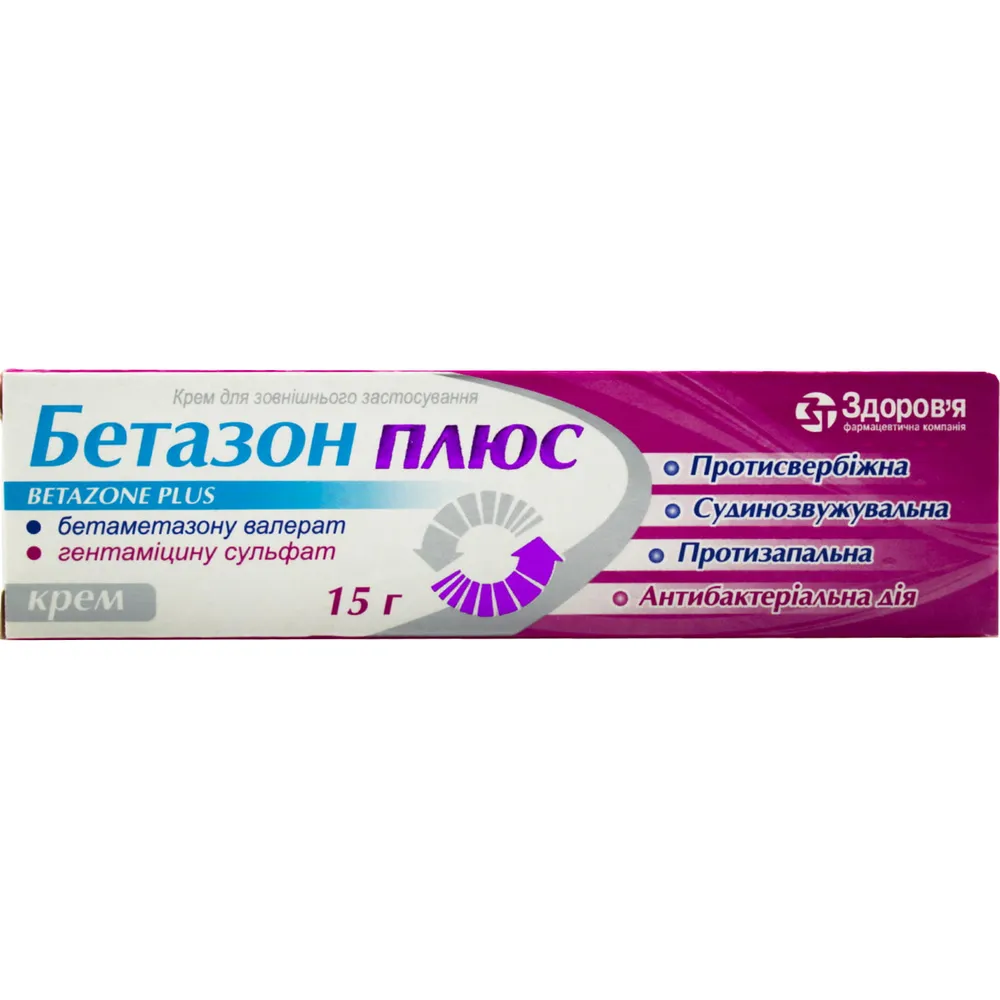
Table of Contents
INSTRUCTIONS FOR MEDICAL USE OF THE MEDICINAL PRODUCT BETAZONE PLUS (BETAZONE PLUS)
Composition:
Active substances: betamethasone, gentamicin;
1 g of the preparation contains micronized betamethasone valerate equivalent to 1 mg of betamethasone; gentamicin sulfate equivalent to 1 mg of gentamicin;
Excipients: cetostearyl alcohol, polyethylene glycol stearate, white soft paraffin, mineral oil, anhydrous disodium hydrogen phosphate, concentrated phosphoric acid, sodium hydroxide, chlorocresol, purified water.
Pharmaceutical form. Topical cream.
Main physicochemical characteristics: white, homogeneous cream.
Pharmacotherapeutic group. Corticosteroids for dermatological use. Corticosteroids in combination with antibiotics. Betamethasone and antibiotics. ATC code D07CC01.
Pharmacological properties.
Pharmacodynamics.
The drug combines the prolonged anti-inflammatory, anti-pruritic, and vasoconstrictive effects of betamethasone valerate with the broad-spectrum antibacterial activity of gentamicin sulfate. It is active against Staphylococcus aureus (coagulase-positive, coagulase-negative, and some penicillinase-producing strains) and gram-negative bacteria: Pseudomonas aeruginosa, Aerobacter aerogenes, Escherichia coli, Proteus vulgaris, and Klebsiella pneumoniae.
Pharmacokinetics.
Data on the pharmacokinetics of the drug are lacking.
Clinical characteristics.
Indications.
Dermatoses amenable to treatment with glucocorticosteroids complicated by, or suspected of being complicated with, secondary infection caused by gentamicin-sensitive microorganisms: eczema (atopic, infantile, nummular), anogenital and senile pruritus, contact dermatitis, seborrheic dermatitis, neurodermatitis, intertriginous dermatitis, solar dermatitis, exfoliative dermatitis, stasis dermatitis, and psoriasis.
Contraindications.
The drug is contraindicated in patients with hypersensitivity to the active substances or to any other component of the drug.
The drug is contraindicated in cutaneous tuberculosis, cutaneous manifestations of syphilis, skin reactions following vaccination, generalized plaque psoriasis, varicose veins, perioral dermatitis, rosacea, varicella (chickenpox), viral infections, and other bacterial and fungal skin infections without appropriate antibacterial and antifungal therapy.
Interaction with other medicinal products and other forms of interaction.
Due to the presence of white soft paraffin and mineral oil as excipients, treatment with the drug in the anogenital area may damage the structure of latex condoms and reduce their effectiveness during treatment.
Special precautions for use.
The product is not intended for ophthalmological use.
Use of the cream under occlusive dressings (e.g. plaster) is not recommended.
Extreme caution should be exercised when applying the cream to the face, and care must be taken to avoid contact with the eyes or mucous membranes.
If skin irritation or signs of hypersensitivity develop during treatment with the cream, administration should be discontinued and appropriate alternative therapy should be initiated.
Any adverse effects associated with systemic corticosteroids, including suppression of adrenal cortex function, may also occur with topical application of glucocorticosteroids, especially in children (particularly infants).
Cross-allergic reactions with aminoglycoside antibiotics have been observed.
Systemic absorption of topical corticosteroids generally increases with higher corticosteroid dosage, prolonged duration of treatment, and larger body surface area treated. Appropriate precautions should be taken in such cases, as corticosteroids may cause suppression of the hypothalamic-pituitary-adrenal (HPA) axis. If HPA axis suppression develops, the drug should be discontinued or the frequency of application reduced, or the patient should be switched to a corticosteroid with weaker activity.
HPA axis function usually recovers after discontinuation of the drug. In some cases, withdrawal symptoms may occur, requiring administration of systemic corticosteroids.
Systemic absorption of gentamicin following topical application may be increased when treating large body surface areas, particularly with prolonged use or in the presence of damaged skin. In such cases, adverse effects related to systemic absorption of gentamicin may occur; therefore, appropriate precautions are recommended.
Prolonged topical use of antibiotics may occasionally lead to overgrowth of resistant microorganisms, including fungi. In such cases, as well as in the event of irritation, sensitization, or superinfection, treatment with the drug should be discontinued and appropriate therapy initiated.
Cetostearyl alcohol may cause local skin reactions (e.g. contact dermatitis).
Chlorocresol may cause allergic reactions.
Use during pregnancy or breastfeeding.
As the safety of topical corticosteroids in pregnancy has not been established, the product should not be used during the first trimester of pregnancy. The drug may be prescribed only during later stages of pregnancy if the expected benefit to the mother outweighs the potential risk to the fetus. Products of this class should not be used in pregnant women over large areas, in large amounts, for prolonged periods, or under occlusive dressings.
It is currently unknown whether corticosteroids, absorbed systemically following topical application, are excreted in breast milk. Therefore, when deciding whether to discontinue breastfeeding or to discontinue the drug, the importance of the therapy for the mother should be taken into account.
Effect on the ability to drive or operate machinery. The product generally does not affect the ability to drive vehicles or operate machinery.
Method of Administration and Dosage
Apply the cream as a thin layer over the entire affected area of skin twice daily – in the morning and evening.
The frequency of application should be determined individually by a physician depending on the severity of the disease. In mild cases, once daily application may be sufficient; in more severe cases, more frequent application may be required.
The duration of treatment depends on the size and location of the lesion, as well as the patient's response to therapy. However, if no clinical improvement is observed within 3–4 weeks, the diagnosis should be reconsidered.
Children
There are no clinical data on the use of this drug in children; therefore, its use is not recommended in this age group.
Since children have a higher surface area to body weight ratio compared to adults, there is increased absorption of the drug. Therefore, children are more susceptible to hypothalamic-pituitary-adrenal (HPA) axis suppression and the development of exogenous corticosteroid effects following topical corticosteroid use.
In children treated with topical corticosteroids, adrenal suppression, Cushing's syndrome, growth retardation, inadequate weight gain, and increased intracranial pressure have been reported.
Signs of adrenal cortex suppression include low plasma cortisol levels and lack of response to adrenocorticotropic hormone (ACTH) stimulation tests. Increased intracranial pressure may manifest as bulging fontanelle, headache, and bilateral optic disc swelling.
Overdose
Prolonged or excessive use of topical glucocorticosteroids may lead to suppression of the hypothalamic-pituitary-adrenal (HPA) axis, resulting in secondary adrenal insufficiency and symptoms of hypercortisolism, including Cushing's disease. Single-dose gentamicin overdose has not been associated with symptoms of toxicity. However, excessive or prolonged use of gentamicin may lead to overgrowth of microorganisms resistant to the antibiotic.
Treatment: Symptomatic therapy should be administered as appropriate. Symptoms of acute hypercortisolism are usually reversible. If necessary, correction of electrolyte imbalances should be performed. In cases of chronic toxic effects, gradual withdrawal of corticosteroids is recommended. If overgrowth of resistant microorganisms occurs, treatment with the drug should be discontinued and appropriate alternative therapy initiated.
Adverse reactions.
Adverse reactions during treatment with the drug are very rare and may include increased sensitivity, skin rash and pigmentation, skin tingling, skin induration, skin cracking, sensation of warmth, lamellar desquamation, focal desquamation, follicular eruptions, erythema, telangiectasia, burning sensation, itching, irritation, dry skin, folliculitis, hypertrichosis, acneiform eruptions, hypopigmentation, perioral dermatitis, allergic contact dermatitis, skin maceration, secondary infection, skin atrophy, striae, and miliaria.
Hypersensitivity reactions are possible in individuals with individual intolerance to any component of the drug.
Treatment with gentamicin may be accompanied by temporary skin irritation (erythema and itching), which usually does not require discontinuation of treatment.
When the drug is applied to large skin areas or used under occlusive dressing, especially over prolonged periods, systemic effects of the drug should be considered. Any adverse effects observed with systemic use of glucocorticoids, including suppression of the adrenal cortex, may also occur with topical application.
Shelf life. 3 years.
Storage conditions. Store in original packaging at temperature not exceeding 25 °C.
Keep out of reach of children.
Packaging. 15 g or 30 g in a tube in a carton.
Prescription status. Prescription only.
Manufacturer. LIMITED LIABILITY COMPANY "CORPORATION "ZDOROV'YA".
Manufacturer's address and location of business activity.
Ukraine, 61013, Kharkiv region, city of Kharkiv, Shevchenka Street, building 22.
(all manufacturing stages, quality control, batch release)
Ukraine, 08301, Kyiv region, city of Boryspil, Shevchenka Street, building 100, letter B-II (building 4).
(all manufacturing stages, batch release)