Betayod-zdorovya
Ukraine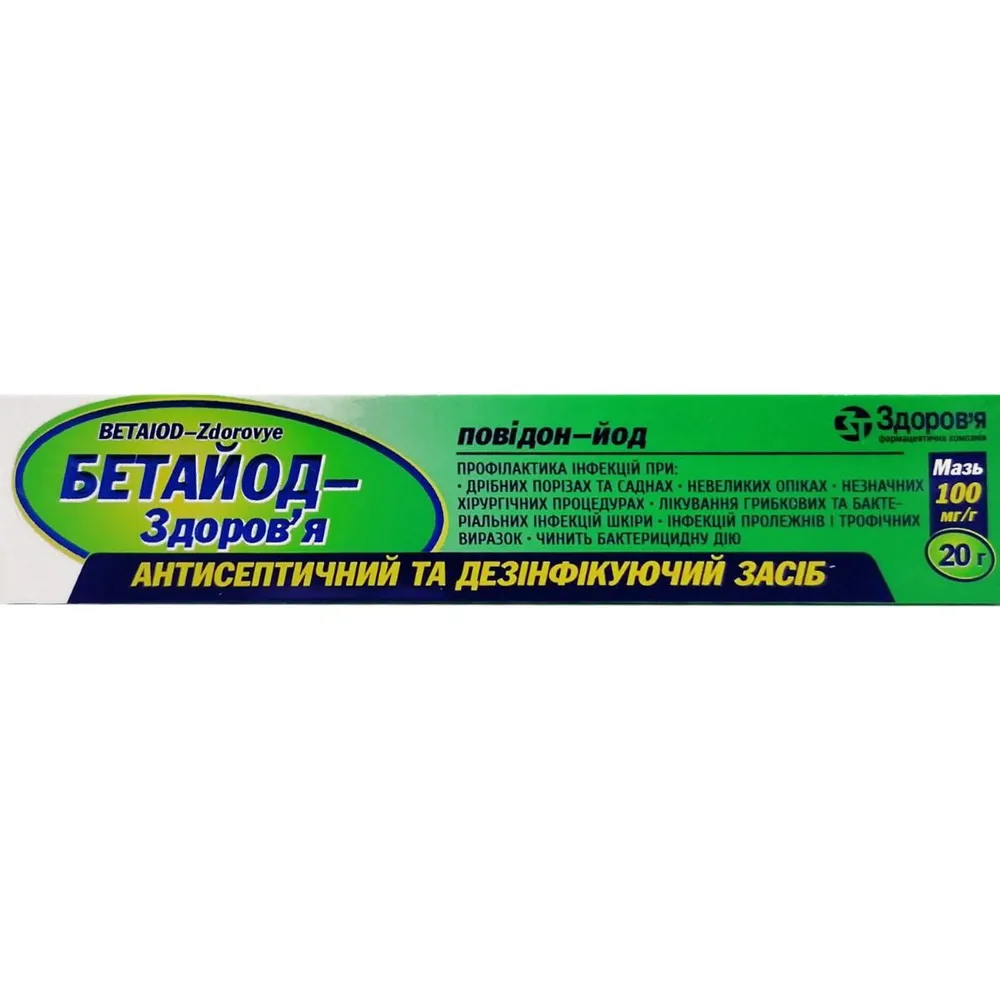
Table of Contents
INSTRUCTIONS FOR MEDICAL USE OF THE MEDICINAL PRODUCT BETAID-ZDOROV'YA (BETAID-ZDOROV'YA)
Composition:
Active substance: povidone-iodine;
1 g of the preparation contains povidone-iodine 100 mg;
Excipients: polyethylene glycol 400, polyethylene glycol 4000, polyethylene glycol 1500, polyethylene glycol 1000, sodium bicarbonate, purified water.
Pharmaceutical form. Ointment.
Main physico-chemical properties: homogeneous brown ointment. A weak specific odor is permissible.
Pharmacotherapeutic group. Antiseptics and disinfectants. Iodine preparations. Povidone-iodine.
ATC code D08AG02.
Pharmacological Properties.
Pharmacodynamics.
Povidone-iodine is a complex of iodine and the polymer polyvinylpyrrolidone, which releases iodine over a certain period after application to the skin. Free iodine exerts a bactericidal effect and has a broad spectrum of antimicrobial activity against bacteria, viruses, fungi, and protozoa.
Mechanism of action: free iodine produces a rapid bactericidal effect, while the polymer acts as an iodine depot.
Upon contact with skin and mucous membranes, a significant amount of iodine is released from the polymer.
Iodine reacts with oxidative sulfhydryl (SH) and hydroxyl (OH) groups of amino acids that are part of enzymes and structural proteins of microorganisms, inactivating or destroying these proteins. Most microorganisms are destroyed in vitro within less than 1 minute, with the primary destructive effect occurring within the first 15–30 seconds. During this process, iodine is decolorized, so a change in the intensity of the brown color serves as an indicator of its effectiveness.
The active substance of the drug has a broad antimicrobial spectrum of activity: it acts against Gram-positive and Gram-negative bacteria (bactericidal), viruses (virucidal), fungi (fungicidal) and fungal spores (sporicidal), as well as certain protozoa.
Due to its mechanism of action, resistance to the drug, including secondary resistance during prolonged use, is not expected.
The drug is water-soluble and easily washed off with water.
Prolonged application of the drug to large wound surfaces or severe burns, as well as to mucous membranes, may lead to absorption of a significant amount of iodine. Usually, prolonged use of the drug results in a rapid increase in blood iodine levels. Concentrations return to baseline levels within 7–14 days after the last application.
In patients with normal thyroid gland function, increased iodine stores do not cause clinically significant changes in thyroid hormonal status.
Pharmacokinetics.
Absorption and renal excretion of povidone-iodine depend on its molecular weight; since this varies between 35,000–50,000, retention of the substance is possible.
Absorption of povidone-iodine or iodide is the same as that of iodine from other sources.
The volume of distribution is approximately 38% of body weight. The biological half-life after vaginal administration is about 2 days. The normal total plasma iodine level is approximately 3.8–6 µg/dL, and the level of inorganic iodine is 0.01–0.5 µg/dL.
The drug is primarily excreted from the body via the kidneys, with a clearance rate of 15 to 60 mL/min, depending on plasma iodine levels and creatinine clearance (normal: 100–300 µg iodine per 1 g creatinine).
Clinical characteristics
Indications
Prevention of infections in minor cuts and abrasions, minor burns, and minor surgical procedures.
Treatment of fungal and bacterial skin infections, as well as infections of pressure sores and trophic ulcers.
Contraindications
- Hypersensitivity to iodine or suspected hypersensitivity, or to other components of the medicinal product.
- Thyroid dysfunction (nodular colloid goiter, endemic goiter, Hashimoto's thyroiditis).
- Hyperthyroidism or other acute thyroid disorders.
- Periods before and after treatment and scintigraphy with radioactive iodine in patients with thyroid carcinoma.
- Dermatitis herpetiformis Duhring.
- Renal insufficiency.
Interaction with other medicinal products and other forms of interaction
The povidone-iodine complex is active against microorganisms within a pH range of 2–7.
Proteins and other organic compounds reduce its activity.
Concomitant use of povidone-iodine and enzymatic ointments for wound treatment reduces the efficacy of both agents. Medicinal products containing mercury, silver, hydrogen peroxide, or taurolidine may interact with the povidone-iodine complex; therefore, their combined use is not recommended.
Simultaneous use of povidone-iodine with antiseptics containing octenidine, or immediately after such antiseptics, may lead to the development of dark necroses at the application sites.
Caution!
Due to its oxidizing properties, povidone-iodine may interfere with the results of certain diagnostic tests, such as tests for occult blood in feces or urine, or glucose in urine.
When povidone-iodine is used, iodine uptake by the thyroid gland may be reduced. This may affect the results of certain diagnostic tests (e.g., thyroid scintigraphy, protein-bound iodine determination, radioactive iodine measurements) or may interfere with iodine used for thyroid therapy.
Thyroid scintigraphy should be performed 1–2 weeks after discontinuation of prolonged povidone-iodine therapy to ensure reliable results.
Special precautions for use
The product is intended for topical use only.
Prolonged use may cause irritation and, occasionally, severe skin reactions. If signs of irritation or hypersensitivity occur, application of the product should be discontinued.
The use of povidone-iodine may reduce iodine uptake by the thyroid gland, which may affect the results of certain diagnostic tests and procedures (thyroid scintigraphy, protein-bound iodine determination, diagnostic procedures using radioactive iodine), thereby making it impossible to plan treatment of thyroid disorders with iodine-containing drugs.
A break of at least 1–4 weeks should be made before using povidone-iodine.
The product should not be used in patients before or after radioactive iodine treatment for thyroid cancer or radioactive iodine scintigraphy.
A significant amount of iodine may cause hyperthyroidism in patients with thyroid dysfunction (e.g., nodular colloid goiter, endemic goiter). Therefore, the duration of treatment and the skin surface area treated should be limited in such patients.
Even after completion of treatment, patients should continue to be monitored for early symptoms of hyperthyroidism, and thyroid function should be controlled.
When used over large skin areas (e.g., extensive burns or wounds) for prolonged periods, a significant amount of iodine may be absorbed, potentially leading to hyperthyroidism in susceptible patients (large skin area defined as over 10% of body surface; treatment duration exceeding 14 days is considered prolonged).
Iodine absorption varies individually among patients, so precise recommendations cannot be provided. Thyroid function tests and physicians’ recommendations are crucial in such cases.
If symptoms of hyperthyroidism occur during treatment, thyroid function should be evaluated.
Particular attention should be paid to patients with pre-existing renal insufficiency when the ointment is used regularly.
Regular use of the ointment should be avoided in patients receiving lithium medications.
The oxidizing effect of povidone-iodine may cause corrosion of metals, whereas plastic and synthetic materials are generally resistant to povidone-iodine. In some cases, discoloration may occur, which is usually reversible. Povidone-iodine can be easily removed from textiles and other materials with warm water and soap. Stubborn stains should be treated with ammonia solution or sodium thiosulfate.
The oxidizing effect of povidone-iodine may lead to false-positive results in certain diagnostic tests (e.g., toluidine and guaiac tests for hemoglobin, and glucose tests in feces and urine).
Do not heat before use. Keep out of reach of children.
Use during pregnancy or breastfeeding
Povidone-iodine should be used only when strictly prescribed by a physician and in the smallest possible doses. Iodine crosses the placental barrier and may pass into breast milk, thus posing a risk of hypersensitivity to iodine in the fetus or newborn. Povidone-iodine levels in breast milk are higher than in blood serum. Therefore, the product may cause hyperthyroidism or elevated thyroid hormone levels in the fetus or newborn. Monitoring of thyroid function in infants is necessary.
The product is contraindicated after the second month of pregnancy and during breastfeeding. Breastfeeding must be discontinued during treatment.
Ability to influence reaction speed when driving or operating machinery
The product does not affect reaction speed when driving or operating machinery.
Method of Administration and Dosage
The drug is intended for topical use.
For the treatment of infections: apply once or twice daily. The treatment duration should not exceed 14 days.
For infection prophylaxis: apply once or twice weekly, as long as necessary. The affected skin area must be cleaned and dried. Apply a thin layer of ointment to the affected skin surface. A dressing may be applied over the treated area.
Children.
Povidone-iodine may be used in newborns and children under 1 year of age only under strict medical indications.
High doses of iodine should be avoided in newborns and infants due to their increased skin permeability and higher incidence of hypersensitivity to iodine, which increases the risk of developing hyperthyroidism. In such patients, povidone-iodine should be used in small amounts. If necessary, thyroid function should be monitored in children.
Overdose.
Symptoms of acute iodine intoxication include:
- metallic taste in the mouth, increased salivation, sensation of burning or pain in the mouth or throat;
- eye irritation and swelling;
- skin reactions;
- gastrointestinal disturbances and diarrhea;
- impaired kidney function and anuria;
- circulatory insufficiency;
- laryngeal edema with secondary asphyxia, pulmonary edema, metabolic acidosis, hypernatremia.
Treatment: symptomatic and supportive therapy should be administered, with special attention to electrolyte balance, kidney function, and thyroid function.
Side effects.
Immune system: hypersensitivity, anaphylactic reactions.
Renal and urinary system: impaired kidney function, acute kidney failure.
Skin and subcutaneous tissue: local skin hypersensitivity reactions such as contact dermatitis with formation of psoriasis-like red, small bullous lesions; allergic reactions including itching, redness, rash, angioedema, exfoliative dermatitis, dry skin, chemical and thermal skin burns.
Endocrine system: hyperthyroidism (sometimes with symptoms such as tachycardia or restlessness); hypothyroidism.
Metabolism and nutrition disorders: electrolyte imbalance; metabolic acidosis.
Prolonged use of povidone-iodine may lead to absorption of a large amount of iodine.
In some cases, iodine-induced hyperthyroidism has been reported following prolonged use of the product, primarily in patients with pre-existing thyroid gland disorders.
In rare cases, generalized acute reactions with decreased blood pressure and/or breathing difficulties (anaphylactic reactions) may occur.
Investigations: changes in serum electrolyte levels (hypernatremia) and serum osmolality, metabolic acidosis.
Reporting of side effects.
Reporting of adverse reactions after drug registration is important. It enables continuous monitoring of the benefit-risk balance of the medicinal product. Healthcare professionals and patients or their legal representatives should report all suspected adverse reactions and lack of drug efficacy through the Automated Pharmacovigilance Information System at the following link: https://aisf.dec.gov.ua.
Shelf life. 2 years.
Storage conditions. Store in the original packaging at a temperature not exceeding 25 °C.
Keep out of reach of children.
Packaging. 20 g or 40 g of the product in a tube in a carton.
Availability category. Over-the-counter.
Manufacturer. LIMITED LIABILITY COMPANY "CORPORATION "ZDOROV'YA".
Manufacturer's address and place of business.
22, Shevchenka Street, Kharkiv, Kharkiv region, 61013, Ukraine.