Betayod plus
Ukraine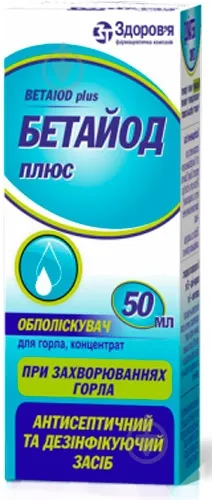
Table of Contents
INSTRUCTIONS FOR MEDICAL USE OF THE MEDICINAL PRODUCT BETAID PLUS (BETAIOD PLUS)
Composition:
Active substances: povidone-iodine, allantoin;
1 ml of the preparation contains povidone-iodine 85 mg; allantoin 1 mg;
Excipients: propylene glycol, menthol, citric acid, sodium citrate, ethanol 96%, purified water.
Pharmaceutical form. Mouthwash concentrate.
Main physicochemical properties: a clear, slightly opalescent, red-brown liquid with a characteristic odor, miscible with water.
Pharmacotherapeutic group.
Medicinal products used in throat disorders. Antiseptics.
ATC code R02A A20.
Pharmacological properties.
Pharmacodynamics.
Povidone-iodine, a disinfecting agent belonging to the group of iodine-containing substances, releases organic iodine upon contact with the skin or mucous membranes, which exerts a broad spectrum of antimicrobial activity through direct action on microbial proteins. It has a partially bactericidal effect against gram-positive and gram-negative cocci and bacilli, certain anaerobic bacteria, yeasts or saccharomycetes, protozoa, and some viruses.
The preparation also contains allantoin, which exerts an anti-inflammatory effect, thus contributing, together with povidone-iodine, to the therapeutic action of the drug.
Pharmacokinetics.
After topical application of povidone-iodine to intact skin, iodine absorption is minimal. When used in the oral cavity, more pronounced systemic absorption of iodine occurs, which may lead to interference with thyroid functions. Iodine in the body is converted into iodides, which accumulate primarily in the thyroid gland and are excreted mainly by the kidneys, as well as in small amounts in feces, saliva, and sweat. Iodides cross the placental barrier and pass into breast milk.
Clinical characteristics.
Indications.
Disinfection of the oral cavity and pharynx in inflammatory and infectious diseases: tonsillitis, pharyngitis, tonsillopharyngitis, tonsillitis, glossitis, and aphthous stomatitis; as part of complex treatment with antibiotics in streptococcal tonsillitis; early symptoms of acute respiratory viral infections.
Contraindications.
- Hypersensitivity to any component of the drug;
- Dermatitis herpetiformis Duhring;
- Hyperthyroidism, adenoma, or thyroid gland function disorders;
- Decompensated heart failure;
- Renal function impairment;
- 2 weeks before and after examination or therapy using radioactive iodine.
Interaction with other medicinal products and other types of interactions.
It is not recommended to combine the drug with other antiseptics for the oral cavity and pharynx, especially hydrogen peroxide.
Due to its oxidizing properties, povidone-iodine may affect the results of certain diagnostic tests, such as detection of occult blood in feces or urine, or glucose in urine. The use of the drug leads to false-positive hemotest results. It may interfere with the results of certain diagnostic tests (e.g., thyroid scintigraphy, determination of protein-bound iodine, measurement of radioactive iodine), or may compete with iodine used in thyroid therapy.
Povidone-iodine should be avoided in patients taking lithium preparations, as their concomitant use may cause a synergistic hypothyroid effect.
Povidone-iodine should not be used simultaneously with preparations containing chlorhexidine or silver sulfadiazine due to possible partial inactivation. Povidone-iodine interacts with strong alkalis, sodium thiosulfate, sodium metabisulfite, and thimerosal; therefore, the drug must not be used simultaneously with these substances.
All interactions are visually manifested by discoloration of the solution, indicating reduced drug efficacy.
The drug should not be used simultaneously with disinfectants containing mercury; enzyme-containing ointments; or tincture of benzoin. The drug is incompatible with oxidizing agents, alkali metal salts, and substances with acidic reaction.
Special precautions for use
The product is not intended for internal use: do not swallow the product. If the patient's condition does not improve within 3 days, or if adverse reactions or unusual sensations occur, a physician should be consulted.
It is not advisable to use the product simultaneously with other antiseptic medicinal products intended for use in the oral cavity and throat.
Povidone-iodine may be used in laryngitis only in exceptional cases.
The product contains 18.6% ethanol.
The product should be used with caution in patients with hepatic insufficiency. In such patients, transaminase levels may increase; therefore, monitoring of their serum levels is necessary.
The use of povidone-iodine may interfere with thyroid scintigraphy. Povidone-iodine should not be used for 1–2 weeks prior to thyroid scintigraphy.
Since the development of hyperthyroidism cannot be excluded, prolonged (more than 14 days) use of povidone-iodine or its use in large amounts in patients (especially elderly patients) with latent thyroid dysfunction is permissible only after careful assessment of the expected benefit versus possible risk. Such patients should be monitored for early signs of hyperthyroidism and appropriate evaluation of thyroid function, even after discontinuation of the product (for up to 3 months).
The product may stain the mucous membranes of the oral cavity, teeth, skin, and clothing. Stains on mucous membranes, teeth, and skin can be removed with alcohol. Stains on clothing can be removed by washing and rinsing with diluted ammonia (ammonium spirit), sodium thiosulfate, or soap and water.
If possible, dental prostheses and similar devices should be removed from the mouth before applying the product.
Do not heat the product before use, as degradation of active substances is accelerated by light and at temperatures above 40°C.
The medicinal product contains propylene glycol, which may cause skin irritation.
Use during pregnancy or breastfeeding
There is no experience with topical use of povidone-iodine in pregnant women. Congenital hypothyroidism or goiter has been observed in newborns whose mothers used iodine topically (after vaginal administration before delivery or application to the skin during pregnancy). Therefore, povidone-iodine must not be used during pregnancy.
Iodine may pass into breast milk. Concentrations of iodine detected in the blood and urine of breastfed infants were many times higher than those observed in their mothers who used povidone-iodine. High concentrations of iodine in serum may cause the development of congenital hypothyroidism in breastfed infants; therefore, povidone-iodine must not be used during breastfeeding.
Effect on the ability to drive vehicles or operate machinery
The use of this product has no effect or has a negligible effect on the ability to drive vehicles or operate machinery.
Administration and Dosage
Apply locally to the mucous membranes of the oral cavity and pharynx.
Adults and children aged 6 years and older.
The diluted solution is intended for rinsing or irrigating the mouth and throat. The solution should not be swallowed. Rinse or irrigate the oral cavity and pharynx with 10–15 mL of diluted solution for approximately 30 seconds. Apply 2–4 times daily, up to a maximum of 6 times daily, with at least 4 hours between applications.
For dilution, use drinking water at a temperature of 18 °C in a ratio of 1:20 to 1:40 (specifically: 2.5–5 mL when using a measuring cup or ½–1 teaspoon per 100 mL of water). Clouding or discoloration of the solution indicates a reduction in its antimicrobial activity.
The same dosage as for adults is recommended for elderly patients and patients with hepatic impairment.
Children.
This medication is indicated for treatment in children aged 6 years and older.
Overdose.
When applied correctly as a local treatment in the oral cavity or pharynx, cases of overdose have not been observed. However, if the iodine solution is swallowed, acute poisoning may occur. Patients initially experience a metallic taste in the mouth, followed by vomiting, stomach pain, and diarrhea. Within 1–3 days, anuria, laryngeal edema leading to asphyxia, aspiration pneumonia, or pulmonary edema may develop. In some cases, vascular collapse may occur.
In animal studies, administration of povidone-iodine caused irritation and, in some instances, damage to the gastrointestinal mucosa. Cases of pyloric stenosis, gastric necrosis, peritonitis, and sepsis have been reported. Inhalation of iodine vapors in animals resulted in respiratory depression due to laryngeal and glottal edema.
Treatment is symptomatic and initially includes standard measures to prevent further absorption of the drug in the gastrointestinal tract. The patient should drink milk and freshly prepared starch solution (to prepare the starch solution: take 2 g of starch in a porcelain cup and mix thoroughly with 8 mL of cool purified water; add 90 mL of boiling purified water; while stirring continuously, heat the mixture to boiling (0.5–1 minute) and maintain until it thickens and becomes lighter in color; cool to room temperature (25 °C) before administration). If the esophagus is not damaged, gastric lavage may be performed. Additionally, activated charcoal and a 1–5% sodium thiosulfate solution should be administered to reduce iodine to iodide. Osmotic diuresis may be used to enhance elimination of absorbed substance. To date, there is no reported experience with dialysis. There is no specific antidote.
Adverse reactions.
The drug is usually well tolerated.
The frequency of adverse reactions was assessed according to the following principle: very common (≥ 1/10), common (≥ 1/100, < 1/10), uncommon (≥ 1/1000, < 1/100), rare (≥ 1/10,000, < 1/1000), very rare (<1/10,000), including isolated reports.
Immune system disorders: rare – hypersensitivity symptoms; very rare – anaphylactic shock.
Gastrointestinal disorders: uncommon – dry mouth.
Skin and subcutaneous tissue disorders: rare – possible iodine-related allergic reactions requiring discontinuation of the drug: itching, hyperemia, urticaria; very rare – angioedema.
General disorders and administration site conditions: uncommon – burning sensation at the application site (especially in children), pain at the application site, sensation of dry mouth.
Injury, poisoning and procedural complications: iodism (metallic taste in mouth, increased salivation, swelling of eyes, larynx, lungs, skin rash, gastrointestinal disturbances, systemic manifestations such as metabolic acidosis, hypernatremia, renal dysfunction, diarrhea) after prolonged use.
Shelf life. 2 years.
Storage conditions. Store in the original packaging at a temperature not exceeding 25 °C.
Keep out of reach of children.
Packaging. 50 ml of solution in a bottle closed with a cap, with a measuring cup in a carton.
Prescription status. Over-the-counter (without prescription).
Manufacturer. Limited liability company "Pharmaceutical Company "Zdorovya".
Manufacturer's address and location of business activity.
22 Shevchenko Street, Kharkiv, Kharkiv region, 61013, Ukraine.