Berlition® 600 efg
Ukraine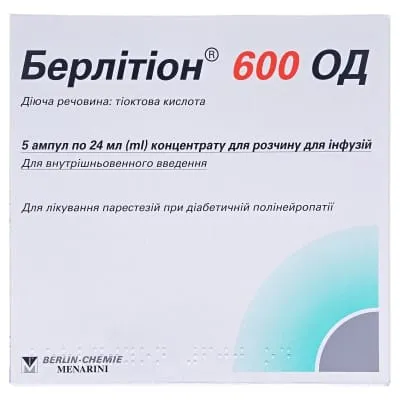
Table of Contents
INSTRUCTIONS FOR MEDICAL USE OF THE MEDICINAL PRODUCT BERLITHION® 600 ED (BERLITHION® 600 ED)
Composition:
Active substance: thioctic acid;
One ampoule (24 ml) of concentrate for infusion solution contains 755 mg of ethylenediamine salt of thioctic acid, equivalent to 600 mg of thioctic acid;
Excipient: water for injections.
Pharmaceutical form. Concentrate for solution for infusion.
Main physicochemical properties: clear greenish-yellow solution.
Pharmacotherapeutic group.
Other agents affecting the digestive system and metabolic processes, thioctic acid.
ATC Code A16AX01.
Pharmacological properties.
Pharmacodynamics.
Thioctic acid is a vitamin-like substance produced in the body that functions as a coenzyme in the oxidative decarboxylation of α-keto acids. Hyperglycemia caused by diabetes mellitus leads to glucose deposition on vascular matrix proteins and the formation of advanced glycation end-products (AGEs). This process results in reduced endoneurial blood flow and endoneurial hypoxia/ischemia, associated with increased generation of reactive oxygen species (ROS) that damage peripheral nerves, as well as depletion of the antioxidant glutathione in peripheral nerves.
In studies on rats, thioctic acid influenced the biochemical processes induced by streptozotocin-induced diabetes, reducing the formation of advanced glycation end-products, improving endoneurial blood flow, increasing physiological glutathione levels, and acting as an antioxidant against reactive oxygen species in nerves affected by diabetic processes. These effects indicate thioctic acid's ability to improve peripheral nerve function. This particularly applies to sensory disturbances in polyneuropathy, which may manifest as dysesthesias and paresthesias, such as burning sensations, pain, numbness, or tingling.
In 1995, a multicenter, placebo-controlled study was conducted on the efficacy of thioctic acid in the symptomatic treatment of diabetic polyneuropathy, which demonstrated favorable effects of thioctic acid on the investigated symptoms, including paresthesias, burning sensations, numbness, and pain.
Pharmacokinetics.
Thioctic acid exhibits a pronounced first-pass effect through the liver. Systemic bioavailability shows considerable individual variability. Thioctic acid is biotransformed via side-chain oxidation and conjugation, and is primarily excreted by the kidneys. The elimination half-life of thioctic acid in humans is approximately 25 minutes, and total plasma clearance is 10–15 mL/min/kg. After a 30-minute infusion of 600 mg of thioctic acid, its plasma concentration reaches about 20 μg/mL. Animal experiments (rats, dogs) using radiolabeling have shown that excretion is predominantly renal (80–90%), mainly in the form of metabolites. In humans, only a negligible amount of unchanged substance is excreted in urine. Biotransformation occurs primarily through side-chain oxidation (β-oxidation) and/or S-methylation of the corresponding thiols.
Thioctic acid interacts in vitro with ionic metal complexes (e.g., cisplatin). Thioctic acid forms poorly soluble complex compounds with sugar molecules.
Clinical characteristics.
Indications.
Paresthesia in diabetic polyneuropathy.
Contraindications.
Hypersensitivity to the active substance or to any of the excipients of the medicinal product in the medical history.
Interaction with other medicinal products and other forms of interaction.
Thioctic acid interacts in vitro with ionic metal complexes (e.g., with cisplatin); therefore, there have been reports of reduced efficacy of cisplatin during concomitant treatment with Berlition® 600 OD.
Thioctic acid forms poorly soluble complex compounds with sugar molecules (e.g., with fructose solution).
Thioctic acid is a metal chelator; therefore, it must not be administered together with metals (iron-containing preparations, magnesium).
Thioctic acid may enhance the blood glucose-lowering effect of insulin and/or other antidiabetic agents; therefore, regular monitoring of blood glucose levels is recommended, especially at the beginning of thioctic acid treatment. In individual cases, to prevent symptoms of hypoglycemia, a reduction in the dose of insulin and/or oral antidiabetic agent may be necessary.
Note:
Regular alcohol consumption is a significant risk factor for the development and progression of the clinical picture of neuropathy and, thus, may interfere with the effectiveness of treatment with Berlition® 600 OD. Therefore, patients with diabetic polyneuropathy are strongly advised to abstain from alcohol consumption. This also applies to periods when therapy is not being administered.
Special precautions for use
Hypersensitivity reactions up to and including anaphylactic shock have been observed with parenteral administration of thioctic acid. Therefore, patients must be under appropriate medical supervision. If early symptoms occur (e.g., itching, nausea, weakness, etc.), treatment should be discontinued immediately; in certain circumstances, further therapeutic measures may be required.
Cases of autoimmune insulin syndrome (AIS) have been reported during treatment with thioctic acid. Patients with human leukocyte antigen genotype (alleles HLA-DRB1*04:06 and HLA-DRB1*04:03) are more susceptible to developing AIS during thioctic acid therapy. The HLA-DRB1*04:03 allele (susceptibility odds ratio for AIS – 1.6) is particularly prevalent among Caucasian populations (more common in Southern Europe than in Northern Europe), while the HLA-DRB1*04:06 allele (susceptibility odds ratio for AIS – 56.6) is especially common in Japanese and Korean patients.
AIS should be considered in the differential diagnosis of spontaneous hypoglycemia in patients receiving thioctic acid.
The main factor in effective treatment of diabetic polyneuropathy is optimal blood glucose control. Diabetic patients, especially at the beginning of treatment, require frequent monitoring of blood glucose levels. In some cases, dosage adjustment of antidiabetic agents may be necessary to prevent hypoglycemia. During treatment of polyneuropathy, transient increased sensitivity due to regenerative processes may occur, accompanied by paresthesia and sensations of "pins and needles."
Alcohol consumption may reduce the effectiveness of the drug; therefore, abstaining from alcohol intake during treatment is recommended.
The drug is light-sensitive; therefore, vials should be removed from the packaging only immediately before use.
Advanced age (over 75 years) represents a relative contraindication for intravenous administration of thioctic acid preparations.
Use during pregnancy or breastfeeding
According to general principles of pharmacotherapy, medicinal products should be used during pregnancy and lactation only after careful assessment of the benefit-risk ratio.
Pregnant women and breastfeeding mothers should be treated with thioctic acid only strictly according to medical indications, although reproductive toxicity studies have not shown any adverse effects on fertility or early embryonic development. Embryotoxic properties were not observed in studies.
There are no data available on the passage of thioctic acid into breast milk.
Ability to influence reaction speed when driving or operating machinery
During treatment with this medicinal product, caution should be exercised when driving vehicles or engaging in other potentially hazardous activities requiring increased attention and rapid psychomotor reactions, due to possible adverse reactions affecting the nervous system and visual organs.
Method of Administration and Dosage
Adults
Dosage
For severe paresthesia caused by diabetic polyneuropathy, intravenous administration of the concentrate for infusion solution is recommended at a dose of 24 mL (1 ampoule of Berlition® 600 OD) per day, corresponding to 600 mg of thioctic acid daily.
Method of Administration
After dilution, the concentrate for infusion solution should be administered intravenously over a period of 2–4 weeks during the initial treatment phase. The contents of 1 ampoule of Berlition® 600 OD should be diluted in 250 mL of 0.9% sodium chloride solution and infused intravenously over no less than 30 minutes. Due to the sensitivity of the active substance to light, the infusion solution should be prepared immediately before administration and protected from light exposure, for example, by using aluminum foil. The prepared infusion solution may be stored for approximately 6 hours, provided it is protected from light.
For subsequent therapy, oral formulations of thioctic acid at a dose of 300–600 mg daily should be used.
Pediatric Population
No data available.
Optimal glycemic control remains the cornerstone of treatment for diabetic polyneuropathy.
Children
Berlition® 600 OD is not indicated for use in children and adolescents due to lack of clinical experience.
Overdose
In cases of overdose, nausea, vomiting, and headache may occur. Accidental ingestion or intentional intake of doses ranging from 10 to 40 g of thioctic acid in suicide attempts, particularly in combination with alcohol, may lead to severe intoxication, potentially resulting in fatal outcomes. The clinical presentation initially includes psychomotor agitation or impaired consciousness, followed by generalized seizures and development of lactic acidosis. Additional consequences of high-dose thioctic acid intoxication may include hypoglycemia, shock, rhabdomyolysis, hemolysis, disseminated intravascular coagulation (DIC), bone marrow suppression, and multiorgan failure.
Treatment. In suspected cases of significant intoxication (e.g., > 80 mg/kg body weight in adults or > 50 mg/kg body weight in children), immediate hospitalization is indicated, along with measures according to general principles of poisoning management (e.g., induction of emesis, gastric lavage, activated charcoal, etc.). Management of life-threatening complications such as generalized seizures and lactic acidosis should follow modern intensive care principles and be conducted symptomatically. Currently, there are no data on the efficacy of hemodialysis, hemoperfusion, or hemofiltration for enhanced elimination of thioctic acid.
Adverse reactions.
Classification of the frequency of adverse reactions:
very common: ≥ 1/10;
common: ≥ 1/100 – < 1/10;
uncommon: ≥ 1/1000 – < 1/100;
rare: ≥ 1/10000 – < 1/1000;
very rare: < 1/10000;
not known: frequency cannot be estimated based on available data.
Blood and lymphatic system disorders.
In isolated cases, petechial hemorrhages in mucous membranes/skin, hypocoagulation, thrombophlebitis were observed.
Very rare: after intravenous administration of thioctic acid, hemorrhagic rash (purpura), platelet function disorders were observed.
Immune system disorders.
Not known: autoimmune insulin syndrome (see section "Special precautions").
Skin allergic reactions such as rash, urticaria, pruritus, eczema, as well as systemic reactions up to the development of shock may occur.
Nervous system disorders.
Very rare: changes or disturbances in taste sensation, headache, hot flushes, increased sweating, dizziness, visual disturbances. After intravenous administration of thioctic acid, seizures and diplopia were observed. In most cases, all these manifestations resolve spontaneously.
Not known: loss of consciousness, seizures.
Gastrointestinal disorders.
In individual cases, when the drug was administered intravenously too rapidly, nausea, vomiting, diarrhea, abdominal pain were observed, which resolved spontaneously.
Hepatobiliary disorders.
Not known: cholestatic hepatitis.
Metabolic and nutritional disorders.
Very rare: due to improved glucose utilization, blood glucose levels may decrease, possibly leading to symptoms resembling hypoglycemia, such as dizziness, increased sweating, headache, visual disturbances.
Cardiac and vascular disorders.
When administered rapidly intravenously, chest pain and tachycardia may occur, which resolve spontaneously.
General disorders and administration site conditions.
Common: after rapid intravenous administration, increased intracranial pressure and dyspnea may occur, which resolve spontaneously.
Very rare: isolated cases of reactions at the injection site and weakness have been reported.
Reporting of possible adverse reactions.
Reporting of possible adverse reactions after drug registration is important. It allows continuous monitoring of the benefit-risk balance of the drug. Healthcare professionals should report any possible adverse reactions through the national reporting system.
Shelf life. 3 years.
Do not use the drug after the expiry date stated on the packaging.
Shelf life after dilution with sodium chloride physiological solution and under protection from light is approximately 6 hours.
Storage conditions.
To protect from light, store ampoules in the cardboard box.
Incompatibilities.
Thioctic acid interacts in vitro with ionic metal complexes (e.g., with cisplatin).
Thioctic acid forms poorly soluble complex compounds with sugar molecules (e.g., with fructose solution).
Berlition® 600 IU is incompatible with glucose solutions, Ringer's solution, and also with solutions that react with SH-groups or disulfide bridges.
For intravenous infusion, Berlition® 600 IU must be diluted exclusively with sodium chloride physiological solution.
Packaging.
Brown glass ampoule containing 24 ml of concentrate for infusion solution; 5 ampoules in a blister pack; 1 or 2 blister packs in a cardboard box.
Prescription status.
Prescription only.
Manufacturer.
BERLIN-CHEMIE AG.
Manufacturer's address and location of business activity.
Glienicker Weg 125, 12489 Berlin, Germany.