Beresh® magnesium plus b6
Ukraine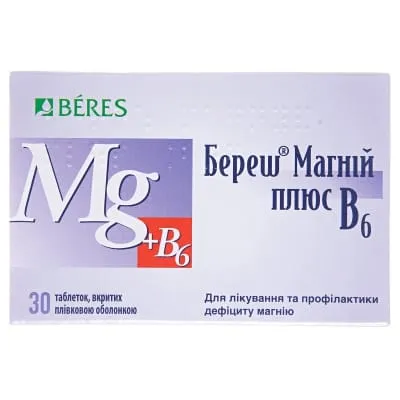
Table of Contents
INSTRUCTIONS FOR MEDICAL USE OF THE MEDICINAL PRODUCT BEREŠâ MAGNESIUM PLUS B6 (BERES MAGNESIUM PLUS B6)
Composition:
Active ingredients: 1 film-coated tablet contains pyridoxine 1.6 mg (in the form of 1.9448 mg pyridoxine hydrochloride), magnesium 250 mg (in the form of 352.92 mg heavy magnesium oxide and 463.93 mg magnesium citrate);
Excipients: calcium hydrogen phosphate anhydrous, microcrystalline cellulose, crospovidone, magnesium stearate, film coating AquaPolish Pink 048.15 (hydroxypropylmethylcellulose, polydextrose, talc, glycerin, titanium dioxide (E 171), yellow iron oxide (E 172), red iron oxide (E 172), black iron oxide (E 172)).
Pharmaceutical form. Film-coated tablets.
Main physicochemical properties: beige film-coated tablets, elongated in shape, with a break line on both sides.
Pharmacotherapeutic group. Other mineral supplements, magnesium preparations.
ATC code A12CC.
Pharmacological Properties.
Pharmacodynamics.
A combined preparation containing magnesium and vitamin B6.
Magnesium – one of the main mineral elements affecting almost all body functions. Its most important properties are as follows:
- One of the key elements in energy metabolism. Adenosine triphosphate (ATP), the molecule serving as the source of chemical energy, can participate in energy synthesis only in the form of its magnesium salt. Magnesium also acts as a cofactor for the enzyme catalyzing this process;
- Magnesium is a structural component in the formation of bones and teeth;
- Regulates the permeability of cell and cellular organelle membranes, particularly plasma membranes and mitochondrial membranes. This contributes to increased elasticity of blood vessel walls, improved contractility of cardiac muscle, and reduced risk of conditions leading to arrhythmia;
- Participates in the function of more than 300 enzymes;
- Protects cells from excessive calcium influx;
- As a calcium antagonist, regulates a wide range of biological processes;
- Indirectly enhances the activity of the antioxidant defense system;
- Reduces the risk of developing convulsive states (eclampsia, preeclampsia), which are primarily observed during pregnancy;
- Possesses antithrombotic activity.
Potential causes of magnesium deficiency:
- Intense physical exertion;
- Increased magnesium requirements during pregnancy or breastfeeding;
- Dietary insufficiency, malabsorption (e.g., various diets, such as weight-loss regimens);
- Impaired digestion and absorption (e.g., intestinal disorders);
- Increased magnesium loss (e.g., diarrhea, burns, use of certain diuretics);
- Treatment with certain medications (e.g., specific antibiotics, immunosuppressants, chemotherapeutic agents).
Concomitant symptoms of magnesium deficiency may include:
- Neurological symptoms (nervousness, irritability, difficulty concentrating, transient fatigue, mild sleep disturbances, mild anxiety);
- Gastrointestinal spasms or palpitations as signs of anxiety (in the absence of heart disease);
- Muscle tremors and spasms (e.g., nocturnal leg cramps), numbness.
In case of magnesium deficiency, neurological and muscular excitability increases, and symptoms such as tremor, ataxia, arrhythmias, tachycardia, and reduced stress tolerance may occur.
Magnesium supplementation may improve these conditions.
Vitamin B6 (pyridoxine):
- As a coenzyme, participates in protein metabolism (transamination, decarboxylation, deamination, transsulfuration, conversion of tryptophan to nicotinic acid, hemoglobin synthesis);
- As a coenzyme, participates in carbohydrate and fatty acid metabolism
(conversion of glycogen to glucose-1-phosphate, conversion of linoleic acid to arachidonic acid).
Pharmacokinetics.
Magnesium.
Actively absorbed from the upper segment of the small intestine; absorption is enhanced by 1,25-dihydroxycholecalciferol. The absorption rate is approximately 30–40% of the administered dose. Magnesium citrate and magnesium oxide have a favorable absorption profile.
Specific transport proteins requiring ATP regulate magnesium transport in plasma and mitochondria (enzyme Ca++-Mg++-ATPase). Typically, calcium and magnesium movements are opposite.
On average, the total body content of Mg++ in an adult is about 1000 mmol. Approximately 50% of this amount is incorporated into bone tissue (30% of this amount is exchangeable). Intracellular and extracellular magnesium account for 45% and 5%, respectively. In blood plasma, magnesium concentration ranges from 0.75 to 1.2 mmol/L, with about 30% of magnesium bound to various plasma proteins.
The majority of magnesium incorporated into bones and teeth is non-exchangeable, but magnesium is also stored in muscle tissues, kidneys, liver, and heart.
The kidneys are the primary organ for magnesium excretion, but they also participate in magnesium retention by reabsorbing the majority of filtered magnesium in the proximal tubules (in the thick ascending limb of the loop of Henle), with excretion accounting for approximately 3–5% of filtered magnesium.
Metabolism of all components is significantly reduced in cases of impaired kidney or liver function.
Vitamin B6.
Various forms of vitamin B6 are absorbed via passive diffusion, primarily in the small and ileal intestine.
In the blood, the main form of vitamin B6 is pyridoxal phosphate, which (like free pyridoxal) is tightly bound to plasma proteins (mainly albumin). Pyridoxal crosses cell membranes more readily than its phosphorylated form. Once pyridoxal passes through the cell membrane, it is rephosphorylated by kinase, making pyridoxal phosphate the primary tissue form.
Vitamins are stored in two forms: partially as pyridoxal phosphate and partially as pyridoxamine phosphate. Larger amounts in protein-bound form are found in the liver, kidneys, brain, spleen, and skeletal muscle.
Excreted in urine as various metabolites, the main one being 4-pyridoxic acid.
Metabolism of all components is significantly reduced in cases of impaired kidney function.
Clinical characteristics.
Indications.
Treatment and prevention of magnesium deficiency.
Contraindications.
Hypersensitivity to the active substances or any of the excipients, concomitant use of other medicinal products containing magnesium, concomitant use with levodopa. Hypermagnesemia, vitamin B6 hypervitaminosis. The use of the medicinal product is contraindicated in cases of severe renal insufficiency, atrioventricular block, myasthenia gravis, severe arterial hypotension, diarrhea, phenylketonuria.
Interaction with other medicinal products and other forms of interaction.
Magnesium reduces the extent of absorption of certain orally administered medicinal products (e.g., tetracyclines, calcium-, phosphorus- and iron-containing preparations, bisphosphonates, sodium fluoride); therefore, the interval between administration of these products and the medicinal product "Beresh® Magnesium plus B6" should be at least 3 hours.
Potassium-sparing diuretics may increase tubular reabsorption of magnesium and therefore should be used only under medical supervision.
Magnesium may reduce digoxin plasma levels; thus, in patients receiving digitalis preparations, the product should be used only under continuous medical supervision.
Pharmacologically significant interactions: mainly with calcium, to a lesser extent – with potassium.
The use of hydralazine, isoniazid, penicillamine, and oral contraceptives increases the requirement for vitamin B6.
Concomitant use with levodopa should be avoided (careful monitoring is required if co-administration is necessary), as levodopa action is inhibited when its administration is not accompanied by inhibitors of peripheral dopa-decarboxylase. Vitamin B6 enhances the peripheral metabolism of levodopa, thereby reducing its penetration through the blood-brain barrier. The use of pyridoxine in any amount is not recommended if levodopa is not administered together with dopa-decarboxylase inhibitors.
Magnesium preparations reduce the effect of oral anticoagulants – warfarin derivatives.
Special precautions for use
In severe magnesium deficiency, treatment should be initiated with parenteral administration; parenteral administration is also recommended for patients with severe malabsorption syndrome.
In concomitant calcium deficiency, magnesium deficiency should be corrected before starting calcium therapy.
In mild or moderate renal insufficiency, the patient should be administered a reduced dose, and serum magnesium levels should be closely monitored (to prevent hypermagnesemia).
Elevated magnesium levels negatively affect cardiac function: magnesium slightly reduces arterial blood pressure and slows cardiac conduction. Therefore, when administering magnesium to patients receiving digitalis-based medications, continuous monitoring (ECG, blood pressure) is mandatory.
The medicine should be stored out of reach of children.
Use during pregnancy or breastfeeding
During pregnancy or breastfeeding, the usual adult daily dose may be used – 1 tablet once daily.
Since data on the safety of using this medicinal product in pregnant or breastfeeding women are lacking, the decision on treatment with this medicine during pregnancy or breastfeeding should be made by a physician, taking into account the benefit-risk ratio for the woman and the potential risk to the fetus (child).
Recommended daily doses of the medicinal product should not be exceeded.
Ability to influence reaction rate while driving or operating machinery
When used at recommended doses, the medicine does not affect the ability to drive or operate machinery.
Method of Administration and Dosage
For treatment
Adults: the usual daily dose is 1 tablet once daily.
Children aged 4–10 years: ½ tablet once daily.
Children aged 11 years and older: 1 tablet once daily.
For prophylaxis
Adults and children aged 11 years and older: 1 tablet once daily.
The tablet should be taken whole at the end of a meal, with one glass of water or fruit juice. If necessary, the tablet may be divided into two halves.
The duration of treatment course is at least 4–6 weeks. Depending on the patient's condition, the course may be repeated as directed by a physician. The duration of prophylactic treatment is 6–8 weeks.
Children.
The medicinal product is contraindicated in children under 4 years of age.
Overdose.
Symptoms of overdose may occur only after prolonged use of doses many times higher than the recommended daily dose. Symptoms of overdose are rarely observed in patients with normal kidney function. However, magnesium intoxication may develop in case of renal insufficiency.
Possible symptoms of intoxication: weakness, nausea, vomiting, bradycardia, decreased arterial pressure, ECG abnormalities, central nervous system depression, slowed reflexes, hyporeflexia, paresthesia; in severe cases – confusion, respiratory insufficiency, coma, cardiac arrest, respiratory paralysis, anuria.
As an antidote, calcium may be administered intravenously at 100–200 mg over 5–10 minutes. In addition, forced diuresis and dialysis may be applied.
Side effects
The side effects listed below are categorized by frequency of occurrence: very common (≥ 1/10); common (≥ 1/100, < 1/10); uncommon (≥ 1/1000, < 1/100); rare (≥ 1/10,000, < 1/1000); very rare (< 1/10,000); frequency not known (cannot be estimated from available data).
Immune system disorders
Frequency not known: hypersensitivity (allergic reactions), which may include pruritus, urticaria, eczema and erythema, angioneurotic edema.
Gastrointestinal disorders
Very rare: diarrhea, abdominal pain; frequency not known: nausea, vomiting.
In such cases, the use of the medicinal product must be discontinued!
Reporting of suspected adverse reactions
Reporting of suspected adverse reactions after authorization of the medicinal product is important. It allows continued monitoring of the benefit-risk balance of the medicinal product. Healthcare professionals should report any suspected adverse reactions via the national pharmacovigilance system.
Shelf life
2 years.
Storage conditions
Store in a dry place, out of reach of children, at a temperature not exceeding 25 °C.
Packaging
10 tablets per blister, 3 or 6 blisters per cardboard box.
Category of release Over-the-counter (without prescription).
Manufacturer
JSC “Beres Pharma”.
Manufacturer's address and place of business
39 Nagy-Sandor-Jozsef Street, Szolnok, 5000, Hungary.