Benoxi
Ukraine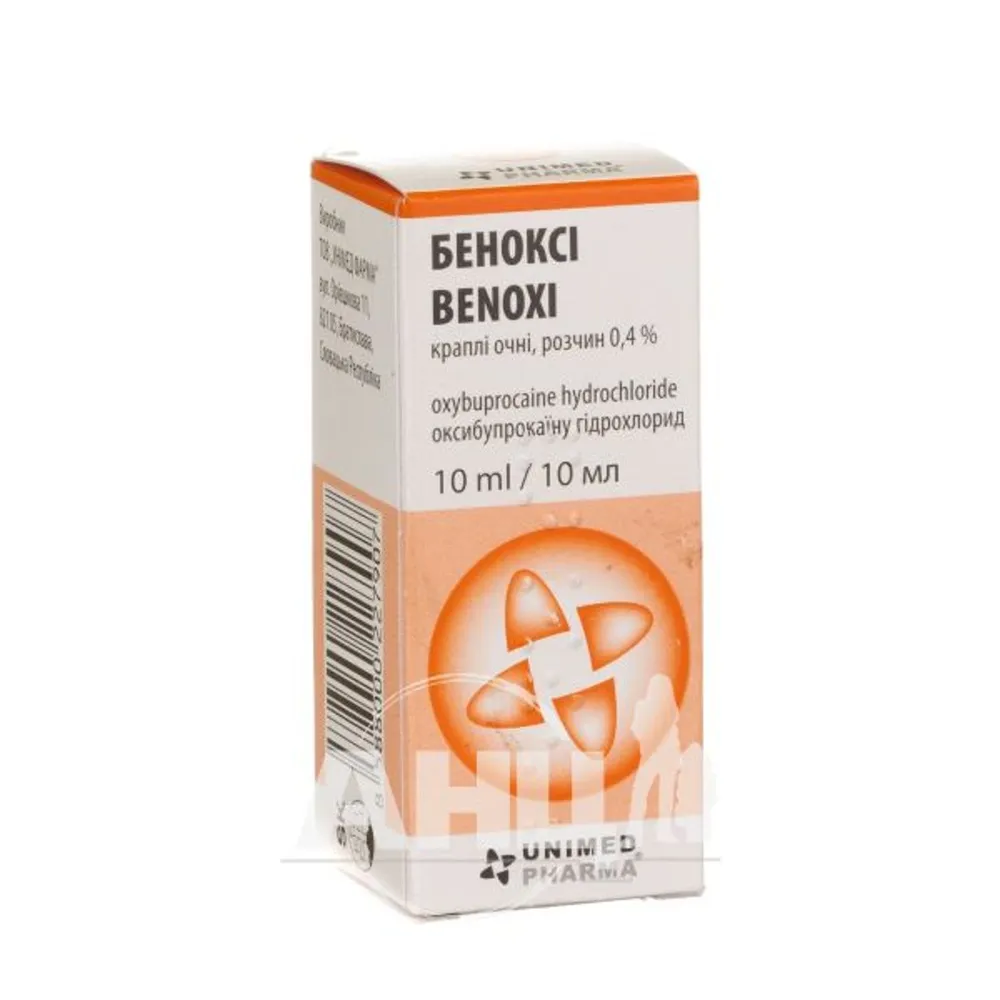
Table of Contents
INSTRUCTIONS FOR MEDICAL USE OF THE MEDICINAL PRODUCT BENOXI (BENOXI)
Composition:
Active substance: oxybuprocaine hydrochloride;
1 ml of solution contains 4 mg of oxybuprocaine hydrochloride;
Excipients: boric acid, chlorhexidine diacetate, water for injections.
Pharmaceutical form. Eye drops, solution.
Main physico-chemical properties: clear, colorless solution without visible mechanical particles.
Pharmacotherapeutic group. Agents used in ophthalmology. Local anesthetics. ATC code S01HA02.
Pharmacological properties.
Pharmacodynamics.
The active substance of the drug, oxybuprocaine hydrochloride, is a synthetic local anesthetic belonging to the group of esters of para-aminobenzoic acid. It is a potent topical anesthetic with a rapidly developing effect and short-term local anesthetic action (10–20 minutes). When reaching sensitive nerve endings in therapeutic doses, oxybuprocaine causes reversible blockade of impulse generation and transmission, thus producing temporary anesthesia at the site of instillation. It does not affect the pupil size or the ability to accommodate. After termination of the local anesthetic effect, sensitivity of the eye returns to its initial state. In vitro, oxybuprocaine exhibits weak antibacterial activity.
Pharmacokinetics.
After instillation into the conjunctival sac, oxybuprocaine is absorbed into the systemic circulation in negligible amounts. In the blood, oxybuprocaine is immediately metabolized by plasma esterases (via cleavage of the ester bond) to form inactive metabolites. The main metabolite is 3-butoxy-4-aminobenzoic acid, 80% of which is excreted by the kidneys in the form of a conjugate with glucuronic acid.
Clinical characteristics.
Indications.
Local short-term anesthesia of the cornea and conjunctiva: during removal of foreign bodies from the cornea and conjunctiva; performance of ophthalmic tonometry, gonioscopy, and other diagnostic examinations; preparation for subconjunctival and retrobulbar injections.
Contraindications.
- Hypersensitivity to the active substance or other components of the medicinal product.
- Severe heart failure.
- Thyrotoxicosis.
- Open penetrating eye injuries.
- Hypersensitivity to other local anesthetics of the ester group of para-aminobenzoic acid or amide group.
- Eye infections.
- Allergic reactions.
Interaction with other medicinal products and other types of interactions.
Benoxi potentiates the effect of succinylcholine and sympathomimetics, and reduces the effect of sulfonamides and beta-blockers.
The product contains the preservative chlorhexidine diacetate, which is incompatible with fluorescein solutions, as it leads to precipitation. Benoxi is also incompatible with silver nitrate, mercury salts, and alkaline substances.
Special precautions for use.
The medication must be administered only by a physician!
Use only for instillation into the conjunctival sac. Do not use for injections. The medicinal product should not be used under home conditions.
Use the drops only for short-term treatment. Since oxybuprocaine has a bacteriostatic effect, Benoxi should not be used before collecting bacteriological swabs.
The patient should not touch the eye during anesthesia, as this may cause injury that remains unnoticed due to the anesthetic effect. The anesthetized eye should be protected from irritating chemical exposures, dust, and bacterial infections.
The medication should be used with caution in patients with pseudocholinesterase deficiency, myasthenia gravis, arterial hypotension, cardiac disorders (heart failure, arrhythmia), and in patients with epilepsy.
Extreme caution should be exercised when administering the medication to individuals with a history of bradycardia or allergic reactions, as severe bradycardia or anaphylactic shock cannot be ruled out.
Uncontrolled use of any anesthetic, even at low concentrations, may lead to corneal epithelial damage even after short-term application. Moreover, such damage may remain unnoticed due to anesthesia. Patients experiencing persistent pain should be prescribed a systemic-acting analgesic. Even single use may result in mild superficial lesions of the corneal epithelium. Repeated, prolonged use intensifies epithelial damage. Corneal stromal infiltration and toxic damage, multiple poorly healing erosions (recurrent corneal erosions), may develop, leading to a condition resembling neurotrophic keratitis.
Patients wearing contact lenses must remove them before using this medication and may reinsert the lenses only after the anesthetic effect has completely worn off.
Systemic absorption of the medication can be reduced by applying pressure to the lacrimal sac located at the inner corner of the eye for one minute after instillation. This prevents the drops from entering the nasal cavity via the nasolacrimal duct.
Use during pregnancy or breastfeeding.
Pregnancy.
The safety of using this medication during pregnancy has not been established. The medication may be used during pregnancy only if, in the physician’s opinion, the potential benefit to the mother outweighs the potential risk to the fetus.
Breastfeeding period.
It is unknown whether oxybuprocaine hydrochloride passes into breast milk. Benoxi may be used in breastfeeding women only if, in the physician’s opinion, the potential benefit to the mother outweighs the potential risk to the infant.
Ability to influence reaction speed when driving or operating machinery.
Since oxybuprocaine is absorbed into the bloodstream, albeit in small amounts, after local instillation into the conjunctival sac, systemic effects may occur. Considering this, driving, operating machinery, or working at heights should be avoided for at least one hour after using the drops and only after vision has fully recovered.
Method of Administration and Dosage
The medication is intended for adults and children aged 2 years and older.
Instill into the conjunctival sac. The eyes should remain closed between successive instillations of the medication.
Anesthesia of the cornea and conjunctiva.
Removal of foreign particles located on the surface: instill 3 times, 1 drop each time, at 5-minute intervals.
Removal of deeply seated foreign particles: 5–10 times, 1 drop each time, at intervals of 30–60 seconds.
Prior to subconjunctival or retrobulbar injection: 3 times, 1 drop each time, at 5-minute intervals.
Ocular tonometry, gonioscopy, and other examinations: 1–2 drops as a single dose.
As with any ophthalmic drops, it is recommended to gently press on the lacrimal sac area at the inner corner of the eye immediately after instillation of each drop and release it after 1 minute to reduce systemic absorption.
Contact lenses should be removed before using the eye drops and may be reinserted only after the anesthetic effect has completely subsided.
When using two or more ophthalmic agents, the interval between their administration should be at least 5 minutes.
Children.
The medication is not intended for use in children under 2 years of age.
Overdose.
Systemic adverse reactions may occur following excessive doses or prolonged use. Systemic toxicity particularly affects the central nervous system and cardiovascular system. Symptoms such as irritability, insomnia, sedation, confusion, excitement, euphoria, disorientation, disturbances in hearing, vision, or speech, paresthesia, nausea, vomiting, muscle twitching, convulsions, respiratory depression, coma, tachycardia, arrhythmia, hypotension, shock, and cardiac arrest require symptomatic treatment. No specific antidote is known.
Adverse reactions.
Eye-related.
After instillation of the medication, transient sensations of stinging and burning, redness, and discomfort may occur, which usually resolve quickly.
Allergic reactions of the eyelids and conjunctiva are possible. With prolonged or frequent use, the following may develop: stromal infiltration, swelling, moderate corneal epithelial damage, keratitis (including toxic, superficial punctate, disciform, superinfectious candidal keratitis), fibrinous iritis, periorbital contact dermatitis (including allergic), suppression of the precorneal film (only in blue eyes), changes in corneal thickness, decreased corneal sensitivity, keratopathies (including linear, bullous keratopathy, toxic keratopathy, necrotic ulcerative keratopathy, postoperative keratopathy), wrinkling of Descemet's membrane, enlargement of endothelial cells, limited iris transillumination, reduced endothelial cell density, extracellular melanosome, subsequent reduction in normal cytokinetic and mitotic activity in ocular cells, formation of peripheral rings on the cornea, development of tolerance, damage to epithelial cells, irreversible superficial damage to cells at the level of corneal endothelial cells, direct cytotoxic effects on corneal cells (including significant reduction in oxygen consumption by corneal epithelium), chemosis, development of hypopyon or corneal perforation, corneal or conjunctival necrosis. Corneal ulcers, recurrent corneal ulcers, delayed corneal healing, irreversible corneal clouding, decreased intraocular pressure, reduced frequency of spontaneous blinking, spontaneous eye movements, pseudopositive reactions, reduced tear film stability, cataract may occur. Cases of fibrinous iritis have been reported.
Cardiovascular system.
Bradycardia.
Nervous system.
Sedation, confusion, excitement, euphoria, disorientation, hearing, vision or speech disturbances, paresthesia, muscle spasms, syncope, and in cases of severe overdose – seizures, respiratory arrest, coma.
Gastrointestinal tract.
Nausea, vomiting, dysphagia.
Immune system.
Allergic reactions, including itching, hyperemia, eyelid swelling, contact allergy, urticaria, Quincke's edema, angioneurotic edema, anaphylactic shock.
Shelf life. 24 months.
Do not store for more than 28 days after first opening.
Storage conditions.
Store in a refrigerator (2 °C – 8 °C).
Do not freeze. Store in original packaging to protect from light.
After first opening, store at a temperature not exceeding 25 °C for no more than 28 days.
Keep out of reach of children.
Packaging.
10 ml in a dropper container. One dropper container with patient information leaflet in a cardboard box.
Prescription status. Prescription only.
Manufacturer. LLC "UNIMED PHARMA" / "UNIMED PHARMA Ltd".
Manufacturer's address and location of business activity.
Orieskova 11, 821 05, Bratislava, Slovak Republic /
Orieskova 11, 821 05 Bratislava, Slovak Republic.