Belosalik lotion
Ukraine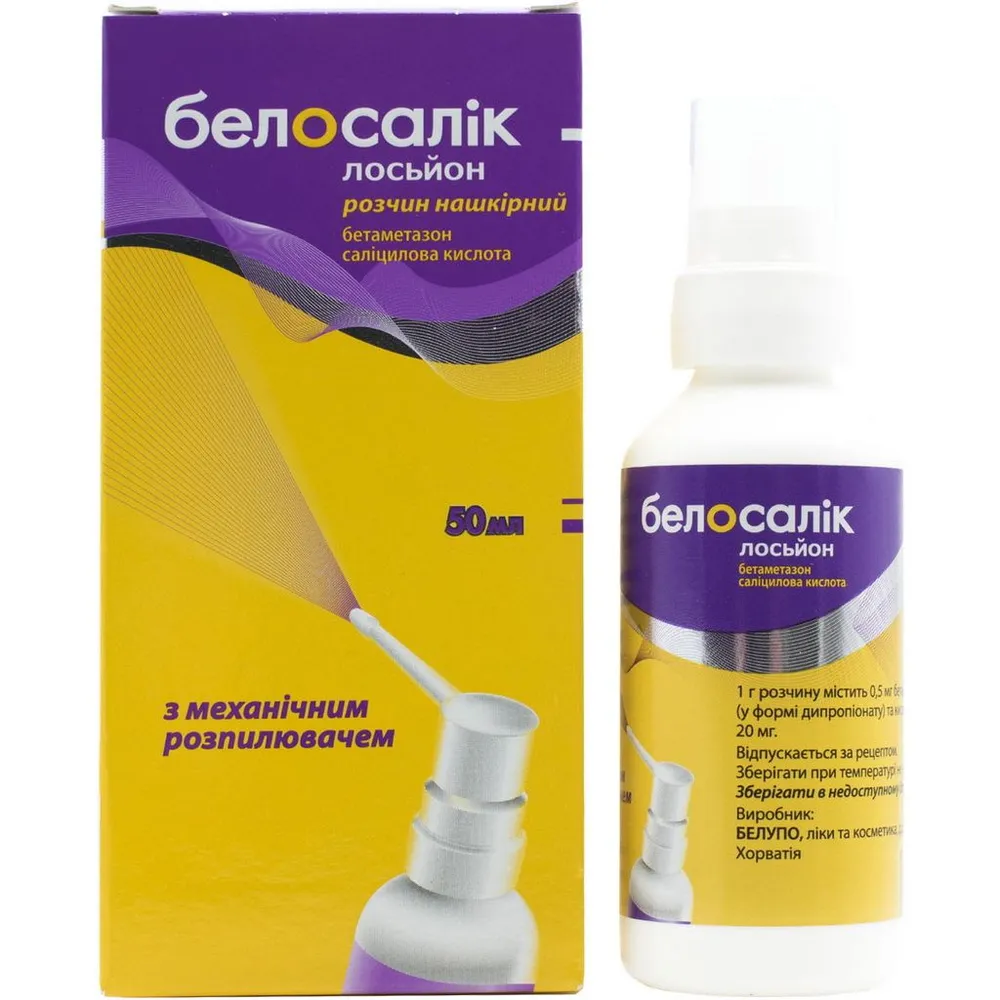
Table of Contents
INSTRUCTIONS FOR MEDICAL USE OF THE MEDICINAL PRODUCT BELSALIK LOTION (BELOSALIK LOSION)
Composition:
Active substances: betamethasone, salicylic acid;
1 g of solution contains betamethasone (as dipropionate) 0.5 mg and salicylic acid 20 mg;
Excipients: disodium edetate, hypromellose, sodium hydroxide, isopropyl alcohol, purified water.
Pharmaceutical form. Topical solution.
Main physicochemical properties: clear, colorless, viscous liquid with an isopropanol odor.
Pharmacotherapeutic group.
Corticosteroids for topical use in dermatology. Active corticosteroids in combination with other agents. ATC code D07XC01.
Pharmacological properties.
Pharmacodynamics.
The product is a combination of the corticosteroid betamethasone and salicylic acid.
Betamethasone is a synthetic fluorinated adrenocorticosteroid for topical use in dermatology, exerting a potent anti-inflammatory, immunosuppressive, and antiproliferative effect. It is a synthetic analogue of prednisolone, exhibiting a high degree of corticosteroid activity with minimal mineralocorticoid effect.
Corticosteroids reduce the formation, release, and activity of chemical mediators of inflammation (kinins, histamine, lysosomal enzymes, prostaglandins). Since leukocytes and macrophages are required to initiate the inflammatory process, corticosteroids inhibit cell migration to the site of injury and reduce vasodilation and increased vascular permeability at the affected site. This vasoconstrictive effect reduces extravasation and the development of edema.
Corticosteroids exert an immunosuppressive effect on type III and type IV hypersensitivity reactions, inhibiting the toxic effects of antigen-antibody complexes deposited on blood vessel walls, which cause cutaneous allergic vasculitis, and also by inhibiting the action of lymphokines, target cells, and macrophages, leading to allergic contact dermatitis. Corticosteroids also prevent the recruitment of sensitized T-lymphocytes and macrophages to target cells.
Salicylic acid exerts a keratolytic effect upon topical application, facilitating the penetration of corticosteroids into the skin.
Pharmacokinetics.
The absorption of betamethasone is influenced by numerous factors, including the presence of inflammation and the condition of the epidermis. When applied topically, corticosteroids are only minimally absorbed through normal, intact skin; however, the presence of skin inflammation may enhance absorption. Systemic absorption following topical application ranges from 12% to 14%. The volume of distribution (Vd) is 1.4 L/kg. Approximately 64% of betamethasone is reversibly bound to plasma proteins. Betamethasone is metabolized in the liver, with metabolites excreted primarily via bile and a smaller portion via urine (approximately 5% in total).
Salicylic acid, when applied to the skin under an occlusive dressing, reaches its maximum plasma concentration after 5 hours. Approximately 6% of the total absorbed salicylic acid is excreted unchanged in urine, while the majority is excreted as metabolites.
Clinical Characteristics.
Indications.
For reduction of inflammatory symptoms of scalp psoriasis and seborrhea.
Contraindications.
Hypersensitivity to betamethasone, salicylic acid, or to any of the excipients of the drug. Also contraindicated in rosacea, acne, widespread plaque psoriasis, perianal and genital pruritus, diaper dermatitis, perioral dermatitis, cutaneous manifestations of syphilis, cutaneous tuberculosis, other bacterial and fungal skin infections without appropriate antibacterial and antifungal therapy, molluscum contagiosum, dermatomycoses, skin reactions following vaccination, varicose veins, and viral infections (e.g., herpes simplex, herpes zoster, varicella). Should not be used under occlusive dressings.
Interaction with other medicinal products and other forms of interaction.
Topical application of salicylic acid should not be combined with oral administration of drugs containing acetylsalicylic acid and other nonsteroidal anti-inflammatory agents. Do not use concurrently with benzoyl peroxide and topical retinoids.
Salicylic acid may increase skin permeability to other topical medicinal products, thereby enhancing their systemic absorption. In addition, salicylic acid may potentiate the adverse effects of methotrexate and the hypoglycemic effect of oral antidiabetic agents, sulfonylurea derivatives.
Special precautions for use.
The drug is not intended for ophthalmological use. The drug must not be used for treatment of the eyes or the skin around the eyes due to the risk of cataract, glaucoma, fungal eye infections, and also herpes simplex exacerbation.
Contact of the drug with the eyes, mucous membranes, wound surfaces, and ulcers should be avoided.
Prolonged topical use of the drug on the face is not recommended due to the possible development of rosacea-like dermatitis, perioral dermatitis, and acne.
When applied to facial skin, treatment duration should be limited to 5 days.
If skin irritation or hypersensitivity occurs during use, treatment should be discontinued. If infection is present, appropriate therapy should be administered.
Any adverse effects associated with systemic corticosteroids, including suppression of adrenal cortex function, may also occur with topical application of glucocorticosteroids, especially in children.
Long-term therapy with the drug should be avoided in all patients, regardless of age.
The drug must not be used under occlusive dressings.
Systemic absorption of glucocorticosteroids or salicylic acid following topical application may be increased when treatment is applied over large body surface areas or when occlusive dressings are used. Appropriate precautions should be taken in such cases, particularly when treating children.
Certain body areas with natural occlusion (groin, axillae, perianal region) are more prone to the development of striae during topical treatment; therefore, use of the drug in these areas should be minimized.
When scaling or hyperkeratosis resolves, treatment should continue with corticosteroids only.
If excessive dryness or increased skin irritation develops, the drug should be discontinued.
Topical corticosteroids may, for various reasons, induce psoriasis, including symptom rebound followed by tolerance development, risk of pustular psoriasis, and local systemic toxicity due to impaired skin barrier function. Patients with hepatic dysfunction are more susceptible to systemic effects. Close monitoring is required in such patients.
Periodic monitoring of the hypothalamic-pituitary-adrenal (HPA) axis function is recommended (urinary and plasma free cortisol tests, ACTH stimulation test). If suppression is detected, the drug should be discontinued, the frequency of application reduced, or it should be replaced with a less potent corticosteroid.
Topical corticosteroids may alter the clinical presentation.
Relapse may occur upon discontinuation of treatment. Infection may worsen, and wound healing may be delayed.
The drug must not be applied to mucous membranes or areas around the eyes due to the keratolytic effect of salicylic acid.
Application of the drug to areas with atrophic skin is contraindicated.
The drug must not be used for treatment of varicose veins.
Visual disturbances
Visual disturbances may occur with systemic and topical corticosteroids (including intranasal, inhaled, and intraocular administration). If symptoms such as blurred vision or other visual disturbances occur, the patient should be referred to an ophthalmologist to evaluate possible causes, including cataract, glaucoma, or rare conditions such as central serous chorioretinopathy, which has been reported following systemic and topical corticosteroid use.
Use during pregnancy or breastfeeding.
Pregnancy.
Since the safety of topical corticosteroids in pregnant women has not been established, the drug should not be used during the first trimester of pregnancy. Use of these drugs may be considered during later stages of pregnancy only if the expected benefit to the mother clearly outweighs the potential risk to the fetus. Drugs of this class are contraindicated during pregnancy when used in high doses or for prolonged periods.
Breastfeeding period.
It is currently unknown whether topically applied corticosteroids, due to systemic absorption, can pass into breast milk. Therefore, when deciding whether to discontinue breastfeeding or discontinue the drug, the necessity of treatment should be taken into account.
Effect on the ability to drive or operate machinery.
The drug does not affect the ability to drive or operate machinery.
Method of Administration and Dosage
The product is intended for topical use only.
Vial with mechanical pump spray
The product should be sprayed twice daily onto affected areas of the scalp using the extended spray nozzle. Before spraying, shake the vial well, hold it in an upright position, place the tip of the nozzle close to the affected area of the scalp, and press the spray pump fully with the index finger. Repeat the required number of sprays over the affected areas of the scalp.
Vial with dropper
The product should be applied twice daily. Apply several drops of the lotion evenly to the affected areas using a cotton swab or fingers, and gently rub into the skin or scalp.
The frequency and duration of treatment differing from the recommended regimen may be determined by a physician based on the severity of the condition. In mild cases, some patients may require only a single daily application.
The product must not be applied to the eyes or near the eyes. The maximum daily dose should be gradually reduced to the lowest possible dose that maintains control of symptoms.
The duration of treatment should be determined individually by a physician.
Children
There are no clinical data on the use of this product in children; therefore, its use in this age group is not recommended.
Due to the higher body surface area to body weight ratio in children compared to adults, systemic absorption of the product is more pronounced. Therefore, children are at greater risk of hypothalamic-pituitary-adrenal (HPA) axis suppression and development of corticosteroid-related adverse effects.
In children treated with topical corticosteroids, adrenal suppression, Cushing's syndrome, growth retardation, inadequate weight gain, and increased intracranial pressure have been reported.
Signs of adrenal suppression include low plasma cortisol levels and lack of response to ACTH stimulation testing. Increased intracranial pressure may present as bulging fontanelle, headache, and bilateral optic disc swelling.
Overdose
Prolonged or excessive use of topical glucocorticosteroids may lead to suppression of the pituitary-adrenal function, resulting in secondary adrenal insufficiency and symptoms of hypercortisolism, including Cushing's disease. Excessive or prolonged use of topical products containing salicylic acid may cause symptoms of salicylism. Symptoms of salicylate overdose include pallor, fatigue, drowsiness, nausea, vomiting, and hearing disturbances.
Treatment: Provide appropriate symptomatic therapy. Symptoms of acute hypercortisolism are usually reversible. If necessary, correct electrolyte imbalances. In cases of chronic toxic effects, gradual withdrawal of corticosteroids is recommended.
Treatment of salicylism is symptomatic. Employ measures to enhance elimination of salicylates from the body. In case of overgrowth of resistant microorganisms, discontinue treatment with the product and initiate appropriate therapy. Administer sodium bicarbonate orally to alkalinize urine and enhance diuresis.
Side effects.
The following adverse reactions may occur with the use of topical corticosteroids: burning sensation, pruritus, irritation, dryness of the skin, stinging, skin thickening, skin cracking, sensation of warmth, lamellar desquamation, focal desquamation, erythema, folliculitis, hypertrichosis, acneiform eruptions, hypopigmentation, perioral dermatitis, and allergic contact dermatitis.
The following adverse reactions may occur more frequently when occlusive dressings are used: skin maceration, secondary infection, skin atrophy, striae, and miliaria.
Hypersensitivity reactions may occur in individuals with known hypersensitivity to any component of the product.
Striae and telangiectasia, mainly on the face, may result from prolonged continuous application of the preparation.
Cases of blurred vision have been reported with corticosteroid use (frequency unknown) (see also section "Special precautions").
Any adverse effects associated with systemic use of glucocorticoids, including adrenal cortex suppression, may also occur with topical application.
Skin-related adverse reactions that may occur with topical use of salicylic acid include: dryness, desquamation, irritation, contact dermatitis, and allergic reactions (urticaria, pruritus), which may require discontinuation of the product.
With prolonged use, systemic absorption of the product may occur, leading to salicylate-related adverse effects such as tinnitus, dizziness, epigastric pain, nausea, vomiting, acidosis, and tachypnea.
Shelf life. 2 years.
Storage conditions.
Store at a temperature not exceeding 25 °C.
Keep out of reach of children.
Packaging.
50 ml or 100 ml in a dropper bottle; 1 bottle per cardboard box.
20 ml, 50 ml, or 100 ml in a bottle with a mechanical pump spray dispenser; 1 bottle per cardboard box.
Prescription status. Prescription only.
Manufacturer.
Belupo, lijekovi i kozmetika, d.d.
Manufacturer's address and place of business.
Danice 5, 48000 Koprivnica, Croatia.