Belogent
Ukraine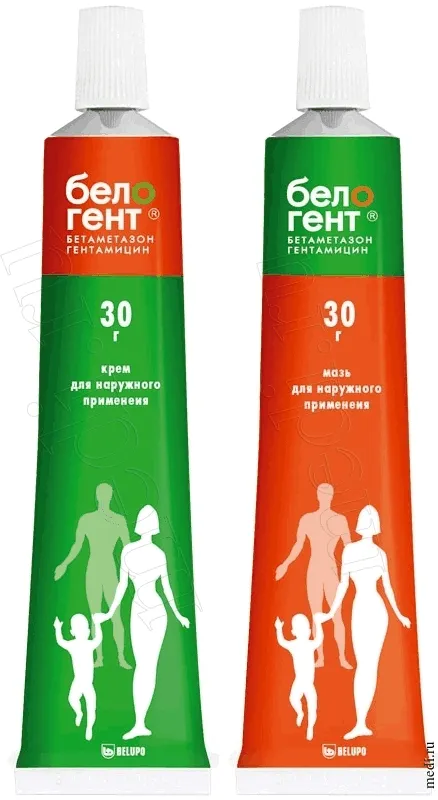
Table of Contents
INSTRUCTION FOR MEDICAL USE OF THE MEDICINAL PRODUCT BELOGENT (BELOGENT®)
Composition:
Active substances: betamethasone dipropionate, gentamicin sulfate;
1 g of cream contains betamethasone dipropionate 0.640 mg, equivalent to 0.500 mg of betamethasone; gentamicin sulfate 1.66 mg, equivalent to 1.00 mg of gentamicin;
Excipients: sodium dihydrogen phosphate, chlorocresol, phosphoric acid, white soft paraffin, mineral oil, macrogol cetylstearyl ether, cetylstearyl alcohol, sodium hydroxide, purified water.
Pharmaceutical form. Cream.
Main physicochemical properties: homogeneous white cream without mechanical inclusions.
Pharmacotherapeutic group. Corticosteroids for dermatological use. Corticosteroids in combination with antibiotics. ATC code D07C C01.
Pharmacological Properties
Pharmacodynamics
Betamethasone dipropionate is a synthetic fluorinated derivative of hydrocortisone. It readily penetrates the skin, exerting potent local anti-inflammatory, antipruritic, and antiallergic effects. It eliminates the causes of inflammatory processes, prevents the release of histamine, and suppresses local allergic symptoms. Due to its local vasoconstrictive action, it reduces exudative reactions.
Gentamicin is an aminoglycoside antibiotic with pronounced bactericidal activity. It belongs to the group of broad-spectrum antibiotics. It exhibits antibacterial activity against gram-negative bacteria (e.g., Proteus, Escherichia coli) and some gram-positive bacteria, including penicillin-resistant staphylococci.
Cross-resistance between gentamicin and other aminoglycosides has been observed.
Pharmacokinetics
Betamethasone dipropionate is not biotransformed in the skin. After penetration through the skin into the body (absorption not exceeding 1%), it is metabolized in the liver and primarily excreted in the urine, with a smaller amount eliminated via bile. Skin absorption of betamethasone dipropionate increases when applied to thin skin, skin folds, or skin with damaged epidermis or inflammation. Furthermore, absorption increases with more frequent application and when used over large skin areas. Skin absorption of betamethasone dipropionate is more pronounced in younger individuals compared to adults.
Gentamicin sulfate is not absorbed through intact skin after topical application; however, when applied to skin damaged by trauma, burns, or ulcers, it may undergo systemic absorption. Gentamicin sulfate is not biotransformed in the body and is excreted unchanged in the urine.
Clinical characteristics.
Indications.
Dermatoses amenable to treatment with glucocorticosteroids complicated or suspected of being complicated by secondary infection caused by microorganisms sensitive to gentamicin: eczema (atopic, nummular), anogenital and senile pruritus, contact dermatitis, seborrheic dermatitis, neurodermatitis, intertriginous dermatitis, solar dermatitis, exfoliative dermatitis, stasis dermatitis, and psoriasis.
Contraindications.
Belogent is contraindicated in patients with hypersensitivity to betamethasone dipropionate, gentamicin, or any other component of the medicinal product, as well as in patients with hypersensitivity to other glucocorticoids or aminoglycoside antibiotics.
The drug is contraindicated during pregnancy.
Belogent cream is also contraindicated in the following cases:
- viral infections, including post-vaccination reactions and varicella;
- cutaneous tuberculosis and syphilis;
- widespread plaque psoriasis;
- varicose veins;
- perioral dermatitis;
- skin neoplasms;
- viral skin infections (e.g., herpes simplex, herpes zoster);
- acne rosacea and rosacea-like dermatitis;
- dermatomycoses;
- other bacterial and fungal skin infections in the absence of appropriate antibacterial and antifungal therapy;
- ophthalmological diseases;
- concomitant systemic therapy with aminoglycoside antibiotics, due to the risk of achieving toxic plasma levels;
- progressive renal failure;
- children under 1 year of age.
Belogent cream must not be applied into the ear canal, eyes, or onto mucous membranes.
Due to the potential for absorption of the active substance, prolonged treatment, application over large skin areas, and treatment under occlusive dressings should be avoided.
Interaction with other medicinal products and other forms of interaction.
No interactions have been observed with topical application of glucocorticosteroids. However, during treatment with this medicinal product, smallpox vaccination and other types of immunization should not be performed (especially during prolonged use over large skin areas) due to the possible lack of an adequate immunological response, such as the production of specific antibodies.
Belogent may enhance the effect of immunosuppressive agents and reduce the effect of immunostimulating agents.
Concomitant use with other dermatological medicinal products is not recommended, as it may reduce the efficacy of Belogent.
Gentamicin interacts with amphotericin B, heparin, sulfadiazine, and beta-lactam antibiotics (e.g., cephalosporins).
Special precautions for use.
Do not use continuously for more than 2 weeks. If skin irritation or signs of hypersensitivity develop during treatment, application of the cream should be discontinued and appropriate therapy should be initiated for the patient.
Medicinal products containing gentamicin should be selected with caution for specific therapy. They should only be used if there is no rapid response to antiseptic measures, the response is inadequate, or antiseptic therapy is contraindicated.
With prolonged use of the drug on large areas of skin, the frequency of adverse effects increases, as well as the possibility of developing bacterial resistance to gentamicin sulfate.
Cross-allergic reactions with aminoglycoside antibiotics have been observed.
Caution is required when using the medicinal product, as it contains gentamicin. Prior to use, hypersensitivity to antibiotics should be assessed and conditions where antibiotic therapy is contraindicated should be identified. Any adverse effects observed with systemic use of glucocorticoids, including suppression of adrenal cortex function, may also occur with topical application of glucocorticoids following systemic absorption, particularly in children.
Systemic absorption of topical glucocorticoids generally increases with higher doses of glucocorticoid, longer duration of treatment, and larger treated body surface area. Therefore, patients using high doses of potent glucocorticoids over large body areas should be closely monitored for early signs of hypothalamic-pituitary-adrenal (HPA) axis suppression. If suppression occurs, Belogent cream should be discontinued, the frequency of application reduced, or the patient switched to a less potent glucocorticoid. In rare cases, withdrawal symptoms may develop, requiring the addition of systemic glucocorticoid therapy.
The use of gentamicin in the treatment of skin infections carries a risk of allergic reactions. Gentamicin is a contact allergen with a sensitization rate of approximately 1.4%. The risk of allergy increases with the duration of therapy. An allergic reaction resulting from topical application of gentamicin is a contraindication for systemic use of gentamicin and other aminoglycosides.
If an infection develops at the site of cream application, appropriate antibacterial or antifungal treatment should be initiated.
If infection symptoms do not resolve, the drug should be discontinued during the period of infection treatment.
Do not apply the medicinal product to facial skin due to the risk of adverse effects (e.g., telangiectasia, perioral dermatitis), even after short-term use. The cream is not intended for ophthalmic use.
Use with caution in patients with psoriasis, as topical application of glucocorticoids to psoriatic lesions may lead to exacerbation of the condition, including relapse due to tolerance development, generalized pustular psoriasis, and systemic toxicity resulting from impaired skin barrier function.
Use in the groin and genital areas only when strictly necessary, as increased absorption and adverse effects (e.g., telangiectasia, perioral dermatitis) may occur even after short-term use.
Use with caution in patients with pre-existing atrophic changes in subcutaneous tissue, especially in elderly individuals.
Do not apply the cream under occlusive dressings, as this may lead to epidermal atrophy, striae formation, and secondary infection.
Prolonged topical use of antibiotics may occasionally lead to overgrowth of resistant microorganisms, including fungi. In such cases, as well as in the event of skin irritation, sensitization, or superinfection, treatment with the drug should be discontinued and appropriate therapy initiated.
Systemic absorption of gentamicin following topical application may be higher when treating large body surfaces, especially with prolonged use or in the presence of skin damage. In such cases, adverse effects associated with systemic use of gentamicin may occur. Gentamicin should therefore be used with caution under these conditions, particularly in children.
Due to the potential for neuromuscular blockade with systemically absorbed aminoglycosides, the medicinal product should be used with caution in patients with myasthenia gravis, Parkinson's disease, other conditions associated with muscle weakness, and in patients concurrently receiving other medicinal products that may cause neuromuscular blockade. Belogent cream contains cetostearyl alcohol, which may cause local skin reactions (e.g., contact dermatitis), and chlorocresol, which may cause allergic reactions.
Due to the presence of soft white paraffin and mineral oil in the cream formulation, use in the anogenital area may damage the structure of latex condoms and reduce their safety during treatment.
Visual disturbances
Visual disturbances may occur with systemic and topical use of corticosteroids (including intranasal, inhaled, and intraocular administration). If symptoms such as blurred vision or other visual disturbances occur, the patient should undergo an ophthalmological examination to evaluate possible causes, which may include cataract, glaucoma, or rare conditions such as central serous chorioretinopathy, which has been reported after systemic and topical use of corticosteroids.
Use during pregnancy or breastfeeding.
Pregnancy.
The medicinal product is contraindicated during pregnancy. There are no data on the topical use of betamethasone and gentamicin in pregnant women. Gentamicin can cross the placental barrier and accumulate in fetal tissues. Reproductive toxicity has been demonstrated in animal studies. Some studies have shown embryotoxic and teratogenic effects after systemic and topical use of betamethasone. There may be an increased risk of congenital malformations with systemic use of corticosteroids, particularly during the first trimester of pregnancy.
Breastfeeding.
It is unknown whether the drug passes into breast milk following topical application; therefore, it is not recommended for use during breastfeeding. Contact between the treated skin and the infant should be avoided.
Effect on ability to drive and use machines.
The drug does not affect the ability to drive or operate machinery.
Method of Administration and Dosage
Apply the cream as a thin layer to the entire affected area of skin twice daily – in the morning and evening.
The frequency of application is determined individually depending on the severity of the disease. In mild cases, once daily application may be sufficient; in more severe cases, more frequent application may be necessary.
The duration of treatment depends on the size and location of the lesion, as well as on the patient's response to therapy.
If no clinical improvement is observed within 3–4 weeks, the physician should reconsider the diagnosis.
Children
There are no clinical data on the use of this medicinal product in children; therefore, its use is not recommended in this age group.
In children, the ratio of body surface area to body weight is higher than in adults, resulting in more intensive absorption of the drug. Children are more susceptible to hypothalamic-pituitary-adrenal (HPA) axis suppression and the development of exogenous corticosteroid effects.
In children treated with topical corticosteroids, adrenal suppression, Cushing's syndrome, growth retardation, inadequate weight gain, and increased intracranial pressure have been reported.
Signs of adrenal suppression include low plasma cortisol levels and lack of response to adrenocorticotropic hormone (ACTH) stimulation tests. Increased intracranial pressure may manifest as bulging of the fontanelle, headache, and bilateral optic disc swelling.
Overdose
Symptoms of overdose may occur with prolonged or excessive use over large skin areas, high doses, or use under occlusive dressings. These symptoms are manifested by an increase in systemic adverse effects typical of corticosteroids (hyperglycemia, glucosuria, Cushing's syndrome) or of gentamicin sulfate (ototoxic and nephrotoxic effects, which may be particularly dangerous in patients with renal impairment).
Single overdose of gentamicin has not led to symptoms of overdose. However, excessive or prolonged use of gentamicin may lead to overgrowth of antibiotic-resistant microorganisms.
Treatment. Provide appropriate symptomatic therapy. Symptoms of acute hypercortisolism are usually reversible. If necessary, correct electrolyte imbalances. In cases of chronic toxic effects, gradual withdrawal of corticosteroids is recommended. In case of overgrowth of resistant microorganisms, discontinue treatment with the drug and initiate appropriate therapy.
Adverse Reactions
Skin and subcutaneous tissue disorders
Acne, steroid purpura, acneiform eruptions, epidermal growth suppression, subcutaneous tissue atrophy, folliculitis, erythema, hypertrichosis, secondary infection, urticaria or maculopapular rash, allergic contact dermatitis, miliaria, pruritus, maceration of the skin, skin stinging, skin irritation or exacerbation of existing lesions, dryness of the skin, depigmentation or hyperpigmentation of the skin, skin discoloration, dilation of small superficial blood vessels, rosacea-like (perioral) dermatitis, erythema, skin atrophy, and striae when the product is used for longer than recommended. Application to the facial skin may cause perioral dermatitis.
Vascular disorders
Prolonged use beyond the recommended duration may lead to dilatation of small blood vessels (telangiectasia).
Auditory system disorders
Application to mucous membranes or large areas of skin, especially damaged skin, or under occlusive dressing may cause ototoxic effects due to the presence of gentamicin sulfate in the cream.
Endocrine system disorders
Signs of hypercortisolism. Prolonged use of the cream over large skin areas or under occlusive dressing, or in children, considering the increased absorption of betamethasone dipropionate, may result in significant systemic corticosteroid effects, manifested as edema, arterial hypertension, decreased immunity, growth and developmental suppression in children, hyperglycemia, glucosuria, and Cushing's syndrome.
Eye disorders
Topical application to the eyelid skin may occasionally lead to the development of glaucoma or accelerate the progression of cataract.
Immune system disorders
Hypersensitivity to corticosteroids may occur; in such cases, the use of the product must be discontinued immediately.
Renal and urinary system disorders
Application to large areas of skin, especially damaged skin, or under occlusive dressing may cause nephrotoxic effects due to the presence of gentamicin sulfate in the cream.
Infections and infestations
Secondary infections.
The product contains cetostearyl alcohol, which may cause local skin reactions (e.g., contact dermatitis).
The product contains chlorocresol, which may cause allergic skin reactions.
Belogent cream is generally well tolerated. In very rare cases, skin irritation may occur, possibly related to individual hypersensitivity to gentamicin.
Local application of gentamicin may delay wound healing. In addition, topical use of gentamicin may occasionally cause ototoxicity, vestibular toxicity, and nephrotoxicity, particularly with repeated application to large wounds.
Cases of blurred vision have been reported (see also section "Special precautions for use") with corticosteroid use (frequency unknown).
Reporting of suspected adverse reactions
It is important to report suspected adverse reactions after marketing authorization. This allows continued monitoring of the benefit-risk balance of the medicinal product. Healthcare professionals should report any suspected adverse reactions.
Shelf life
4 years.
Storage conditions
Store at a temperature not exceeding 25 °C.
Keep out of the reach of children.
Packaging
15 g or 30 g in tubes, 1 tube per cardboard box.
Prescription status
Prescription only.
Manufacturer
Belupo, lijekovi i kozmetika d.d.
Manufacturer's address and place of business
Danicica 5, 48000 Koprivnica, Croatia