Belastazin
Ukraine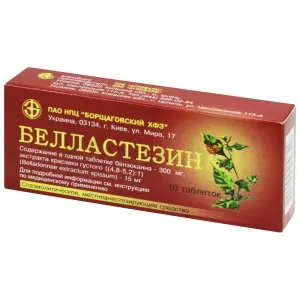
Table of Contents
INSTRUCTIONS FOR MEDICAL USE OF THE MEDICINAL PRODUCT BELLASTHESIN (BELLASTHESINUM)
Composition:
Active substances: benzocaine, dry extract of belladonna;
One tablet contains: benzocaine – 300 mg, dry extract of belladonna (Belladonnae extractum spissum) – aqueous-ethanolic ((4.8–5.2):1) (extraction solvent 20 % (v/v) ethanol), containing 1.5 % of total alkaloids calculated as atropine – base (hyoscyamine) and dry matter – 15 mg;
Excipients: microcrystalline cellulose, sodium croscarmellose, mannitol (E 421), calcium stearate, copovidone.
Pharmaceutical form. Tablets.
Main physicochemical properties: round-shaped brown tablets with marbled surface and speckles of light and brown color of varying intensity, beveled edges, a groove, and a characteristic weak specific odor.
Pharmacotherapeutic group. Agents used in functional gastrointestinal disorders. Spasmolytics in combination with analgesics. Alkaloids of belladonna in combination with analgesics. ATC code A03D B.
Pharmacological properties.
Belastezin is a combined preparation containing belladonna extract and benzocaine (anaesthesin). It exerts analgesic and spasmolytic effects. The analgesic effect is due to benzocaine, a local anesthetic; the spasmolytic effect is due to belladonna.
Clinical characteristics.
Indications.
- Spasms of smooth-muscle organs of the gastrointestinal tract;
- spasms of biliary ducts;
- hypersecretory gastritis;
- hypersalivation (increased salivation).
Contraindications.
- Hypersensitivity to belladonna, benzocaine, other amide anesthetics, or any other component of the drug;
- cardiovascular diseases in which increased heart rate may be undesirable: atrial fibrillation, tachycardia, chronic heart failure, ischemic heart disease, mitral stenosis, severe arterial hypertension;
- glaucoma;
- urinary retention or predisposition to it;
- gastrointestinal disorders associated with obstruction;
- myasthenia gravis;
- hyperthermic syndrome;
- thyrotoxicosis;
- acute bleeding;
- thromboembolic disease, granulocytopenia (the drug contains benzocaine).
Interaction with other medicinal products and other types of interactions.
If the patient is taking any other medicinal products, it is essential to inform the physician!
When using Belastezin:
- with amantadine, antiarrhythmic anticholinergic drugs (including quinidine), tricyclic antidepressants, glutethimide − anticholinergic effects of Belastezin are enhanced;
- with opioid analgesics and drugs that depress the central nervous system (including phenothiazines) − dangerous CNS depression may occur;
- with butyrophenones (haloperidol) and organic nitrates − intraocular pressure increases;
- with systemic corticosteroids − corticosteroid effect is reduced and increased intraocular pressure may occur;
- with pilocarpine − its effect in glaucoma treatment is diminished;
- with M-cholinoblockers − anticholinergic effects are enhanced;
- with furosemide − orthostatic hypotension may occur;
- with reserpine, MAO inhibitors, guanethidine, antacids, ascorbic acid, attapulgite − Belastezin's effect is reduced;
- with levodopa − systemic levodopa concentrations are decreased; therefore, dosage adjustment is required;
- with certain antihistamines (including meclizine) − antihistaminic effect is enhanced;
- with beta-adrenoreceptor blockers − their effect is reduced;
- with hormonal contraceptives − contraceptive effect is reduced;
- with non-selective inhibitors of neuronal reuptake of monoamines − sedative effect is enhanced;
- with non-steroidal anti-inflammatory drugs, griseofulvin, digoxitin, doxycycline, metoclopramide, metronidazole − their effects are reduced;
- with ketoconazole − Belastezin-induced elevation of gastric pH reduces ketoconazole absorption; therefore, Belastezin should be taken no earlier than 2 hours after ketoconazole;
- with sulfonamides − their antibacterial activity is reduced;
- with indapamide, nizatidine − their effects are enhanced;
- with potassium chloride − mucosal damage of the gastrointestinal tract may occur.
Special precautions for use.
Before starting treatment with Belastezin, consult a physician.
In case of persistent or worsening abdominal pain of unknown origin accompanied by such symptoms as fever, nausea, vomiting, changes in intestinal peristalsis, decreased blood pressure, loss of consciousness, or presence of blood in the stool, medical consultation is required.
Do not exceed the recommended doses of the drug. The smallest effective dose should be used.
Alcoholic beverages should be avoided during treatment with this drug.
Use with caution in patients:
- with autonomic (vegetative) neuropathy;
- with prostatic hypertrophy without urinary tract obstruction;
- with Down's syndrome, cerebral palsy, or brain injury;
- with hepatic or renal impairment;
- with chronic lung diseases associated with low production of difficult-to-expectorate sputum, especially in debilitated patients;
- with reflux esophagitis, hiatal hernia combined with reflux esophagitis;
- with inflammatory bowel diseases, including ulcerative colitis and Crohn's disease;
- with megacolon;
- with xerostomia (dry mouth), particularly in elderly or debilitated patients;
- in hyperthermia, especially in elderly or debilitated patients – hyperthermia may be exacerbated;
- in high ambient temperatures (risk of heat stroke due to suppression of sweat gland activity).
In patients with undiagnosed and therefore untreated angle-closure glaucoma, use of anticholinergic agents such as belladonna alkaloids may lead to increased intraocular pressure. Therefore, if eye pain, redness of the eyes, or visual impairment/loss occur, the patient should consult an ophthalmologist.
There is a risk of methemoglobinemia when using drugs containing benzocaine, particularly in patients with congenital defects such as glucose-6-phosphate dehydrogenase deficiency, NADH-methemoglobin reductase deficiency, pyruvate kinase deficiency, or hemoglobin M. Symptoms such as cyanosis of the skin, lips, and nail beds, headache, dizziness, difficulty breathing, weakness, and tachycardia may indicate potentially life-threatening methemoglobinemia requiring immediate medical intervention.
Belladonna alkaloids may affect the results of the following laboratory tests:
- gastric acidity test (may antagonize the action of pentagastrin and histamine; the drug should be discontinued 24 hours before the test);
- gastric emptying radionuclide study (may delay gastric emptying);
- phenolsulfonphthalein urinary excretion test (may delay urinary excretion of phenolsulfonphthalein).
The drug contains benzocaine, which may cause a positive doping test result in athletes.
Do not use the drug for longer than the recommended duration without consulting a physician!
If symptoms of illness do not begin to resolve, or if the patient's condition worsens, or if adverse reactions occur, discontinue the drug and consult a physician regarding further use.
Use during pregnancy or breastfeeding.
Use during pregnancy is possible only if, in the physician’s opinion, the expected benefit to the mother outweighs the potential risk to the fetus.
If use of the drug is necessary, breastfeeding should be discontinued.
Ability to affect reaction speed when driving or operating machinery.
Due to possible adverse effects on the nervous system and visual organs, patients should refrain from driving or operating machinery while using this drug.
Method of Administration and Dosage.
For oral use in adults: 1 tablet 3 times daily. The tablet should be swallowed whole, without chewing, with a sufficient amount of water.
Belastezin is intended for short-term use. If symptoms do not resolve within 3–5 days, consult a physician regarding further treatment.
Children.
Clinical data on efficacy and safety in children are lacking; therefore, the drug should not be used in pediatric patients.
Overdose.
Symptoms: intensification of adverse reactions, nausea, vomiting, tachycardia, decreased arterial blood pressure, excitement, irritability, tremor, seizures, insomnia, drowsiness, hallucinations, hyperthermia, central nervous system depression, respiratory and vasomotor center depression.
There have been reports that drugs containing benzocaine may cause methemoglobinemia. Symptoms such as cyanosis of the skin, lips, and nail beds, headache, dizziness, dyspnea, weakness, tachycardia, may indicate potentially life-threatening methemoglobinemia requiring immediate medical intervention.
Treatment: gastric lavage, parenteral administration of cholinomimetics and anticholinesterase agents. Phenothiazines must not be used. In case of methemoglobinemia development – intravenous administration of methylene blue. Symptomatic treatment.
In case of overdose, seek immediate medical help!
Side effects.
Gastrointestinal tract: dry mouth, thirst, taste disturbances, dysphagia, constipation, decreased intestinal motility up to atony, reduced tone of bile ducts and gallbladder.
Urinary system: difficulty and delayed urination.
Cardiovascular system: facial flushing, hot flashes, palpitations, arrhythmia including extrasystoles, myocardial ischemia.
Nervous system: headache, dizziness.
Eyes: mydriasis, photophobia, accommodation paralysis, increased intraocular pressure.
Respiratory system and mediastinal organs: reduced secretory activity and bronchial tone, leading to formation of viscous sputum that is difficult to cough up.
Skin and subcutaneous tissue: skin rashes, itching, urticaria, hyperemia, exfoliative dermatitis.
Immune system: anaphylactic reactions, anaphylactic shock.
Other: decreased sweating, dry skin, dysarthria.
Methemoglobinemia may occur during treatment (skin, lips, and nail beds cyanosis, headache, dizziness, dyspnea, weakness, tachycardia) (the product contains benzocaine).
If any adverse reactions occur, discontinue use of the drug immediately and consult a physician without delay.
Reporting suspected adverse reactions.
Reporting of adverse reactions after drug registration is of great importance. It enables ongoing monitoring of the benefit-risk balance of the medicinal product. Healthcare and pharmacy professionals, as well as patients or their legal representatives, are encouraged to report all suspected adverse reactions and lack of drug efficacy via the Automated Pharmacovigilance Information System at: https://aisf.dec.gov.ua.
Shelf life. 3 years.
Do not use after the expiry date stated on the packaging.
Storage conditions.
Store in the original packaging at a temperature not exceeding 25 °C.
Keep out of reach of children.
Packaging.
10 tablets in a blister pack, 1 blister pack in a carton.
Supply category. Over-the-counter.
Manufacturer.
Public Joint-Stock Company "Scientific and Production Center "Borshchagovskiy Chemical and Pharmaceutical Plant".
Limited Liability Company "Agrofarm".
Manufacturer's address and place of business.
Ukraine, 03134, Kyiv, Miru Street, 17.
Ukraine, 08200, Kyiv region, Irpin, Centralna Street, 113-A.