Belacne® duo
Ukraine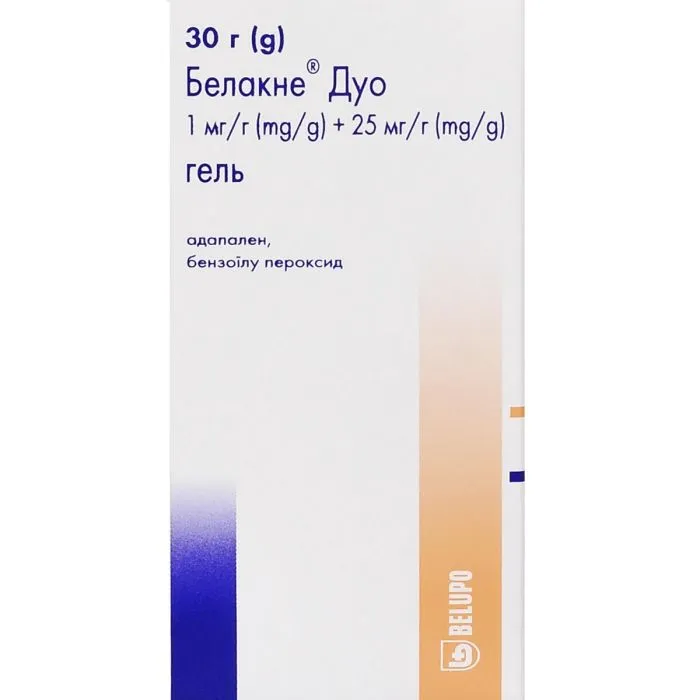
Table of Contents
INSTRUCTIONS FOR MEDICAL USE OF THE MEDICINAL PRODUCT BELACNE® DUO
Composition:
Active substances: adapalene, benzoyl peroxide;
1 g of gel contains 1 mg of adapalene and 25 mg of benzoyd peroxide (as aqueous benzoyl peroxide);
Excipients: disodium edetate, sodium docecyl sulfate, glycerol, poloxamer 124, propylene glycol, Sipeneo P600 (copolymer of acrylamide and sodium acryloyldimethyl taurate, isohexadecane, polysorbate 80, sorbitan oleate, water), sorbitan oleate, purified water.
Pharmaceutical form. Gel.
Main physicochemical properties: opaque gel, white to very pale yellow in color.
Pharmacotherapeutic group. Topical agents for acne treatment. Retinoids for topical treatment of acne. Adapalene, combinations.
ATC code D10AD53
Pharmacological Properties
Pharmacodynamics
Mechanism of Action and Pharmacodynamic Effects
BELACNE® DUO combines two active substances that act through different but complementary mechanisms.
Adapalene is a chemical derivative of naphthoic acid with retinoid activity. Studies of its biochemical and pharmacological profile have shown that adapalene acts on the pathogenesis of acne vulgaris: it is a potent modulator of cellular differentiation and keratinization and has anti-inflammatory properties. Mechanistically, adapalene binds to specific nuclear retinoic acid receptors. Current evidence indicates that topical adapalene normalizes the differentiation of follicular epithelial cells, thereby reducing the formation of microcomedones. Adapalene suppresses both chemotactic (directed) and chemokinetic (random) responses of human polymorphonuclear leukocytes in in vitro assay models; it also inhibits the metabolism of arachidonic acid into inflammatory mediators.
Benzoyl peroxide: Benzoyl peroxide has been shown to have antimicrobial activity, particularly against P. acnes, which is abnormally present in the pilosebaceous unit affected by acne. In addition, benzoyl peroxide demonstrates exfoliating and keratolytic effects. Benzoyl peroxide also acts as a sebostatic agent, counteracting the excessive sebum production associated with acne.
Pharmacokinetics
The pharmacokinetic (PK) properties of the fixed combination of adapalene/benzoyl peroxide are similar to the PK profile of adapalene 0.1% gel.
In a 30-day clinical pharmacokinetic study conducted in patients with acne who were tested under maximal conditions (2 g of gel per day) using either the fixed combination gel or an adapted formulation of adapalene 0.1%, adapalene was not quantifiable in the majority of plasma samples (quantification limit: 0.1 ng/mL). Low levels of adapalene (Cmax from 0.1 to 0.2 ng/mL) were measured in two blood samples from subjects receiving the fixed combination of adapalene/benzoyl peroxide and in three samples from subjects receiving adapalene 0.1% gel. The highest AUC0–24h of adapalene observed in the fixed combination group was 1.99 ng·h/mL.
These results are comparable to those obtained in previous clinical pharmacokinetic studies of various formulations of adapalene 0.1%, where systemic exposure to adapalene was consistently low.
Percutaneous absorption of benzoyl peroxide is low; upon application to the skin, it is completely converted into benzoic acid, which is rapidly eliminated.
Clinical characteristics
Indications
For the treatment of acne vulgaris with comedones, papules and pustules.
Contraindications
- Hypersensitivity to the active substances or to any of the excipients
- Pregnancy
- Planning pregnancy
Interaction with other medicinal products and other forms of interaction
No interaction studies have been performed.
Based on previous experience with the use of adapalene and benzoyl peroxide, no interactions are known with other medicinal products that may be administered transdermally and simultaneously with BĒLACNE® DUO. However, other retinoids, benzoyl peroxide, or products with a similar mechanism of action should not be used concurrently. Caution should be exercised when using cosmetic products with desquamative, irritant or drying effects, as they may cause cumulative irritation when used with BĒLACNE® DUO.
Absorption of adapalene through human skin is low (see section "Pharmacokinetics"), therefore interaction with systemic medicinal products is unlikely.
Percutaneous penetration of benzoyl peroxide into the skin is low, and the active substance is completely metabolized to benzoic acid, which is rapidly eliminated. Thus, potential interaction of benzoic acid with systemic medicinal products is unlikely.
Special precautions for use
BELACNE® DUO, gel, should not be applied to damaged skin (cuts or abrasions), eczematous skin, or sunburned skin.
BELACNE® DUO must not come into contact with the eyes, mouth, nostrils, or mucous membranes. If the product gets into the eyes, rinse immediately with warm water.
BELACNE® DUO contains 40 mg of propylene glycol (E1520) per gram, equivalent to 4% by mass.
If a reaction indicating hypersensitivity to any component occurs, treatment with BELACNE® DUO should be discontinued.
Excessive exposure to sunlight or UV radiation should be avoided.
BELACNE® DUO should not come into contact with any colored materials, including hair and dyed fabrics, as this may cause bleaching or discoloration.
This medicinal product contains propylene glycol, which may cause skin irritation.
Use during pregnancy or breastfeeding
Oral administration is associated with congenital anomalies. With topical use of retinoids at recommended doses, systemic exposure is expected to be low due to minimal dermal absorption. However, individual factors (e.g., impaired skin barrier, excessive use) may increase systemic exposure.
Pregnancy
BELACNE® DUO is contraindicated during pregnancy and in women planning pregnancy. Data on topical use of adapalene in pregnant women are lacking or limited.
Animal studies have shown reproductive toxicity at high systemic exposure following oral administration.
Clinical experience with topical use of adapalene and benzoyl peroxide during pregnancy is limited. If pregnancy occurs, treatment with this medicinal product should be discontinued.
Breastfeeding
No studies have been conducted on the passage of the fixed combination gel of adapalene / benzoyl peroxide into animal or human milk following topical application.
No effect on the breastfed infant is expected, as systemic exposure to BELACNE® DUO in breastfeeding women is negligible. BELACNE® DUO may be used during breastfeeding.
To avoid contact exposure to the infant, application of BELACNE® DUO gel to the chest area should be avoided during breastfeeding.
Fertility
No studies on the effect of the fixed combination gel of adapalene / benzoyl peroxide on human fertility have been conducted.
However, reproductive studies in rats showed no effect of adapalene or benzoyl peroxide on fertility.
Ability to affect reaction speed when driving or operating machinery. No effect.
Method of Administration and Dosage
BETACNE® DUO should be applied once daily in the evening to the entire acne-affected area on clean, dry skin. A thin layer of the gel should be applied with fingertips, avoiding the eye area and lips (see section "Special Warnings and Precautions for Use").
Tube: the amount of gel on the fingertip corresponds approximately to a 2.5 cm strip or 0.5 g of gel.
Bottle: one pump delivers approximately 0.5 g of gel.
If irritation occurs, patients should be advised to use non-comedogenic moisturizers, to reduce the frequency of BETACNE® DUO application (e.g., every other day), or to temporarily interrupt or completely discontinue treatment.
The duration of treatment should be determined by the physician based on the clinical condition. Early signs of clinical improvement usually appear within 1–4 weeks of treatment.
Children. The safety and efficacy of BETACNE® DUO have not been established in children under 9 years of age.
Overdose
BETACNE® DUO is intended for topical application only, once daily.
In case of accidental ingestion, appropriate symptomatic measures should be taken.
Adverse Reactions
The following categories are used to describe the frequency of adverse reactions: very common (≥ 1/10), common (≥ 1/100, < 1/10), uncommon (≥ 1/1000, < 1/100), rare (< 1/10000), and frequency not known (cannot be calculated from available data). Within each frequency group, adverse reactions are listed in order of decreasing severity.
Eye disorders
Frequency not known*: eyelid edema.
Immune system disorders
Frequency not known*: anaphylactic reaction.
Respiratory, thoracic and mediastinal disorders
Frequency not known*: throat tightness, dyspnea.
Skin and subcutaneous tissue disorders
Common: dry skin, irritant contact dermatitis, skin irritation, burning sensation of the skin, erythema, skin peeling (desquamation).
Uncommon: pruritus, sunburn.
Frequency not known*: allergic contact dermatitis, facial swelling, skin pain (burning pain), vesicles, skin color changes (hyperpigmentation and hypopigmentation), urticaria, application site burn**.
* Data from post-marketing surveillance.
** Most cases of "application site burns" were superficial burns, but cases of second-degree burns or severe burn reactions have been reported.
If skin irritation occurs after application of BELACNE® DUO, its intensity is usually mild or moderate, with local signs and symptoms of tolerability [erythema, dryness, desquamation, burning, and skin pain (burning pain)], which typically peak during the first week and then resolve spontaneously.
Reporting of suspected adverse reactions
Reporting suspected adverse reactions after medicine authorization is of great importance. It allows continuous monitoring of the benefit-risk balance of the medicine. Medical and pharmaceutical personnel, as well as patients or their legal representatives, should report all cases of suspected adverse reactions and lack of efficacy of the medicine via the Automated Pharmacovigilance Information System at the following link: https://aisf.dec.gov.ua.
Shelf life. 24 months.
Shelf life after first opening: 6 months at a temperature not exceeding 25 °C.
Storage conditions
Store at a temperature not exceeding 30 °C.
Keep out of reach of children.
Packaging. 30 g in a tube and cardboard box; 30 g in a bottle with an airless pump and cardboard box.
Prescription status. Prescription only.
Manufacturer. Belupo, pharmaceuticals and cosmetics, Inc. / Belupo, lijekovi i kozmetika, d.d.
Manufacturer's address and location of its business operations
Ulica Danica 5, 48000 Koprivnica, Croatia / Ulica Danica 5, 48000 Koprivnica, Croatia