Beclafort evohaler
Ukraine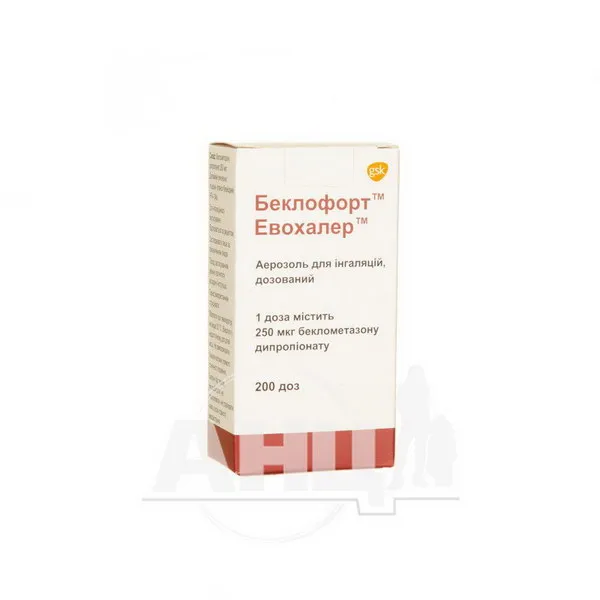
Table of Contents
INSTRUCTIONS FOR MEDICAL USE OF THE MEDICINAL PRODUCT BEOFORTE EVOTALER (BECLOFORTEEVOHALER)
Composition:
Active substance: beclometasone dipropionate;
1 dose of the preparation contains beclometasone dipropionate 250 mcg;
Excipients: HFA-134a, anhydrous ethanol, glycerol.
Pharmaceutical form. Metered dose inhalation aerosol.
Main physicochemical properties: clear, colorless solution.
Pharmacotherapeutic group. Medicinal products for the treatment of obstructive respiratory diseases administered by inhalation. Glucocorticoids.
ATC code R03BA01.
Pharmacological properties.
Pharmacodynamics.
Beclometasone dipropionate is a prodrug with low affinity for glucocorticoid receptors. It is hydrolyzed by esterases to form the active metabolite, beclometasone-17-monopropionate, which has high local anti-inflammatory activity.
Pharmacokinetics.
Following inhaled administration, systemic absorption of unchanged beclometasone dipropionate occurs via the lungs, with minimal oral absorption of the fraction deposited in the gastrointestinal tract. Prior to absorption, beclometasone dipropionate undergoes extensive conversion to its active metabolite, beclometasone-17-monopropionate. Systemic absorption of beclometasone-17-monopropionate results from uptake both in the lungs and the gastrointestinal tract. The absolute bioavailability after inhaled administration is approximately 60% of the administered dose for beclometasone-17-monopropionate.
Beclometasone dipropionate is rapidly eliminated from systemic circulation by metabolism involving esterases. The main metabolite is the active compound, beclometasone-17-monopropionate.
The volume of distribution of beclometasone dipropionate at steady state is moderate (20 L), whereas that of beclometasone-17-monopropionate is higher (424 L). Plasma protein binding is moderately high (87%).
Beclometasone dipropionate and beclometasone-17-monopropionate have high plasma clearance (150 and 120 L/h, respectively), with elimination half-lives of 0.5 hours and 2.7 hours, respectively. Approximately 60% of the dose is excreted in feces and 12% in urine as free and conjugated polar metabolites. Renal clearance of beclometasone dipropionate and its metabolites is negligible.
Clinical characteristics.
Indications.
Treatment of severe asthma in adults, as well as treatment of patients requiring systemic corticosteroids for adequate control of bronchial asthma symptoms.
Contraindications.
Hypersensitivity to any component of the medicinal product.
Interaction with other medicinal products and other forms of interactions.
Beclometasone is less dependent on CYP3A metabolism than some other corticosteroids, and interactions are generally unlikely; however, there is a potential for systemic adverse effects when used concomitantly with strong CYP3A inhibitors (e.g., ritonavir, cobicistat). In such cases, appropriate patient monitoring should be performed.
Beclomethasone Evohaler contains a very small amount of ethanol; therefore, theoretically, an interaction may occur in patients with increased sensitivity when used concomitantly with disulfiram or metronidazole.
Special precautions for use.
Treatment of bronchial asthma should be carried out according to the recommendations for the management of bronchial asthma. The patient's condition must be monitored regularly both clinically and by assessing pulmonary function tests.
An increased frequency of using short-acting inhaled β2-agonists indicates a progressive loss of asthma control. In such cases, therapy should be reviewed. Sudden and progressive worsening of asthma control is life-threatening; therefore, the possibility of increasing the dose of corticosteroids should be considered. Patients at risk should perform daily peak flow monitoring.
Beclomethasone Evohaler is not intended for the relief of acute asthma attacks but for long-term maintenance therapy. For symptomatic relief during acute asthmatic episodes, fast- and short-acting inhaled bronchodilators should be used.
The inhalation technique should be checked in each patient to ensure that aerosol activation is synchronized with inhalation for optimal drug delivery to the lungs.
Lack of response to treatment or severe asthma exacerbation should be managed by increasing the dose of Beclomethasone Evohaler and, if necessary, by administering systemic corticosteroids and/or antibiotics in case of infection.
When inhaled corticosteroids are used, especially at high doses and for prolonged periods, systemic effects may occur, although significantly less than with oral corticosteroids. Systemic effects may manifest as Cushing's syndrome, cushingoid features, adrenal suppression, growth retardation in children and adolescents, decreased bone mineralization, cataract, and glaucoma, as well as less frequently, various physiological and behavioral effects including psychomotor hyperactivity, sleep disturbances, restlessness, depression, or aggression (particularly in children). Therefore, it is important that the dose of inhaled corticosteroids be reduced to the lowest possible level that maintains effective control of asthma symptoms (see section "Adverse reactions").
Regular monitoring of growth in children receiving long-term treatment with inhaled corticosteroids is recommended.
Individual hypersensitivity to inhaled corticosteroids may occur.
Due to the potential for adrenal suppression, switching patients from oral corticosteroids to Beclomethasone Evohaler requires special attention and continuous monitoring of adrenal function.
The transition to Beclomethasone Evohaler and discontinuation of systemic therapy should be gradual. The patient should be warned about the need for additional systemic steroid administration during periods of stress, such as severe asthma attack, serious intercurrent illness, surgery, or trauma.
Similarly, replacing systemic corticosteroid therapy with inhaled therapy may occasionally unmask allergic conditions previously controlled by systemic steroids, such as allergic rhinitis or eczema. These allergic manifestations should be treated with antihistamines and/or topical agents, including topical corticosteroids.
Treatment with Beclomethasone Evohaler must not be stopped abruptly.
As with other inhaled corticosteroids, Beclomethasone Evohaler should be administered with particular caution in patients with active or latent pulmonary tuberculosis.
As with other inhaled medications, paradoxical bronchospasm with rapidly increasing shortness of breath after inhalation may occur. In such cases, rapid-acting inhaled bronchodilators should be administered immediately, inhalation of Beclomethasone Evohaler should be discontinued, the patient should be evaluated, and alternative therapy should be initiated if necessary.
Visual disturbances
Visual disturbances may occur with both systemic and local administration of corticosteroids. If a patient develops symptoms such as blurred vision or other visual disturbances, they should be referred to an ophthalmologist for evaluation of possible causes, which may include cataract, glaucoma, or rare conditions such as central serous chorioretinopathy, which has been reported after systemic and local corticosteroid use.
Patients should be informed that the product contains a small amount of ethanol and glycerin. In therapeutic doses, the amounts of ethanol and glycerin are extremely low and pose no risk to patients.
Use during pregnancy or breastfeeding.
Pregnancy
There is insufficient evidence regarding the safety of beclomethasone dipropionate or the propellant HFA-134a in pregnant women. Reproductive studies in animals using beclomethasone dipropionate showed adverse effects typical of potent corticosteroids only at high levels of systemic exposure; direct inhalation provides minimal systemic exposure. Studies on the effects of the propellant HFA-134a on reproductive function and fetal development in animals did not reveal any clinically significant adverse effects. No clinically significant adverse effects have been associated with HFA-134a. Therefore, the occurrence of any adverse effects in humans is unlikely. Medication should be used during pregnancy only if the expected benefit to the mother outweighs any potential risk to the fetus.
Breastfeeding
Studies on the excretion of beclomethasone dipropionate into milk in animals have not been conducted. It may be assumed that beclomethasone dipropionate is excreted into breast milk; however, at the doses used for inhalation, the potential for significant levels in breast milk is low. Beclomethasone dipropionate should be used during breastfeeding only if the expected benefit to the mother exceeds the potential risk to the newborn/infant.
Ability to affect reaction speed when driving or operating machinery.
Beclomethasone Evohaler has no effect or a negligible effect on the ability to drive a vehicle or operate machinery.
Method of Administration and Dosage
Beclofort Evohaler is for oral inhalation only.
Patients must be informed about the prophylactic nature of beclometasone dipropionate therapy and that treatment must be regular, even in the absence of asthma symptoms.
Dosage should be adjusted according to individual response.
If improvement after using short-acting bronchodilators becomes less effective or a higher number of inhalations than usual is required, the treatment regimen should be reviewed.
Patients who have difficulty coordinating breathing with inhaler use are recommended to use a spacer device to facilitate inhalation of inhaled medications.
The initial dose should correspond to the severity of the disease. For patients requiring a high dose of inhaled corticosteroid, the initial dose should be 1000 mcg per day. The dose may then be adjusted to achieve control of asthma symptoms or reduced to the lowest effective dose, depending on individual patient response.
Patients aged 12 years and older (including elderly patients)
1000 mcg per day; the dose may be increased to 2000 mcg per day. After stabilization of the patient's condition, the dose may be reduced. The total daily dose can be administered in two, three, or four divided doses.
To achieve optimal results, Beclofort Evohaler must be used regularly, even in the absence of symptoms.
As with other inhaled medications, therapeutic effect may decrease if the canister becomes cold. The canister must not be broken, punctured, or burned, even when empty.
Before first use or after an interval of 3 or more days without use, remove the mouthpiece cap by gently pressing the sides, shake the inhaler well, and release one puff into the air to ensure proper functioning.
Instructions for Using the Inhaler
- Remove the mouthpiece cap by gently pressing the sides.
- Ensure that there are no foreign objects inside or outside the inhaler, including the mouthpiece.
- Shake the inhaler thoroughly to remove any foreign objects and to evenly mix the contents.
- Hold the inhaler vertically with the index finger on top of the canister above the mouthpiece and the other fingers supporting the bottom of the device.
- Breathe out fully, then place the mouthpiece in the mouth between the teeth and seal the lips around it without biting.
- Begin to inhale slowly and deeply through the mouth, and at the same time press down on the top of the canister to release the medication, continuing to inhale slowly and deeply (this releases one dose of aerosol).
- Remove the inhaler from the mouth, take the finger off the canister, and hold the breath for as long as possible.
- If additional puffs are needed, wait approximately 30 seconds, keeping the inhaler upright, then repeat steps 3–7.
- Replace the mouthpiece cap, pressing gently until a click is heard.
IMPORTANT:
Perform steps 5, 6, and 7 without rushing. It is important to inhale as slowly as possible just before actuating the inhaler. For the first few times, practice in front of a mirror. If a "mist" appears at the top of the inhaler or around the sides of the mouth, restart the procedure from step 2.
If the physician has provided different instructions for using the inhaler, follow those instructions and consult the physician in case of any difficulties.
Cleaning
Cleaning of the inhaler is generally not required, but if necessary, follow the recommendations below:
- Remove the metal canister from the plastic inhaler holder and remove the mouthpiece cap.
- Wipe the plastic holder and mouthpiece with a damp cloth.
- Allow to dry in a warm place. Avoid excessive heat.
- Replace the metal canister and mouthpiece cap.
DO NOT PLACE THE METAL CANISTER IN WATER.
Children
Not recommended for children under 12 years of age.
Overdose
When Beclofort Evohaler is used at doses exceeding the recommended levels, temporary suppression of adrenal cortex function may occur. This does not require emergency intervention, as adrenal function will recover within a few days, as confirmed by plasma cortisol levels. However, prolonged use of doses higher than recommended may result in some degree of adrenal suppression. In such cases, adrenal reserve function should be monitored. Treatment with Beclofort Evohaler may continue at doses approved for asthma control.
There is no specific antidote for beclometasone dipropionate overdose. In case of overdose, supportive therapy with appropriate monitoring should be administered as needed. Further management should be based on the clinical condition or according to local guidelines, if available.
Side effects
The following adverse reactions are classified by organ systems according to the frequency of occurrence: very common (≥1/10), common (≥1/100 to <1/10), uncommon (≥1/1,000 to <1/100), rare (≥1/10,000 to <1/1,000), very rare (<1/10,000), including isolated reports, and not known (cannot be estimated from the available data). Data on very common, common, and uncommon adverse reactions are primarily based on clinical trials. Data on rare and very rare adverse reactions are mainly obtained from spontaneous reports.
Infections and infestations
Very common: oral and pharyngeal candidiasis.
Immune system
Hypersensitivity reactions have been reported, including:
- uncommon: skin rash, urticaria, pruritus, erythema;
- very rare: angioedema, respiratory symptoms (dyspnea and/or bronchospasm with increased wheezing, cough), and anaphylactoid/anaphylactic reactions.
Endocrine system
Systemic effects may occur, including (see section "Special warnings and precautions for use"):
very rare: Cushing's syndrome, Cushingoid features, adrenal suppression, growth retardation in children and adolescents, decreased bone mineralization, cataract, and glaucoma.
Psychiatric disorders
Very rare: feelings of anxiety, sleep disorders, depression, aggression, behavioral changes including hyperactivity and agitation (mainly in children).
Respiratory system
Common: hoarseness, throat irritation.
Very rare: paradoxical bronchospasm (see section "Special warnings and precautions for use").
Eye disorders
Not known: visual disturbances (see section "Special warnings and precautions for use").
Shelf life. 2 years.
Storage conditions.
Keep out of the reach and sight of children. Store at a temperature not exceeding 30 °C.
Avoid exposure to direct sunlight. Do not freeze.
After each use, immediately replace the mouthpiece cap, pressing gently until a characteristic click is heard.
The container is under pressure. Do not expose to temperatures above 50 °C.
Packaging. Aerosol container with a metering valve containing 200 doses, in a cardboard package.
Prescription status. Prescription only.
Manufacturer.
Glaxo Wellcome Production, France /
Glaxo Wellcome Production, France.
Manufacturer's address.
Glaxo Wellcome Production, Zone Industrielle №2, 23, rue Lavoisier, 27000 Evreux, France /
Glaxo Wellcome Production, Zone Industrielle №2, 23, rue Lavoisier, 27000 Evreux, France.