Baneocin
Ukraine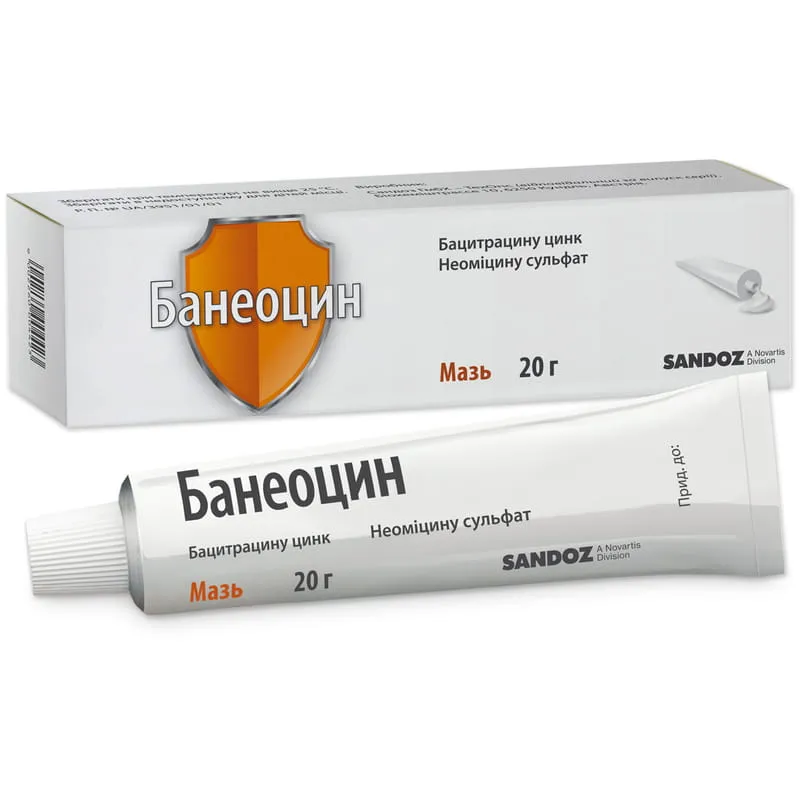
Table of Contents
INSTRUCTIONS FOR MEDICAL USE OF THE MEDICINAL PRODUCT BANEOCIN (BANEOCIN®)
Composition:
Active ingredients: 1 g of ointment contains bacitracin zinc 250 IU, neomycin sulfate 5000 IU;
Excipients: lanolin, white soft paraffin.
Pharmaceutical form. Ointment.
Main physicochemical properties: yellowish homogeneous ointment with a slight characteristic odor.
Pharmacotherapeutic group.
Antibiotics for topical use. ATC code D06AX.
Pharmacological Properties.
Pharmacodynamics.
Baneocin is a combined antibacterial preparation for topical use, containing two bactericidal antibiotics with synergistic action. Bacitracin is a polypeptide antibiotic active mainly against gram-positive microorganisms such as hemolytic streptococcus, staphylococcus, Clostridium spp., Corynebacterium diphtheriae, Treponema pallidum, as well as against some gram-negative pathogens such as Neisseria spp. and Haemophilus influenzae. The spectrum of activity also includes actinomycetes and fusobacteria. Bacitracin-resistant strains are rarely observed.
Neomycin is active against both gram-positive and gram-negative microorganisms, including staphylococci, Proteus, Enterobacter aerogenes, Klebsiella pneumoniae, Salmonella, Shigella, Haemophilus influenzae, Pasteurella, Neisseria meningitidis, Vibrio cholerae, Bordetella pertussis, Bacillus anthracis, Corynebacterium diphtheriae, Streptococcus faecalis, Listeria monocytogenes, Escherichia coli, Mycobacterium tuberculosis, Borrelia, and Leptospira icterohaemorrhagiae.
The combined use of bacitracin and neomycin provides a broad antimicrobial spectrum; however, the preparation is inactive against Pseudomonas, Nocardia spp., fungi, and viruses.
Bacitracin and neomycin are generally not intended for systemic administration. Topical application of the ointment significantly reduces the risk of sensitization associated with systemic antibiotic use.
Pharmacokinetics.
Since absorption of bacitracin and neomycin through damaged skin is minimal, maximum drug concentration is achieved at the site of application. Tissue tolerance is considered excellent, with no observed inactivation by biological products, blood, or tissue components. However, when applying the preparation to large areas of damaged skin, potential absorption and its consequences should be considered (see sections "Side Effects", "Special Warnings").
When used correctly, Baneocin ointment exerts local action at the site of application. If absorption of active ingredients occurs, the serum half-life of neomycin and bacitracin is approximately 2–3 hours.
Bacitracin is minimally absorbed through mucous membranes and intact skin. However, absorption through skin with open wounds may occur.
Neomycin is minimally absorbed through intact skin. However, through inflamed or damaged skin, or in the absence of a keratinized layer (ulcers, wounds, burns), neomycin is rapidly absorbed.
Clinical characteristics.
Indications.
Local treatment and prevention of bacterial skin infections caused by microorganisms sensitive to the drug:
- furuncles, carbuncles (after surgical intervention), abscesses (after incision), sycosis, including deep sycosis in the beard area, hidradenitis suppurativa, pseudofurunculosis, paronychia;
- limited bacterial skin infections, including contagious impetigo, infected varicose ulcers, secondary infections in eczema, infections following burns, after cosmetic surgery and skin grafting (also for prophylactic purposes and when dressings are used);
- as adjunctive therapy in the treatment of infected wounds (e.g., in external otitis, secondary infection of surgical scars).
Contraindications.
Hypersensitivity to the components of the drug or to other aminoglycoside antibiotics.
Significant and severe skin lesions (possible resorption of the drug with development of ototoxic effects leading to hearing loss).
The drug should not be used in patients with severe cardiogenic or nephrogenic excretory disorders, or with a history of vestibular or cochlear impairment, when uncontrolled absorption of the drug is possible. Do not apply into the external auditory canal in cases of perforated tympanic membrane.
Do not apply near the eyes.
Interaction with other medicinal products and other forms of interaction.
If systemic absorption occurs, concomitant use of cephalosporins or aminoglycoside antibiotics increases the risk of nephrotoxic reactions.
Concomitant use of diuretics such as ethacrynic acid or furosemide may enhance signs of ototoxicity or nephrotoxicity.
In case of systemic absorption, concurrent use with opioid analgesics, analgesic agents, or muscle relaxants increases the risk of neuromuscular conduction disturbances.
Usage Notes.
When using the drug in patients with extensive skin lesions, one should consider the possibility of absorption of the active components of the drug and, consequently, the development of ototoxic and/or nephrotoxic effects. Since the risk of toxic effects increases in patients with pronounced liver and/or kidney impairment, such patients should have urine and blood parameters monitored, and audiometric tests performed before and during intensive treatment with Baneocin.
Precautionary measures should be observed when using the drug long-term in patients with chronic otitis media due to the potential ototoxic effect.
Combinations of systemic and topical aminoglycosides should be avoided due to the risk of cumulative toxicity.
If uncontrolled absorption of Baneocin occurs, the possibility of neuromuscular blockade should be considered, especially in patients with acidosis, a history of severe myasthenia (Myasthenia gravis), or other neuromuscular disorders. Neuromuscular blockade can be reversed by calcium salts or proserin (neostigmine).
With prolonged treatment, overgrowth of resistant microorganisms and fungi may occur. In such cases, appropriate therapy should be initiated.
The drug should be discontinued in patients who develop allergy or superinfection.
Phototoxic reactions or photosensitization may occur upon exposure to sunlight or UV radiation.
The ointment contains lanolin as an excipient, which may cause local skin reactions (e.g., contact dermatitis).
Use during pregnancy or breastfeeding.
If there is a risk of absorption of active substances during pregnancy or breastfeeding, the ointment should be used only if, in the physician's opinion, the expected benefit to the mother outweighs the potential risk to the fetus or infant. Like other aminoglycoside antibiotics, neomycin crosses the placental barrier. There have been reports of hearing impairment in the fetus following systemic administration of high doses of aminoglycosides.
Before breastfeeding, any residual drug should be removed from the mammary gland using boiled water and sterile cotton.
Ability to influence reaction rate while driving or operating machinery.
Unknown.
Method of Administration and Dosage.
For adults and children, Baneocin ointment should usually be applied 2–3 times daily for 7 days.
When applied locally for longer than 7 days, the dose of neomycin should not exceed 1 g per day (equivalent to 200 g of ointment). For repeated courses, the maximum dose should be halved.
A small amount of ointment should be applied to the affected area and gently rubbed in. If necessary, after applying the medication to the affected area, a gauze dressing may be applied.
Children.
There is insufficient data on the safety of using the drug in this pharmaceutical form in young children; therefore, use in children is possible only upon a physician's prescription following careful assessment of the benefit-risk ratio.
Overdose.
With doses significantly exceeding the recommended ones, due to possible absorption of the active ingredients, symptoms indicating nephro- and/or ototoxic reactions should be considered, especially in patients with trophic ulcers.
Treatment: symptomatic therapy.
Adverse reactions.
The frequency of adverse reactions is defined as follows: very common (≥ 1/10), common (≥ 1/100, < 1/10), uncommon (≥ 1/1,000, < 1/100), rare (≥ 1/10,000, < 1/1,000), very rare (< 1/10,000), frequency not known (cannot be estimated from the available data).
Generally, the medicinal product is well tolerated when applied topically.
Immune system disorders: rare – in cases of allergic reactions to neomycin, cross-allergy to other aminoglycoside antibiotics may occur in approximately 50% of cases; frequency not known – hypersensitivity to neomycin and many other substances may occur when the product is used in chronic dermatoses or chronic otitis media. Under certain circumstances, allergy may manifest as lack of successful wound healing.
Nervous system disorders: not known – vestibular nerve damage, neuromuscular blockade.
Ear and labyrinth disorders: frequency not known – ototoxicity.
Skin and subcutaneous tissue disorders: rare – allergic reactions, mainly presenting as contact dermatitis. Allergic reactions caused by neomycin occur less frequently than generally assumed; frequency not known – prolonged use may lead to allergic reactions such as redness, dryness and desquamation of the skin, rash, pruritus. Extension of lesions or lack of wound healing may be due to allergy. Photosensitization or phototoxic reactions cannot be ruled out upon exposure to sunlight or ultraviolet radiation.
Renal and urinary disorders: frequency not known – nephrotoxicity.
Shelf life. 3 years.
Storage conditions.
Store at a temperature not exceeding 25 °C.
Keep out of the reach of children.
Packaging.
5 g or 20 g of ointment in a tube; 1 tube per cardboard box.
Availability. Over-the-counter.
Manufacturer.
Sandoz GmbH – Production Unit Anti-Infectives GMP and Chemical Operations Kundl (AIG Kundl) (responsible for batch release).
Manufacturer's address.
Biochemiestrasse 10, 6250 Kundl, Austria.
Or
Manufacturer.
Lek Pharmaceuticals d.d., Slovenia (responsible for batch release).
Manufacturer's address.
Verovškova 57, 1526 Ljubljana, Slovenia.