Baldosil
Ukraine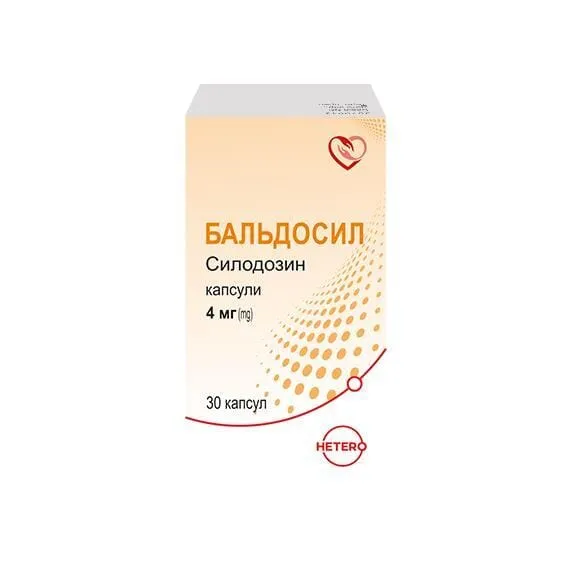
Table of Contents
INSTRUCTIONS FOR MEDICAL USE OF THE MEDICINAL PRODUCT BOLDOSIL (BALDOSIL)
Composition:
Active substance: silodosin;
1 capsule contains 4 mg of silodosin;
Excipients: sorbitol, pregelatinized starch, sodium stearyl fumarate; capsule shell: gelatin, purified water, titanium dioxide (E 171), black ink.
Pharmaceutical form. Capsules.
Main physicochemical properties: hard gelatin capsules of size "3" with a white body and a white cap, marked with black ink "H" on the cap and "S1" on the body, filled with white or almost white powder.
Pharmacotherapeutic group. α-Adrenoreceptor antagonists. Silodosin.
ATC code G04CA04.
Pharmacological properties.
Pharmacodynamics.
Mechanism of action. Silodosin is a selective antagonist of postsynaptic alpha-1-adrenoceptors, which are predominantly located in the prostate gland, bladder base, bladder neck, prostate capsule, and prostatic urethra. Blockade of these alpha-1-adrenoceptors leads to relaxation of smooth muscles in these tissues, thereby improving urinary flow and reducing symptoms of benign prostatic hyperplasia (BPH).
An in vitro study evaluating the binding affinity of silodosin for three alpha-1-adrenoceptor subtypes (alpha-1A, alpha-1B, and alpha-1D) demonstrated that silodosin binds with high affinity to the alpha-1A subtype.
In clinical studies, administration of silodosin in patients did not result in a significant reduction in supine arterial blood pressure.
Silodosin at doses of 8 mg and 24 mg daily, compared to placebo, has no statistically significant effect on ECG intervals or cardiac repolarization.
Pharmacokinetics.
Pharmacokinetic characteristics of silodosin were evaluated in adult male patients, healthy or with BPH, after single and/or multiple oral doses ranging from 0.1 mg to 24 mg daily. Within this dose range, the pharmacokinetic characteristics of silodosin change linearly.
Absorption
Silodosin is well absorbed following oral administration, with absorption proportional to the administered dose. After a single 8 mg daily dose, maximum plasma concentration (Cmax) of silodosin was 61.6 ± 27.54 ng/mL; mean time to reach Cmax (tmax) in plasma was 2.6 hours; elimination half-life (t1/2) was 13.3 ± 8.07 hours. Absolute bioavailability of the drug is approximately 32%.
Effect of food
The maximum effect of food (i.e., co-administration with a high-calorie, high-fat meal) on silodosin pharmacokinetics has not been evaluated. The effect of a meal with moderate fat content and medium caloric value was variable, reducing Cmax of silodosin by approximately 18–43% and AUC by 4–49% across three different studies. In a study assessing relative bioavailability of the contents of an 8 mg silodosin capsule sprinkled onto applesauce compared to administration of the intact capsule, bioequivalence of silodosin was demonstrated based on AUC0–24 and Cmax.
Distribution
The apparent volume of distribution of silodosin is 49.5 L, and it is approximately 97% bound to plasma proteins.
Metabolism
Silodosin undergoes extensive metabolism via glucuronidation, alcohol and aldehyde dehydrogenase, and cytochrome P450 3A4 (CYP3A4). The main metabolite of silodosin is the glucuronide conjugate (KMD-3213G), formed by direct conjugation of silodosin via UDP-glucuronosyltransferase 2B7 (UGT2B7). Concomitant use with inhibitors of UGT2B7 (e.g., probenecid, valproic acid, fluconazole) may potentially increase the effects of silodosin. KMD-3213G, which has shown activity in vitro, has an extended elimination half-life (approximately 24 hours) and reaches plasma concentrations (AUC) about four times higher than silodosin. A second major metabolite (KMD-3293) is formed via alcohol and aldehyde dehydrogenase and reaches plasma concentrations similar to silodosin. KMD-3293 is not expected to significantly contribute to the overall pharmacological activity of silodosin.
Excretion
Ten days after oral administration of radiolabeled (14C) silodosin, approximately 33.5% of the radioactive label was recovered in urine and 54.9% in feces. After intravenous administration, plasma clearance of silodosin was approximately 10 L/h.
Special patient groups
Race. No specific clinical studies investigating the effect of race have been conducted.
Elderly patients. In a study comparing elderly men (mean age 69 years) and young men (mean age 24 years), exposure (AUC) and elimination half-life of silodosin were approximately 15% and 20% higher, respectively, in elderly patients compared to younger ones. No differences in Cmax of silodosin were observed. In another study, no significant differences in safety or efficacy were observed between elderly and younger patients.
Children. The effect of silodosin has not been evaluated in patients under 18 years of age.
Renal impairment. In a study involving patients with moderate renal impairment, total AUC, Cmax, and elimination half-life of silodosin (bound and unbound) were 3.2, 3.1, and 2 times higher, respectively, compared to subjects with normal renal function. AUC and Cmax of unbound silodosin were 2.0 and 1.5 times higher, respectively, in subjects with moderate renal impairment compared to those with normal renal function.
In controlled and uncontrolled clinical studies, the incidence of orthostatic hypotension and dizziness was higher in subjects with moderate renal impairment receiving 8 mg silodosin daily than in those with normal or mildly impaired renal function.
Hepatic impairment. In a study comparing patients with moderate hepatic impairment (Child-Pugh score 7 to 9) to healthy subjects, the pharmacokinetic profile of silodosin after single-dose administration was not significantly altered in patients with moderate hepatic impairment. Dose adjustment is not required in patients with mild or moderate hepatic impairment. The pharmacokinetics of silodosin in patients with severe hepatic impairment have not been studied.
Drug interactions
Cytochrome P450 (CYP) 3A4 inhibitors. Two clinical drug interaction studies were conducted in which a single oral dose of silodosin was administered together with the strong CYP3A4 inhibitor ketoconazole at doses of 400 mg and 200 mg once daily for 4 days, respectively. Concomitant administration of 8 mg silodosin with 400 mg ketoconazole resulted in a 3.8-fold increase in Cmax and a 3.2-fold increase in AUC of silodosin. Concomitant administration of 4 mg silodosin with 200 mg ketoconazole caused a similar increase: 3.7-fold in Cmax and 2.9-fold in AUC. Silodosin is contraindicated with strong CYP3A4 inhibitors.
The effect of moderate CYP3A4 inhibitors on silodosin pharmacokinetics has not been evaluated.
Due to the potential for increased silodosin exposure, caution should be exercised when co-administering silodosin with moderate CYP3A4 inhibitors, especially those that also inhibit P-glycoprotein (P-gp) (e.g., verapamil, erythromycin).
P-glycoprotein (P-gp) inhibitors. In vitro studies have shown that silodosin is a substrate of P-gp. A drug interaction study with a strong P-gp inhibitor has not been conducted. However, in drug interaction studies with ketoconazole, a CYP3A4 inhibitor that also inhibits P-gp, a significant increase in silodosin exposure was observed. Inhibition of P-gp may lead to increased silodosin concentrations. Silodosin is not recommended in patients taking strong P-gp inhibitors (e.g., cyclosporine).
Digoxin. The effect of silodosin on digoxin pharmacokinetics was evaluated in a multiple-dose study. No significant differences in AUC or Cmax of digoxin were observed when digoxin was administered alone or concomitantly with silodosin.
Other metabolic enzymes and transporters. In vitro studies showed that silodosin does not inhibit the activity of CYP1A2, CYP2A6, CYP2C9, CYP2C19, CYP2D6, CYP2E1, or CYP3A4, nor does it induce the activity of CYP1A2, CYP2C8, CYP2C9, CYP2C19, CYP3A4, or P-gp.
Clinical characteristics.
Indications. For the symptomatic treatment of benign prostatic hyperplasia (BPH).
Contraindications.
Hypersensitivity to silodosin or to any of the excipients of the medicinal product.
Severe renal impairment (creatinine clearance [CrCl] < 30 mL/min).
Severe hepatic impairment (Child–Pugh score > 10).
Concomitant use with strong cytochrome P450 3A4 (CYP3A4) inhibitors (e.g., ketoconazole, clarithromycin, itraconazole, ritonavir).
Interaction with other medicinal products and other forms of interaction.
Moderate and strong CYP3A4 inhibitors
In a clinical inhibition study, co-administration with the strong CYP3A4 inhibitor ketoconazole (400 mg) resulted in a 3.8-fold increase in maximum plasma concentration (Cmax) and a 3.2-fold increase in exposure (AUC) of silodosin. Concomitant use of strong CYP3A4 inhibitors such as itraconazole or ritonavir may increase silodosin plasma concentrations. Concomitant administration of silodosin with strong CYP3A4 inhibitors is contraindicated (see sections "Contraindications", "Special precautions for use").
The effect of moderate CYP3A4 inhibitors on the pharmacokinetics of silodosin has not been evaluated. Concomitant use with moderate CYP3A4 inhibitors (e.g., diltiazem, erythromycin, verapamil) may increase silodosin concentrations. Caution and monitoring for adverse effects are required when silodosin is used concomitantly with moderate CYP3A4 inhibitors.
Strong P-glycoprotein (P-gp) inhibitors
In vitro studies have shown that silodosin is a substrate of P-gp. Ketoconazole, a CYP3A4 inhibitor that also inhibits P-gp, caused a significant increase in silodosin exposure. Inhibition of P-gp may lead to increased silodosin concentrations. Therefore, Baldosil is not recommended in patients taking strong P-gp inhibitors such as cyclosporine.
Alpha-blockers
Pharmacodynamic interaction between silodosin and other alpha-blockers has not been established. However, interactions may be expected; therefore, Baldosil should not be used in combination with other alpha-blockers (see section "Special precautions for use").
Digoxin
The effect of concomitant administration of silodosin and digoxin 0.25 mg/day for 7 days was evaluated in a clinical study. Concomitant use of silodosin and digoxin did not significantly alter the steady-state pharmacokinetics of digoxin. Dose adjustment is not required.
Phosphodiesterase type 5 inhibitors (PDE-5)
Concomitant administration of silodosin with a single dose of 100 mg sildenafil or 20 mg tadalafil was evaluated in a clinical study. Orthostatic vital signs were monitored for 12 hours after co-administration. During this period, the total number of positive orthostatic test results was higher in the group receiving silodosin and a PDE-5 inhibitor compared to silodosin alone. No cases of symptomatic orthostasis or dizziness were reported in patients receiving silodosin with a PDE-5 inhibitor.
Antihypertensive agents
Pharmacodynamic interactions between silodosin and antihypertensive agents have not been thoroughly studied in clinical trials. However, approximately one-third of patients in clinical studies received concomitant antihypertensive medications with silodosin. The incidence of dizziness and orthostatic hypotension in these patients was higher than in patients receiving silodosin alone (4.6% vs. 3.8% and 3.4% vs. 3.2%, respectively). Caution is required when using silodosin concomitantly with antihypertensive agents, and patients should be monitored for possible adverse effects (see section "Special precautions for use").
Metabolic interactions
In vitro data indicate that silodosin is not capable of inhibiting or inducing cytochrome P450 enzyme systems.
Food interactions
The effect of a moderate-fat, moderate-calorie meal on the pharmacokinetics of silodosin was variable, reducing maximum plasma concentration (Cmax) by approximately 18–43% and exposure (AUC) by 4–49% across three different studies. Clinical safety and efficacy trials of silodosin were consistently conducted under fed conditions. Patients should be instructed to take silodosin with food to minimize the risk of adverse effects (see section "Pharmacological properties").
Special precautions for use.
Orthostatic phenomena
Postural hypotension, with or without symptoms (e.g., dizziness), may occur at the beginning of silodosin treatment. As with other alpha-blockers, there is a possibility of syncope. Patients should be warned about the risk of driving, operating machinery, or performing hazardous tasks at the beginning of therapy (see section "Adverse reactions").
Renal impairment
In a clinical pharmacological study, plasma concentrations of silodosin (AUC and Cmax) were approximately three times higher in subjects with moderate renal impairment compared to those with normal renal function, while the elimination half-life of silodosin was doubled. The dose of Baldozil should be reduced to 4 mg in patients with moderate renal impairment. Caution and monitoring for adverse effects are required in such patients (see section "Pharmacological properties").
The effect of silodosin has not been studied in patients with severe renal impairment. Baldozil is contraindicated in patients with severe renal impairment (see section "Contraindications").
Hepatic impairment
In a study comparing patients with moderate hepatic impairment (Child-Pugh score of 7 to 9) to healthy subjects, the pharmacokinetics of a single dose of silodosin were not significantly altered in patients with hepatic impairment. Dose adjustment is not required in patients with mild or moderate hepatic impairment. The effect of silodosin has not been studied in patients with severe hepatic impairment; therefore, it should not be administered to such patients (see sections "Contraindications", "Pharmacological properties"). Baldozil is contraindicated in patients with severe hepatic impairment.
Pharmacokinetic interactions
In a drug interaction study, concomitant administration of a single 8 mg dose of silodosin with 400 mg of ketoconazole, a strong CYP3A4 inhibitor, resulted in a 3.8-fold increase in maximum plasma concentration of silodosin and a 3.2-fold increase in silodosin exposure (i.e., AUC). Therefore, concomitant use of ketoconazole or other strong CYP3A4 inhibitors (e.g., itraconazole, clarithromycin, ritonavir) is contraindicated (see section "Interaction with other medicinal products and other forms of interaction").
Pharmacodynamic interactions
The pharmacodynamic interaction between silodosin and other alpha-blockers has not been established. However, interaction may be expected, and Baldozil should not be used in combination with other alpha-blockers (see section "Interaction with other medicinal products and other forms of interaction").
A specific pharmacodynamic interaction study between silodosin and antihypertensive agents has not been conducted. In patients receiving concomitant antihypertensive therapy with silodosin, no significant increase in the frequency of syncope, dizziness, or orthostasis was observed. However, caution is required when used concomitantly with antihypertensive agents, and patients should be monitored for possible adverse effects (see sections "Adverse reactions", "Interaction with other medicinal products and other forms of interaction").
Caution is also recommended when co-administering alpha-adrenoblockers, including silodosin, with PDE-5 inhibitors. Alpha-adrenoblockers and PDE-5 inhibitors are vasodilators that may lower blood pressure. Concomitant use of these two drug classes may potentially lead to symptomatic hypotension (see section "Interaction with other medicinal products and other forms of interaction").
Prostate carcinoma
Since BPH and prostate carcinoma present with similar symptoms and both conditions may coexist, prostate carcinoma should be ruled out before initiating treatment with Baldozil for BPH.
Intraoperative floppy iris syndrome (IFIS)
Intraoperative floppy iris syndrome has been observed during cataract surgery in some patients who were taking or had previously taken alpha-1-blockers. This variant of the small pupil syndrome is characterized by a combination of a flaccid iris that billows in response to intraoperative irrigation currents, progressive intraoperative miosis despite preoperative dilation with standard mydriatics, and potential iris prolapse toward phacoemulsification incisions. Patients who are planning cataract surgery should inform their ophthalmologist that they are taking Baldozil (see section "Adverse reactions").
Laboratory interactions
No laboratory interactions were observed during clinical trials. Treatment with silodosin for 52 weeks had no significant effect on prostate-specific antigen (PSA) levels.
Use during pregnancy or breastfeeding.
Silodosin is intended only for use in male patients.
Ability to influence the speed of reactions when driving or operating machinery.
Postural hypotension, with or without symptoms (e.g., dizziness), may occur at the beginning of silodosin treatment. As with other alpha-blockers, there is a possibility of syncope. Patients should be warned about the risk of driving, operating machinery, or performing hazardous tasks at the beginning of therapy.
Method of Administration and Dosage
Dosage
The recommended dose is 8 mg (two 4 mg capsules) orally once daily with food.
For certain patient groups, the recommended dose is 4 mg (one capsule) of Baldozil once daily (see below).
Patients with renal impairment. Baldozil is contraindicated in patients with severe renal impairment (CLcr < 30 mL/min). In patients with moderate renal impairment (CLcr 30–50 mL/min), the dose should be reduced to 4 mg once daily with food. No dose adjustment is required in patients with mild renal impairment (CLcr 50–80 mL/min) (see sections "Contraindications", "Special Warnings and Precautions for Use", "Pharmacological Properties").
Patients with hepatic impairment. Since there is no clinical experience with the use of the drug in patients with severe hepatic impairment (Child–Pugh score > 10), Baldozil is contraindicated in such patients. No dose adjustment is required in patients with mild or moderate hepatic impairment (see sections "Contraindications", "Special Warnings and Precautions for Use", "Pharmacological Properties").
Elderly patients. Dose adjustment in elderly patients is not required (see section "Pharmacological Properties").
Method of Administration
For oral use.
Patients who have difficulty swallowing tablets or capsules may carefully open the Baldozil capsule and empty the powder onto a tablespoon of apple puree. The apple puree should be swallowed immediately (within 5 minutes) without chewing, followed by a glass of cool water to ensure complete swallowing of the powder. The apple puree must not be hot and should be soft enough to be swallowed without chewing. The mixture of powder and apple puree should be used immediately (within 5 minutes) and must not be stored for later use. Splitting the contents of the Baldozil capsule is not recommended (see section "Pharmacological Properties").
Children. Not to be used in pediatric practice.
Overdose.
The effect of silodosin was evaluated in doses up to 48 mg/day administered to healthy male volunteers. The dose-limiting adverse reaction was postural hypotension.
If silodosin overdose results in hypotension, cardiovascular support is the primary treatment. Normalization of blood pressure and heart rate may be achieved by maintaining the patient in a supine position. If this measure is inadequate, intravenous fluid administration should be considered. Vasopressors may be used if necessary, and renal function should be monitored and supported as needed. Dialysis is unlikely to be beneficial, as silodosin is highly (97%) protein-bound.
Adverse Reactions
Clinical Trial Experience
Because clinical trials are conducted under widely varying conditions, the adverse reaction rates observed during clinical trials of a drug may not reflect the rates observed in clinical practice.
In clinical studies, patients with BPH received 8 mg of silodosin daily. At least one treatment-emergent adverse reaction was reported in 55.2% of patients receiving silodosin (36.8% of patients receiving placebo). The majority (72.1%) of adverse reactions in patients receiving silodosin (59.8% in patients receiving placebo) were classified as mild. Overall, 6.4% of patients receiving silodosin (2.2% in the placebo group) discontinued treatment due to an adverse reaction (treatment-emergent). The most commonly reported reaction was retrograde ejaculation (2.8%) in patients receiving silodosin. Retrograde ejaculation is reversible upon discontinuation of treatment.
Adverse reactions occurring in at least 2% of patients receiving silodosin and more frequently than in the placebo group: retrograde ejaculation, dizziness, diarrhea, orthostatic hypotension, headache, nasopharyngitis, nasal congestion.
In two other studies, between 1% and 2% of patients receiving silodosin reported the following adverse effects more frequently than in the placebo group: insomnia, increased PSA levels, sinusitis, abdominal pain, asthenia, and rhinorrhea. In the silodosin treatment group, one case of syncope was reported in a patient who was concurrently taking prazosin, and one case of priapism was reported.
One case of intraoperative floppy iris syndrome (IFIS) was reported in an open-label safety study of silodosin.
Postmarketing Experience
The following adverse reactions have been identified during post-approval use of silodosin. Because these reactions are reported voluntarily from a population of uncertain size, it is not always possible to reliably estimate their frequency or establish a causal relationship to drug exposure.
Skin and subcutaneous tissue disorders: toxic rash, purpura, skin rash, pruritus, and urticaria.
Hepatobiliary disorders: jaundice, liver function abnormalities associated with elevated transaminase levels.
Immune system disorders: allergic-type reactions, including skin reactions, as well as tongue swelling and throat swelling leading to serious outcomes.
Reporting of Adverse Reactions
Reporting of adverse reactions after drug registration is highly important. It allows continuous monitoring of the benefit-risk balance of the medicinal product. Healthcare and pharmaceutical professionals, as well as patients or their legal representatives, should report all suspected adverse reactions and lack of efficacy through the Automated Pharmacovigilance Information System at the following link: https://aisf.dec.gov.ua.
Shelf life. 2 years.
Storage conditions. Store in the original packaging at a temperature not exceeding 25 °C, in a place inaccessible to children.
Packaging. 30 capsules in a container, 1 container in a cardboard box.
Prescription category. Prescription only.
Manufacturer. Hetero Labs Limited, India.
Manufacturer's address and location of operations. Unit III, Formulation Plot No 22 - 110 IDA, Jeedimetla, Hyderabad, 500 055 Telangana, India.