Aziter
Ukraine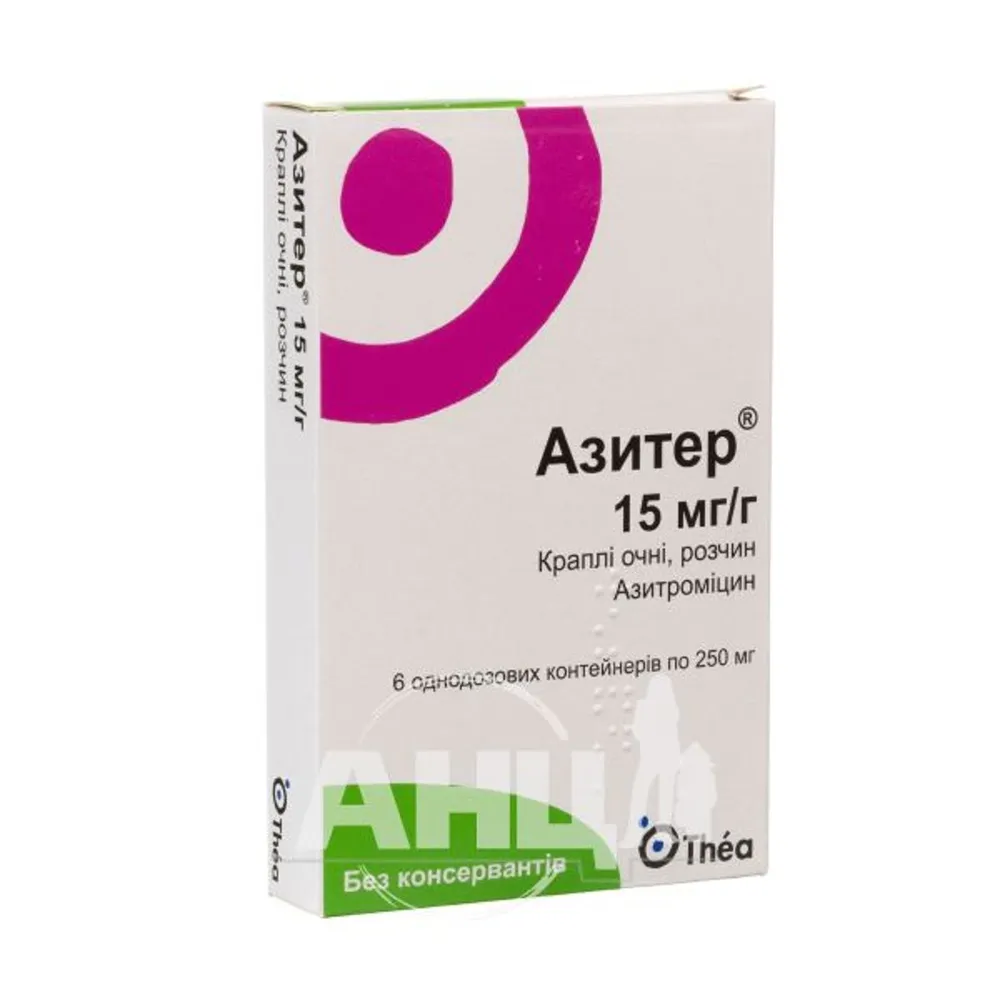
Table of Contents
INSTRUCTIONS FOR MEDICAL USE OF THE MEDICINAL PRODUCT Azyter®
Composition:
Active substance: azithromycin;
1 g of solution contains 15 mg of azithromycin dihydrate, equivalent to 14.3 mg of azithromycin;
1 single-dose container (250 mg of solution) contains 3.75 mg of azithromycin dihydrate;
Excipients: medium-chain triglycerides.
Pharmaceutical form. Eye drops, solution.
Main physicochemical properties: clear, colorless or slightly yellow oily liquid, practically free from foreign particles.
Pharmacotherapeutic group. Ophthalmological medicinal products. Antiinfectives. Antibiotics. ATC Code S01A A26.
Pharmacological properties.
Pharmacodynamics.
Azithromycin is a second-generation macrolide antibiotic belonging to the azalide group.
Mode of action of azithromycin involves inhibition of bacterial protein synthesis by binding to the 50S ribosomal subunit and suppression of peptide translocation.
Mechanism of resistance
Generally, bacterial resistance to macrolides is associated with one of three mechanisms: modification of the target site, antibiotic inactivation, or active antibiotic efflux from the cell. Bacteria possess various efflux systems. In streptococci, efflux is largely controlled by mef genes, leading to limited resistance to macrolides (M phenotype). Target site modification by methylase encoded by the erm gene (MLSB phenotype) may result in cross-resistance to different classes of antibiotics.
Complete cross-resistance between erythromycin, azithromycin, other macrolides, lincosamides and streptogramin B exists among Streptococcus pneumoniae, beta-haemolytic group A streptococci, Enterococcus faecalis, and Staphylococcus aureus, including methicillin-resistant Staphylococcus aureus (MRSA).
Constitutive mutants in inducibly resistant strains with erm(A) or erm(C) can be selected in vitro at low concentrations (~10-7 CFU) in the presence of azithromycin.
Breakpoint concentrations. The minimal inhibitory concentrations (MICs) for microorganisms in relation to the specified indications are presented below (see section "Indications").
It should be noted that the MIC breakpoints and in vitro spectrum of activity listed below apply to systemic use. These MIC values do not apply to topical ocular administration due to the high local concentrations achieved in situ and physicochemical conditions that may influence the overall antibiotic activity at the site of application.
The European Committee on Antimicrobial Susceptibility Testing (EUCAST) has established the following breakpoint concentrations for azithromycin:
- Haemophilus influenzae: susceptible ≤ 0.12 mg/L, resistant > 4 mg/L;
- Moraxella catarrhalis: susceptible ≤ 0.5 mg/L, resistant > 0.5 mg/L;
- Neisseria gonorrhoeae: susceptible ≤ 0.25 mg/L, resistant > 0.5 mg/L;
- Staphylococcus spp*: susceptible ≤ 1.0 mg/L, resistant > 2.0 mg/L;
- Streptococcus pneumoniae: susceptible ≤ 0.25 mg/L, resistant > 0.5 mg/L;
- Streptococcus A, B, C, G: susceptible ≤ 0.25 mg/L, resistant > 0.5 mg/L.
* spp includes all species within the genus.
EUCAST states that erythromycin may be used to determine susceptibility to azithromycin for the specified microorganisms.
The prevalence of acquired resistance may vary geographically and over time for individual species; therefore, local resistance data are essential, particularly when treating severe infections. Expert advice should be sought if local resistance rates are such that the efficacy of the drug in treating at least some types of infections is questionable.
Antibacterial spectrum of azithromycin against bacterial species according to indications
Usually susceptible species
Gram-negative aerobes: Moraxella (Branhamella) catarrhalis, Neisseria gonorrhoeae1, Haemophilus influenzae$, Haemophilus parainfluenzae$.
Others: Chlamydia trachomatis*.
Species with potential for developing resistance
Gram-positive aerobes:
Staphylococcus aureus (methicillin-resistant and methicillin-susceptible),
Staphylococcus coagulase-negative (methicillin-resistant and methicillin-susceptible), Streptococcus pneumoniae, Streptococcus pyogenes, Streptococcus viridans, Streptococcus agalactiae, Streptococcus group G.
Resistant species
Gram-positive aerobes: Corynebacterium spp., Enterococcus faecium.
Gram-negative aerobes: Pseudomonas aeruginosa, Acinetobacter, Enterobacteriaceae.
* Clinical efficacy demonstrated against susceptible strains isolated according to approved indications.
$ Intermediate intrinsic susceptibility.
1 Conjunctivitis caused by Neisseria gonorrhoeae requires systemic treatment (see section "Special precautions for use").
Clinical trial data
- Trachomatous conjunctivitis caused by Chlamydia trachomatis
In a randomized, double-blind, 2-month trial, Aziter® was compared with a single oral dose of azithromycin for the treatment of trachoma in 670 children (aged 1 to 10 years). The efficacy of Aziter® administered twice daily for 3 days (96.3%) did not differ significantly from that of orally administered azithromycin (96.6%).
Mass treatment, therapy, and prophylaxis of trachoma with Aziter® (instilled twice daily for 3 days) in all population groups (from birth) were evaluated during stage IV of a multicentre, open, non-comparative study conducted in northern Cameroon (112,000 patients). In a sample of 2,400 children aged ≥1 to <10 years, the prevalence of active trachoma, which was 31.1% before treatment with Aziter®, decreased to 6.3% after 1 year and to 3.1% at year 2 and 3.
No serious adverse reactions were observed in the population receiving treatment with this product.
- Bacterial purulent conjunctivitis
In a randomized, blinded study conducted in various geographical regions of Europe, North Africa, and India, Aziter® (instilled twice daily for 3 days) was compared with tobramycin 0.3% (eye drops) administered every 2 hours for 2 days, then 4 times daily for 5 days, in 1,043 patients with bacterial purulent conjunctivitis, including 109 children under 11 years of age, 5 neonates (birth to 27 days), and 38 infants and toddlers (28 days to 23 months).
Clinical cure within 9 days with Aziter® (87.8%) did not differ significantly from treatment with tobramycin (89.4%). The microbiological cure rate with Aziter® was comparable to that with tobramycin.
Children
The efficacy and safety of Aziter® in children aged ≤18 years were demonstrated in a randomized, blinded, controlled study comparing Aziter® (instilled twice daily for 3 days) with tobramycin (instilled every 2 hours for 2 days, then 4 times daily for 5 days) in 282 children with bacterial purulent conjunctivitis (including 148 patients from birth to 24 months). On day 3, clinical recovery in the most affected eye was significantly higher in the Aziter® group (47%) compared to the tobramycin group (28%). By day 7, 89% of patients receiving Aziter® (twice daily for 3 days) were cured, compared to 78% in the tobramycin group. There was no statistically significant difference in bacteriological status between the two groups on day 7. Aziter® was well tolerated in all age groups. No new adverse reactions were observed in children. The short treatment duration with 1.5% azithromycin, the low number of required administrations, and the ease of instillation were positively evaluated by both children and their parents.
Pharmacokinetics.
Azithromycin was not detected in plasma of patients with bacterial conjunctivitis after administration of Aziter® at the recommended doses (limit of quantification: 0.0002 µg/mL in plasma). Pharmacokinetic studies in children have not been conducted.
Clinical characteristics.
Indications.
Azyter® is indicated for local antibacterial therapy of conjunctivitis caused by susceptible strains in children from the first days of life and adults, namely:
- purulent bacterial conjunctivitis;
- trachomatous conjunctivitis caused by Chlamydia trachomatis.
Contraindications.
Hypersensitivity to azithromycin or any other macrolide or to any other component of the medicinal product.
Interaction with other medicinal products and other forms of interaction.
Specific studies on interactions with Azyter® have not been conducted.
Since Azyter® eye drops have no systemic effect when administered ocularly (no significant plasma concentrations of azithromycin are observed; see section "Pharmacokinetics"), no interactions between azithromycin and other medicinal products administered orally are expected.
When using other eye drop formulations concomitantly with Azyter®, a 15-minute interval between administrations should be maintained, with Azyter® administered last.
Special precautions for use
The medication is not intended for oral or injectable administration, including periocular or intraocular injection.
If an allergic reaction occurs, treatment should be discontinued.
Patients should be informed that they must not continue using the medication for more than 3 days, even if residual signs of bacterial conjunctivitis are still present.
Symptom relief is generally observed within 3 days of treatment. If there is no improvement after this period, the treatment regimen should be re-evaluated.
Contact lenses should not be used during treatment for bacterial conjunctivitis.
Cases of fulminant hepatitis, which may lead to life-threatening liver failure, have been reported with systemic use of azithromycin. This risk is not expected with topical ocular administration, as systemic exposure to the active substance is clinically insignificant (see section "Pharmacokinetics").
Hypersensitivity
As with erythromycin and other macrolides, rare but serious allergic reactions have been reported, including angioneurotic edema and anaphylaxis (rarely fatal); dermatological reactions including acute generalized exanthematous pustulosis (AGEP), Stevens-Johnson syndrome (SJS), toxic epidermal necrolysis (rarely fatal), and drug reaction with eosinophilia and systemic symptoms (DRESS). Some of these azithromycin-related reactions have resulted in recurrent symptoms and required a longer period of observation and treatment.
If allergic reactions occur, the medication should be discontinued and appropriate symptomatic therapy initiated. Physicians should be aware that allergic symptoms may recur after discontinuation of symptomatic treatment.
Pediatric population
Comparative studies on the efficacy and safety of Aziter® eye drops for the treatment of trachomatous conjunctivitis in children under 1 year of age have not been conducted. However, there are no known safety concerns or differences in the pathophysiology of the disease that would preclude the use of Aziter® for this indication in children under 1 year of age, considering the clinical experience in treating children from 1 year of age and the experience of using the medication in neonates for the treatment of purulent bacterial conjunctivitis.
Use in newborns
Based on international consensus regarding eye and genital tract infections transmissible to newborns, non-trachomatous (chlamydial) conjunctivitis caused by Chlamydia trachomatis, as well as conjunctivitis caused by Neisseria gonorrhoeae, require systemic treatment.
In newborns and infants under 3 months of age, systemic infections (e.g., pneumonia, bacteremia) caused by Chlamydia trachomatis may be associated with conjunctivitis. In such cases, differential diagnosis should be established and systemic treatment initiated if necessary.
Aziter® eye drops are not used for the prevention of bacterial conjunctivitis in newborns.
Use during pregnancy or breastfeeding
Pregnancy. No effect on pregnancy is expected, as systemic exposure to azithromycin is negligible. Aziter® may be used during pregnancy.
Breastfeeding . Limited data indicate that azithromycin is excreted in breast milk. However, due to the low concentration and low systemic bioavailability, the dose received by infants is considered insignificant. Therefore, breastfeeding may continue during treatment.
Reproductive function . Animal studies do not indicate any effect of azithromycin on male or female reproductive function. The effect on human reproductive function has not been studied. However, since the systemic exposure to azithromycin is clinically insignificant, no effect on human reproductive function is expected.
Ability to affect reaction speed when driving or operating machinery
Blurred vision may occur temporarily after instillation. In such cases, patients should wait until vision returns to normal before driving or operating machinery.
Method of Administration and Dosage
The medication is intended for instillation into the eyes.
The physician should provide the patient with instructions on the proper use of the antibacterial agent.
Adults
Instill 1 drop into the conjunctival sac twice daily, in the morning and evening. Treatment duration is 3 days.
There is no need to continue treatment beyond 3 days.
Adherence to the prescribed dosage regimen is essential for successful treatment.
Elderly Patients
Dosage adjustment is not required.
Instructions for Use
-
Wash your hands and sit or stand comfortably.
-
Gently pull the lower eyelid of the affected eye downward with your finger.
-
Bring the tip of the opened single-dose container as close to the eye as possible without touching the eye.
-
Gently squeeze the container so that one drop falls into the eye, then release the lower eyelid.
-
Close the eye and press with a finger on the inner corner of the treated eye for 1 minute.
-
Repeat all the above steps for the second eye, if instructed by the physician.
-
Immediately discard the single-dose container, even if some solution remains. Do not save for later use.
When using multiple topical ophthalmic agents, administer the medications at intervals of at least 15 minutes.
Children. The medication may be used in children from birth. Dosage is the same as that specified for adults in the section "Method of Administration and Dosage." Dosage adjustment in children is not required (see sections "Special Warnings" and "Pharmacodynamic Properties").
Overdose
The total amount of azithromycin administered for treatment of both eyes is too low to cause symptoms of overdose if the contents of a single-dose container are administered intravenously or orally.
Adverse Reactions
During clinical trials and post-marketing surveillance of the medicinal product Aziter® 15 mg/g, eye drops, solution, the following treatment-related adverse reactions have been reported.
Adverse reactions are categorized by frequency as follows: very common (≥ 1/10), common (≥ 1/100, < 1/10), uncommon (≥ 1/1000, < 1/100), rare (≥ 1/10,000, < 1/1000), very rare (< 1/10,000), and not known (cannot be estimated from available data).
Immune system disorders
Uncommon: Angioedema*, hypersensitivity reactions.
Eye disorders (at site of administration)
Very common: Ocular discomfort (itching, burning, stinging).
Common: Blurred vision, sensation of eyelid sticking together, foreign body sensation.
Uncommon: Conjunctivitis*, allergic conjunctivitis*, keratitis*, eyelid eczema*, eyelid swelling*, eye allergy*, conjunctival hyperemia, increased lacrimation, eyelid erythema.
Skin and subcutaneous tissue disorders
Not known (cannot be estimated from available data): Toxic epidermal necrolysis$, drug reaction with eosinophilia and systemic symptoms (DRESS syndrome)$, Stevens-Johnson syndrome (SJS)$, exfoliative dermatitis$, acute generalized exanthematous pustulosis (AGEP) $.
* These adverse reactions were not observed during clinical trials of Aziter® eye drops. These adverse reactions were reported during post-marketing use of azithromycin. The frequency was calculated using the formula 3/X, where X is the total number of individuals exposed across all studies and clinical trials, or corresponds to a frequency of 3/879 – "uncommon".
$ Extrapolated from systemic effects.
Paediatric population. Clinical studies in paediatrics have demonstrated that the safety profile in children is comparable to that in adults. No new adverse effects were identified. Safety profiles were also similar across different paediatric subgroups (see section "Pharmacological properties").
Reporting suspected adverse reactions
Reporting of suspected adverse reactions after marketing authorization is important. It allows continued monitoring of the benefit-risk balance of the medicinal product. Healthcare professionals, pharmacists, patients, or their legal representatives should report all suspected adverse reactions and lack of efficacy via the Automated Pharmacovigilance Information System at the following link: https://aisf.dec.gov.ua.
Shelf life. 36 months.
After first opening of the single-dose container, the contents should be used immediately and the single-dose container discarded.
Storage conditions. Store at 2 °C to 8 °C. Keep single-dose containers in sachets to protect from light.
Keep out of reach and sight of children.
Packaging. 250 mg in a single-dose container, 6 single-dose containers in a sachet,
No. 6 (1 sachet) in a cardboard box.
Prescription status. Prescription only.
Manufacturer.
LABORATOIRE UNITHER / LABORATOIRE UNITHER.
Manufacturer's address and place of business.
1 rue de l'Arquerie, Coutances, 50200, France /
1 rue de l'Arquerie, Coutances, 50200, France.
Marketing Authorization Holder.
LABORATOIRES THEA / LABORATOIRES THEA.
For reporting suspected adverse reactions and lack of efficacy:
Pharmacovigilance contact person at Laboratoires Thea responsible for Ukraine,
email: [email protected],
tel: 044 467-57-70 (24/7), 044 585-04-60.
Address of Marketing Authorization Holder.
12 rue Louis Blériot, 63100 Clermont-Ferrand Cedex 2, France /
12 rue Louis Blériot, 63100 Clermont-Ferrand Cedex 2, France.