Azionam
Ukraine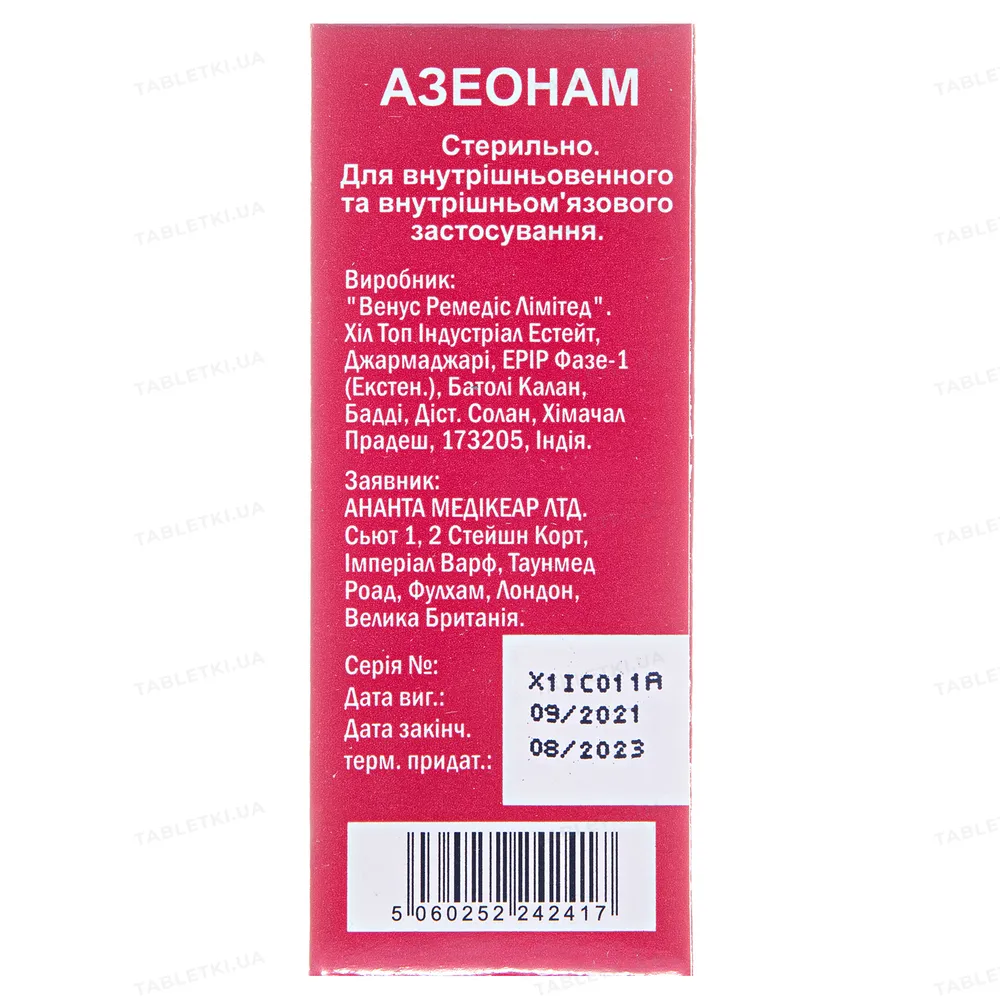
Table of Contents
INSTRUCTIONS FOR MEDICAL USE OF THE MEDICINAL PRODUCT AZEONAM (AZEONAM)
Composition:
Active substance: aztreonam;
1 vial contains aztreonam 1 g;
Excipient: L-arginine.
Pharmaceutical form. Powder for solution for injection or infusion.
Main physicochemical properties: white crystalline odourless powder.
Pharmacotherapeutic group. Antimicrobial agents for systemic use.
ATC code J01D F01.
Pharmacological properties.
Pharmacodynamics.
Aztreonam is a monobactam beta-lactam antibiotic with potent bactericidal activity against a wide range of Gram-negative aerobic pathogens. Unlike most beta-lactam antibiotics, it is not an inducer of beta-lactamase activity in vitro. Aztreonam is generally active in vitro against resistant aerobic microorganisms whose beta-lactamases hydrolyze other antibiotics.
Pharmacokinetics.
Single 30-minute intravenous infusions of 0.5 g, 1.0 g, and 2.0 g in healthy volunteers resulted in peak serum concentrations of 54, 90, and 204 mg/L, respectively, while single 3-minute intravenous injections of the same doses produced peak levels of 58, 125, and 242 mg/L. Peak aztreonam concentrations are reached approximately one hour after intramuscular administration. After administration of equivalent single intramuscular and intravenous doses, serum concentrations at 1 hour (1.5 hours from the start of intravenous infusion) were comparable.
The mean elimination half-life of aztreonam in serum was approximately 1.7 hours in patients with normal renal function, regardless of dose or route of administration. In healthy volunteers, 60–70% of a single intramuscular or intravenous dose was excreted in urine within 8 hours, and excretion was nearly complete within 12 hours.
Clinical characteristics.
Indications.
Azactam is indicated for the treatment of the following infections caused by susceptible aerobic Gram-negative microorganisms:
- Urinary tract infections, including pyelonephritis and cystitis (initial and recurrent), asymptomatic bacteriuria, particularly caused by organisms resistant to aminoglycosides, cephalosporins, or penicillins.
- Gonorrhea: acute uncomplicated urogenital or anorectal infection caused by strains of N. gonorrhoeae that either produce or do not produce beta-lactamase.
- Lower respiratory tract infections, including pneumonia, bronchitis, and pulmonary infections in patients with cystic fibrosis.
- Bacteremia/septicemia.
- Meningitis caused by Haemophilus influenzae or Neisseria meningitidis. Since aztreonam acts only against Gram-negative microorganisms, it should not be used as monotherapy for initial empiric treatment; however, it may be used in combination with an antibiotic active against Gram-positive organisms until susceptibility test results are available.
- Bone and joint infections.
- Skin and soft tissue infections, including those associated with postoperative wounds, ulcers, and burns.
- Intra-abdominal infections: peritonitis.
- Gynecological infections: pelvic inflammatory disease, endometritis, and parametritis.
Azactam is indicated as adjunctive therapy in surgical procedures for the treatment of infections caused by susceptible organisms, including abscesses, infections complicating perforations of hollow organs, skin infections, and serous surface infections.
Bacteriological investigations should be performed to identify the causative pathogens and determine their susceptibility to aztreonam. Therapy may be initiated before susceptibility test results are available.
In patients at risk of infection with resistant pathogens, additional antibiotic therapy should be administered concomitantly with Azactam to ensure broad-spectrum coverage until the causative pathogens are identified and their susceptibility determined. Based on these results, appropriate antibacterial therapy should be continued.
Patients with serious Pseudomonas infections may receive concomitant treatment with Azactam and an aminoglycoside due to their synergistic effect. If such combination therapy is prescribed for these patients, in vitro susceptibility testing should be performed to determine the activity of the combination. During aminoglycoside therapy, standard monitoring of serum levels and renal function should be applied.
Contraindications.
Hypersensitivity to the active substance or to any of the excipients of the medicinal product.
Azactam is contraindicated during pregnancy. Aztreonam crosses the placenta and enters the fetal circulation.
Interaction with other medicinal products and other forms of interaction.
Concomitant administration of probenecid or furosemide with aztreonam results in a clinically insignificant increase in serum aztreonam levels.
Due to induction of beta-lactamases, certain antibiotics (e.g., cefoxitin, imipenem) have been shown to exert an antagonistic effect on many beta-lactams, including aztreonam, against certain aerobic Gram-negative organisms such as Enterobacter species and Pseudomonas species.
Appropriate monitoring should be performed when anticoagulants are used concomitantly. Dose adjustment of oral anticoagulants may be required to maintain the desired level of anticoagulation (see sections "Special precautions" and "Adverse reactions").
Single-dose pharmacokinetic studies have not shown any significant interaction between aztreonam and gentamicin, cephadrine, clindamycin, or metronidazole.
Unlike broad-spectrum antibiotics, aztreonam does not affect normal anaerobic intestinal flora. No disulfiram-like reactions with alcohol consumption have been reported.
Special precautions for use.
Allergic reactions
Antibiotics, as well as other medicinal products, should be prescribed with caution to patients with a history of allergic reactions to structurally related compounds. In case of an allergic reaction, the drug should be discontinued and appropriate supportive therapy initiated. Severe hypersensitivity reactions may require administration of epinephrine and other emergency measures. Clinical studies have not shown significant cross-sensitivity between aztreonam and antibodies to penicillins or cephalosporins. The incidence of hypersensitivity to aztreonam in clinical trials was low; however, until further data are available, caution should be exercised in patients with a history of hypersensitivity to beta-lactam antibiotics.
Renal/hepatic impairment
Encephalopathy (e.g., confusion, altered consciousness, seizures, movement disorders) has been observed during treatment with beta-lactams, particularly aztreonam, especially in patients with impaired renal function and in cases of beta-lactam overdose.
Patients with hepatic or renal impairment should be monitored appropriately during therapy.
Serious blood and skin disorders
Serious blood disorders (including pancytopenia) and skin disorders (including toxic epidermal necrolysis) have been reported during aztreonam therapy. In case of severe skin reactions or hematological abnormalities, aztreonam should be discontinued.
Seizures
Seizures have been reported rarely during treatment with beta-lactams, including aztreonam (see section "Adverse reactions").
Clostridium difficile-associated diarrhea
Clostridium difficile-associated diarrhea (CDAD) has been reported with nearly all antibacterial agents, including aztreonam. The severity may range from mild diarrhea to fatal colitis. CDAD should be considered in all patients presenting with diarrhea following antibiotic use. Careful medical history is necessary, as CDAD has been reported to occur up to two months after antibiotic administration. If CDAD is suspected or confirmed, antibiotics not directed against C. difficile should be discontinued. Medicinal products that inhibit gastrointestinal motility should not be administered.
Concomitant therapy with other antimicrobial agents and aztreonam is recommended as initial treatment for patients at risk of infection with pathogens resistant to aztreonam.
As with other antibiotics, in the treatment of pulmonary exacerbations in patients with cystic fibrosis, although clinical improvement is usually observed, long-term eradication of bacteria is not achieved.
Overgrowth of non-susceptible microorganisms
Treatment with the drug may lead to overgrowth of non-susceptible microorganisms, including gram-positive organisms and fungi. Appropriate measures should be taken if superinfection occurs during therapy. In comparative studies, the number of patients requiring treatment for superinfection was similar to that in the control group.
Prolongation of prothrombin time / increased effect of oral anticoagulants
Prolongation of prothrombin time has been observed rarely in patients receiving aztreonam. In addition, numerous cases of increased effect of oral anticoagulants have been reported in patients treated with antibiotics, including beta-lactams. Severe infections or inflammation, as well as advanced age and general patient condition, are risk factors. Appropriate monitoring is required when anticoagulants are used concomitantly. Dose adjustment of oral anticoagulants may be necessary to maintain the desired level of anticoagulation (see sections "Interaction with other medicinal products and other forms of interaction" and "Adverse reactions").
Concomitant use with aminoglycosides
If aminoglycosides are administered concurrently with aztreonam, especially at high initial doses or during prolonged therapy, renal function should be monitored due to the potential nephrotoxicity and ototoxicity of aminoglycoside antibiotics.
Children
Safety and efficacy data in neonates under one week of age are limited; therefore, the use of Azeonam in such patients requires careful evaluation.
Arginine
Aztreonam for injection contains arginine. Studies in low-birth-weight neonates have shown that arginine administered as part of aztreonam may lead to increased serum levels of arginine, insulin, and indirect bilirubin. The consequences of this amino acid during neonatal treatment have not been fully established.
Effect on serological test results
A positive direct or indirect Coombs test may occur during treatment with aztreonam.
Use during pregnancy or breastfeeding.
Pregnancy. Aztreonam is contraindicated during pregnancy. Aztreonam crosses the placenta and enters the fetal circulation.
Adequate and well-controlled studies in pregnant women have not been conducted. In studies conducted in pregnant rats and rabbits given up to 15 daily doses, five times the maximum recommended human dose, no evidence of embryotoxicity, fetotoxicity, or teratogenicity was observed. Since animal study results are not always predictive of human response, aztreonam should be used during pregnancy only if clearly needed.
Breastfeeding. Aztreonam is excreted in breast milk in concentrations less than 1% of maternal plasma levels. Women should avoid breastfeeding during aztreonam therapy.
Ability to affect reaction speed when driving or operating machinery.
This medicinal product may significantly impair the ability to drive a vehicle or operate machinery in case encephalopathy occurs (see sections "Special precautions for use" and "Overdose").
Administration and Dosage
The medicinal product should be administered by intramuscular or intravenous injection or by intravenous infusion. For intramuscular administration, inject deeply into a large muscle mass, such as the upper quadrant of the gluteus maximus or the lateral part of the thigh.
Adults
The dosage range for aztreonam is 1 to 8 g per day given in equally divided doses. The usual dose is 3 to 4 g per day. The maximum recommended dose is 8 g per day. The dosage and route of administration should be determined based on the susceptibility of the causative organisms, the severity of the infection, and the patient's condition.
Recommended doses for adults:
| Type of infection1 |
Dosage |
Frequency (hours) |
Route of administration |
| Urinary tract infections |
500 mg or 1 g |
8 or 12 |
IM or IV |
| Gonorrhoea/cystitis |
1 g |
single dose |
IM |
| Cystic fibrosis |
2 g |
6–8 |
IV |
| Moderately severe systemic infections |
1 g or 2 g |
8 or 12 |
IM or IV |
| Severe systemic infections or life-threatening infections |
2 g |
6 or 8 |
IM or IV |
| Other infections or |
1 g 2 g |
8 12 |
IM or IV IV |
| 1 Due to the severe nature of infections caused by Pseudomonas aeruginosa, a dosage of 2 g every 6 or 8 hours is recommended, at least for initial therapy of systemic infections caused by this microorganism. |
|||
The intravenous route is recommended for patients who require single doses greater than 1 g, as well as for patients with bacterial septicemia, localized parenchymal abscess (e.g., intra-abdominal abscess), peritonitis, meningitis, other severe systemic infections, or life-threatening infections.
Geriatric patients
Renal function is the primary factor determining dosage in elderly patients; these patients may have reduced renal function. Serum creatinine may not be an accurate indicator of renal status. Therefore, as with all other antibiotics excreted by the kidneys, creatinine clearance should be determined and dosage adjusted accordingly if necessary.
Elderly patients generally have creatinine clearance above 30 mL/min and should therefore receive the normal recommended dose. If creatinine clearance is below 30 mL/min, the dosing regimen must be adjusted (see section "Renal impairment").
Renal impairment
Elimination of aztreonam from serum may be prolonged in patients with transient or sustained renal insufficiency; therefore, after the usual initial dose, the aztreonam dosage should be reduced by half in patients with creatinine clearance between 10 and 30 mL/min/1.73 m².
For patients with severe renal impairment (creatinine clearance less than 10 mL/min/1.73 m²) undergoing hemodialysis, the usual initial dose should be administered initially. The maintenance dose should be one-quarter of the usual initial dose, administered at the usual fixed intervals of 6, 8, or 12 hours. For serious infections or life-threatening infections, in addition to maintenance doses, one-eighth of the initial dose should be administered after each hemodialysis session.
Hepatic impairment
For prolonged treatment of patients with chronic hepatic dysfunction and cirrhosis, a dose reduction of 20–25% is recommended, particularly in cases of alcoholic cirrhosis and when renal function is also impaired.
Children
The usual dose for children older than 1 week is 30 mg/kg every 6 or 8 hours. In cases of severe infections, patients aged 2 years and older should receive 50 mg/kg every 6 or 8 hours. The recommended dose for all patients in the treatment of infections caused by P. aeruginosa is 50 mg/kg every 6–8 hours.
The maximum daily dose for children should not exceed the maximum recommended dose for adults.
Dosage information for neonates younger than 1 week is not available.
Reconstitution
Aztreonam 1 g for injection or infusion concentrate for solution for injection is supplied in 20 mL vials.
After adding diluent, the contents of the vial should be shaken vigorously immediately.
Vials containing reconstituted product are intended for single use only; any unused portion of the solution remaining after administration of a single dose must be discarded.
Depending on the type and volume of diluent used, the pH ranges from 4.5 to 7.5, and the color may vary from colorless to slightly yellowish-solomon, possibly developing a slight pinkish tint upon standing; however, this does not affect its efficacy.
For intramuscular injection: add at least 3 mL of Water for Injections or 0.9% Sodium Chloride for Injections per gram of aztreonam and shake well.
| Single-dose vial |
Volume of diluent to be added |
| 0.5 g |
1.5 mL |
| 1.0 g |
3.0 mL |
For intravenous injection: add 6–10 mL of water for injections to the contents of the vial and shake well. Inject slowly directly into the vein over 3–5 minutes.
For intravenous infusion: add at least 3 mL of water for injections per gram of aztreonam and shake well. This initial solution should be further diluted with a suitable infusion solution to a final concentration of less than 2% w/v (at least 50 mL of solution per gram of aztreonam). The infusion should be administered over 20–60 minutes.
Compatible infusion solutions:
0.9% sodium chloride injection solution;
5% glucose solution for intravenous infusion;
5% or 10% mannitol for intravenous infusion;
sodium lactate for intravenous infusion;
0.9%, 0.45%, or 0.2% sodium chloride and 5% glucose solution for intravenous infusion;
Ringer's solution for injection;
Hartmann's solution for injection.
An administration set for volume control may be used to transfer the initial aztreonam solution into a compatible infusion solution. When using a Y-site administration, particular attention should be paid to calculating the volume of aztreonam solution required to deliver the full dose.
Intravenous infusion solutions of aztreonam for injection, prepared with 0.9% sodium chloride injection solution or 5% glucose for intravenous infusion, in PVC or glass containers, to which clindamycin phosphate, gentamicin sulfate, tobramycin sulfate, or sodium cefazolin have been added at concentrations commonly used clinically, remain stable for 24 hours when stored in a refrigerator (2–8°C). The mixture of sodium ampicillin with aztreonam in 0.9% sodium chloride injection solution remains stable for 24 hours when stored in a refrigerator (2–8°C); 5% glucose for intravenous infusion remains stable for 8 hours under refrigeration.
If aztreonam and metronidazole are to be used simultaneously, they should be administered separately, as storage of solutions containing combinations of the two products may result in a cherry-red discoloration.
Any unused medicinal product or waste material should be disposed of in accordance with current requirements.
Children.
Data on the safety and efficacy of aztreonam in neonates under 1 week of age are limited; therefore, the use of Azeonam in such patients requires careful evaluation.
Overdose.
Therapy with beta-lactams, including aztreonam, may cause encephalopathy (e.g., confusion, altered consciousness, seizures, movement disorders), particularly in patients with impaired renal function and in cases of beta-lactam overdose.
Cases of overdose have not been reported. If necessary, aztreonam can be removed from blood serum by hemodialysis and/or peritoneal dialysis. Aztreonam may also be removed from blood serum by continuous arteriovenous hemofiltration.
Adverse Reactions
Adverse reactions are listed by system organ classes according to MedDRA (Medical Dictionary for Regulatory Activities). Frequency is defined as follows: very common (≥1/10); common (≥1/100 <1/10); uncommon (≥1/1000 <1/100); rare (≥1/10000 <1/1000); very rare (<1/10000); frequency not known (cannot be estimated from the available data).
| System Organ Classes |
Frequency |
MedDRA Term |
| Blood and lymphatic system disorders |
Uncommon |
Pancytopenia1, thrombocytopenia, thrombocytosis, leukocytosis, neutropenia, eosinophilia, anemia, prolonged prothrombin time, prolonged activated partial thromboplastin time, positive Coombs test1 |
| Ear and labyrinth disorders |
Uncommon |
Vertigo, tinnitus |
| Eye disorders |
Uncommon |
Diplopia |
| Gastrointestinal disorders |
Uncommon Frequency not known |
Gastrointestinal hemorrhage, pseudomembranous colitis1, oral malodor Abdominal pain, oral ulcers, nausea, vomiting, diarrhea, taste alteration |
| General disorders and administration site conditions |
Uncommon Frequency not known |
Chest pain, hyperthermia, asthenia, malaise Injection site discomfort, weakness, increased sweating, myalgia, pyrexia, transient increase in serum creatinine |
| Hepatobiliary disorders |
Uncommon Frequency not known |
Hepatitis, jaundice Elevated transaminases*, increased alkaline phosphatase in blood* |
| Infections and infestations |
Uncommon |
Vaginitis, vaginal candidiasis |
| Immune system disorders |
Frequency not known |
Anaphylactic reaction |
| Investigations |
Uncommon |
Electrocardiogram changes |
| Musculoskeletal and connective tissue disorders |
Uncommon |
Myalgia |
| Nervous system disorders |
Uncommon Frequency not known |
Seizures1, paresthesia, dizziness, headache Dysgeusia Encephalopathy (confusion, altered consciousness, epilepsy, movement disorder) |
| Psychiatric disorders |
Uncommon |
Confusion, insomnia |
| Renal and urinary disorders |
Uncommon |
Increased blood creatinine |
| Reproductive system and breast disorders |
Uncommon |
Galactorrhea |
| Respiratory, thoracic and mediastinal disorders |
Uncommon Frequency not known |
Wheezing, dyspnea, sneezing, nasal congestion Bronchospasm |
| Skin and subcutaneous tissue disorders |
Frequency not known |
Toxic epidermal necrolysis1, angioneurotic edema, erythema multiforme, exfoliative dermatitis, hyperhidrosis, petechiae, purpura, urticaria, rash, pruritus |
| Cardiac disorders |
Uncommon Frequency not known |
Hypotension, hemorrhage Phlebitis, thrombophlebitis, flushing |
* Usually reversible during treatment and without obvious signs or symptoms of hepatobiliary dysfunction.
1 See section "Special precautions".
Reporting of adverse reactions
Reporting of adverse reactions after registration of the medicinal product is of great importance. It allows continuous monitoring of the benefit-risk balance of this medicinal product. Healthcare and pharmaceutical professionals, as well as patients or their legal representatives, should report all suspected adverse reactions and lack of efficacy via the Automated Pharmacovigilance Information System at: https://aisf.dec.gov.ua.
Shelf life.
2 years.
Storage conditions.
Store in the original packaging at a temperature not exceeding 25 °C.
Keep out of the reach of children.
The reconstituted solution should be stored at 2–8 °C for up to 18 hours.
Incompatibilities.
Aztreonam must not be mixed with any other drug, antibiotic or solvent except those listed in the section "Dosage and administration".
In case of intermittent infusion of aztreonam and another drug through the same line, the line should be flushed before and after administration of aztreonam with any infusion solution compatible with both medicinal products. Drugs must not be administered simultaneously.
Packaging.
1 g of the drug in a glass vial closed with a rubber stopper and an aluminum cap with a "flip-off" component, one vial per carton.
Prescription status. Prescription only.
Manufacturer.
"Venus Remedies Limited".
Manufacturer's address and site of operations.
Hill Top Industrial Estate, Jharmajhari, ERIP Phase-1 (Ext.), Bhatoli Kalan, Baddi, Dist. Solan, Himachal Pradesh, 173205, India.
Marketing Authorization Holder.
Ananta Medikare Ltd.
Address of the Marketing Authorization Holder.
Suite 1, 2 Station Court, Imperial Wharf, Townmead Road, Fulham, London, United Kingdom.