Acik
Ukraine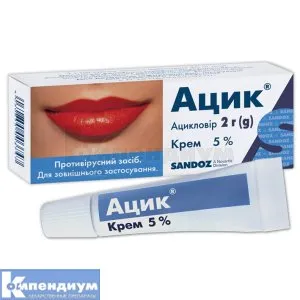
Table of Contents
INSTRUCTIONS FOR MEDICAL USE OF THE MEDICINAL PRODUCT Acic® (ASIC®)
Composition:
Active substance: acyclovir;
1 g of cream contains acyclovir 50 mg;
Excipients: stearyl polyoxylglyceride, dimethicone 350, cetyl alcohol, white soft paraffin, mineral oil, propylene glycol, purified water.
Pharmaceutical form. Cream.
Main physicochemical properties: a homogeneous cream of white or almost white color, free from lumps and foreign particles, without signs of phase separation.
Pharmacotherapeutic group. Antiviral agents. Acyclovir. ATC code D06B B03.
Pharmacological properties.
Pharmacodynamics.
Acyclovir is an antiviral agent with high in vitro activity against herpes simplex virus types I and II. Its toxic effect on host cells is minimal. After penetrating into herpes virus-infected cells, acyclovir is phosphorylated to form the active compound, acyclovir triphosphate. The first step of this process depends on the presence of virus-encoded thymidine kinase. Acyclovir triphosphate acts as both an inhibitor and a substrate for viral DNA polymerase, thereby preventing further viral DNA synthesis without affecting normal cellular processes.
Pharmacokinetics.
Pharmacokinetic studies have shown minimal systemic absorption of acyclovir following repeated topical application of the cream.
Clinical characteristics.
Indications.
Treatment of infections of the lips and face caused by herpes simplex virus (Herpes labialis).
Contraindications.
Hypersensitivity to acyclovir, valacyclovir, propylene glycol, or to any other components of the cream.
Interaction with other medicinal products and other forms of interactions.
No interactions have been identified.
Special precautions for use
The cream should only be applied for the treatment of herpes labialis and facial herpes. It is not recommended to apply the cream to mucous membranes of the oral cavity or eyes, or to use it for the treatment of genital herpes. Accidental contact of the cream with the eyes should be avoided.
Patients suffering from particularly severe or frequently recurring episodes of Herpes labialis should consult a physician. Patients with herpes should be advised to avoid transmitting the virus to others, especially when active lesions are present (e.g., by washing hands before and after applying the cream). The product is not recommended for use in immunocompromised patients. Such patients should seek medical advice for the treatment of any infection.
The medicinal product contains propylene glycol, which may cause skin irritation, and cetyl alcohol, which may cause local skin reactions (e.g., contact dermatitis).
After opening the tube, the cream may be used for up to 36 months. Do not use after the expiry date stated on the packaging.
Use during pregnancy or breastfeeding
This medicinal product should be used during pregnancy or breastfeeding only if, in the opinion of the physician, the expected benefit outweighs the potential risk. It should be noted that systemic absorption of acyclovir following topical application of the cream is very low.
In clinical studies, the use of acyclovir in any formulation has not been associated with an increased incidence of fetal developmental abnormalities.
Some clinical data indicate that acyclovir may pass into breast milk when the cream is used. However, the amount of acyclovir that may be transferred to the infant through breastfeeding after application of this product is negligible.
There are no data on the effect of acyclovir on female fertility. Clinical studies have shown that oral administration of acyclovir has no clinically significant effect on male fertility. Specifically, no clinically significant effects on sperm count, motility, or morphology were observed in men treated with oral acyclovir at doses up to 1 g daily for periods of up to 6 months.
Effect on ability to drive and use machines
No data available.
Method of Administration and Dosage
The product is intended for topical use only.
Adults and children aged 12 years and older: apply the cream 5 times daily at approximately 4-hour intervals, excluding nighttime. It is important to start treatment as early as possible at the onset of infection, preferably during the prodromal stage or erythema phase. Treatment may also be initiated at later stages—papules or blisters.
Treatment should last for at least 4 days. If healing has not occurred, treatment may be continued for up to 10 days. If symptoms persist after 10 days of treatment, the patient should consult a physician.
To ensure adequate application of the cream to all affected skin areas, cotton swabs are recommended. Acyc® cream should be applied to visible infected areas (herpes lesions, swelling, erythema), including the surrounding area. If applying the cream with fingers, hands should be washed before and after use. Excessive rubbing or contact with towels on affected areas should be avoided to prevent aggravation or transmission of infection.
For optimal therapeutic effect, the cream should be applied at the first signs of herpes infection (burning, itching, tingling, and redness). Topical antiviral treatment with Acyc® cream is not indicated once crusts have formed on the skin.
Children.
There is insufficient data on the safety of using the product in children under 12 years of age; therefore, its use is recommended only in children aged 12 years and older.
Overdose.
No adverse effects have been reported following accidental oral or topical application of the entire tube content due to minimal systemic exposure. In case of suspected overdose, medical advice should be sought.
Side effects.
Immune system disorders
Very rare (< 1/10000): immediate hypersensitivity reactions, including angioedema and urticaria.
Skin and connective tissue disorders
Uncommon (≥ 1/1000; < 1/100): transient burning or stinging pain after cream application, moderate skin dryness and desquamation, pruritus, acute generalized exanthematous pustulosis (AGEP).
Rare (≥ 1/10000; < 1/1000): erythema, contact dermatitis after cream application (sensitivity testing has shown that such cases were mostly related to components of the cream base rather than to acyclovir).
Shelf life. 3 years.
Storage conditions.
Store at a temperature not exceeding 25°C.
Keep out of reach of children. Do not freeze.
Packaging.
2 g of cream in a tube; 1 tube in a cardboard box.
Availability.
Over-the-counter (without prescription).
Manufacturer.
Salutas Pharma GmbH.
Manufacturer's location and address of business operation.
Production site in Osterweddingen, Lange Herren 3, Sülzetal, OT Osterweddingen, Saxony-Anhalt, 39171, Germany.