Acc®
Ukraine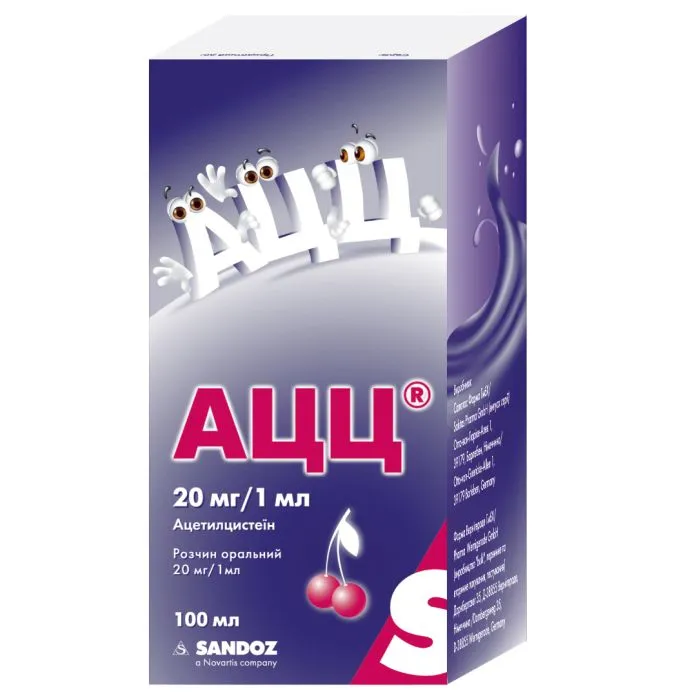
Table of Contents
INSTRUCTIONS for medical use of the medicinal product АЦЦ® (ACC®)
Composition:
Active substance: acetylcysteine;
1 ml of solution contains 20 mg of acetylcysteine;
Excipients: methylparaben (E 218), sodium benzoate (E 211), disodium edetate, sodium saccharin, cherry flavor, sodium carmellose, sodium hydroxide, purified water.
Pharmaceutical form. Oral solution.
Main physicochemical properties: clear, slightly viscous solution with a cherry flavor.
Pharmacotherapeutic group.
Mucolytic agents. ATC code R05C B01.
Pharmacological properties.
Pharmacodynamics.
Acetylcysteine (ACC) is a mucolytic expectorant used to liquefy sputum in respiratory diseases associated with the production of thick mucus. Acetylcysteine is a derivative of the amino acid cysteine. The mucolytic effect of the drug has a chemical nature. Due to its free sulfhydryl group, acetylcysteine breaks the disulfide bonds of acidic mucopolysaccharides, leading to depolymerization of mucus glycoproteins, reduction of mucus viscosity, and facilitating expectoration and clearance of bronchial secretions. The drug retains activity in the presence of purulent sputum.
Acetylcysteine also possesses antioxidant and pneumoprotective properties, due to the binding of chemical radicals by its sulfhydryl groups, thereby neutralizing them. Furthermore, the drug promotes increased synthesis of glutathione – an important factor in intracellular protection not only against oxidative toxins of exogenous and endogenous origin but also against certain cytotoxic substances. This characteristic of acetylcysteine allows its effective use in paracetamol overdose.
Pharmacokinetics.
After oral administration, acetylcysteine is rapidly and completely absorbed and undergoes hepatic metabolism, forming cysteine, a pharmacologically active metabolite, as well as diacetylcysteine, cystine, and subsequently mixed disulfides. Bioavailability is very low – approximately 10%. Maximum plasma concentration is reached within 1–3 hours after administration. Protein binding in plasma is approximately 50%. Acetylcysteine is excreted by the kidneys as inactive metabolites (inorganic sulfates, diacetylcysteine).
The elimination half-life is primarily determined by rapid biotransformation in the liver and is approximately 1 hour. In cases of impaired liver function, the elimination half-life is prolonged to up to 8 hours.
Clinical characteristics.
Indications.
Treatment of acute and chronic diseases of the bronchopulmonary system in which reduction of sputum viscosity and improvement of its expectoration and coughing-up are required.
Contraindications.
Hypersensitivity to the active substance or to any of the excipients. Acute phase of gastric and duodenal ulcer, haemoptysis, pulmonary haemorrhage, severe exacerbation of bronchial asthma.
Interaction with other medicinal products and other forms of interaction.
Interaction studies were conducted only in adults.
Concomitant use of acetylcysteine with antitussive agents may enhance sputum retention due to suppression of the cough reflex.
When administered simultaneously with antibiotics such as tetracyclines (except doxycycline), ampicillin, amphotericin B, cephalosporins, and aminoglycosides, interaction with the thiol group of acetylcysteine may occur, leading to reduced activity of both agents. Therefore, the interval between administration of these drugs should be at least 2 hours. This does not apply to cefixime and loracarbef.
Concomitant administration of nitroglycerin and acetylcysteine has been associated with marked hypotension and significant dilation of temporal arteries. When simultaneous use of nitroglycerin and acetylcysteine is necessary, patients should be monitored for potentially severe hypotension, and should be warned about the possibility of headache.
Activated charcoal reduces the effectiveness of acetylcysteine.
It is not recommended to dissolve acetylcysteine with other drugs in the same glass.
Acetylcysteine reduces the hepatotoxic effect of paracetamol.
Synergism between acetylcysteine and bronchodilators has been observed.
Acetylcysteine may act as a cysteine donor and increase glutathione levels, promoting detoxification of oxygen free radicals and certain toxic substances in the body.
Effect on laboratory tests.
Acetylcysteine may interfere with colorimetric assays for salicylates and with tests for urinary ketone bodies.
Special precautions for use
There have been isolated reports of severe skin reactions (Stevens-Johnson syndrome and Lyell's syndrome) associated with the use of acetylcysteine. Therefore, if any changes in the skin or mucous membranes occur, administration of the drug must be discontinued immediately and medical advice must be sought regarding further treatment.
The drug should be used with caution in patients with a history of gastric or duodenal ulcer, especially when other medications that irritate the gastric mucosa are taken concomitantly.
Acetylcysteine affects histamine metabolism; therefore, prolonged therapy should not be prescribed to patients with histamine intolerance, as it may lead to symptoms of intolerance (headache, vasomotor rhinitis, itching).
Acetylcysteine should be administered with caution in patients with a history of bronchial asthma.
Acetylcysteine should be used with caution in patients with liver or kidney disease to avoid accumulation of nitrogen-containing compounds in the body.
Administration of acetylcysteine, particularly at the beginning of treatment, may cause liquefaction of bronchial secretions and increase their volume. If the patient is unable to effectively expectorate sputum, postural drainage and bronchoaspiration may be required.
A mild sulfurous odor is not an indication of product deterioration but is characteristic of the active substance.
The product contains the excipient methylparaben (E 218), which may cause allergic reactions (possibly delayed).
1 ml of oral solution contains 1.78 mmol (41.02 mg) of sodium. This should be taken into account when prescribing the drug to patients requiring a sodium-restricted (low sodium/low salt) diet.
Use during pregnancy or breastfeeding
Acetylcysteine may be used during pregnancy or breastfeeding only if the expected benefit to the mother outweighs the potential risk to the fetus or infant.
Ability to influence reaction speed when driving or operating machinery
Does not affect.
Method of Administration and Dosage
Recommended dosage regimen for the medicinal product ACC®, oral solution.
Adults and children aged 12 years and older.
10 mL of solution 2–3 times daily (equivalent to 400–600 mg of acetylcysteine per day).
Children aged 2 to 6 years.
5 mL of solution 2–3 times daily (equivalent to 200–300 mg of acetylcysteine per day).
Children aged 6 to 12 years.
10 mL of solution 2–3 times daily (equivalent to 400–600 mg of acetylcysteine per day).
10 mL of oral solution corresponds to half of the measuring cap or 2 syringes.
Method of Administration.
ACC®, oral solution, should be taken after meals. The dose should be measured using an oral dosing syringe or the measuring cap provided with the medicinal product.
Method of dose measurement using the syringe:
- Unscrew the child-resistant cap by pressing it down and turning it to the left.
- Insert the perforated stopper provided in the package into the neck of the bottle. If the stopper cannot be fully inserted, the cap may be placed and screwed on. The stopper serves to attach the syringe to the bottle and must remain inserted in the bottle neck.
- Insert the syringe into the opening of the stopper. Push the plunger as far as possible into the syringe.
- Carefully turn the bottle upside down together with the syringe, then pull the plunger to the mark corresponding to the required number of milliliters (mL). If bubbles are present in the solution drawn into the syringe, press the plunger to expel the solution and slowly draw it again. If the prescribed dose exceeds 5 mL, the syringe should be filled several times.
- Turn the bottle upright and remove the syringe from the perforated stopper.
- The solution can be administered directly from the syringe to the child or poured from the syringe into a spoon. If the child receives the solution directly from the syringe, they should be seated upright. The solution should be administered slowly, directing it to the inner cheek surface to prevent choking.
After use, the syringe should be rinsed with clean water.
ACC®, oral solution, should not be used for longer than 4–5 days without consulting a physician. ACC®, oral solution, should be taken after meals.
Children.
May be used in children aged 2 years and older. As adequate dosing data in neonates are lacking, ACC®, oral solution, should be administered to such patients only after consultation with a physician.
Overdose.
There are no reported cases of overdose with oral formulations of acetylcysteine. Volunteers have taken up to 11.6 g of acetylcysteine per day for three months without experiencing any serious adverse effects. Oral doses of up to 500 mg acetylcysteine/kg body weight/day were tolerated without symptoms of intoxication.
Symptoms. Overdose may manifest with gastrointestinal symptoms such as nausea, vomiting, and diarrhea. In children, there is a risk of hypersecretion.
Treatment. There is no specific antidote for acetylcysteine poisoning; treatment is symptomatic.
Side effects.
The following classification is used to describe the frequency of adverse effects: very common (≥ 1/10), common (≥ 1/100, < 1/10), uncommon (≥ 1/1000, < 1/100), rare (≥ 1/10,000, < 1/1000), very rare (< 1/10,000).
Cardiovascular system: uncommon – tachycardia, arterial hypotension.
Nervous system: uncommon – headache.
Skin: uncommon – allergic reactions (pruritus, urticaria, exanthema, eczema, rash, angioneurotic edema).
Auditory system: uncommon – tinnitus.
Respiratory system: rare – dyspnea, bronchospasm (mainly in patients with bronchial hyperreactivity associated with bronchial asthma), rhinorrhea.
Gastrointestinal tract: uncommon – heartburn, dyspepsia, stomatitis, abdominal pain, nausea, vomiting, diarrhea, unpleasant breath odor.
General disorders: uncommon – fever.
Individual severe skin reactions (Stevens-Johnson syndrome and Lyell's syndrome) have been reported. With the use of acetylcysteine, very rare cases of bleeding have been reported, mostly associated with the development of hypersensitivity reactions. Cases of decreased platelet aggregation have been observed; however, there is no clinical confirmation. Very rare cases of Quincke's edema (angioedema), facial swelling, anemia, hemorrhages, anaphylactic reactions, or even anaphylactic shock have been reported.
Shelf life. 2 years.
Storage conditions.
Special storage conditions are not required. Keep out of reach of children.
After opening the container, the solution should be stored at a temperature not exceeding 25 °C and used within 18 days.
Packaging.
Oral solution 20 mg/mL in 100 mL or 200 mL bottles; 1 bottle with a measuring cap and/or measuring applicator (syringe) in a cardboard box.
Availability. Over-the-counter (without prescription).
Manufacturer.
- Solutas Pharma GmbH (batch release).
- Pharma Verinnerode GmbH (bulk production, primary and secondary packaging, testing).
Manufacturer's address and location of business activity.
- Otto-von-Guericke-Allee 1, 39179 Barleben, Germany.
- Dornburgsweg 35, D-38855 Wernigerode, Germany.