Acc® long lemon
Ukraine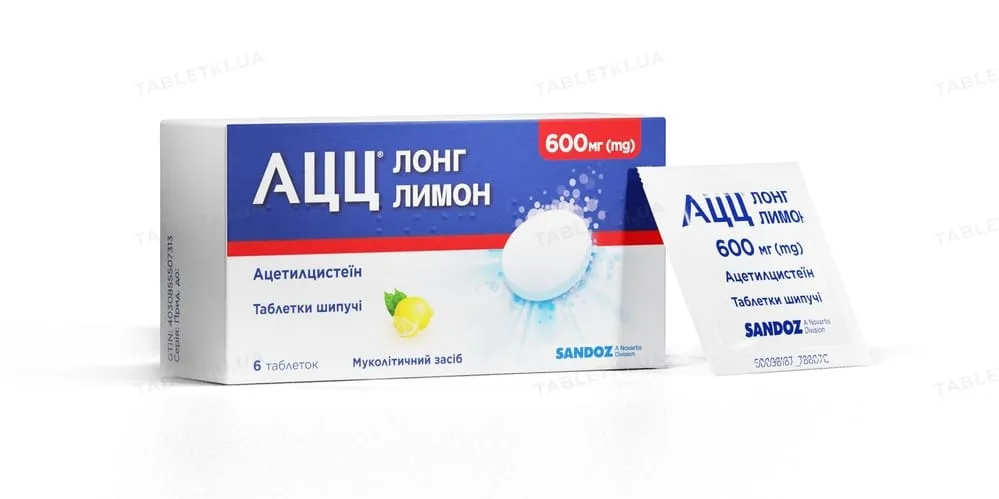
Table of Contents
INSTRUCTIONS FOR MEDICAL USE OF THE MEDICINAL PRODUCT ACC® LONG LEMON
Composition:
Active substance: acetylcysteine;
One effervescent tablet contains 600 mg of acetylcysteine;
Excipients: anhydrous citric acid (E 330), sodium bicarbonate, anhydrous sodium carbonate, mannite (E 421), anhydrous lactose, ascorbic acid (E 300), sodium cyclamate (E 952), sodium saccharin (E 954), disodium citrate dihydrate (E 331), zinc sulfate monohydrate, lemon flavor "BB".
Pharmaceutical form. Effervescent tablets.
Main physico-chemical properties: white round tablets with a dividing line, surface without defects, lemon odor, specific smell.
Pharmacotherapeutic group. Medicinal products used for cough and colds. Mucolytic agents.
ATC code R05C B01.
Pharmacological properties.
Pharmacodynamics.
N-acetyl-L-cysteine (acetylcysteine) exerts a pronounced mucolytic effect on mucous and mucopurulent secretions by depolymerizing mucoprotein complexes and nucleic acids that contribute to the viscosity of the vitreous and purulent components of sputum and other secretions. Additional properties include reduction of induced mucocyte hyperplasia, increased surfactant production due to stimulation of type II pneumocytes, and stimulation of mucociliary apparatus activity, thereby improving mucociliary clearance.
N-acetyl-L-cysteine also exerts a direct antioxidant effect due to the presence of a nucleophilic free thiol (SH) group, which can directly interact with electrophilic groups of reactive oxygen radicals. It is important to note that acetylcysteine prevents the inactivation of α-1-antitrypsin—an enzyme that inhibits elastase—by hypochlorous acid (HOCl), a potent oxidant produced by myeloperoxidase in activated phagocytes.
Moreover, the molecular structure of acetylcysteine enables it to easily penetrate cell membranes. Inside the cell, acetylcysteine is deacetylated to form L-cysteine, an essential amino acid for glutathione synthesis. In addition, as a precursor of glutathione, acetylcysteine exerts an indirect antioxidant effect. Glutathione is a highly active tripeptide widely distributed in animal tissues and essential for maintaining cellular functional capacity and morphological integrity. It is a key component of the most important intracellular defense mechanism against oxidative radicals, both exogenous and endogenous, as well as against certain cytotoxic substances, including paracetamol.
Paracetamol exerts cytotoxic effects by progressively depleting glutathione levels. Acetylcysteine plays a crucial role in maintaining adequate glutathione levels, thereby enhancing cellular protection. As a result, acetylcysteine serves as a specific antidote in paracetamol poisoning.
In patients with chronic obstructive pulmonary disease (COPD), administration of 1200 mg of acetylcysteine daily for 6 weeks led to a significant increase in inspiratory volume and forced vital capacity (FVC), possibly due to reduced air trapping.
In patients with idiopathic pulmonary fibrosis (IPF), administration of acetylcysteine 600 mg orally three times daily for one year, in combination with standard IPF therapy (prednisolone and azathioprine), helped preserve lung vital capacity (VC) and diffusing capacity of the lungs for carbon monoxide measured by the single-breath method.
When administered as inhalation therapy over one year, acetylcysteine contributed to a reduction in the rate of disease progression in patients with IPF.
When used at very high doses (up to 3000 mg daily for 4 weeks), acetylcysteine did not cause significant toxic effects in patients with cystic fibrosis.
The antioxidant efficacy of acetylcysteine is associated with a marked reduction in elastase activity in sputum, which is the most significant indicator of lung function in patients with cystic fibrosis. In addition, during treatment, a decrease in the number of neutrophils in the airways was observed, as well as a reduction in the number of neutrophils actively releasing elastase-rich granules.
Pharmacokinetics.
Absorption
In humans, acetylcysteine is completely absorbed after oral administration. Due to metabolism in the intestinal wall and the first-pass effect, the bioavailability of acetylcysteine after oral administration is very low (approximately 10%). No differences have been observed among various dosage forms. In patients with various respiratory and cardiovascular diseases, maximum plasma concentration of acetylcysteine is reached within 1–3 hours after administration and remains elevated for up to 24 hours.
Distribution
Acetylcysteine is distributed in the body both in unchanged form (20%) and as metabolites (active) (80%), with predominant distribution in the liver, kidneys, lungs, and bronchial secretions. The volume of distribution of acetylcysteine ranges from 0.33 to 0.47 L/kg. Plasma protein binding is approximately 50% four hours after drug administration and decreases to 20% after 12 hours.
Metabolism
After oral administration, acetylcysteine is rapidly and extensively metabolized in the intestinal wall and liver. The resulting metabolite, cysteine, is considered active. Subsequently, both acetylcysteine and cysteine are metabolized via the same pathway.
Elimination
Approximately 30% of the administered dose is excreted by the kidneys. After oral administration, the elimination half-life (T1/2) of acetylcysteine is 6.25 (4.59–10.6) hours.
Clinical characteristics.
Indications.
Treatment of acute and chronic diseases of the bronchopulmonary system associated with increased mucus production.
Paracetamol overdose.
Contraindications.
Hypersensitivity to acetylcysteine or to any of the excipients of the medicinal product.
Hepatitis, renal insufficiency (to avoid increasing nitrogen-containing substances in the body).
Peptic ulcer of the stomach and duodenum in the stage of exacerbation, hemoptysis, pulmonary hemorrhage.
Children under 12 years of age. This is not a contraindication for use in the treatment of paracetamol overdose.
Interaction with other medicinal products and other forms of interaction.
Interaction studies have been conducted only in adults.
Concomitant use of this medicinal product with antitussive agents may lead to dangerous mucus retention due to suppression of the cough reflex. Therefore, combined therapy with such agents should be prescribed only after careful diagnosis.
Activated charcoal reduces the effectiveness of acetylcysteine.
Information on inactivation of antibiotics by acetylcysteine has so far been obtained only from in vitro experiments involving direct mixing of substances. If simultaneous administration of acetylcysteine and any oral medicinal products (including antibiotics) is necessary, they should be taken at an interval of at least 2 hours. This does not apply to loracarbef.
Concomitant administration of nitroglycerin and acetylcysteine has been associated with significant hypotension and dilation of the temporal artery. When simultaneous use of nitroglycerin and acetylcysteine is required, patients should be monitored for potentially severe hypotension, and they should also be warned about the possibility of headache.
Concomitant use of acetylcysteine and carbamazepine may result in subtherapeutic levels of carbamazepine.
Acetylcysteine forms sulfides with a characteristic odor upon contact with metals or rubber; therefore, glassware should be used for dissolving the drug.
Effect on laboratory tests
Acetylcysteine may interfere with colorimetric assays for salicylates and with the determination of ketone bodies in urine.
Special precautions for use
The use of acetylcysteine, particularly at the beginning of treatment, may lead to liquefaction of sputum and an increase in bronchial secretions. If the patient is unable to effectively expectorate sputum, postural drainage and bronchoaspiration are required.
During treatment with acetylcysteine, it is recommended to consume an adequate amount of fluids.
Particular caution is necessary when treating patients with histamine intolerance. Long-term use of the medicinal product ACC® Long Lemon is not recommended in such patients due to its effect on histamine metabolism, which may cause symptoms of intolerance (e.g., headache, vasomotor rhinitis, itching).
A mild sulfurous odor is not an indication of product deterioration, but is characteristic of the active substance.
One effervescent tablet contains 6.03 mmol (138.8 mg) of sodium. This should be taken into account by patients on a salt-restricted diet (low-sodium or low-salt diet).
The medicinal product ACC® Long Lemon is also contraindicated in patients with certain rare hereditary disorders, such as galactose intolerance, lactase deficiency, or glucose-galactose malabsorption.
Patients with bronchial asthma should be under strict medical supervision during treatment due to the possible development of bronchospasm. If bronchospasm occurs, treatment with acetylcysteine should be discontinued immediately.
The drug should be used with caution in patients with a history of gastric or duodenal ulcer, especially when taken concomitantly with other medicinal products that irritate the gastric mucosa.
Acetylcysteine should be administered with caution in patients with hepatic or renal impairment to avoid accumulation of nitrogen-containing substances in the body.
Use during pregnancy or breastfeeding
Pregnancy
Clinical data on the use of acetylcysteine in pregnant women are limited. Animal studies have not revealed any direct or indirect adverse effects on reproductive toxicity.
As a precautionary measure, the use of the medicinal product ACC® Long Lemon effervescent tablets should be avoided during pregnancy.
Before using the drug during pregnancy, potential risks should be weighed against the expected benefits.
Breastfeeding
There is no information available on the passage of acetylcysteine and/or its metabolites into breast milk. A risk to the infant cannot be excluded.
A decision should be made whether to discontinue breastfeeding or to discontinue/abstain from the use of ACC® Long Lemon, taking into account the benefits of breastfeeding for the infant and the benefits of therapy for the woman.
Fertility
There are no data on the effect of acetylcysteine on human fertility. Animal studies have not revealed any harmful effect on fertility when the drug is used at recommended doses.
Ability to influence reaction speed when driving or operating machinery
There is no evidence that acetylcysteine affects the ability to drive or operate machinery.
Method of Administration and Dosage
Adults and children aged 12 years and older
1 effervescent tablet once daily (equivalent to a daily dose of 600 mg acetylcysteine).
For children under 12 years of age and in cases where the daily dose should be divided into several administrations, acetylcysteine should be used in another pharmaceutical form or appropriate dosage.
The effervescent tablet should be dissolved in 1/3 glass of water. Do not add other medicinal products to this solution. After preparing the solution, it should be taken as soon as possible. In individual cases, due to the presence of the stabilizer – ascorbic acid – in the formulation, the prepared solution may be left for approximately 2 hours before administration.
The duration of treatment is determined by the physician, depending on the nature of the disease (acute or chronic). The course of treatment with the drug should not exceed 4–5 days.
Paracetamol overdose
Within the first 10 hours after ingestion of the toxic substance, the medicinal product ACC® Long Lemon should be administered as soon as possible at a dose of 140 mg/kg, followed by 70 mg/kg every 4 hours for 1–3 days.
No interactions with food have been reported; there are no recommendations regarding administration in relation to food intake.
Children
The drug is indicated for children aged 12 years and older.
Overdose
There are no data on cases of overdose with oral formulations of acetylcysteine. Volunteers have taken 11.2 g of acetylcysteine per day for three months without developing any serious adverse effects. Acetylcysteine administered at a dose of 500 mg/kg/day does not cause overdose.
Overdose may cause gastrointestinal symptoms such as nausea, vomiting, and diarrhea. In children, there is a risk of hypersecretion.
There is no specific antidote in case of acetylcysteine poisoning; treatment is symptomatic.
Side effects
The most common adverse reactions associated with oral administration of acetylcysteine are gastrointestinal reactions. Hypersensitivity reactions, including anaphylactic shock, anaphylactic/anaphylactoid reactions, bronchospasm, angioedema, rash, and pruritus, occurred less frequently.
Assessment of adverse reactions is based on the following frequency classification:
Very common (≥ 1/10);
Common (≥ 1/100, < 1/10);
Uncommon (≥ 1/1000, < 1/100);
Rare (≥ 1/10,000, < 1/1000);
Very rare (< 1/10,000);
Frequency not known (available data do not allow estimation of frequency).
General disorders and administration site conditions
Uncommon: headache, fever, hyperthermia, allergic reactions (pruritus, urticaria, exanthema, rash, bronchospasm, angioedema, Quincke’s edema, tachycardia, and hypotension).
Rare: anaphylactic reactions and shock.
Frequency not known: facial swelling, eczema.
Blood and lymphatic system disorders
Frequency not known: anemia.
Cardiac, thoracic and mediastinal disorders
Uncommon: tachycardia, arterial hypotension.
Rare: hemorrhage.
Very rare: hemoptysis.
Uncommon: dyspnea, bronchospasm – mainly in patients with bronchial hyperreactivity due to bronchial asthma.
Gastrointestinal disorders
Uncommon: stomatitis, abdominal pain, vomiting, nausea, diarrhea.
Rare: dyspepsia.
Frequency not known: unpleasant breath odor.
Ear and labyrinth disorders
Uncommon: tinnitus.
Respiratory system disorders
Rare: rhinorrhea.
Nervous system disorders
Uncommon: headache.
Immune system disorders
Uncommon: hypersensitivity reactions.
Rare: anaphylactic shock, anaphylactic/anaphylactoid reactions.
Investigations
Uncommon: decreased blood pressure.
In very rare cases, severe skin reactions such as Stevens-Johnson syndrome and Lyell’s syndrome have been reported in association with acetylcysteine use. In most cases, at least one other medicinal product is more likely to be the cause of the mucocutaneous syndrome. Therefore, if any new skin or mucosal changes occur, medical advice should be sought immediately and acetylcysteine should be discontinued without delay.
Several studies have shown reduced platelet aggregation in the presence of acetylcysteine. The clinical significance of this observation is unknown.
Reporting of suspected adverse reactions
Reporting suspected adverse reactions after marketing authorization is important. It allows continued monitoring of the benefit-risk balance of the medicinal product. Healthcare professionals are required to report any suspected adverse reactions in accordance with applicable legal requirements.
Shelf life
3 years.
Storage conditions
Store at temperatures not exceeding 30 °C. Keep out of reach of children.
Incompatibilities
In vitro incompatibility has been observed with certain semi-synthetic penicillins, tetracyclines, cephalosporins, and aminoglycosides. There are no data on incompatibility with antibiotics such as amoxicillin, erythromycin, and cefuroxime.
When dissolving acetylcysteine, glassware should be used. Contact with metal and rubber surfaces should be avoided.
It is not recommended to dissolve acetylcysteine together with other medicinal products in the same glass.
Packaging
1 effervescent tablet per sachet; 6, 10, or 20 sachets per cardboard box.
Prescription status
Over-the-counter (without prescription).
Manufacturer
Salutas Pharma GmbH, Germany.
Manufacturer's address and place of business
Otto-von-Guericke-Allee 1, 39179 Barleben, Germany.