Ascocin® max
Ukraine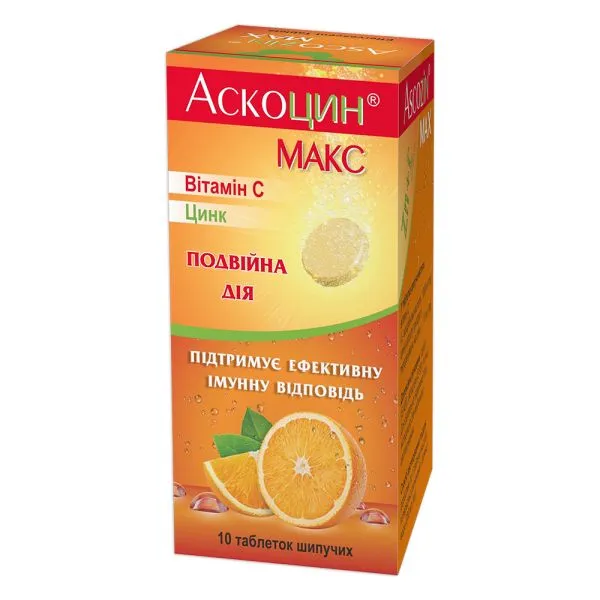
Table of Contents
INSTRUCTIONS FOR MEDICAL USE OF THE MEDICINAL PRODUCT ASKOZIN® MAX (ASCOZIN® MAX)
Composition:
Active substances: vitamin C (L-ascorbic acid); zinc citrate trihydrate;
1 effervescent tablet contains: vitamin C (L-ascorbic acid) 1000 mg; zinc citrate trihydrate, calculated as zinc 10 mg;
Excipients: sorbitol (E 420), anhydrous citric acid, sodium bicarbonate, anhydrous sodium carbonate, aspartame (E 951), acesulfame potassium, sodium chloride, flavoring agent "IF1212 Orange flavor SD", annatto powder 1% coloring agent, polyethylene glycol 6000.
Pharmaceutical form. Effervescent tablets.
Main physicochemical properties: round tablets from light-orange to orange in color with visible specks, with smooth surfaces on both sides.
Pharmacotherapeutic group. Combined preparations containing ascorbic acid (vitamin C). ATC code A11GB.
Pharmacological properties.
Pharmacodynamics.
AscoCin® Max is a combination preparation containing two medicinal substances: water-soluble vitamin C – ascorbic acid, and the trace element zinc.
Mechanism of action of ascorbic acid
Ascorbic acid (vitamin C) is an important antioxidant and metabolic agent that regulates oxidation-reduction processes and enhances the body's adaptive capacity. Due to the limited ability of the body to store vitamin C, regular intake of sufficient amounts is essential for humans.
Ascorbic acid and its metabolite, dehydroascorbic acid, form a reversible redox system that participates in numerous enzymatic reactions and constitutes the basis for the broad spectrum of vitamin C activity. Ascorbic acid functions as a cofactor in several hydroxylation and amidation reactions by transferring electrons to enzymes involved in the regeneration of various biological substrates. The importance of ascorbic acid for the human body is most evident in scurvy – a clinically apparent deficiency of vitamin C. Ascorbic acid plays a key role in the formation of hydroxyproline from proline, which in turn is essential for the development of functionally active collagen. Symptoms observed in scurvy, such as delayed wound healing, impaired bone growth, vascular fragility, and defective dentin formation, are consequences of impaired collagen synthesis.
Mechanism of action of zinc
As with vitamin C, low levels of zinc may also negatively affect the rate of wound, ulcer, and pressure sore healing. Zinc status is important for maintaining an effective immune response, particularly T-cell-mediated immunity.
Pharmacokinetics.
Ascorbic acid
Absorption. Ascorbic acid is absorbed primarily in the upper part of the small intestine via sodium-dependent active transport. When ascorbic acid is present in high concentrations, absorption occurs via passive diffusion. After oral administration of vitamin C in doses of 1–12 g, the fraction of ascorbic acid absorbed decreases from approximately 50% to about 15%, although the absolute amount absorbed continues to increase.
Distribution. The maximum physiological concentration of vitamin C is approximately 1500 mg. About 24% of ascorbic acid is bound to plasma proteins. Serum concentration is typically around 10 mg/L (60 μmol/L). A concentration of less than 6 mg/L (35 μmol/L) indicates that vitamin C intake is not consistently sufficient, while a concentration below 4 mg/L (20 μmol/L) indicates current inadequate intake of ascorbic acid. In clinically evident scurvy, serum vitamin C concentration is less than 2 mg/L (10 μmol/L).
Metabolism. Ascorbic acid is partially metabolized via dehydroascorbic acid to oxalic acid and other products. However, when administered orally in excess amounts, ascorbic acid is predominantly excreted unchanged in urine and feces. Urine also contains the metabolite ascorbate-2-sulfate.
Elimination. The elimination half-life of ascorbic acid depends on the route of administration, dose administered, and absorption rate. After oral administration of 1 g ascorbic acid, the half-life is approximately 13 hours. When vitamin C is administered at doses of 1–3 g per day, it is excreted from the body via urine. With doses exceeding 3 g, the amount excreted unchanged in feces increases.
Zinc
Absorption. Zinc is absorbed along the entire length of the small intestine. Absorption of ionic zinc administered as a solution on an empty stomach ranges between 41–79%. When zinc is ingested from food or dietary supplements, the absorbed fraction is 10–40%.
Distribution. To maintain zinc homeostasis, total body zinc content is partially regulated by controlling intestinal absorption efficiency and release from endogenous stores of this trace element. Total body zinc content in adults ranges from approximately 2.3 mmol (1.5 g) in women to 3.8 mmol (2.5 g) in men. Zinc is present in all organs, tissues, body fluids, and secretions. Zinc is primarily an intracellular ion, with over 95% of total zinc located within cells. Zinc is associated with all cellular organelles, but approximately 60–80% of cellular zinc is found in the cytosol.
Metabolism. The total amount of zinc in most tissues is considerably greater than that in blood plasma. Thus, relatively small fluctuations in tissue zinc content, such as in the liver, can significantly affect plasma zinc concentration. All absorbed zinc passes through tissues via plasma, and it is estimated that plasma zinc concentration turns over approximately 130 times per day. There is no specialized "zinc depot."
Studies in volunteers consuming diets low in zinc (2.6–3.6 mg/day / 40–55 μmol/day) have shown that circulating zinc levels and the activity of zinc-containing enzymes can be maintained within normal ranges for several months, highlighting the efficiency of zinc homeostasis mechanisms.
Elimination. The primary route of excretion for endogenous zinc is the gastrointestinal tract, with final elimination in feces. After oral or intravenous administration of test doses of zinc, only 2–10% is excreted in urine, with the remainder eliminated in feces. In humans, fecal excretion may vary from <15 μmol/day (1 mg/day) with very low zinc intake to over 80 μmol/day (5 mg/day) with very high intake. Normally, approximately 6–9 μmol (400–600 μg) of zinc are excreted daily in urine.
Clinical characteristics.
Indications.
Treatment of vitamin C and zinc deficiency.
Contraindications.
Hypersensitivity to any component of the medicinal product.
Nephrolithiasis, particularly in medical history.
Oxalate-origin urolithiasis or oxaluria.
Severe kidney diseases, severe degree renal failure (including patients on dialysis).
Hemochromatosis.
Interaction with other medicinal products and other types of interactions.
Interactions related to ascorbic acid
Deferoxamine: ascorbic acid may enhance tissue toxicity of iron, especially in myocardium, which may lead to cardiac decompensation.
Cyclosporine: ascorbic acid may reduce cyclosporine blood levels.
Warfarin: high doses of ascorbic acid may affect warfarin efficacy.
Effect on laboratory test results
Since ascorbic acid is a strong reducing agent, it may cause chemical changes in laboratory test results involving redox reactions, such as glucose, creatinine, carbamazepine, uric acid, and inorganic phosphate assays in urine, serum, and fecal occult blood tests. When using the product, it is recommended to consult the manufacturer's information to determine whether ascorbic acid affects laboratory test results.
Interactions related to zinc
Zinc forms complexes with certain substances (including tetracycline and quinolone antibiotics, penicillamine), resulting in reduced absorption of both substances. Since these interactions occur in the gastrointestinal tract, their interaction potential can be minimized by taking the medicinal product separately from other drugs. Usually, it is sufficient to take zinc at least 2 hours before or 4–6 hours after taking another drug, unless otherwise specified.
Copper: zinc may reduce copper absorption.
Special precautions for use.
Patients with renal insufficiency should consult a physician before starting high-dose ascorbic acid intake (see section "Overdose").
Recommended doses should not be exceeded. Acute or chronic overdose (more than 2 g/day) increases the risk of adverse outcomes, including formation of oxalate stones, acute tubular necrosis and/or renal failure (see section "Overdose").
Patients with glucose-6-phosphate dehydrogenase deficiency should not take doses exceeding the recommended amount. Overdose of ascorbic acid in this patient group has been associated with development of hemolytic anemia (see section "Overdose").
Patients taking other single-component vitamins, multivitamin preparations, or any other medicinal products, or those under medical supervision, should consult a physician before taking this medicinal product (see sections "Interaction with other medicinal products and other forms of interaction" and "Overdose").
AscoCin® Max should be administered separately from other medicinal products, with an interval of 4 hours, unless otherwise indicated (see section "Interaction with other medicinal products and other forms of interaction").
Vitamin C may affect laboratory test results, potentially leading to their misinterpretation. It is necessary to inform your physician about use of this medicinal product, as well as about any planned or ongoing diagnostic procedures.
Ascorbic acid may interfere with the performance of test kits and glucose meters measuring glucose levels, potentially leading to inaccurate results. It is recommended to review the instructions for use of the test kit or glucose meter (see section "Interaction with other medicinal products and other forms of interaction").
The medicinal product AscoCin® Max contains sorbitol; therefore, consult a physician before taking it if you have been diagnosed with intolerance to certain sugars.
This medicinal product also contains aspartame, a phenylalanine derivative, which poses a risk for patients with phenylketonuria.
One tablet of the medicinal product AscoCin® Max contains 158.37 mg of sodium; therefore, patients following a sodium-controlled diet should use this medicinal product with caution.
Use during pregnancy or breastfeeding.
Pregnancy and breastfeeding
Due to the lack of sufficient controlled studies in humans evaluating the risk of using this medicinal product during pregnancy or breastfeeding, this medicinal product should not be used during pregnancy or breastfeeding.
Fertility
Currently, there are no data indicating a negative effect of ascorbic acid and/or zinc on human fertility.
Ability to affect reaction speed when driving or operating machinery.
The medicinal product has no effect or a negligible effect on the ability to drive or operate machinery.
Dosage and Administration.
Ascozin® Max is administered to adults as 1 tablet per day, previously dissolved in a glass of water (200 mL).
Children.
Ascozin® Max should not be administered to children (under 18 years of age).
Overdose.
There is no data on overdose of the medicinal product when used at recommended doses.
The intake of vitamin C and zinc from all other sources should be taken into account.
Clinical signs and symptoms, laboratory test results, and consequences of overdose are highly variable and depend on individual susceptibility and surrounding circumstances.
General manifestations of vitamin C and/or zinc overdose may include an increased incidence of gastrointestinal disorders, including diarrhea, nausea, and vomiting.
If the above symptoms occur, the use of this medicinal product should be discontinued and medical advice should be sought.
Specific clinical manifestations may include the following:
Associated with ascorbic acid
Acute or chronic overdose of vitamin C may significantly increase oxalate levels in blood serum and urine. In some cases, this may lead to hyperoxaluria, calcium oxalate crystalluria, calcium oxalate deposition, kidney stone formation, tubulointerstitial nephropathy, and acute renal failure. Patients with mild to moderate renal insufficiency may be susceptible to these toxic effects of vitamin C at lower doses, and should consult a physician prior to initiating treatment.
Overdose of ascorbic acid may lead to oxidative hemolysis or disseminated intravascular coagulation in patients with glucose-6-phosphate dehydrogenase deficiency.
Associated with zinc
Zinc overdose may cause irritation and erosion of the gastrointestinal mucosa, acute tubular necrosis, interstitial nephritis, copper deficiency, sideroblastic anemia, and myeloneuropathy.
If overdose is suspected, the use of the product should be discontinued and medical advice should be sought for treatment of clinical manifestations. Vitamin C can be removed by hemodialysis.
Adverse Reactions
Gastrointestinal disorders: diarrhea, nausea, vomiting, gastrointestinal and abdominal pain.
Skin disorders: pruritus, skin rashes, swelling.
Immune system disorders: hypersensitivity reactions, allergic reactions, anaphylactic reactions, anaphylactic shock, asthma, angioneurotic edema, urticaria, cardiopulmonary distress.
Reporting of suspected adverse reactions
Reporting suspected adverse reactions after authorization of the medicinal product is important. It allows continued monitoring of the benefit-risk balance of the medicinal product. Healthcare professionals should report any suspected adverse reactions via the national reporting system and through the feedback form on the website: https://kusum.ua/pharmacovigilance/.
Shelf life.
3 years.
Storage conditions.
Store in a tightly closed tube.
Store in the original packaging at a temperature not exceeding 25 °C.
Keep out of reach and sight of children.
Packaging.
10 or 20 tablets in a tube, 1 tube in a cardboard box.
Supply category.
Over-the-counter (without prescription).
Manufacturer.
Kusum Healthcare Pvt Ltd.
Manufacturer's address and site of operations.
Plot No. M-3, Indore Special Economic Zone, Phase-II, Pithampur, Distt. Dhar, Madhya Pradesh, Pin 454774, India.