Ascoril
Ukraine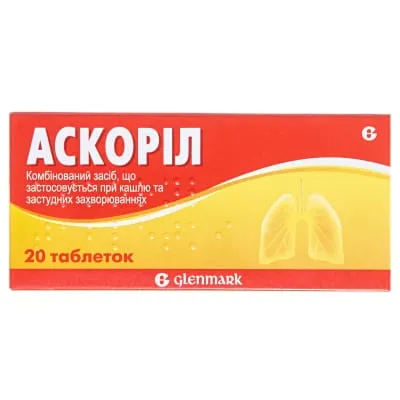
Table of Contents
INSTRUCTIONS FOR MEDICAL USE OF THE MEDICINAL PRODUCT AССORIL (ASCORIL)
Composition:
Active substances: 1 tablet contains salbutamol sulfate equivalent to salbutamol 2 mg, bromhexine hydrochloride 8 mg, guaifenesin 100 mg;
Excipients: calcium hydrogen phosphate, maize starch, methylparahydroxybenzoate (E 218), propylparahydroxybenzoate (E 216), talc, colloidal anhydrous silicon dioxide, magnesium stearate.
Pharmaceutical form. Tablets.
Main physico-chemical characteristics: white, round, flat tablets with bevelled edges, with a break line on one side.
Pharmacotherapeutic group.
Combined preparations used in cough and common colds. Expectorants. Combinations.
ATC code R05C A10.
Pharmacological Properties
Pharmacodynamics
Salbutamol is a direct sympathomimetic agent and a selective β2-adrenergic receptor agonist. The primary action of β-adrenergic agonists is their ability to stimulate adenylate cyclase, an enzyme that catalyzes the formation of cyclic adenosine monophosphate (cAMP) from adenosine triphosphate (ATP). Increased cAMP levels lead to relaxation of bronchial smooth muscles and inhibit the release of immediate hypersensitivity mediators from cells, particularly mast cells. Salbutamol relaxes smooth muscles of the bronchi, uterus, and skeletal muscle vasculature. Salbutamol exerts a stronger and more prolonged effect on β2-adrenergic receptors than isoproterenol. Salbutamol may also enhance mucociliary transport mechanisms.
Bromhexine exerts expectorant and mucolytic effects. Bromhexine is a derivative of benzylamine and vasicine. It increases sputum volume, reduces its viscosity, and promotes its evacuation from the bronchi; it stimulates hydrolytic depolymerization of mucoprotein fibers and enhances the activity of ciliated epithelium. It is known that bromhexine induces the release of lysosomal enzymes by bronchial glands.
Other pharmacological effects of bromhexine are also known: increased exocrine gland secretion (e.g., lacrimation) and enhanced pulmonary surfactant production. Concomitant administration of bromhexine with oxytetracycline, erythromycin, ampicillin, or amoxicillin results in increased concentrations of these antibiotics in sputum.
It is believed that the increased exocrine gland secretion observed during bromhexine use may be attributed to its metabolite, ambroxol (NA-872).
Guaifenesin. Guaifenesin acts by stimulating gastric mucosal receptors and reflexively enhancing secretion of respiratory tract glands. As a result, bronchial secretion volume increases and its viscosity decreases.
Pharmacokinetics
Salbutamol
Salbutamol is well absorbed from the gastrointestinal tract, with a bioavailability ranging from 50% to 85%. After oral administration, maximum plasma concentration (Cmax) is reached within 1–4 hours (Tmax). Food does not affect the bioavailability of salbutamol. Protein binding is approximately 10%. The volume of distribution (Vd) is 156 ± 38 L. Salbutamol is metabolized in the liver to an inactive sulfate conjugate. It is primarily excreted by the kidneys. Between 64% and 98% is excreted in urine and 1.2–7% in feces. The elimination half-life of salbutamol is 3–6.5 hours.
Bromhexine.
Bromhexine is well absorbed from the gastrointestinal tract. Maximum plasma concentration of bromhexine occurs approximately 1 hour after administration. It is metabolized in the liver to its active metabolite, ambroxol. Bromhexine is primarily excreted in urine as metabolites, with only a small fraction excreted unchanged. The elimination half-life of bromhexine is 6.5 hours.
Guaifenesin
Guaifenesin is well absorbed from the gastrointestinal tract. Approximately 60% of guaifenesin is hydrolyzed in the blood within 7 hours, forming β(2-methoxyphenoxy)-lactic acid. Guaifenesin is excreted in urine in the form of metabolites. The elimination half-life of guaifenesin is 1 hour.
Clinical characteristics.
Indications.
Symptomatic treatment of productive cough associated with various respiratory diseases accompanied by bronchospasm.
Contraindications.
Hypersensitivity to salbutamol, other sympathomimetics, bromhexine, guaifenesin, or to any of the other components of the medicinal product. Coronary insufficiency, arrhythmia, other severe cardiovascular disorders, hyperthyroidism, severe hepatic dysfunction, gastric or duodenal ulcer, or history of peptic ulcer disease. Porphyria.
Interaction with other medicinal products and other forms of interaction.
Concomitant use of salbutamol and other oral sympathomimetic agents is not recommended, as such combination may lead to cardiovascular disturbances.
Concomitant administration of monoamine oxidase inhibitors (MAOIs) and indirect sympathomimetics often causes hypertensive crisis. Salbutamol should be administered with particular caution to patients receiving treatment with MAOIs or tricyclic antidepressants, as well as for at least 2 weeks after discontinuation of such therapy, since the adverse cardiovascular effects of salbutamol may be potentiated. Isolated cases have been reported in which adverse effects such as tachycardia and hypomanic state were associated with this interaction.
In healthy volunteers who received digoxin for 10 days, an increase in its serum concentration by 16% to 22% was observed after a single dose of salbutamol.
The clinical significance of these observations in patients with obstructive airway diseases receiving long-term treatment with salbutamol and digoxin has not yet been fully elucidated. However, monitoring serum digoxin levels is advisable in patients receiving concomitant treatment with digoxin and salbutamol.
Hypokalemia, which may develop during treatment with salbutamol-containing preparations, may be exacerbated by concomitant use of diuretics. This increases the risk of developing arrhythmias when cardiac glycosides are administered during such therapy.
The effects of salbutamol may be reduced by concomitant use of β-blockers, especially non-selective ones (such as propranolol), and may be enhanced by concomitant administration of xanthines (e.g., theophylline).
β-blockers may not only block the bronchodilating effect of β-agonists but also induce bronchospasm in patients with bronchial asthma. Therefore, the use of β-blockers is contraindicated in asthmatic patients.
However, under certain circumstances, such as for post-myocardial infarction prophylaxis, β-blocker therapy may be considered in asthmatic patients. In such cases, they should be used with caution.
β-agonists may potentiate ECG changes and/or hypokalemia induced by potassium-depleting diuretics (such as loop and thiazide diuretics).
Although the clinical significance of these effects is unknown, caution is recommended when β-agonists are used concomitantly with potassium-depleting diuretics.
Concomitant use of salbutamol with inhalational anesthetics, epinephrine, tricyclic antidepressants, and corticosteroids should be avoided.
Bromhexine should not be administered concomitantly with medicinal products containing codeine. Concomitant use of bromhexine with agents that irritate the gastrointestinal tract (e.g., nonsteroidal anti-inflammatory drugs) may result in mutual enhancement of mucosal irritation in the stomach. Concurrent administration with antibiotics (amoxicillin, erythromycin, cefuroxime, doxycycline) and sulfonamides may increase their concentration in bronchial secretions. Concomitant use with antitussive agents that suppress the cough center may impair the expectoration of liquefied sputum (resulting in accumulation of bronchial secretions in the airways). Concurrent use with bronchodilators is possible. Bromhexine is incompatible with alkaline solutions.
Guaifenesin potentiates the effects of central nervous system depressants, as well as ethanol. It may also cause false-positive results in diagnostic tests for 5-hydroxyindoleacetic acid and vanillylmandelic acid in urine.
Guaifenesin enhances the effects of sedatives and muscle relaxants.
Special precautions for use.
Salbutamol, like other β-adrenergic receptor stimulants, should be administered with caution in patients with seizure disorders, diabetes mellitus, and cardiovascular disorders (arterial hypertension).
Salbutamol may affect the cardiovascular system, manifesting as increased heart rate, elevated blood pressure, and ECG changes such as flattening of the T wave, QT interval prolongation, and ST segment depression. Therefore, salbutamol should be used with caution in patients with cardiovascular diseases, especially those with arterial hypertension.
In some patients, as with other β-adrenergic receptor agonists, clinically significant changes in systolic and diastolic blood pressure may occur.
Sudden and progressive worsening of bronchial asthma is a life-threatening condition requiring administration of corticosteroids or an increase in their dose. The need for increased salbutamol dosage indicates worsening asthma control and necessitates a review of therapy, including, if necessary, the initiation of corticosteroid treatment.
Salbutamol may cause paradoxical bronchospasm with sudden worsening of dyspnea, which may be life-threatening. In such cases, the drug should be discontinued immediately and medical advice sought.
Isolated cases of myocardial ischemia associated with salbutamol use have been reported. Patients with heart disease (e.g., ischemic heart disease) who are treated with salbutamol and experience chest pain or other symptoms suggestive of cardiac disease exacerbation should seek immediate medical attention. Symptoms such as dyspnea and chest pain should be carefully evaluated, as they may be manifestations of either cardiac or respiratory disease.
Treatment with β2-agonists may result in severe hypokalemia. Particular caution is required in patients with severe acute asthma, as this effect may be potentiated by concomitant use of xanthine derivatives, corticosteroids, diuretics, and hypoxia. In such cases, regular monitoring of serum potassium concentration is recommended.
Like other β-adrenergic receptor agonists, salbutamol may cause reversible metabolic changes, such as increased blood glucose levels. As a result, isolated cases of ketoacidosis have been reported in patients with diabetes mellitus. Concomitant use of corticosteroids may exacerbate this condition. Blood glucose levels should be monitored before and during treatment in such patients.
Guaifenesin should be used with caution in the treatment of cough with excessive mucus production, persistent or chronic cough due to smoking, asthma, chronic bronchitis, or emphysema.
Bromhexine is contraindicated in patients with gastric or duodenal ulcers or a history of peptic ulcer disease, as bromhexine may affect the gastrointestinal mucosa. The drug should be used under medical supervision in patients with a history of gastrointestinal bleeding. Adequate fluid intake is necessary during treatment, as it enhances the expectorant effect of bromhexine.
Very rarely, severe skin reactions such as erythema multiforme, Stevens-Johnson syndrome, toxic epidermal necrolysis (Lyell's syndrome), and acute generalized exanthematous pustulosis have occurred during bromhexine treatment. If skin or mucosal changes occur, medical advice should be sought immediately and the drug discontinued.
The drug should be used with special caution in impaired bronchial motility associated with excessive bronchial secretion (e.g., ciliary dyskinesia syndrome) due to the risk of secretion retention.
The drug should be used with caution in patients with glaucoma.
The drug should be used with special caution in patients with renal impairment (including severe renal insufficiency) or hepatic disorders (in mild to moderate hepatic insufficiency), with dose reduction or prolonged dosing intervals.
Periodic monitoring of liver function is recommended, especially during prolonged treatment.
The drug should not be administered prior to anesthesia.
The drug is contraindicated in patients with hypertrophic cardiomyopathy.
Methylparahydroxybenzoate (E 218) and propylparahydroxybenzoate (E 216), components of the medicinal product, may cause allergic reactions (possibly delayed).
Use during pregnancy or breastfeeding.
Do not use.
Ability to affect reaction speed when driving or operating machinery.
Patients should refrain from driving or operating machinery during treatment with this medicinal product.
Dosage and Administration.
For adults and children aged 12 years and older: take 1 tablet orally three times daily.
Children aged 6 to 12 years: ½–1 tablet three times daily.
Duration of treatment is determined individually.
Children.
Do not administer this medicinal product to children under 6 years of age.
Overdose.
Symptoms: excitation, confusion, respiratory depression, rapid breathing, impaired consciousness, ataxia, diplopia, mild metabolic acidosis, arrhythmias, chest pain, hypotension up to shock, tachycardia, accelerated heart rate, severe tremor—especially in the hands. Gastrointestinal complaints may occur, including nausea and vomiting; seizures, extrasystoles, drowsiness, headache, hypokalemia, abdominal pain, and exacerbation of gastric ulcer.
The most common signs and symptoms of salbutamol overdose are transient pharmacologically induced changes caused by β-agonists, such as tachycardia, tremor, hyperactivity, and metabolic disturbances including hypokalemia (see sections "Special Warnings" and "Adverse Reactions").
Salbutamol overdose may lead to hypokalemia; therefore, serum potassium levels should be monitored. Cases of lactic acidosis have been reported following administration of high therapeutic doses or overdose of short-acting β2-agonists. Serum lactate levels should thus be checked, and metabolic acidosis monitored accordingly—especially in cases of persistent or worsening tachypnea despite improvement in bronchospasm symptoms such as stridorous breathing.
Minor or moderate guaifenesin overdose may cause dizziness, gastrointestinal disturbances, nausea, vomiting, or decreased muscle tone. Very high doses of guaifenesin may lead to symptoms such as excitation, confusion, and respiratory depression. Rare cases of bladder or kidney stones have been reported in patients who took large amounts of guaifenesin over a prolonged period.
Treatment. Symptomatic therapy. Continuous electrocardiographic monitoring is recommended to assess cardiac function.
Adverse Reactions
Immune system disorders: hypersensitivity reactions including rash, pruritus, anaphylactic reactions, including drug hypersensitivity syndrome with eosinophilia and systemic symptoms, anaphylactic shock, angioneurotic edema, urticaria, oropharyngeal edema, facial swelling; in isolated cases – erythema multiforme, Stevens-Johnson syndrome, toxic epidermal necrolysis (Lyell's syndrome), acute generalized exanthematous pustulosis.
Gastrointestinal disorders: dyspeptic symptoms, nausea, vomiting, diarrhea, abdominal pain, exacerbation of gastric/duodenal ulcer, gastralgia, unpleasant taste in the mouth.
Nervous system disorders: tremor, myalgia, headache, hyperactivity, dysgeusia, dizziness, restlessness, insomnia, paroxysmal pharyngeal paresthesia.
Cardiovascular disorders: tachycardia; peripheral vasodilation; cardiac arrhythmias, including ventricular fibrillation, supraventricular tachycardia, and extrasystoles; hypotension or hypertension; palpitations; myocardial ischemia; collapse.
Respiratory system disorders: breathing difficulties, increased cough.
Salbutamol may provoke paradoxical bronchospasm, a potentially life-threatening condition. If this occurs, the drug must be discontinued immediately and alternative therapy initiated.
Metabolism and nutritional disorders: hypokalemia. The use of β2-agonists may potentially lead to pronounced hypokalemia, increased serum lactate levels / lactate acidosis.
Other adverse reactions: myospasm, muscle cramps, sensation of muscle pressure, hyperthermia, chills, mydriasis, urinary bladder atony, increased sweating, hyperglycemia, thrombocytopenia.
In some patients, transient elevation of blood aminotransferase levels may develop due to bromhexine.
Shelf life.
2 years.
Storage conditions.
Store in a dry, protected from light place at a temperature not exceeding 25 °C.
Keep out of reach of children.
Packaging.
10 tablets per blister pack, 1, 2, or 5 blisters per cardboard package.
Prescription status.
Prescription only.
Manufacturer.
Glenmark Pharmaceuticals Ltd.
Manufacturer's address and place of business.
-
Plot No E-37/39, M.I.D.C., Industrial Estate, Satpur, Nasik – 422 007, India.
-
Village Kishanpura, Baddi-Nalagarh Road, Tehsil Baddi, Distt. Solan (H.P.) 173 205, India.